|
||||||||||||||||||||||
 |
||||||||||||||||||||||
![F-22A Raptor, FB-22, F-22E, F-22N and Variants Index Page [Click for more ...]](APA/f-fb-22.png "F-22A Raptor, FB-22, F-22E, F-22N and Variants Index Page [Click for more ...]") |
 |
![People's Liberation Army Air Power Index Page [Click for more ...]](APA/pla-air-pwr.png "People's Liberation Army Air Power Index Page [Click for more ...]") |
 |
 |
 |
 |
 |
 |
![Military Ethics, Culture, Education and Training Index Page [Click for more ...]](APA/ethx-culture.png "Military Ethics, Culture, Education and Training Index Page [Click for more ...]") |
 |
||||||||||||
 |
![Russian / Soviet Weapon Systems Index Page [Click for more ...]](APA/rus-weps.png "Russian / Soviet Weapon Systems Index Page [Click for more ...]") |
 |
 |
 |

|
 |
 |
 |
 |
 |
||||||||||||
 |
 |
|||||||||||||||||||||
| Last Updated: Mon Jan 27 11:18:09 UTC 2014 | ||||||||||||||||||||||
|
||||||||||||||||||||||
|
||||||||||||||||||||||
|
||||||||||||||||||||||
|
|
|
|
|
|
|
|
|
|
|
||||||||||||
|
|
|
|
|
|
|
|
|
|
|
||||||||||||
|
|
|||||||||||||||||||||
| Last Updated: Mon Jan 27 11:18:09 UTC 2014 | ||||||||||||||||||||||
|
||||||||||||||||||||||
| TECHNOLOGY
EXPLAINED PART ONE COMPOSITES |
|||
|
|||
|
The most significant types of material to gain wider application in the 1970s are fibre/epoxy composites. They are becoming and will become one of the most important materials involved in high performance aircraft technology. The development of many new configurations, such as forward swept wing (FSW) aircraft, relies wholly on materials of this kind and further progress in V/STOL technology is doubtful without them. 1. Analysis of Problems and Requirements When using conventional materials, we very quickly notice their limitations in strength, as compared to their relatively high density. The strength of the material depends on a multitude of factors, the great majority of which directly relate to the crystalline structure and its uniformity. An ideally uniform structure possesses a strength often an order or more greater than its non-ideal counterpart, because there is no local stress concentration, thus every molecular bond is equally stressed. The strength is determined by bond strength, which can be very high. A non-ideally uniform material, as the great majority are, suffers strength limitations due to a large number of minute flaws (internal and surface) which will cause local increases in stress when loaded. If these local stresses exceed bond strength, the material fails. Corrosion accelerates the process, by creating microcracks and penetrating between crystals. Fatigue enhances the negative effects. All of these problems can be overcome by using more or stronger material, but the penalty is weight, and weight is the number one factor in the choice of aircraft materials. We can list the basic demands on any new material as such:
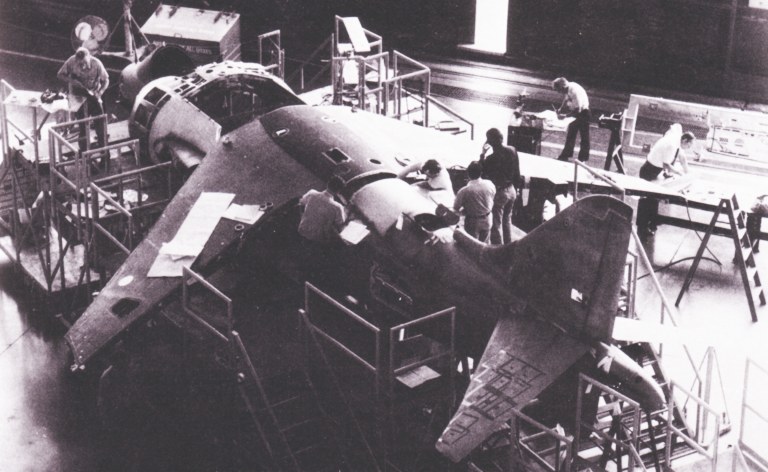
2. Composite Materials Composite fibre materials satisfy all of the given requirements by using an epoxy resin matrix material reinforced with high strength fibres. The properties of both materials determine the behaviour of the composite. The fibres have high strength due to a very uniform structure and the absence of surface flaws, thus their strength approaches the theoretical strength of the fibre material, determined by molecular bond strengths. Currently used materials are boron, graphite, glass, Kevlar and various hybrids, each of these is best suited to some particular application. The matrix material is an epoxy resin. These polymers are very stable and have excellent bonding properties, especially with graphite. The polymer chains are crosslinked, creating an extremely rigid 3-D matrix, giving the material exceptional toughness. Epoxies decompose rather than melt and are inert to most solvents. They are very stable, this practically eliminates corrosion/weathering problems. A composite of high strength fibres and an epoxy resin exhibits a combination of properties of both components. Composites have very high strength and toughness, making them an ideal material for aviation. They are reasonably light, being stronger, less can be used, resulting in a significant drop in weight. Fatigue (aside from extreme overstressing) is virtually non-existent. Composites are easy to repair - either mechanical fastening (bolting) or glueing, the epoxy bonds very well with adhesives. There is no direct analogue to metal corrosion, the little weathering which could occur is eliminated by choice of resin and surface coating. In terms of cost, composites are not cheap, but their price has significantly dropped in the last decade and large scale use will accelerate this effect. The composite is, up to date, the material closest to the aircraft designer's ideal. 3. Applications The manufacture of a component can be divided into several stages: manufacture of the prepreg sheet(s), cutting, curing, cleaning, glueing to other subassemblies, curing and cleaning, followed by thorough fault scanning. Prepreg - is a term used for uncured sheets of composite. Graphite fibre is manufactured from a precursor, eg polyacrylonitrile, which is drawn into fibres and carbonized. The fibre, in plies, interlayered with the epoxy resin, forms prepreg sheets. The orientation of the fibre layers in these sheets determines the strength and stiffness of the sheet. Uncured prepreg is the material supplied to aircraft manufacturers. Cutting, preparing. The aircraft manufacturer then cuts the sheets to shape, often many at once, using a high power (0.5-1.5kW) CO2 laser. Several plies are often used for a single component, each different. Curing is done in an autoclave, at elevated temperatures and pressures, which must be precisely controlled. After curing, it's cleaned (still on its tooling form) and further subassemblies are fastened. Titanium, aluminium or composite, the subassemblies are glued together with sheets of adhesive. Further curing in an autoclave bonds the subassemblies into one component, which is then cleaned and prepared for testing. Testing. The component is first X-rayed for hidden cracks, then scanned by ultrasound. Ultrasonic C-scan detects delaminations or ply-subassembly separations, often taking several hours. The result is a composite component, anything from a stabilator to a speedbrake. The component can be fastened by glueing or bolting, the former having the advantage of a tight seal (fuel tanks, pressurised areas), the latter easy replacing. Advanced wing is mounted on a Harrier fuselage as the prototype of the Advanced Harrier AV-8B takes shape at McDonnell Douglas Corporation in St Louis. The new supercritical wing structure, largest aircraft part ever made of composite material, weighs 1374 pounds, including control surfaces which have yet to be mounted. All spars and the upper and lower surfaces are fabricated of graphite epoxy, saving 330 pounds over conventional materials. McDonnell Douglas has built two prototypes of the AV-8B for the US Marine Corps. The Advanced Harrier, being developed under a licensing agreement with British Aerospace, will have twice the range or payload of the AV-8A Harrier (MDC). The use of composites brings changes in design approach. In order to get the required strength and stiffness, several plies may be used, each different in shape and fibre orientation. Other materials than composites may be incorporated, either as fastening points or frames. Honeycomb materials (Aluminium) combined with composites create very light, but rigid structures, ideal for wing surfaces. Future applications will go even further, demanding specific fibre orientation patterns for each ply, where the ply itself will be designed (in terms of fibre layout). Configurations, such as forward swept wings, demand special strength/stiffness/flexing properties which, in turn, require very careful and thorough design. Conformal radar antennae may further complicate the situation, by reducing the effective load-bearing cross-section of the wing. A notable advantage, when fabricating composites, is the possibility of producing integral moldings, which seal better and require far less fasteners, increasing reliability. Each type of composite is best suited for some specific application. Glassfibre is cheap and reasonably stiff, graphite and boron, though more expensive, are used for their superior strength. The compromise is a hybrid, either glass/graphite plies or graphite/epoxy skin over a glass/epoxy structure. The rotor blades of the Aerospatiale SA360 are a typical case. Strength may not always be the only determining factor, USMC CH-46s are to be retrofitted with fibreglass rotor blades. Aside from price, one of the reasons why glass won over graphite was the size of radar returns. The interference between a Doppler radar and a turning rotor is characteristic even against heavy clutter, and in this day of look-down/shoot-down radars, stealth is worth more than a few kilograms of payload. The gradual penetration of composites can be easily seen on the teen-series fighters.
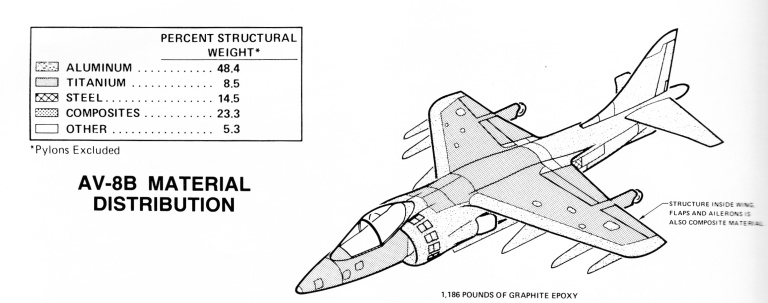
The best demonstration, by far, of the potential of composites, is the MDC AV-8B Advanced Harrier program. A significant increase in performance over the AV-8A was required, but the only powerplant available was the RR - F402 Pegasus used in the AV-8A. A tough nut to crack, better performance from the same engine, but a solution existed. Graphite/epoxy composites. Without them, all the aerodynamic improvements could hardly compensate for the additional weight. The most significant change is a new, supercritical wing, with larger area, higher aspect ratio, increased fuel volume, store capacity and cruise efficiency over the smaller AV-8A wing. The wing is almost entirely graphite/epoxy (Pic 1).
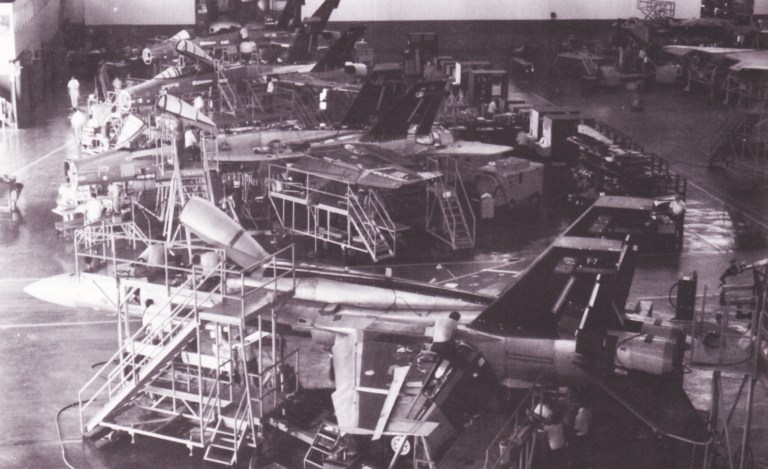
Further improvements involve redesigned air intakes and ground effect enhancement through positive circulation (forward thrust nozzle positioning) and gun strake LIDs (lift improvement devices)/inner pylon interaction. Weight was reduced with a composite forward fuselage, stabilators, and parts of the rear fuselage. Over 26 per cent of the structure is composite. The result - an effective doubling of payload/range performance and an aircraft that requires throttling down for vertical landings, as compared to the AV-8A. No surprise that the USMC was pretty upset with the Carter administration's plans to stop the program. Having a significant lead over the Harrier GR Mk 5, the AV-8B becomes an attractive prospect, even if the RAF isn't too pleased with the cruise-efficient wing. The RAN's outlook for another conventional carrier is bleak, both cost and the Navy's capacity to protect a carrier practically ruling out anything but V/STOL, thus leaving little other option, in replacing the A-4s, than the AV-8B. The survivability of a runway in any current war is not very high and V/STOL will become a necessity in the next two decades. The US Navy's V/STOL (A) and (B) projects rely completely on composites, as there are no other materials so ideally suited to the conditions of naval deployment. The future of composites is very bright. Rockwell is developing a FSW lightweight fighter which will use composite wings and very probably incorporate composites in the fuselage structure. V/STOL A and B will take their share. The constantly pressing demands for higher performance, mainly T/W ratios, will require a drop in weight, as higher thrust means more fuel used and fuel is valuable, whether we look at price or availability during combat. The growing amounts of ECM, radar, radar processing, nav-attack and ECCM gear necessary for survival have their penalty in weight and the designer will have to satisfy all requirements. Advanced composites are the solution and they will dominate designs of the 1990s. Where are the days of wood and doped fabric air superiority?
Carbon fibre composites substantially reduce the
weight of
the F-18 tail assembly. As is illustrated by this photo, the bulk of
the
tailplane is of composite material, as is the dorsal spine and centre
wing skins (MDC). |
|||
|
|||||||||||||
|
|
|
|
|
|
|
|
|
|
|
|||
|
|
|
|
|
|
|
|
|
|
|
|||
 |
|
|
|||||||||||
| Artwork, graphic design, layout and text © 2004 - 2014 Carlo Kopp; Text © 2004 - 2014 Peter Goon; All rights reserved. Recommended browsers. Contact webmaster. Site navigation hints. Current hot topics. | |||||||||||||
|
Site Update
Status:
$Revision: 1.753 $
Site History: Notices
and
Updates / NLA Pandora Archive
|
|||||||||||||
|
|
Tweet | Follow @APA_Updates | |||||||||||
|
|
|||||||||||||
|
|
|||||||||||||