|
||||||||||||||||||||||
 |
||||||||||||||||||||||
![F-22A Raptor, FB-22, F-22E, F-22N and Variants Index Page [Click for more ...]](APA/f-fb-22.png "F-22A Raptor, FB-22, F-22E, F-22N and Variants Index Page [Click for more ...]") |
 |
![People's Liberation Army Air Power Index Page [Click for more ...]](APA/pla-air-pwr.png "People's Liberation Army Air Power Index Page [Click for more ...]") |
 |
 |
 |
 |
 |
 |
![Military Ethics, Culture, Education and Training Index Page [Click for more ...]](APA/ethx-culture.png "Military Ethics, Culture, Education and Training Index Page [Click for more ...]") |
 |
||||||||||||
 |
![Russian / Soviet Weapon Systems Index Page [Click for more ...]](APA/rus-weps.png "Russian / Soviet Weapon Systems Index Page [Click for more ...]") |
 |
 |
 |

|
 |
 |
 |
 |
 |
||||||||||||
 |
 |
 |
||||||||||||||||||||
| Last Updated: Mon Jan 27 11:18:09 UTC 2014 | ||||||||||||||||||||||
|
||||||||||||||||||||||
|
||||||||||||||||||||||
|
||||||||||||||||||||||
|
|
|
|
|
|
|
|
|
|
|
||||||||||||
|
|
|
|
|
|
|
|
|
|
|
||||||||||||
| |
|
|
||||||||||||||||||||
| Last Updated: Mon Jan 27 11:18:09 UTC 2014 | ||||||||||||||||||||||
|
||||||||||||||||||||||
D.I.E.D. in Air Combat |
||||||||
|
Air Power
Australia - Australia's Independent Defence Think Tank
|
||||||||
| Air Power Australia NOTAM 3rd August, 2008 |
||||||||
|
||||||||
|
||||||||
| Air combat is a complex subject, and one that is changing rapidly on a global scale. A advanced country that is slowly developing its air combat capabilities, can be ‘leapfrogged’ and overmatched by one currently less capable, but where development is more focused and rapid. A case of the quick and the dead. There are some relatively simple, logical observations and analytical tools that reveal enduring and essential truths about air combat. A determined and well-resourced country can easily find a capability-growth path to achieving the level of airspace control it requires for its national security. 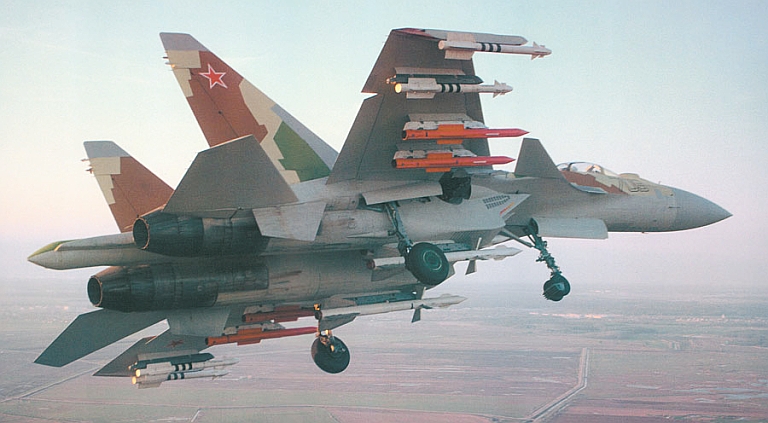 Su-35
demonstrator #709 displays a mix of R-27 Alamo and R-77 Adder BVR
missiles (KnAAPO).
Regional Air Dominance is a Persistent Requirement Australia has “Regional Air Dominance” (RAD) as part of its National strategy and military posture, and RAD will feature prominently in the next iteration of the Defence White Paper. The reason for this persistence is that the alternative is logically untenable. Once a country loses control of its airspace, it becomes vulnerable - its military, civilian population and national assets can be attacked and destroyed at will by an opponent. There are two dimensions to Regional Air Dominance: distance-from-the-nation and future-developments. Distance-from-the-nation coverage in arcs that include nations to the North and West reveal current airpower capabilities ranging from ‘none’ to ‘highly capable’. Future-developments also cover this broad range, remembering that in 1990, India was practically insolvent and China had large numbers of obsolete aircraft. Today they are both highly capable, and are developing their air power in ‘leaps and bounds’. So, depending on how far is travelled in either dimension, the air power discovery journey quickly finds there are two obstacles to Regional Air Dominance: the proliferation of highly lethal air combat aircraft (and their associated weapons and supporting systems) and surface-based Integrated Air Defence Systems (IADS) which effectively protect a volume of airspace. In Australia’s Region, there exist very capable air combat aircraft fleets made by Sukhoi, MiG and Boeing, and these fleets are expanding. As a baseline example, there is the vectored thrust Sukhoi/KnAAPO/Irkut Su-30MKI/MKM, fitted with the N011M radar, capable electronic warfare systems, and weapons that overmatch those of US origin in range, agility and terminal homing seeker sensors. In the very near future (2010), the new Su-35BM/Su-35-1 becomes operational, followed soon after by the PAK-FA. Each of these aircraft is planned to achieve Operational Capability before the F-35 JSF. Given the US Air Force view that the F-35 is an aircraft designed as a battlefield interdictor, intended to operate under the cover of the more capable F-22A Raptor, it is not credible that the Lightning II is a weapon system that will reliably impose Regional Air Dominance against such opposition. The F/A-18A HUG and F/A-18F Super Hornet are even less able to do so. 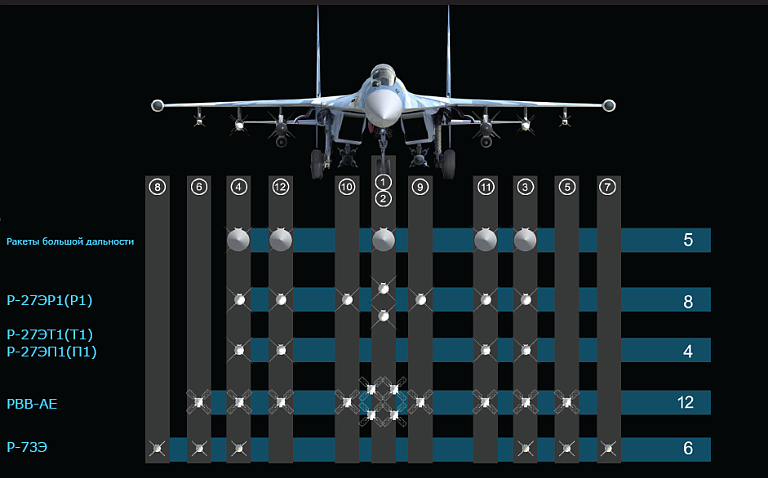 Loadout options for Su-35BM/Su-35-1: 5 x
Long Range AAM (R-172/AAM-L); 8 x R-27ER1/R1 Alamo; 4 x R-27ET1/T1 or
R-27EP1/P1 Alamo; 12 x R-77/RVV-E Adder; 6 x R-73E Archer. The loadout
for the active radar seeker equipped R-27EA would be 8 rounds (KnAAPO).
The ‘Live’ and ‘Kill’ Chains: D.I.E.D. Air combat aircraft are killing machines. While this may be a ‘politically incorrect’ statement, it is the truth. There is a sequence of events require to complete any air combat engagement: Detect, Identify, Engage, Destroy. Events must be completed in that order – i.e. they are ‘chained’. The 'Live Chain' is what it takes to survive in airspace contested by an opponent, while the Kill Chain is what it takes to prevail in combat. An air combat aircraft will only achieve its primary mission of killing its opposition if it can stay alive. The ‘Live Chain’ ensures the air combat aircraft survives to implement a ‘Kill Chain’ against an adversary. These are the four steps in the D.I.E.D. chain: Detect: Using on-board or off-board sensors, opposing air combat aircraft or key IADS components must be located to allow weapons to be brought to bear; Identify: While there may be many objects detected the objective of this step is to determine which of these objects are actual adversaries, which are allies, which are neutral, which are false targets and which are decoys; Engage: the ‘shooter’ must select targets that are actual adversaries and manoeuvre to a release position inside its weapon’s engagement envelope; Destruction: On arrival at the target, the weapon must be effective at killing its target. 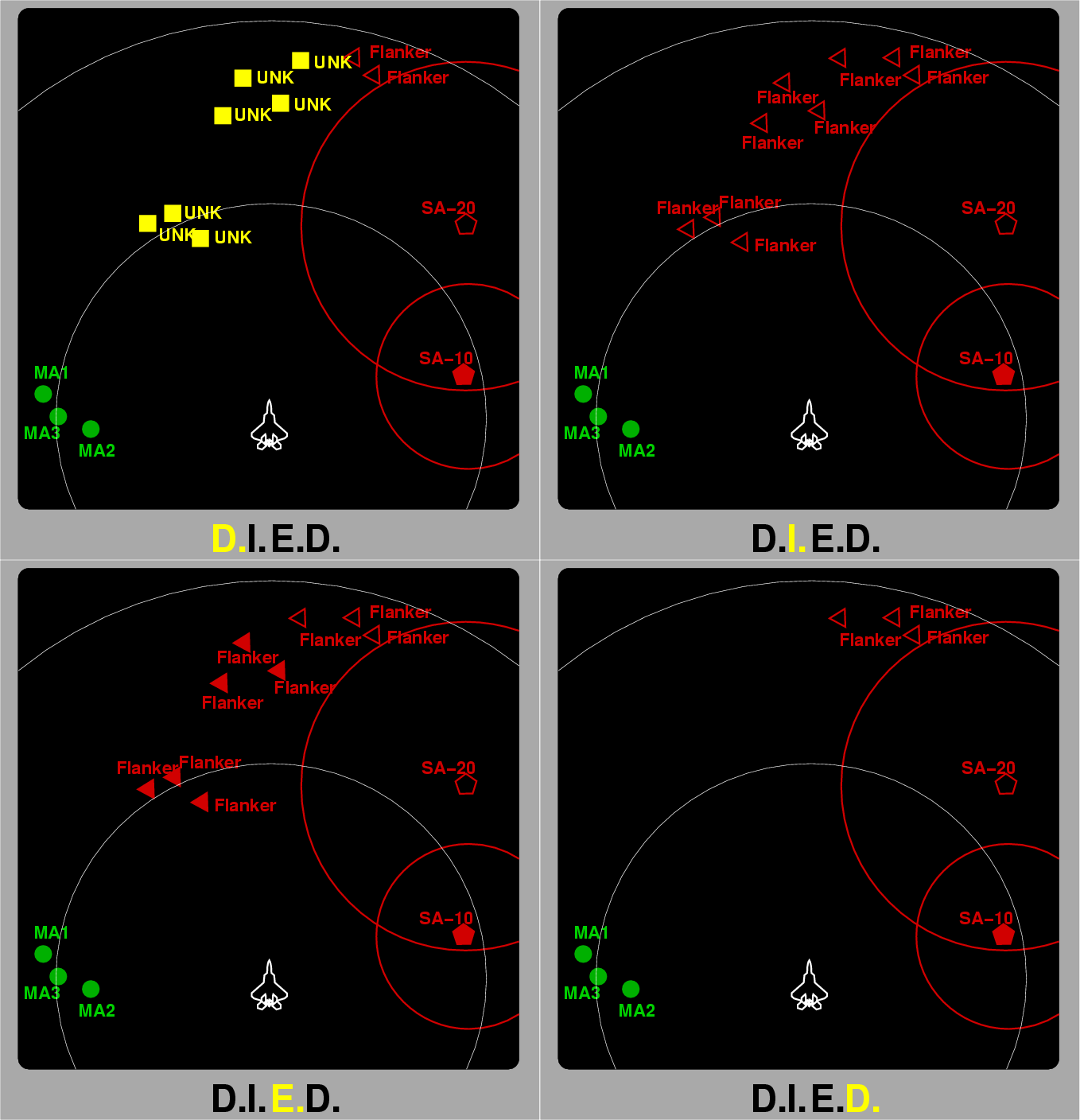 The DIED chain from a pilot's perspective (C. Kopp).
The ‘Live’ Chain: Survival is the first requirement in air combat – even if it means leaving the battle-space to fight another day. These are the steps in the 'Live chain': Detect: If possible, deny an adversary’s sensors detection. ‘Low Observable’ designs deflect or absorb probing radar beams, but must be effective across the sensor spectrum which begins with low frequency radio wavelengths and ends in the millimetre radar band. Passive sensors span the radio-frequency bands, through the infrared up to the ultraviolet bands. Emission control of aircraft systems is vital, as passive radiofrequency sensors can find and track emissions from radars and computer networking terminals, while infrared sensors can detect hot airframe components and engine efflux. Aircrew must adopt an approach that avoids detection – this may be terrain masking or presenting an aspect of the aircraft where reflections and emissions in the direction of a detector are minimised. Identify: Make it difficult for an adversary to ‘sort the wheat from the chaff’ by careful use of emissions and objects that ‘spoof’ detection systems. Fly approach patterns that appear to be non-aggressive. Return a response to a detection probe that looks like a different object, in a different location.
Engage: If the adversary appears to have a sensor lock, break it with electronic emissions, seduce it with decoys, or by presenting a less detectable aspect to radar. Manoeuvre to stay outside the known engagement range and altitude of opposing weapons. If an incoming weapon is detected, use the same DIED methods against its tracking systems. Generally, aircraft onboard and surface based sensors are ‘smarter’ than sensors in the seekers of engaging missiles, so deceiving or defeating a 'not so smart' weapon may be a way to frustrate an attack. Destruction: Having a warhead explode at a lethal range from a target is a difficult task, and an engaging weapon can be defeated in its terminal phase. Powerful, directed emissions can disrupt tracking. Chaff and flares can obscure the target, although these measures are being increasingly negated by on-board signal processing in ‘smart missiles’. Present a convincing false target with a towed decoy or release free-flying decoys that confuse the attacking weapon. Finally, a determined manoeuvre can move the airframe outside fusing distance, especially after a long flight when the incoming weapon has little capability to turn sharply. The ‘Kill Chain'. An effective ‘Kill Chain’ capability is primarily built in the design phase of a aircraft weapon system - an air combat weapon system developer must ‘know thine enemy’ and combine aircraft, sensor and weapons in a way that overmatch potential enemies’ capabilities, assuring that an engagement results a ‘live’ approach until weapons release, a ‘kill’ result against an opponent, and then surviving the disengagement from the fight. Accurately forecasting potential opponents' air combat capabilities is an essential part of this process. If we wish to assess a potential or actual opponent's capabilities to achieve a ‘kill’, the DIED chain can be used very effectively, as follows: Detect: Sensors must be optimised to probe at those frequencies where targets give reliable signatures. Cooperative detections, using on-board or off-board sensors can often defeat low observability from some aspects and at some frequencies; for example a pair of air combat aircraft might force a low observable aircraft to reveal a highly reflective surface, or a low frequency ground-based sensor might find a persistent return, which can be uploaded via a radio link or network to a fighter aircraft or missile in flight. Identify: Combinations of sensors can discriminate and identify targets – an aircraft with no high frequency reflections and strong low frequency reflections is likely to be a ‘stealth’ target. Similarly, combinations of radar and infrared detections can often identify the source. Many platforms emit distinctive waveforms – examples: a specific ‘Low Probability of Intercept’ radar, a JTIDS/Link-16 network terminal. Height and speed of the detection can eliminate narrow the possible identity of the detection.
Engage: Most importantly, if one aircraft has a flight envelope superior to another (in terms of speed, endurance, altitude, range and manoeuvre), then the time and place of the engagement can be dictated by the superior aircraft which becomes the hunter, and the other the quarry. Cooperative engagement is becoming increasingly important. One sensor system may obtain a persistent, identified track, which can be passed to a ‘shooter’ for execution. Aggressive action can draw a defensive response, such as firing a missile; a tactical disengagement can force a miss. This engage-disengage cycle is repeated until the quarry runs out of either shots or fuel, or both, turns for home, and is then hunted down and killed with impunity. Destruction: Selection and carriage of effective weapons and having capacity for multiple shots has a substantial effect on lethality. Examples are weapons with the capacity to engage at long range, that use seekers that operate in different parts of the spectrum, that have high terminal manoeuvre performance, and have ‘smart’ real-time processing to defeat terminal defensive measures. Warheads need to be large enough and smart enough, to kill, rather than maim the victim aircraft. Conclusion Success in air combat is achieved by realising that losing air dominance is not an option for a sovereign nation. Analysing and forecasting long-term tends in air combat weapons systems and the Concept of Operations of potential adversaries is essential, especially when the technology and the tactics of air combat are developing so rapidly. A technology that confers an advantage today, e.g. ‘Low Observability’ (LO) i.e. 'stealth' may be a future liability – for example if a LO platform’s performance was sacrificed to achieve stealth and it is subsequently detected in another part of the spectrum. The ‘Detect, Identify, Engage, Destroy’ (D.I.E.D) is a useful analytical tool to maximise a nation’s air combat capability. Air combat systems must ‘live’ by disrupting an adversary’s DIED kill processes. Then the DIED chain must be executed as a ‘kill’ process to destroy adversaries and achieve victory in battle. National security comes from having the ‘right stuff’ when needed. Ad hoc solutions based on aircraft choices which are ‘convenient’, ‘accessible’, ‘politically saleable’ or otherwise compromised in fundamental capabilities will not lead Australia down this essential path. An understanding of developments in technology, evolving concepts of operations, and the national will to invest in air combat systems that are always superior to potential adversaries, is the path to sovereign air dominance. |
||||||||
|
Related Reading
F/A-18E/F Super Hornet vs. Sukhoi Flanker Analysis [Click for more ...] Sukhoi Flanker Analysis [Click for more ...] Nebo SVU VHF AESA Analysis [Click for more ...] S-300 SAM System Analysis [Click for more ...] F-22A Raptor Analysis [Click for more ...] Joint Strike Fighter Analysis [Click for more ...] |
||||||||
| Air
Power Australia Website - http://www.ausairpower.net/ Air Power Australia Research and Analysis - http://www.ausairpower.net/research.html |
||||||||
 |
||||||||
| |
||||||||
|
|||||||||||||
|
|
|
|
|
|
|
|
|
|
|
|||
|
|
|
|
|
|
|
|
|
|
|
|||
| |
|
|
|||||||||||
| Artwork, graphic design, layout and text © 2004 - 2014 Carlo Kopp; Text © 2004 - 2014 Peter Goon; All rights reserved. Recommended browsers. Contact webmaster. Site navigation hints. Current hot topics. | |||||||||||||
|
Site Update
Status:
$Revision: 1.753 $
Site History: Notices
and
Updates / NLA Pandora Archive
|
|||||||||||||
|
|
Tweet | Follow @APA_Updates | |||||||||||
|
|
|||||||||||||
|
|
|||||||||||||