|
||||||||||||||||||||||
 |
||||||||||||||||||||||
![F-22A Raptor, FB-22, F-22E, F-22N and Variants Index Page [Click for more ...]](APA/f-fb-22.png "F-22A Raptor, FB-22, F-22E, F-22N and Variants Index Page [Click for more ...]") |
 |
![People's Liberation Army Air Power Index Page [Click for more ...]](APA/pla-air-pwr.png "People's Liberation Army Air Power Index Page [Click for more ...]") |
 |
 |
 |
 |
 |
 |
![Military Ethics, Culture, Education and Training Index Page [Click for more ...]](APA/ethx-culture.png "Military Ethics, Culture, Education and Training Index Page [Click for more ...]") |
 |
||||||||||||
 |
![Russian / Soviet Weapon Systems Index Page [Click for more ...]](APA/rus-weps.png "Russian / Soviet Weapon Systems Index Page [Click for more ...]") |
 |
 |
 |

|
 |
 |
 |
 |
 |
||||||||||||
 |
 |
 |
||||||||||||||||||||
| Last Updated: Mon Jan 27 11:18:09 UTC 2014 | ||||||||||||||||||||||
|
||||||||||||||||||||||
|
||||||||||||||||||||||
|
||||||||||||||||||||||
|
|
|
|
|
|
|
|
|
|
|
||||||||||||
|
|
|
|
|
|
|
|
|
|
|
||||||||||||
| |
|
|
||||||||||||||||||||
| Last Updated: Mon Jan 27 11:18:09 UTC 2014 | ||||||||||||||||||||||
|
||||||||||||||||||||||
Navalising the F-22 RaptorRestoring America's Maritime Air Dominance |
||||||||||||||||||||||||||||||||||||||||||||||||||||||||||||||||||||||||
|
Air Power
Australia - Australia's Independent Defence Think Tank
|
||||||||||||||||||||||||||||||||||||||||||||||||||||||||||||||||||||||||
| Air Power Australia NOTAM 23rd February, 2009 |
||||||||||||||||||||||||||||||||||||||||||||||||||||||||||||||||||||||||
|
||||||||||||||||||||||||||||||||||||||||||||||||||||||||||||||||||||||||
|
||||||||||||||||||||||||||||||||||||||||||||||||||||||||||||||||||||||||
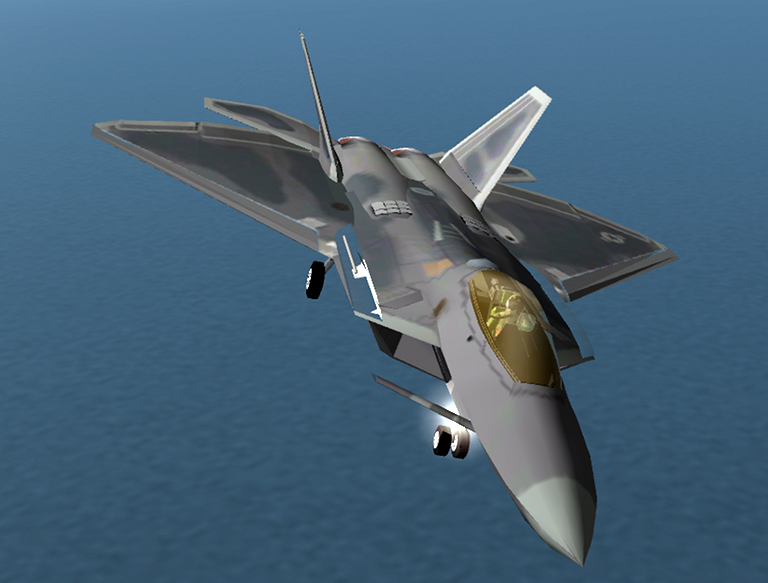
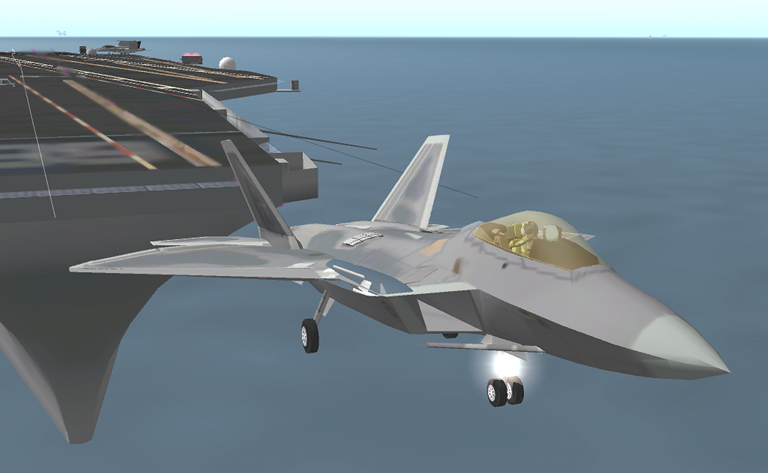 F/A-22N
Sea Raptor: the US Navy will soon confront an
operational environment where any nation equipped with modern long
range aircraft such as the Su-27/30/35 Flanker will be able to
challenge a Carrier Strike Group with a saturation supersonic cruise
missile attack. Neither the F/A-18E/F Super Hornet nor the F-35C Joint
Strike Fighter will have the performance or stealth to deal with this
kind
of threat. The only technological choice available within a feasible
timeline and budget is a direct adaptation of the existing F-22A Raptor
(Authors).
|
||||||||||||||||||||||||||||||||||||||||||||||||||||||||||||||||||||||||
| The 7th May, 1942 in the Battle of the
Coral Sea was the day when naval warfare changed forever. This
was the first fleet action in which aircraft carriers engaged each
other. It was also the first naval battle in history in which neither
side's ships sighted or fired directly upon each other. Although
technically a win for the Japanese Navy, its forces were sufficiently
weakened that in the subsequent Battle of Midway, the United States
Navy convincingly defeated the Imperial Japanese Navy. Since
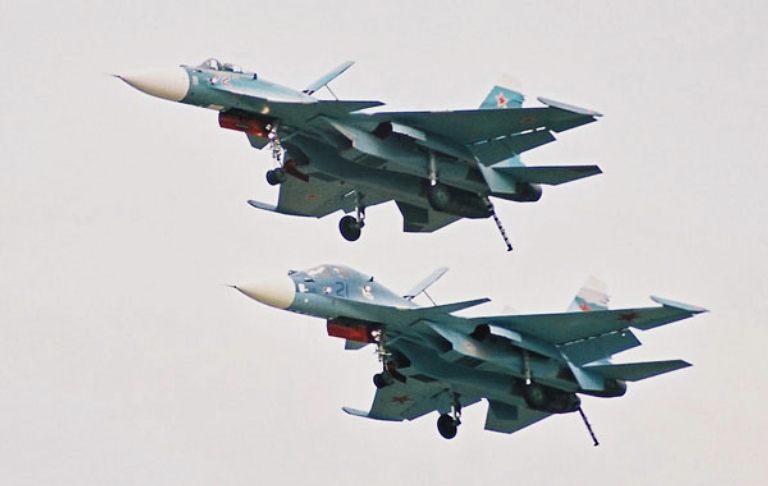
then, the USN has never been defeated at sea. The halcyon days of the USN projecting immense power wherever and whenever they choose, may be at an end. The airborne torpedoes and kamikazes of this era are supersonic sea-skimming anti-ship cruise missiles, all developed in Russia, but now proliferating across the Asia-Pacific Region, and being manufactured under licence by other countries, such as India. India has bold plans to export over 500 of the Kh-61/SS-N-26 Yakhont derived BrahMos. The tridents that might pierce the hulls of the US Navy warships are: the ’Carrier Buster’ Kh-41 or SS-N-22 ‘Sunburn’, which can have conventional, thermobaric or nuclear warheads; the Kh-61 Yakhont / BrahMos or SS-N-26 ‘Stallion’; and the devilishly clever 3M54 series or SS-N-27 ‘Sizzler’, which cruises at subsonic speed to the vicinity of the fleet, pops up at about 40 nautical miles for a radar fix, then launches a Mach 2.7 supersonic manoeuvring ‘dart’ at the victim warship. How will these attacks be delivered? The way to penetrate a Carrier Strike Group’s (CSG’s) defences is to deliver unmanageable swarms of missiles – technically termed a ‘saturation attack’ to overwhelm the Anti-Ship Missile Defence Systems. The Soviets invested enormous effort into the Operations Research underpinning this tactic. To carry out such an attack, Flanker fighters can carry a single Sunburn round, or three Sizzler rounds, or four Stallion / BrahMos rounds. Venerable aircraft like the Tu-95M/Tu-142 Bear, the Tu-22M3 Backfire, and the new Chinese H-6K turbofan Badger are all options for antiship strikes, and all can strike from long ranges, carrying six or more such missiles per aircraft. In an operational scenario, the US Navy’s E-2C/D Hawkeye fleet would be able to detect the incoming Bears, Backfires or Badgers to scramble the F/A-18E/F and F-35B/C aircraft for an effective intercept, even if the strike aircraft arrive in a small fleet to deliver their swarm of missiles. So, if Bear, Backfire or Badger striker aircraft carry the anti-ship missiles, they will need to be escorted by ‘offensive counter-air’ (OCA) Flankers. For these fighter escorts this is a ‘high-high-high’ altitude profile mission, so with an effective OCA weapons load, the un-refuelled combat radius will be about 1,000 nautical miles with internal fuel and external tanks. All late model Flankers have air-to-air refuelling capabilities, so this OCA range could extend to 1,500 nm and well beyond with enough tanker support. That’s a lot of blue water from which to exclude the US Navy. These ranges are also significant, as the F/A-18E/F and the F-35B/C struggle to exceed unrefuelled combat radii much beyond 600 nm with any useful weapons load. So, if countries operating late model Flankers choose, they can effectively neuter the USN by denying it access to targets within range of carrier based shipboard attack aircraft. Ehrhard and Work have cleverly proposed in a recent study that the US Navy deploy highly stealthy 1,500+ nautical mile combat radius UCAVs (Unmanned Combat Aerial Vehicles) from carrier decks to permit attacks from outside the reach of land based bombers and fighters. This is a sound and well thought out strategy, which forces land based bombers, and especially their tanker refuelled fighter escorts, to operate at very long ranges, which seriously reduces sustained sortie rates and restricts deployable numbers. The ‘Ehrhard strategy’ solves part of the puzzle, but not the entire puzzle. Subsonic UCAVs suffer the same sortie rate limitations as subsonic cruising land based aircraft attacking the fleet. They cannot eliminate the problem of long range air attack on the fleet, but only reduce its intensity [1]. An attacker can play a more aggressive game than simply launching swarms of supersonic sea skimmers. Suppose the enemy’s intent is to inflict so much attrition upon the US Navy, that it is rendered combat ineffective. The first target is the E-2C/D Hawkeye Airborne Early Warning (AEW&C) aircraft. Some Flankers will be armed with OCA weaponry, others with the long-range R-172 or R-37 ‘AWACS-killer’ missiles – specifically designed to kill AEW&C aircraft at ranges of up to 200 nautical miles. The OCA Flankers protect the Flankers tasked with killing the AEW&C aircraft. The ensuing air battle is likely to down a number of E-2C/D Hawkeyes, F/A-18E/F and F-35B/C aircraft, bleeding the CSG’s air defences. Finally, the full-strength anti-ship strike will be scheduled, with large numbers of OCA Flankers escorting Striker Flankers and/or Bears, and/or Backfires, and/or Badgers. If the surviving missile swarm exceeds the defensive capability of the DDG escorts, then a lot of hulls will ‘turn turtle’. A ‘Reversed Mariana’s Turkey Shoot’ and ‘Reversed Battle of Midway’, all in one. That is, current US Navy air power and operations planning will not be able to protect its Carrier Strike Groups against existing and developing global threats. A much more effective naval air combat capability will be needed for the CSGs to survive. |
||||||||||||||||||||||||||||||||||||||||||||||||||||||||||||||||||||||||
Supersonic
Sea Skimming Anti-Ship Cruise Missiles
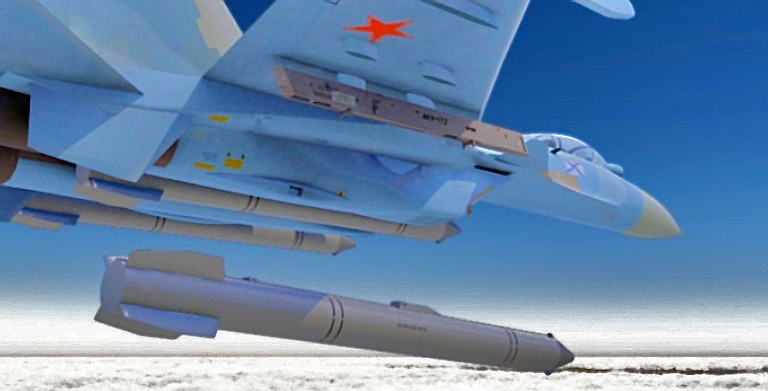 Digital rendering of the air launched
supersonic sea skimming 3M-54AE Sizzler
being released from a navalised carrier based Su-33 Flanker D. The
Flanker can carry three rounds. China is procuring this long range
shipboard fighter for its planned fleet of aircraft carriers (Novator).
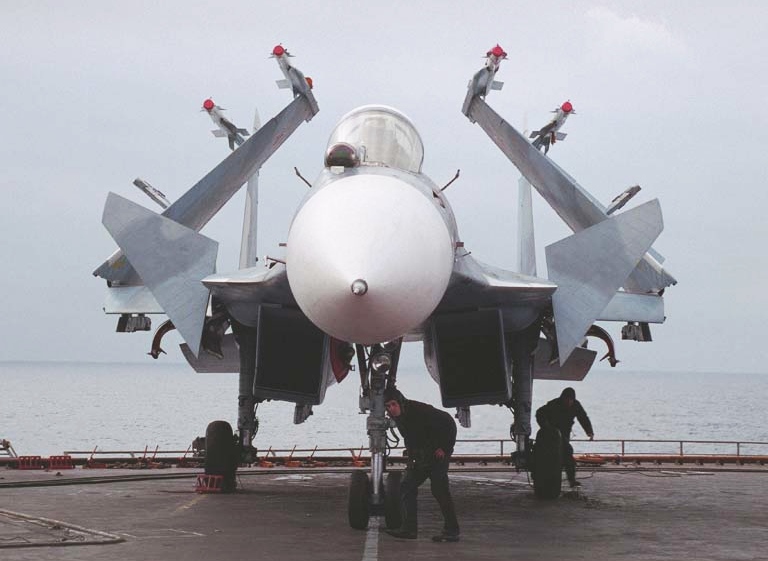
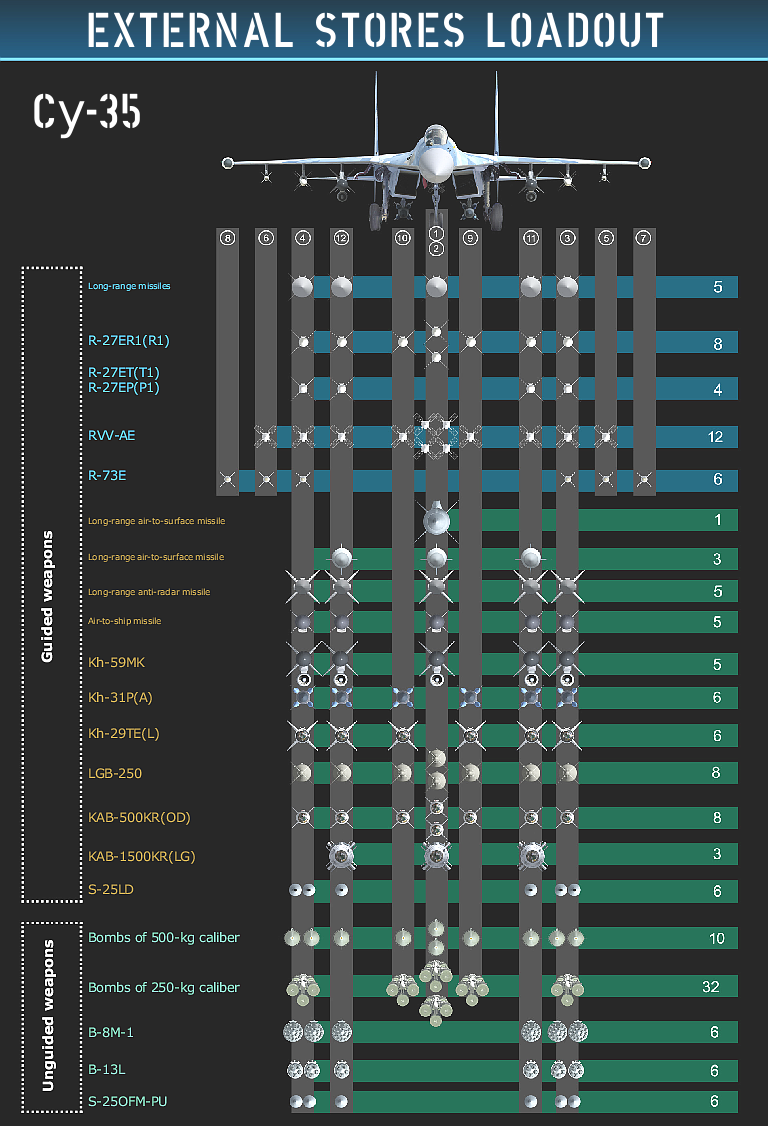 Su-35BM Flanker E+ external stores configuration. Anti-ship missile loadouts include: 1 x Sunburn, 3 x supersonic Sizzlers, 5 x Kayak (Harpoonski), 5 x anti-ship Kingbolt, 4 x Stallion (not drawn), or up to five subsonic cruise missiles such as the baseline Sizzler (KnAAPO image). 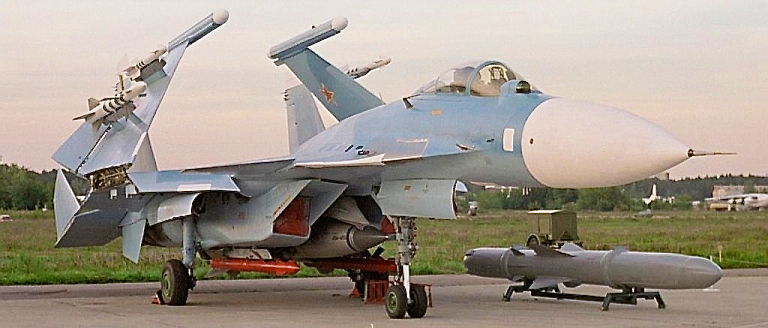 A Russian Navy Su-33, derived from the land based Su-27S, on display with a mixed payload of OCA weapons, and a centreline supersonic sea skimming Kh-41 Sunburn, carried using a special cradle adaptor. The missile on the stand is a supersonic sea skimming Kh-61 Stallion. Sukhoi/KnAAPO have migrated most of the technology in the Su-33 to other Flanker variants. 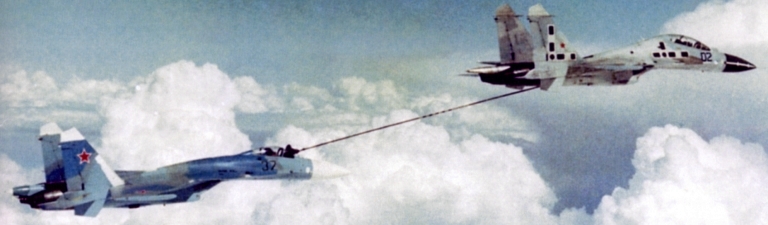 The navalised Su-33 was the first to introduce a retractable refuelling probe, similar to the F-14 design, as well as the UPAZ-1A Sakhalin buddy refuelling store. These have since migrated to land based variants, providing a buddy tanking option for Flanker users lacking full sized tankers. |
||||||||||||||||||||||||||||||||||||||||||||||||||||||||||||||||||||||||
The answer to the naval air defence problem lies in the late Cold War US Navy maritime strategy model of ‘killing the archer, rather than the arrow’ – which means engaging and destroying the attacking aircraft before they can launch their lethal sea skimming supersonic payloads. Late model Flankers such as the Su-35BM have a clear advantage over the F/A-18E/F. Even with reduced radar signatures, the F/A-18E/F has a residual signature that allows the Su-35BM to launch a PL-12, or R-77M, or ramjet RVV-AE-PD at the kinematic limits of these missiles’ engagement envelopes – and with the Flanker higher and faster than the Super Hornet, well outside its AIM-120C/D range envelope. So the Flanker gets ‘free shots’ – and can carry lots of them. The F/A-18E/F has some fine defensive electronic countermeasures and the ALE-55 will seduce many of the incoming missiles – but not all. The R-77M ‘Adder’ will have alternate active radar, heat-seeking and passive anti-radar homing seeker heads, so any competent OCA force would deliver a mix of these missiles in a mass firing. This is a ‘damned if you do, damned if you don’t’ situation for the Navy Hornets – the radar and electronic counter measures are required to prosecute attack on the Flankers, but will attract passive anti-radar homing missiles. The missiles with heat-seeking guidance also present a serious threat as their homing is not affected by the towed decoy. Expect the exchange ratio to be about 4:1 in favour of the Flanker E+. The F-35 B/Cs might fare a bit better, but their Achilles’ heel is a shortage of missile shots. A Flanker E+ can carry up to 10 long-range missiles and 2 short range missiles, but not to a distance of 1,000 nm. At 500 nm or so, they can carry 8 long range missiles, and can fire them all in a track-while-scan’ mode. The JSF’s reduced signature forces engagements where both aircraft are within range of the other’s missiles. However, the Flanker E+ has more missile shots than the JSF; has modern DRFM Electronic Counter Measures; and, possibly, a towed decoy where the F-35 has none. Long range heat-seeking missiles pose the same danger to the JSF as to the Hornet. Expect an exchange rate of at best about 1:1 between the Flanker E+ and the JSF. Both the Hornet and JSF lack the aerodynamic agility to out-turn missiles. They also lack the speed essential to a safe disengagement from a fight. Here is another thorny dilemma in modern naval air warfare. If the US Navy defensive fighters stay close enough to the fleet to be covered by the CG/DDGs’ Surface to Air Missiles on egress, they have allowed the enemy to get within launch range of their anti-shipping missiles; if they don’t, they will be cut down during the egress to the carrier. The argument which comes next is predictable – deploy an air combat aircraft that can effectively ‘kill the archer’ and survive. This aircraft is a ‘navalized’ F-22A – let us call it the ‘F/A-22N Sea Raptor’. This is not the same as the cancelled Naval Advanced Tactical Fighter (NATF). The US Navy wanted an advanced fighter, but the NATF failed because the Navy wanted a de-facto new-technology F-14 engineered from F-22 components. This suggestion is the converse; convert the F-22A into an F-14 replacement – a much lower risk and less costly approach. The fiscal and timeline costs of restarting the early 1990s F-22 derived ‘swing wing’ NATF are simply out of feasible bounds. |
||||||||||||||||||||||||||||||||||||||||||||||||||||||||||||||||||||||||
The Naval Advanced Tactical Fighter (NATF) Proposals
 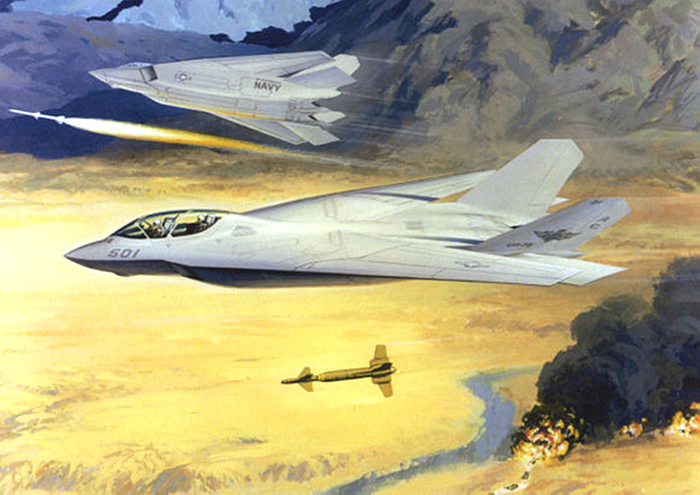 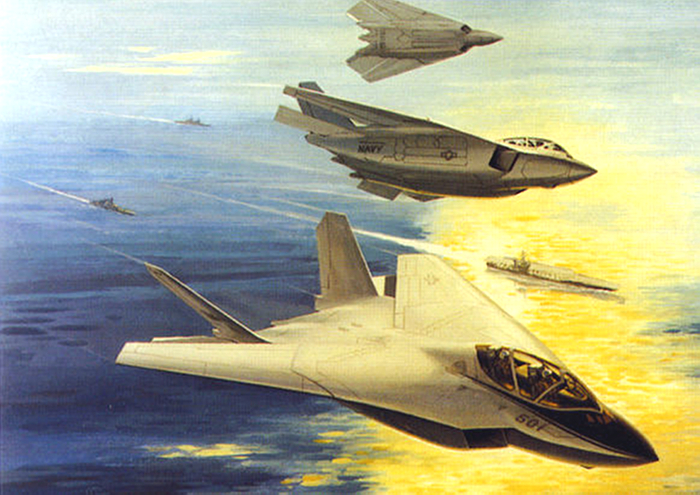 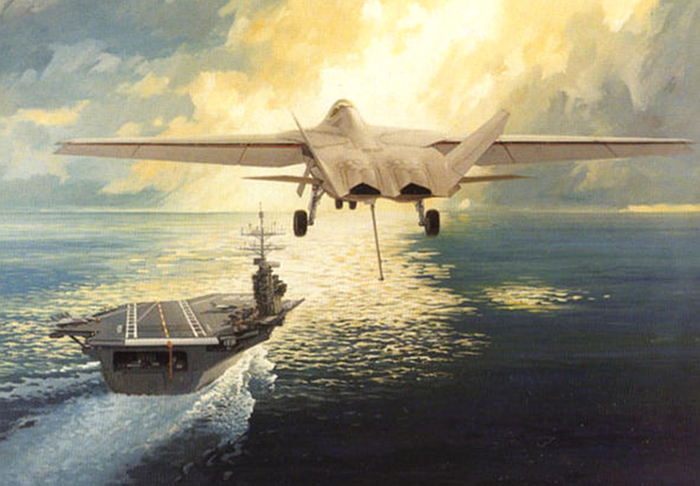 |
||||||||||||||||||||||||||||||||||||||||||||||||||||||||||||||||||||||||
| Is that the choir that can be
heard singing a chorus of ‘you cannot do that!’? Well, suspend
disbelief and inter-service politics for a few minutes, and see what
might be done with a little imagination and old-fashioned pragmatic
American Engineering ‘know-how’. Look at the remarkable overlay of a scaled image of the F/A-22N on a line drawing of the F-14D. Note the similarity of the size and weight of the aircraft, although the F/A-22N has substantially more thrust. To reduce the F/A-22N’s deck footprint – or spotting factor in naval language - its wings could be folded between the flaps and aileron. |
||||||||||||||||||||||||||||||||||||||||||||||||||||||||||||||||||||||||
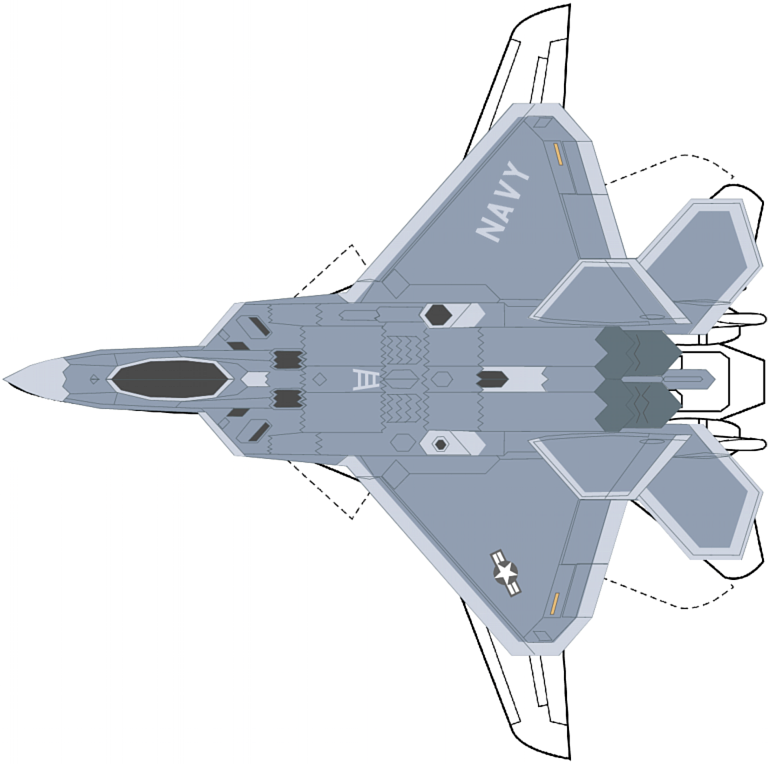 Size
Comparison of F/A-22N Sea Raptor and F-14A Tomcat (NASA/C. Kopp)
|
||||||||||||||||||||||||||||||||||||||||||||||||||||||||||||||||||||||||
| How about the approach and trap
speeds, critical for carrier operations? About 125 KIAS at 50,000
lbs gross weight would be useful - the F-35C approach speed is ~145
KIAS. There are several ways of
reducing the F/A-22N’s approach and landing speed (Refer Annex),
including using the Raptor’s thrust vectoring capability (TVC) though
this will require a means of providing a balancing pitching moment in
the Powered Approach (PA) configuration. One way this can be achieved
is by replacing the existing hinged nose-wheel doors with scissoring
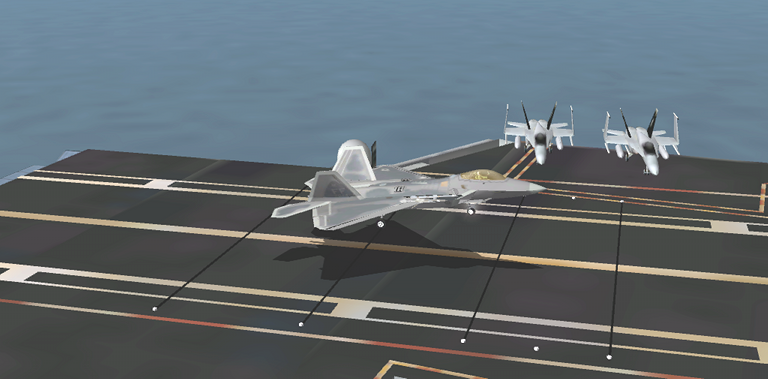
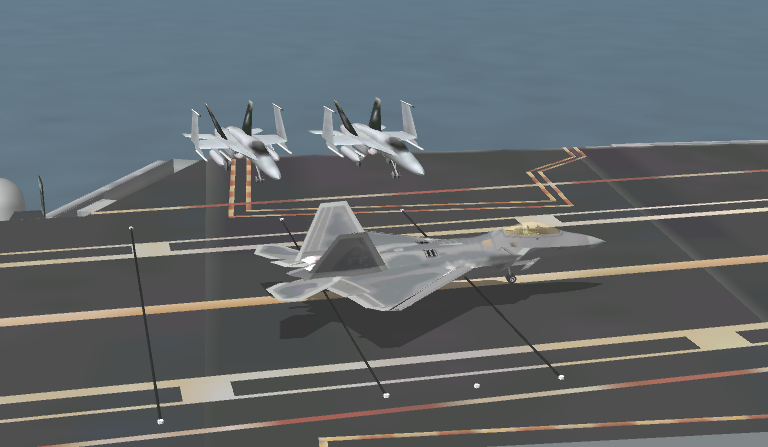
lifting canards. Drop the gear and the lifting canards deploy
with a fixed positive angle of attack, providing lift and moving the
centre-of-pressure forward. The elevators in turn respond with
less ‘download’. This configuration has been modelled
and flown using a basic simulator as a comparator, with an F-22A
configured with such lifting canards allowing nicely controlled
approaches at 135 KIAS and traps at 125 KIAS. These speeds are
similar to the F-14, which having a similar gross weight on recovery,
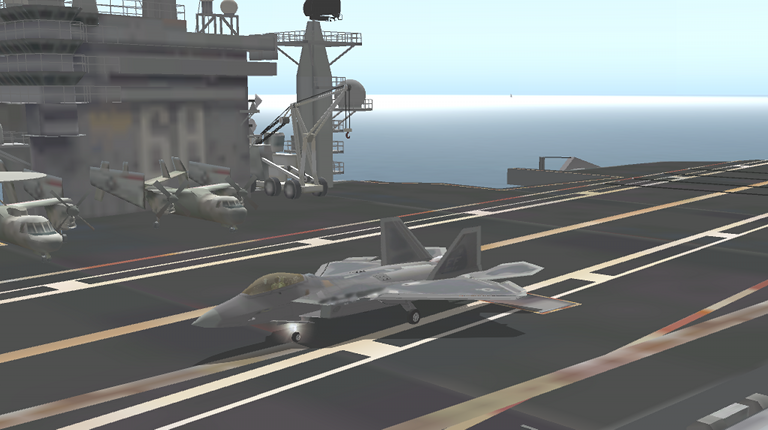
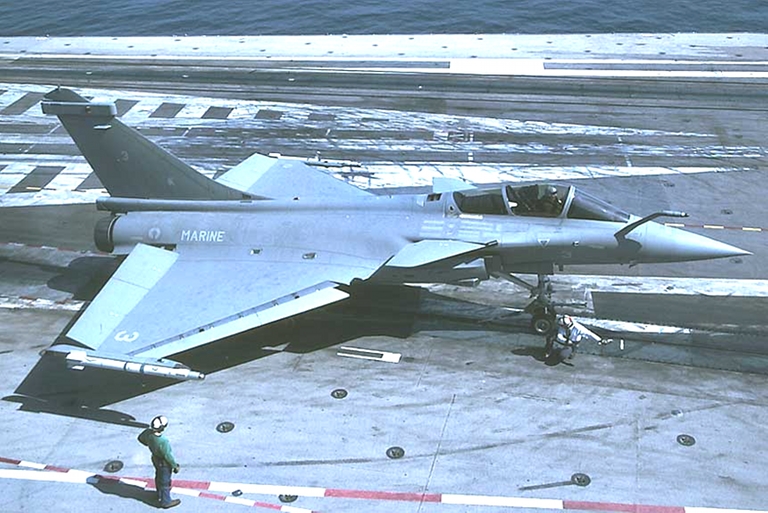
results in similar momentum to be absorbed by the arrestor cable motors. The canards would also assist in catapult launches, so with the F/A-22N at its maximum takeoff weight of about 80,000 lbs, it should be within the capacity of installed catapults. For comparison the F-14 MTOW is around 75,000 lbs, but it has much less engine thrust available compared to the F/A-22N. It may be necessary to ‘beef-up’ the airframe in some places, but the basic supersonic 9G rated structure is already there. Specific design changes might include a carrier qualified 24 ft/sec sink rate undercarriage, ‘beefing up’ the support and load transfer structure for the stronger undercarriage, a navalised nose gear with catapult launch bar, and a carrier rated arrestor hook for recoveries. The USAF boom refuelling could be retained, and the F-35B/C aerial refuelling probe added to the forward fuselage. So configured, the F/A-22N would be able to take on fuel wherever it finds a friendly tanker. The avionic and systems build would be based on the Air Force Block 40 plus configuration, so an F/A-22N Sea Raptor would have the Block 40’s full range of networking, air-to-air and air-to-ground strike capabilities. Additional Navy datalinks and ACLS would be required. Has this been done before? Well yes. The Russians were able take the impressive Su-27S Flanker B and re-engineer it into the world's best shipboard fighter, the Su-33 Flanker D. The French successfully converted the land based Rafale into the Rafale M Navale. The idea that the experienced engineering cadres of Northrop-Grumman or Boeing might lack the engineering skills to do the same for the F/A-22N Sea Raptor, and do so efficiently, is difficult to accept. And the cost? Pricing the Research and Development & Test and Evaluation, Production Engineering & Tooling (the NRE Costs) for the lifting canard, folding wings, undercarriage redesign, airframe strengthening and marinising comes in at a rough-order-of-magnitude (ROM) cost of around $230M (-10%/+30% variance). This figure includes an appropriate margin for risk. Over a production run of some 500 aircraft, the overall program cost, as distinct from price charged, including amortisation of the NRE, would add somewhat less than $10 million to the current F-22A production cost of $142 million . . .and that is assuming “all new” for any affected existing parts. However, the bulk of any affected parts will likely be able to be modified/upgraded, thus becoming cost effective ‘cousin parts’ like those extolled in the JSF Program for the savings they will generate. This is what one would call a classic capability bargain with superior cost benefit for all (…except any opposing threats, of course). You take an already outstanding aircraft, and make it even more effective with an investment that is a tiny fraction of the cost of developing a whole new aircraft type or, for that matter, the money that still needs to be spent on trying to get the F-35B/C to meet its already surpassed specification. More savings come from the volume production. Current cost estimate across the planned 91 x F-35B aircraft is ~ $158M a copy. For the current production F-22A, this figure is $142M a copy. A production run of over 700 Raptors will reduce this latter unit price substantially, so the USAF, USN and the USMC are all winners if the Sea Raptor numbers increase. The ugly reality is that the US Navy is staring down the barrel of a global environment where its underperforming Hornets and Super Hornets, and planned to underperform F-35B/C Joint Strike Fighters are neither viable as penetrating strike assets or actually capable of keeping the fleet alive in the face of modern Russian designed supersonic sea skimming weapons, which have proliferated on a global scale. The F/A-22N Sea Raptor renders the F-35C CV completely redundant, as it will provide around three times the capability of the F-35C at similar unit procurement costs, with a twin engine airframe better suited to naval operations. This would permit cancellation of the F-35C, never a favourite with professional naval aviators. The funding reserved for around 400 F-35Cs would buy a similar number of F/A-22Ns, producing the same commonality and economy of scale effects seen when the Air Force adopted the F-4C/D, while the Navy and Marines flew the F-4B. Should the Marines be equipped with the F/A-22N rather than the planned F-35B STOVL JSF, the total build numbers for both services could be as high as 680 aircraft. The F/A-22N provides, inherently, if not subjected to client or contractor induced cost and capability creep, much higher cross-variant commonality than the F-35 JSF does, driving down production costs with increasing build numbers much more effectively. Purchasing an aircraft with the ability to engage and defeat aircraft possessing the air combat capabilities of the Su-35BM Flanker E+ is a critical strategic decision for the United States. If it chooses aircraft inferior to those of potential adversaries, then not only will its Air Force risk annihilation in battle, but also the mighty power of its Naval Carrier Strike Groups is likely to be terminated in the second decade of this century. Without the navalized F/A-22N Sea Raptor, the US Navy will find itself out of the business of blue and brown water sea control, relegated to Third World counter-insurgency support roles. The F/A-22N ‘Sea Raptor’ is the only remaining choice. |
||||||||||||||||||||||||||||||||||||||||||||||||||||||||||||||||||||||||
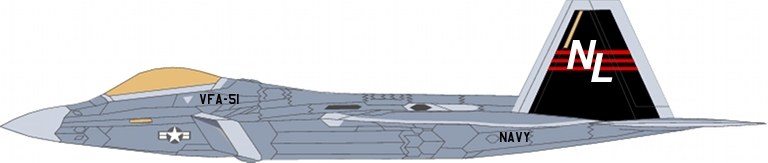 F/A-22N Sea Raptor in the livery of VFA-51, formerly the VF-51 F-14 squadron (C. Kopp) |
||||||||||||||||||||||||||||||||||||||||||||||||||||||||||||||||||||||||
Endnotes:[§] Peter Goon is a graduate of the US Naval Test Pilot School (USNTPS Class 80), Flight Test Engineer Course - 1981.[1] Tom Ehrhard and Robert Work, Range, Persistence, Stealth, and Networking: The Case for a Carrier-Based Unmanned Combat Air System, Center for Strategic and Budgetary Analysis, Washington DC, 18/06/2008, URI: http://www.csbaonline.org/4Publications/PubLibrary/ R.20080618.Range_Persistence_/R.20080618.Range_Persistence_.pdf; Robert Work and Tom Ehrhard, The Unmanned Combat Air System Carrier Demonstration Program: A New Dawn for Naval Aviation?, Center for Strategic and Budgetary Analysis, Washington DC, 18/06/2008, URI: http://www.csbaonline.org/4Publications/PubLibrary/ S.20070711.The_Unmanned_Comba/S.20070711.The_Unmanned_Comba.pdf |
||||||||||||||||||||||||||||||||||||||||||||||||||||||||||||||||||||||||
Annex - F/A-22N
Sea Raptor vs F-22A
Design Changes
|
|
Design Change |
Key Performance
Parameter (KPP)/Options |
Level of Risk |
| |
|
|
|
CV Arrestor Hook |
KPP: No degradation in VLO performance |
|
|
Option A |
Arrestor in VLO fairing |
LOW |
|
Option B |
VLO shaped external
Arrestor |
MED-LOW |
| |
||
|
CV Main Undercarriage |
KPP: 24 ft/sec sink rate |
LOW |
|
CV Nose Gear |
KPP: Catapult rated; 24
ft/sec sink rate |
LOW |
| |
|
|
|
Structural Enhancement |
KPP: No Significant BEW
Increase |
LOW |
|
Approach/Trap Speed/Attitude Control |
KPP: F-14 class trap
momentum; |
|
|
Option A |
Nosewheel door lifting
canards |
LOW |
|
Option B |
Retractable shoulder
lifting canards |
MED |
|
Option C |
Non-retractable
shoulder lifting canards |
MED-LOW |
|
Option D |
Elevating spine winglet
(in place of Refuel Receptacle) |
MED-HIGH |
|
Option E |
Blown Flaps/Blown Wing |
MED-HIGH |
|
Outer Wing Fold |
KPP: No degradation in
VLO performance |
LOW |
|
Marinising/Corrosion
Treatment |
KPP: No degradation in
VLO performance |
MED-LOW |
|
Navy
Datalinks/ACLS/Antennas |
KPP: No degradation in
VLO performance |
MED-LOW |

|
|||||||||||||
|
|
|
|
|
|
|
|
|
|
|
|||
|
|
|
|
|
|
|
|
|
|
|
|||
| |
|
|
|||||||||||
| Artwork, graphic design, layout and text © 2004 - 2014 Carlo Kopp; Text © 2004 - 2014 Peter Goon; All rights reserved. Recommended browsers. Contact webmaster. Site navigation hints. Current hot topics. | |||||||||||||
|
Site Update
Status:
$Revision: 1.753 $
Site History: Notices
and
Updates / NLA Pandora Archive
|
|||||||||||||
|
|
Tweet | Follow @APA_Updates | |||||||||||
|
|
|||||||||||||
|
|
|||||||||||||