|
||||||||||||||||||||||
 |
||||||||||||||||||||||
![F-22A Raptor, FB-22, F-22E, F-22N and Variants Index Page [Click for more ...]](APA/f-fb-22.png "F-22A Raptor, FB-22, F-22E, F-22N and Variants Index Page [Click for more ...]") |
 |
![People's Liberation Army Air Power Index Page [Click for more ...]](APA/pla-air-pwr.png "People's Liberation Army Air Power Index Page [Click for more ...]") |
 |
 |
 |
 |
 |
 |
![Military Ethics, Culture, Education and Training Index Page [Click for more ...]](APA/ethx-culture.png "Military Ethics, Culture, Education and Training Index Page [Click for more ...]") |
 |
||||||||||||
 |
![Russian / Soviet Weapon Systems Index Page [Click for more ...]](APA/rus-weps.png "Russian / Soviet Weapon Systems Index Page [Click for more ...]") |
 |
 |
 |

|
 |
 |
 |
 |
 |
||||||||||||
 |
 |
|||||||||||||||||||||
| Last Updated: Mon Jan 27 11:18:09 UTC 2014 | ||||||||||||||||||||||
|
||||||||||||||||||||||







|
SEA
4000 - The Air Warfare Destroyer
|
First published in Defence Today, June 2004 as 'Navy decides on Air Warfare Destroyers' by Dr Carlo Kopp Text, Line Art © 2004, 2007 Carlo Kopp |
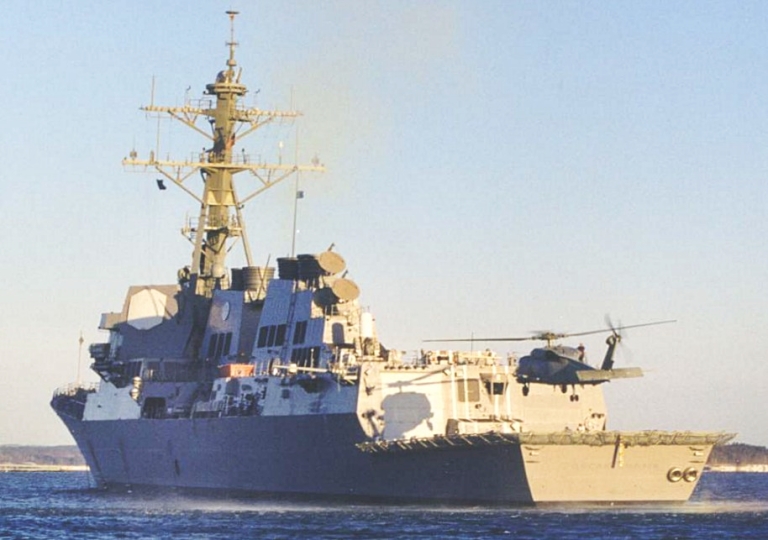 The DDG-79 Arleigh Burke Flight IIA class destroyer is regarded by many to be the leading contender for SEA 4000. Equipped with the SPY-1D AEGIS system, late build examples displace over 9,000 tonnes full load. The US Navy plans to operate 48 examples, replacing the DDG-2 class (US Navy). The SEA 4000 Air Warfare Destroyer (AWD) project is the largest single naval project currently in the funding pipeline, and in scope and size is the biggest ADF project other than the NACC project. Given the enormous impact this project will have on the Navy's budget, and indeed the Defence budget as a whole, it is well worth careful scrutiny. Many interesting questions arise in relation to the role definition of these warships, and the technological choices to be made, which Dr Carlo Kopp will explore in detail. The SEA 4000 Requirement The RAN has long and hard lobbied for a replacement class of vessels to plug the hole left by the departure of the capable Charles F Adams DDG-2 class Air Warfare Destroyers. The Oliver Hazard Perry FFG-7 class and ANZAC class warships have very limited air defence and indeed anti-missile defence capabilities, and would be seriously challenged to survive in any high intensity conflict. Indeed, neither class of warship was designed to operate independently, the FFGs being a lightweight US Navy design used as a gap filler to supplement the Spruance class ASW frigates, and the ANZAC class being designed for use in low intensity regional contingencies. The three AWDs are to become the core assets for the RAN's surface fleet, as the oldest FFGs are retired over the coming decade. The RAN's aims in the AWD project are manifold. In a 2003 presentation, CMDR G.A. McGUIRE, DDSC, stated the following aims:
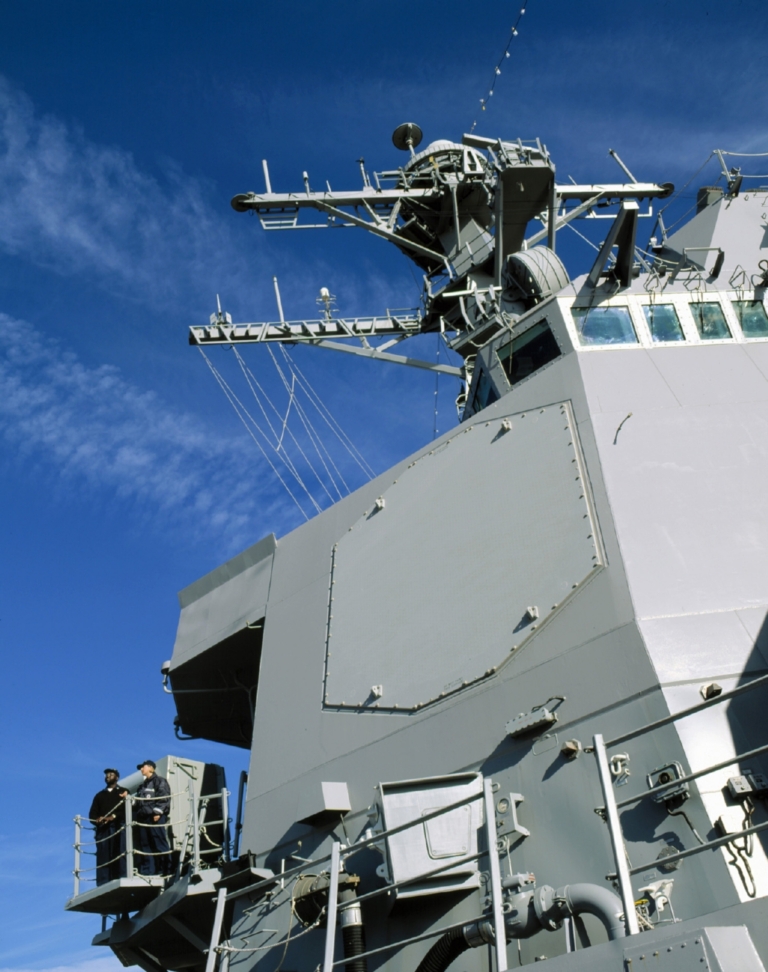
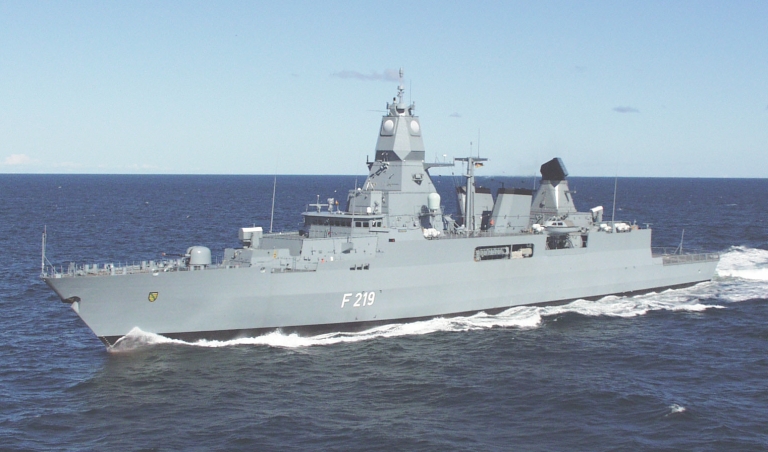
These aims have been amplified by Defence Minister Sen Robert Hill to include a capability to provide ballistic missile defence to protect amphibious landing sites and other high value assets, ostensibly using a SPY-1 Aegis derivative radar and evolutions of the RIM-66/67 Standard Surface to Air Missile (SAM) family. These are some very ambitious aims, which also make some very strong assumptions about the future regional threat environment. The SEA 4000 schedule was intended to include a requirements analysis and an Operational Concept Definition document to be produced in 2003, followed by 2nd pass design phase ending in 2004/5 and 3rd pass with a contractual commitment in 2007. The first vessel is the class was planned to be delivered in 2012 and following acceptance trials, to enter fleet service at some date after that. The ship's combat system and hull designs were to be considered separately, with the caveat that some systems would be tied to specific warship designs. The Three Contenders At the time of writing three warship designs were shortlisted. These are the US Gibbs & Cox DDG-51 Arleigh Burke class, the Spanish IZAR Alvaro De Bazan Class (F100), and the German Blohm + Voss Sachsen Class (Type F124). The DDG-51 class is the US Navy's current tier one destroyer, which replaced the DDG-2 class. The US Navy defines the DDG-51 as a Multi-Mission Guided Destroyer Missile designed to operate independently, or as units of Carrier Strike Groups (CSG), Expeditionary Strike Groups (ESG), and Missile Defense Action Groups in multi-threat environments that include air, surface, and subsurface threats and regards the ship to be the most powerful surface combatant ever put to sea. At this time in service and planned DDG-51 class vessels number 48, with three variants in service. Hulls DDG 51-78 (Flights I/II) are 153.92 metres in length, hulls DDG 79-98 (Flight IIA) 155.29 metres in length, with full load displacements between 8,448.04 and 9,347.2 tonnes. The ships are propelled by four GE LM 2500-30 gas turbines driving two shafts with 100,000 SHP. The DDG-51s have a complement of 23 officers and 300 enlisted personnel. The first in the class entered service during the early 1990s. In terms of its mission payload, the DDG-51 class is built around the Lockheed-Martin 4 MegaWatt 4,100 element class SPY-1D AEGIS radar/combat system, and the vessels are typically armed with a mix of vertical launch ASROC, BGM-109 Tomahawk, RIM-66/67 Standard area defence SAMs in Mk.41 Vertical Launch Systems fore and aft, a pair of triple tube torpedo launchers carrying Mk.46, a pair of Phalanx 20 mm CIWS guns, and a 5 inch Mk.45 gun. A helicopter flight deck is provided, but no hangars. The RIM-162 ESSM point defence SAM would be carried in four packs each occupying a single Mk.41 VLS cell. In US Navy service the DDG-51s are used to supplement the CG-47 Ticonderoga class AEGIS cruisers in air defence roles, but are also commonly used to lead Surface Action Groups. It is a very capable surface combatant, its principal air defence limitation being in the use of three SPG-62 X-band illuminators, compared to the four carried by the CG-47 class. The IZAR F100 Alvaro de Bazan class multirole frigate is the Spanish Navy's latest surface combatant, and one of the few non-US warships to carry the SPY-1D AEGIS system (Japan's Kongo class also uses SPY-1). Like the DDG-51 the F100 is essentially a multi-role surface combatant, with a bias to air defence capability. The four ships in the class have a full load displacement of 5,800 tonne, with a length of 146.7 metres, the last to launch this year. Propulsion is provided by a pair of GE LM 2500 gas turbines and a pair of IZAR diesels, driving a pair of variable pitch props. The F100 has a complement of 48 officers and 202 enlisted personnel. The mission payload is similar to that of the DDG-51s. The SPY-1D AEGIS is the primary air defence sensor, used to target the SM-2MR Block IIIA and RIM-162 SAMs in Mk.41 VLS, and providing cueing for the FABA 20mm Meroka 2B CIWS. A pair of dual tube Mk.32 torpedo launchers are used, carrying Mk.46 rounds, as well an a pair of mortars and 20 mm guns. ASuW capability is provided with a pair of four round BGM-84 Harpoon launchers, and a 5 inch Mk.45 Mod 2 gun. The helicopter flight deck is sized for the SH-60 Seahawk. The F100 class will be used as task group air defence escorts, as lead vessels for SAGs, and also for ASW and ASuW tasks. While smaller than the DDG-51 class, this is still a formidable surface combatant. Ostensibly an Air Defence Frigate, the F124 Sachsen (Saxon) class warships are more the multirole surface combatant than the specialised air defence vessel. Unlike the DDG-51 and F100 series, built around the SPY-1 AEGIS system, the F124 is the first warship to deploy an X-band active phased array engagement radar, coupled with a mechanically steered 200 NMI class L-band Thales Nederland (formerly Signaal) SMART-L 3D radar. The three ships in this class, FGS Sachsen (F219), FGS Hamburg (F220) and FGS Hessen (F221) are 143.0 metres in length, with a displacement of 5,600 tonnes. Propulsion is provided by a single GE LM 2500 gas turbine and a pair of MTU 20V1163 diesels, driving a pair of variable pitch props. The F124 class has a complement of 37 officers and 191 enlisted personnel. The mission payload of the F124 class is very different from the DDG-51 and F100, but in the same capability class. The mechanically steered SMART-L 3D radar provides long range search and acquisition, and missile engagements using the SM-2MR Block IIIA and RIM-162 SAMs in a 32 cell Mk.41 VLS are prosecuted using the 3,000+ element class X-band Thales Nederland APAR active phased array. A pair of Mk.31 launchers with RIM-116A Rolling Airframe Missiles are used for point defence. ASW capability is provided with a pair of triple tube Mk.32 torpedo launchers carrying EurotorpMU90 rounds. ASuW capability is provided with a pair of four tube RGM-84 Harpoon launchers, an Oto Melara 76mm gun and a pair of Rheinmetall 20mm guns. EU sources claim that a KMW PzH 2000 155mm gun was trialled on the FGS Hamburg (F220) late last year. The helicopter flight deck is sized for the large 15 tonne helicopter, such as the EH101 Merlin, with paired hangars sized for the NH90. The systems and weapon fit on the F124 make it a very capable multirole surface combatant, despite its Air Defence Frigate designation. All three warships are significantly larger and heavier than the 4,500 tonne class DDG-2s, and the 3,600 tonne class FFG-7s, the DDG-51 being almost 2.5 times larger in displacement than an FFG-7. All three are multirole surface combatants suitable for leading SAGs, with a strong bias toward to air defence roles. All three represent the last modern Western surface combatant classes likely to be constructed with conventional hull and superstructure designs, as EU nations will likely follow the US lead with the DD(X) class and build future surface combatants using faceted stealth techniques. These warships are also likely to be the last of a generation built using classical antenna and radar configurations. The DDG-51 and F100 using the S-band passive phased array SPY-1 system as a long range search and acquisition radar, and the F124 using a mechanically steered 3D radar. Only the F124 class uses the upcoming generation of active phased arrays in its APAR X-band engagement radar. In terms of basic technology, this raises some interesting questions as to the 'technological strategy' being pursued by Defence with the SEA 4000 project, no less interesting questions than the role optimisations of these warships' weapon systems. |
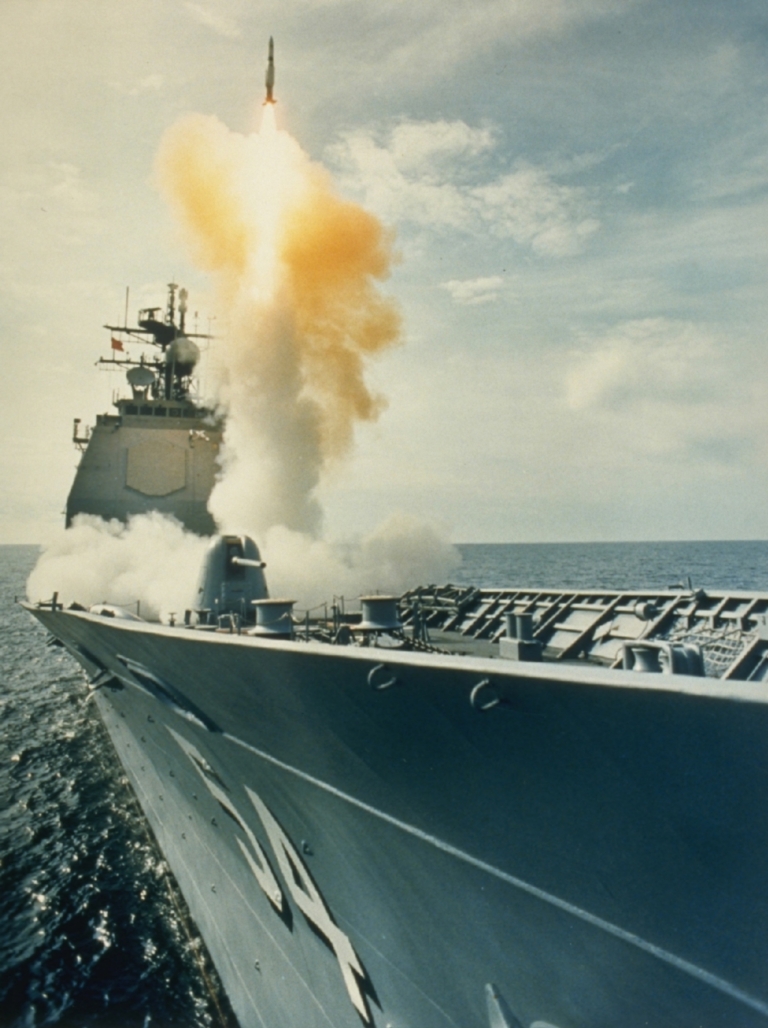
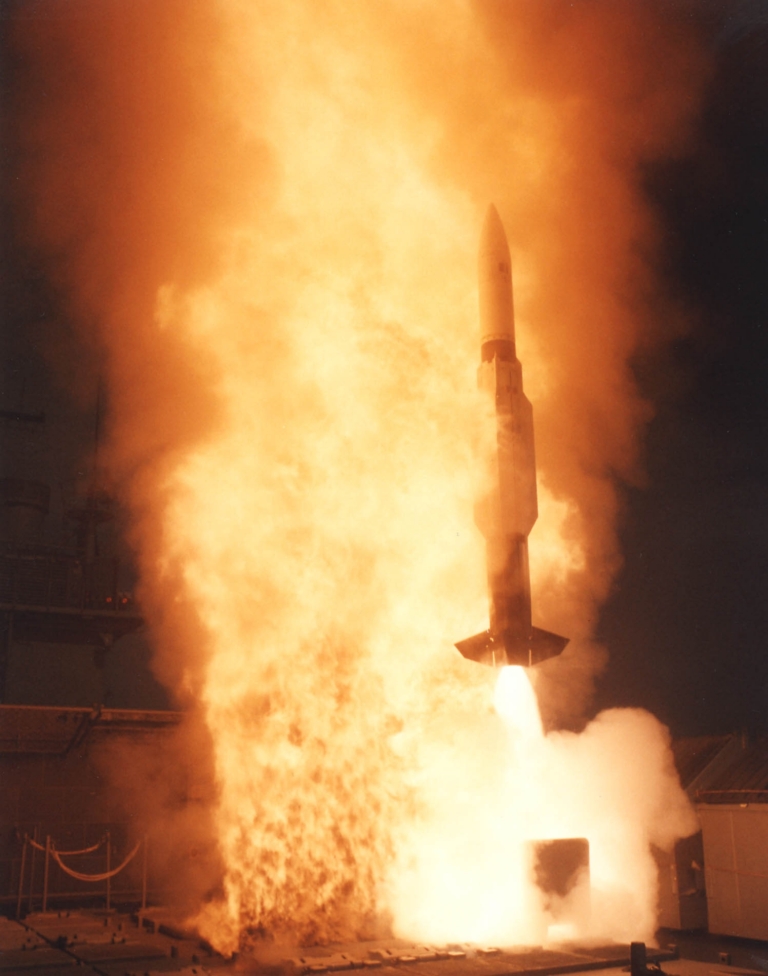
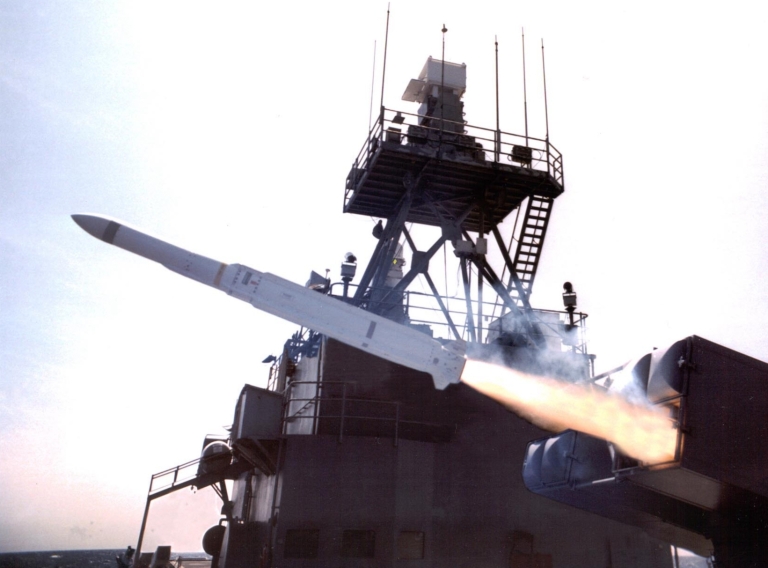
 The
SPY-1 radar system is at the heart of the AEGIS weapon
system, and was first deployed on the CG-47 Ticonderoga class air
defence cruisers. This long range S-band Moving Target Indicator radar
uses passive phase shifter based phased array technology, and was
designed to engage and destroy aircraft and Russian supersonic missiles
like the Kh-22/AS-4 Kitchen and KSR-5/AS-6 Kingfish. The depicted
missile launch is from a Mk.41 Vertical Launch System on a CG-47 class
cruiser (Lockheed-Martin).
The
core of the AEGIS system is a powerful, software based
battle management system, providing a highly automated capability to
track and engage large numbers of targets concurrently. It remains the
benchmark in naval air defence systems (Lockheed-Martin).
Spain's
F100 class is the first non-US warship to be equipped
with the AEGIS system, using the SPY-1D variant common to the DDG-51
class. Although only 2/3 of the displacement of a late build DDG-51,
the F100 is highly capable multirole surface combatant.
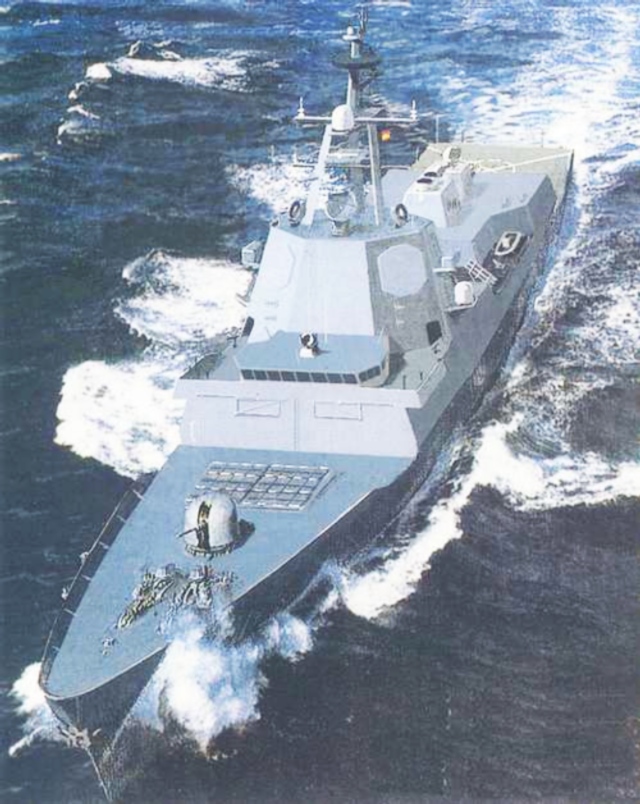
Germany's
F124 air defence frigate is the odd one out amongst
the SEA 4000 contenders, as it does not use the AEGIS weapon system. It
employs a conventional long range search radar, combined with the APAR
X-band phased array engagement radar, used for tracking, missile
midcourse guidance and illumination. As such it is the only contender
system built for handling saturation Anti-Ship Cruise Missile attacks
(Blohm & Voss Image).
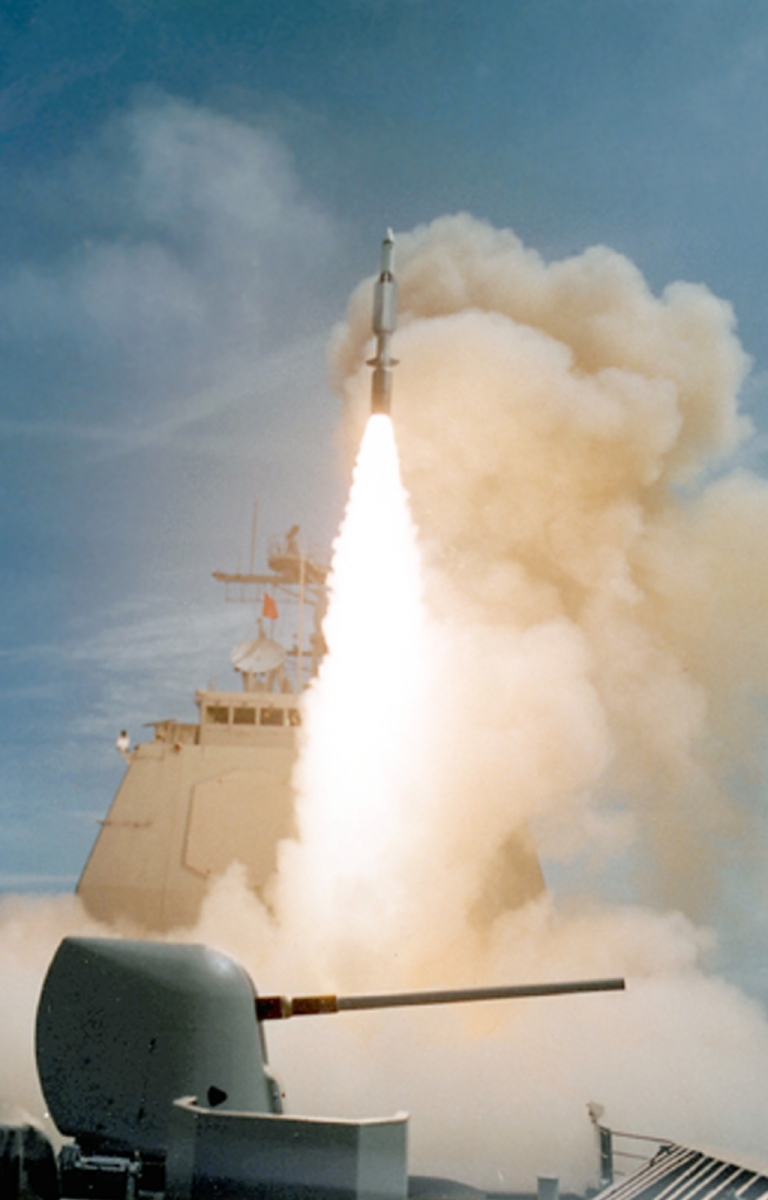
The
Block III RIM-66 Standard Missile is the primary air defence
weapon used by all three contenders, using terminal X-band semi-active
homing guidance with midcourse datalink updates (Raytheon).
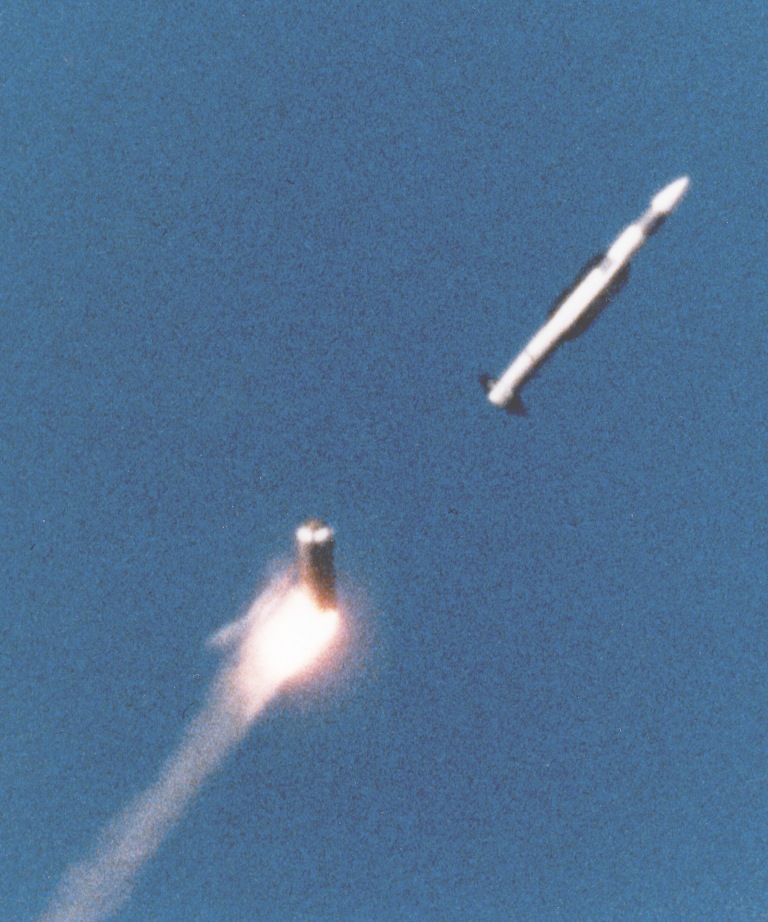
The
Block IV RIM-66 Standard Missile is being developed as an
anti-ballistic missile interceptor, intended to engage Tactical and
Intermediate Range Ballistic Missiles. Note the additional booster
stage and enlarged strakes (Raytheon).
The
RIM-162 Evolved Sea Sparrow Missile is the weapon of choice
for engaging sea skimming Anti-Ship Cruise Missiles. Developed in an
international program, the missile employs terminal X-band semi-active
homing guidance with midcourse datalink updates. A single Mk.41 VLS
cell can be loaded with an insert carrying four ESSM rounds, to
maximise weapon loadout (Raytheon).
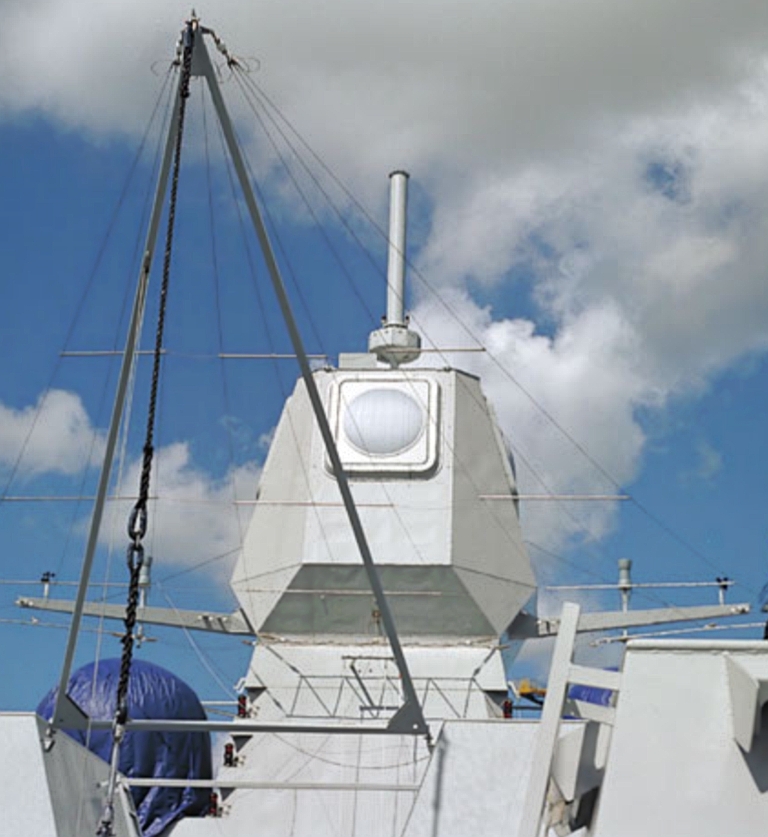
The Thales Nederland (formerly Signaal) APAR is the first production X-band active phased array engagement radar to be deployed, reaching its users several years ahead of the US Navy Raytheon SPY-3 X-band Multi-Function Radar. With 3,000+ TR-Modules per face, the APAR has two to three times the module count of contemporary X-band AESA fighter radars. As this radar provides the beam steering agility of a phased array, it is capable of much better handling saturation missile attacks, where antenna dwell time for tracking, midcourse guidance and illumination must be carefully scheduled between targets (Thales). |
|
Roles and Missions vs Threat Capabilities On the strength of public statements by Defence it would appear that the SEA 4000 warships are primarily intended to provide long range air defence cover for amphibious operations in the region, air defence escort cover for amphibious vessels or convoys, and blue water capabilities as lead vessels for SAGs. The role optimisations of the three shortlisted warships fit this classical role definition reasonably well. More curious is the case put publicly for the use of these warships as anti-ballistic missile defence platforms, ostensibly to defend amphibious landing sites from tactical or intermediate range ballistic missiles. Indeed some media commentators have suggested these warships might be used for a broader national missile defence role, something even the most ambitious overseas proponents of ballistic missile defence would dare not suggest. The principal threat to surface shipping and amphibious landings within this region will be anti-shipping and land attack cruise missiles, of Russian, cloned Russian or indigenous origin. Such weapons are now well established in regional inventories, with highly ambitious shopping plans by a number of regional operators. These weapons can be launched by coastal batteries from mobile trailers, by surface warships, submarines and a wide range of aircraft. The sheer diversity of these weapons is an issue in its own right. In statistical terms regional cruise missile inventories already outnumber conventional theatre ballistic missile capabilities, and this trend will continue over time. Cruise missiles are more accurate, cheaper per range/payload, and harder to detect in flight. At the top end of the threat scale are large Russian supersonic ramjet cruise missiles, such as the sea skimming Raduga Kh-41 Moskit (SS-N-22 Sunburn) Mach 2.2 135 NMI class ASCM, and the Kh-61 Yakhont/PJ-10 Brahmos A/S (SS-N-26) Mach 2.5 160 NMI class ASCM. Designed to inflict serious damage to aircraft carriers or large transports, these supersonic sea skimmers can cut smaller warships in half. China has deployed the Sunburn on its Sovremenyy destroyers, while India intends to launch licence built Brahmos missiles from surface warships, coastal batteries and aircraft. An arguably no less lethal arrival in the region is the Novator 3M54 Alfa/Club/Kalibr family of ASCMs, now available as torpedo tube launch rounds for the Kilo class SSKs. The sea-skimming subsonic 3M-54E1 Alfa (SS-N-27) subsonic 160 NMI class ASCM most closely resembles the now retired BGM-109 TASM anti-ship Tomahawk variant. Its sibling, the 120 NMI class 3M-54E is a more lethal variant, which carries a rocket propelled Mach 2.9 class manoeuvring sea skimming payload section. When the 3M-54E seeker acquires its target, the aft section of the missile is jettisoned, the rocket motor ignited and the victim warship has to deal with a sea skimming Mach 3 class weapon. India has acquired the 3M-54 series, and reports now claim a tit for tat buy by China. An air launch 3M-54E variant has been marketed on the Su-32FN/34 fighter, while the Yakhont and Moskit have been integrated on the Su-27/30 Flanker series. If India proceeds with its intended lease of the Tu-22M3 Backfire C, we are also apt to see the arrival of the massive 200 NMI class Raduga Kh-22M Burya (AS-4 Kitchen), capable of Mach 4 class speeds at altitude. Designed with its smaller sibling, the KSR-5 (AS-6), to kill aircraft carriers, the Kh-22 was the impetus for the development of AEGIS during the 1970s. One tier down from these weapons are shorter ranging ASCMs. The Mach 4 class ramjet Zvezda-Strela Kh-31 (AS-17 Krypton) family of weapons has been acquired by China for its Su-30 fleet, it is available in 60 NMI and extended range 110 NMI variants with antishipping radar and passive anti-radiation seekers. China is also to deploy the 50 NMI class subsonic Kh-59MK2 Ovod, a antishipping radar seeker equipped derivative of the AS-18 Kazoo. India operates the 70 NMI class Kh-35U Uran/Kharpunski (AS-20 Kayak) - a Russian Harpoon - with reports claiming China has ordered the same. China has manufactured since the 1970s a wide range of derivatives of the Russian liquid rocket propelled Styx missile, usually labelled the Silkworm family of missiles. While subsonic, these large 2 to 3 tonne weapons are available in ship, coastal battery and air launch versions, including a turbojet powered model and a range of seeker variants are available. China also builds an indigenous analogue to the Exocet/Harpoon in its YJ-8 family of sea skimming missiles, available with rocket and turbojet propulsion. While all of these weapons are available with anti-shipping seekers, some are also available in land attack variants, or dual role variants. Evidence is now also emerging of a Chinese program to field sub/ship and air launched land attack cruise missiles in the class of the 600 NMI range US Tomahawk and CALCM. Reports indicate a Tomahawk clone, and Kh-55/65 (AS-15 Kent) derivative will enter service by the end of the decade. China is now testing a new Badger variant, the H-6H, equipped to carry four such cruise missiles. This is highly lethal mix of weapons, likely to be encountered in blue water operations, and littoral operations including the support of amphibious landings. The key and perhaps most important common feature of most of these weapons is that they have sea skimming or low altitude cruise profiles, and range performance in excess of 40 NMI. With most of these weapons being of Russian origin, it is inevitable that the Russian doctrine of massed saturation attack will be adopted as part of the training package provided. Developed during the Cold War to defeat US Navy battle groups, this doctrine aims to place as large as possible a number of missiles onto the target warships in as narrow a time window as possible to saturate the ships' defences. From an air defence perspective this is as ugly an environment as possible. Because most of the these weapons are sea skimmers with more than 25 NMI range, they can be launched without warning from well below the radar horizon of an air defence warship. The long range detection capability of such warships is nearly irrelevant here, since the launching aircraft can be flown in under the mainlobes of the radar to the missile release point. The tactics long used by the RAAF with its F-111C/Harpoon combination are simply replicated using Russian weapons. A warship is thus likely to get its first warning as the
missiles pop up over the radar horizon, 15 to 25 NMI distant, depending
on radar antenna elevation. With around 2 to 3 minutes warning time for
subsonic missiles, and as little as 40 seconds for supersonic missiles,
the warship must be capable of tracking these ASCMs, launching its
SAMs, providing terminal phase illumination, assessing the kill, and
repeating with a second shot if need be, before the ASCMs get inside
the minimal engagement distance of the weapon system. If the ASCMs get
past the point defence SAMs, then the last line of defence is the
terminal gun system or short range SAM, which even if effective may not
prevent the ship from being showered with debris.
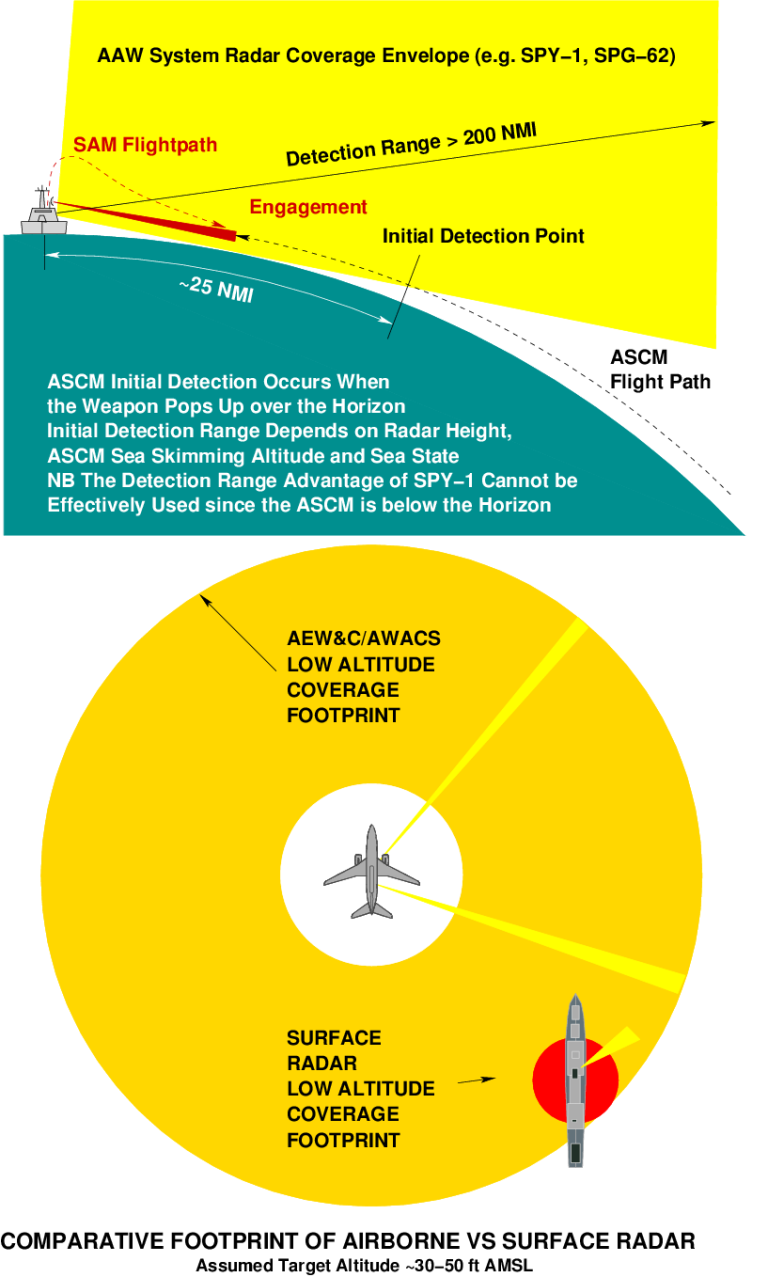
In a cruise missile rich threat
environment, all surface
warships are confronted with the physics of radar propagation which
hide inbound low flying missiles below the radar horizon. For wide area
air defence operations, AEW&C aircraft are a much more productive
means of surveilling airspace (Author).
The RIM-162 ESSM was designed for this style of engagement. However, the issue is as much one of missile dynamics as it is of having an X-band tracking and illuminating system capable of concurrently tracking and illuminating for multiple defensive SAMs. On average up to two SAMs must be launched to guarantee the kill of an incoming ASCM, if a half a dozen ASCMs are inbound, then there is a real risk that the ship's illuminators will be saturated and an ASCM will get through. While a single missile may not sink a warship, it could inflict enough damage to render it vulnerable to subsequent attacks. The game for a warship is thus one of being able to exceed the rate of fire in missiles thrown against it, in the narrow time and space window afforded by the radar horizon. Having a 250 NMI range 3D radar and 100 NMI range two stage SAMs may be almost irrelevant. Only an opponent devoid of modern anti-shipping missiles would even consider an conventional air attack from medium altitudes, using dumb and smart bombs or rockets. Such opponents will be a scarce commodity in this region. Basic Technology Issues The high availability of modern ASCMs, especially supersonic weapons, has seen the evolution of a new generation of defensive technologies for warships. The first of these are X-band phased array radars (Active Electronically Steered Arrays or AESAs), the second is low observable faceted hull shaping rules to reduce the warship's radar signature. At this time two X-band AESA radar systems are in production or development for this application, these are the Raytheon AN/SPY-3 Multi-Function Radar (MFR) planned for the US Navy DD(X), CG(X), retrofits on CVN-77, CVNX aircraft carriers and possibly LHD-8, LPD-12 and LPD-17 amphibious ships, and the Thales Active Phased Array Radar (APAR) on the F124 class. The planned NATO Self-Defense ESSM Active Phased Array Radar (SEAPAR) is intended to combine aspects of the SPY-3 and APAR, and is a joint project between Raytheon Naval & Maritime Integrated Systems (N&MIS) and Thales Naval Nederland (TNNL) under the sponsoship of the NATO SeaSparrow Surface Missile System Project Office. The basic technology in these X-band arrays compares closely to the APG-77 and APG-81 radars on the F/A-22A and JSF fighters respectively. These radars are designed to stop saturation ASCM attacks - the specific buzzword being raid density as a measure of how many inbound ASCMs can be engaged. This class of radar will track the incoming missiles, provide midcourse guidance for outbound SAMs, and terminal illumination to SAM impact. As they are electronically steered, a single AESA panel can be timeshared in milliseconds between multiple inbound missiles and outbound SAMs. With potentially large panel apertures, this class of radar will match or exceed the detection performance of top tier fighter radars like the APG-77 - which can detect a 1 m2 target at more than 100 NMI. Operating in the X-band, such radars can provide highly accurate angle tracking, and can be very effective at detecting skin returns from small surface features on small targets. It is no accident that specialised ballistic missile defence radars like the Raytheon THAAD radar, the Israeli Green Pine, the Russian 9S19 Imbir (High Screen) and the Raytheon X-Band Radar (XBR) for the NMD system are all X-band designs. Active array technology offers other important benefits. One is graceful degradation with individual module failures, unlike passive arrays like the SPY-1 generation which are vulnerable to single point failures in the main transmitter tube. Another is much lower sidelobe emissions resulting from the ability to apply better taper functions through module gain and phase control - in effect such radars are much stealthier than passive phase control only arrays like the SPY-1 generation. Conventional wisdom in radar engineering favours the lower VHF/UHF and L-bands for long range search radars, and the X-band for shorter ranging tracking and engagement radars. The S-band used in the SPY-1 is a compromise, to improve performance in tracking smaller targets and to avoid the additional array size incurred with longer wavelengths. The Volume Search Radar (VSR) intended to complement the SPY-3 on the DD(X)/CG(X) was originally defined as an L-band radar and recently shifted to the S-band. Notwithstanding this, an X-band AESA radar built to detect a 0.001 m2 cruise missile at 20 NMI will also detect a 10 m2 aircraft at 200 NMI, making it quite competitive in the long range surveillance role. The generational jump we are seeing now in shipboard radars
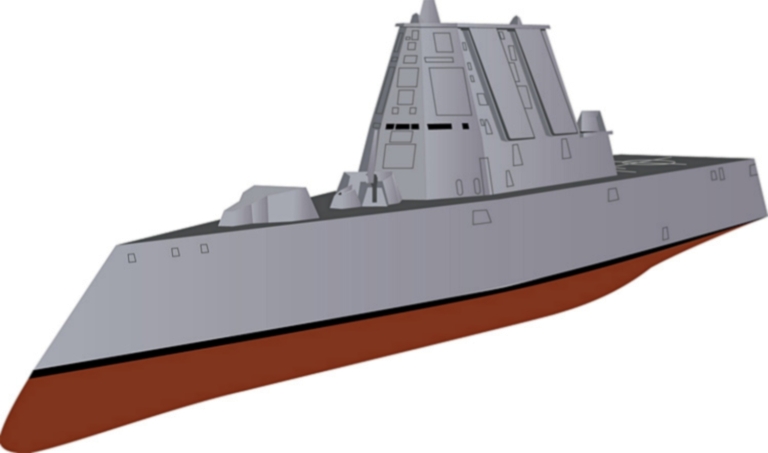
will be paralleled in stealth shaping techniques. Trialled originally
in the Lockheed Sea Shadow program during the 1980s, stealth techniques
are to be used full scale in the new US Navy DD(X)/CG(X) family of
12,000 tonne class warships. These vessels will have no exposed masts,
a tall faceted superstructure will carry all antennas flush mounted in
the skin panels. The result will be a warship which is much harder to
detect on radar, especially if microwave absorbent or lossy coating
materials are exploited. While absorbers can be used to reduce the
signature of conventional warships, the results cannot compete against
a design shaped for stealth from the outset. Stealth of this quality
must be designed in from the outset, as with combat aircraft, and shape
alone will account for much of the gains seen.
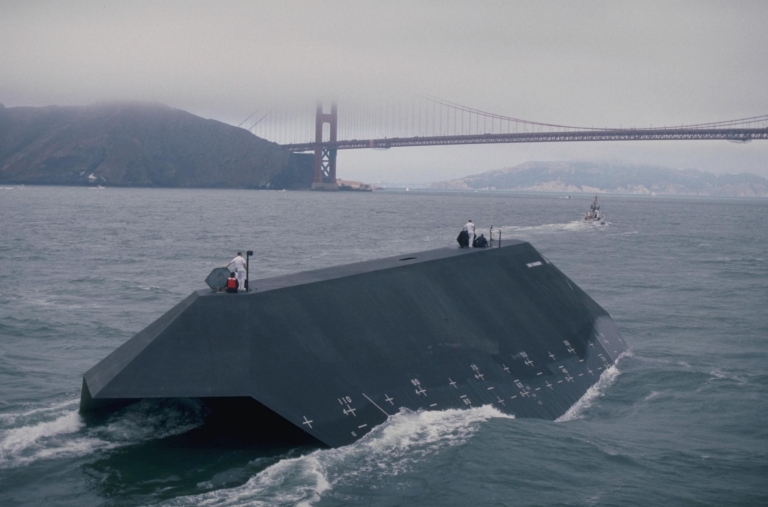
Lockheed's 1980s Sea Shadow technology demonstrator was the first ever stealth warship. Anecdotes from the period claim it was so stealthy, it could be detected as a black hole in the ocean wave clutter background (Lockheed-Martin).
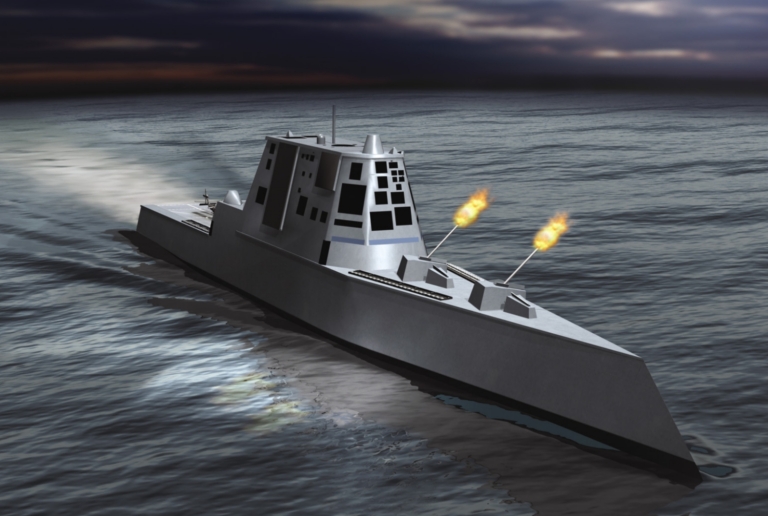
The US
Navy's
new 12,000 tonne class Northrop-Grumman DD(X)
destroyers will be the first of a new generation of surface combatants
incorporating a wide range of technological innovations. Two of these
are of particular interest. The first is the integrated dual band
radar suite combining the active phased array X-band SPY-3 MFR and
S-band Volume Search Radars, both sharing a common back end for antenna
control and processing. The SPY-3, also planned for the CG(X) and a
wide range of larger vessels, is designed to defeat saturation missile
attacks. The wave piercing hull shape and superstructure is designed
for stealth from the outset, resulting in a much lower radar signature
than any current warships (US Navy/Northrop-Grumman).
Given the enormous investment of taxpayer's funds about to be sunk into the Air Warfare Destroyer project, some fundamental questions must be asked: We are at the beginning of a major and radical transition point in naval surface combatant technologies, a transition which cannot be crossed by evolutionary modification or upgrades of existing designs, yet the program implementation as it stands is centred in technologies many of which date back to the 1970s. Why must the program follow the current timeline? Why can it not be deferred to encompass designs exploiting DD(X)/CG(X) generation technologies? With Westralia, Tobruk, Manoora and Kanimbla coming due for replacement, there is ample work for the domestic industry regardless of AWD timelines. Why is the warship to be optimised around providing long range air defence cover and ballistic missile defence cover, when clearly the dominant threat to warships, transport shipping and amphibious landings over coming decades will be in low flying cruise missiles, which the region is already awash in? Indeed, if the warship is to be effective at all in its stated primary roles of defending other vessels and amphibious landing sites, then it must be equipped with an X-band active phased array in the class of the SPY-3 or APAR systems, designed from the outset to stop saturation sea skimming missile attacks. Given the radar horizon constrained low altitude coverage limitations of a long range radar on a warship, why is so much investment being put into a capability with inherent limitations, while only four Wedgetails are planned, despite these providing the low altitude surveillance coverage equivalent to dozens of warships each? There is no doubt that the RAN will need a new class of surface combatant to replace the older FFGs, and there is no doubt that this vessel will need to be highly survivable in the most competitive maritime warfighting environment worldwide. The current AWD program is misdirected in its role optimisation, and poorly thought out in its choice of technologies. A very good case can be made for the AWD program to be delayed by at least a half decade to permit the incorporation of modern low observable hull technology, and the latest X-band active array technology, preferably in a smaller and more affordable hull. If SEA 4000 materialises in its current form, the RAN will be burdened for the next three decades with the last of a generation of technologies, with a design ill adapted to the developing realities of regional maritime warfare. |
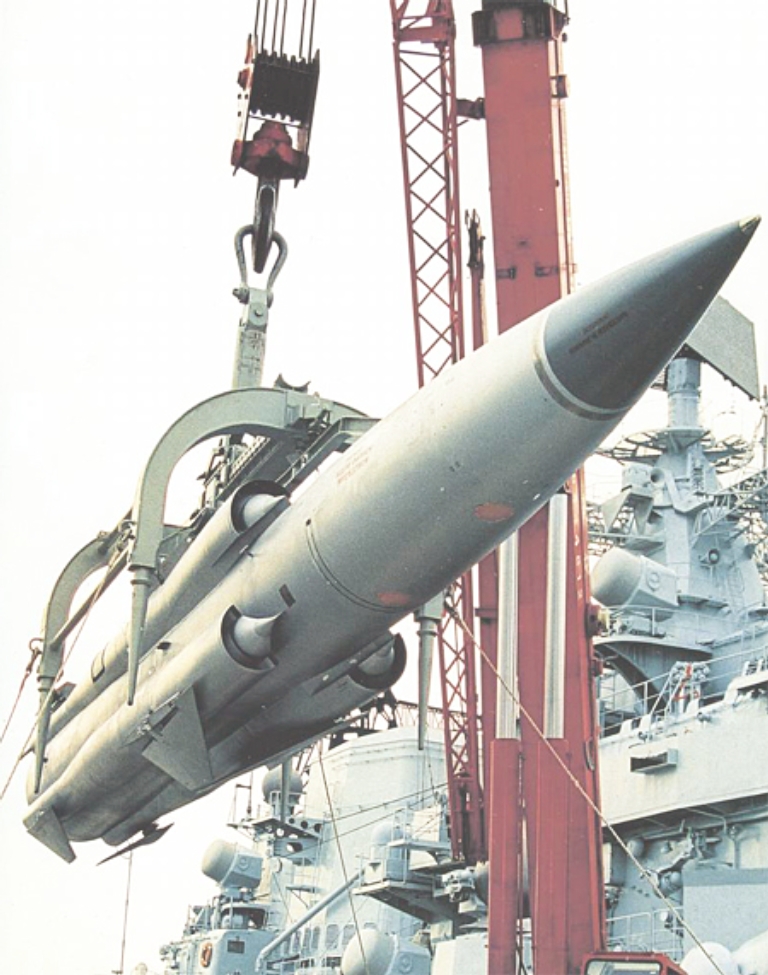
3M-80 / SS-N-22
Sunburn (PLA-N Image)
|
Imagery Sources: US DoD, Author, PLA-N Line Artwork: © 2004, 2007 Carlo Kopp |


|
|||||||||||||
|
|
|
|
|
|
|
|
|
|
|
|||
|
|
|
|
|
|
|
|
|
|
|
|||
 |
|
|
|||||||||||
| Artwork, graphic design, layout and text © 2004 - 2014 Carlo Kopp; Text © 2004 - 2014 Peter Goon; All rights reserved. Recommended browsers. Contact webmaster. Site navigation hints. Current hot topics. | |||||||||||||
|
Site Update
Status:
$Revision: 1.753 $
Site History: Notices
and
Updates / NLA Pandora Archive
|
|||||||||||||
|
|
Tweet | Follow @APA_Updates | |||||||||||
|
|
|||||||||||||
|
|
|||||||||||||