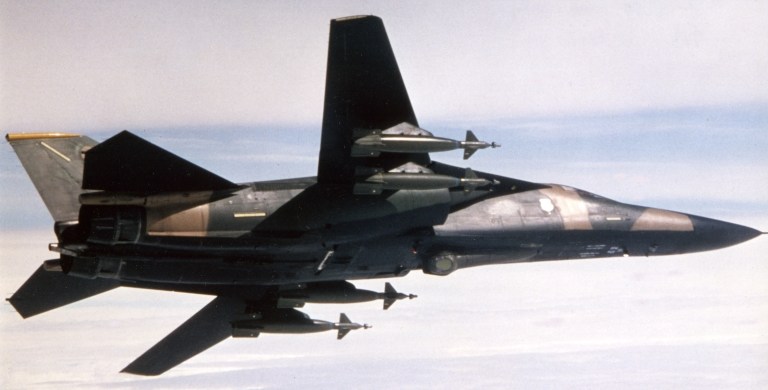
|
||||||||||||||||||||||
 |
||||||||||||||||||||||
![F-22A Raptor, FB-22, F-22E, F-22N and Variants Index Page [Click for more ...]](APA/f-fb-22.png "F-22A Raptor, FB-22, F-22E, F-22N and Variants Index Page [Click for more ...]") |
 |
![People's Liberation Army Air Power Index Page [Click for more ...]](APA/pla-air-pwr.png "People's Liberation Army Air Power Index Page [Click for more ...]") |
 |
 |
 |
 |
 |
 |
![Military Ethics, Culture, Education and Training Index Page [Click for more ...]](APA/ethx-culture.png "Military Ethics, Culture, Education and Training Index Page [Click for more ...]") |
 |
||||||||||||
 |
![Russian / Soviet Weapon Systems Index Page [Click for more ...]](APA/rus-weps.png "Russian / Soviet Weapon Systems Index Page [Click for more ...]") |
 |
 |
 |

|
 |
 |
 |
 |
 |
||||||||||||
 |
 |
|||||||||||||||||||||
| Last Updated: Mon Jan 27 11:18:09 UTC 2014 | ||||||||||||||||||||||
|
||||||||||||||||||||||
|
||||||||||||||||||||||
|
||||||||||||||||||||||
|
|
|
|
|
|
|
|
|
|
|
||||||||||||
|
|
|
|
|
|
|
|
|
|
|
||||||||||||
|
|
|||||||||||||||||||||
| Last Updated: Mon Jan 27 11:18:09 UTC 2014 | ||||||||||||||||||||||
|
||||||||||||||||||||||
| F-111
UPDATE Parts 1 and 2 |
||
|
||
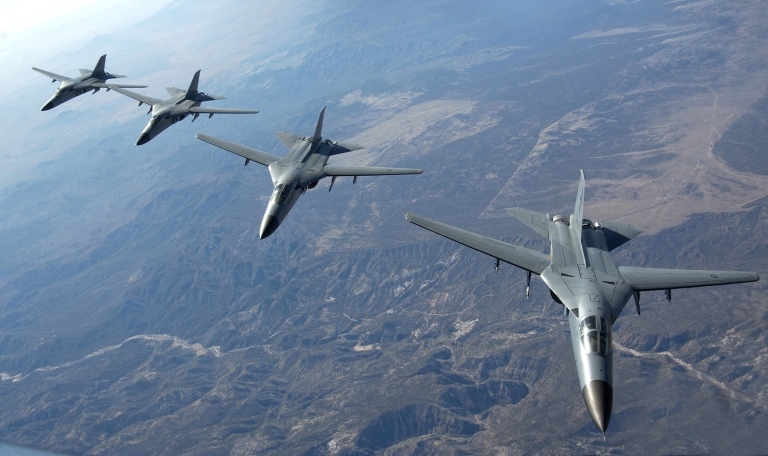 Part 1 The Present
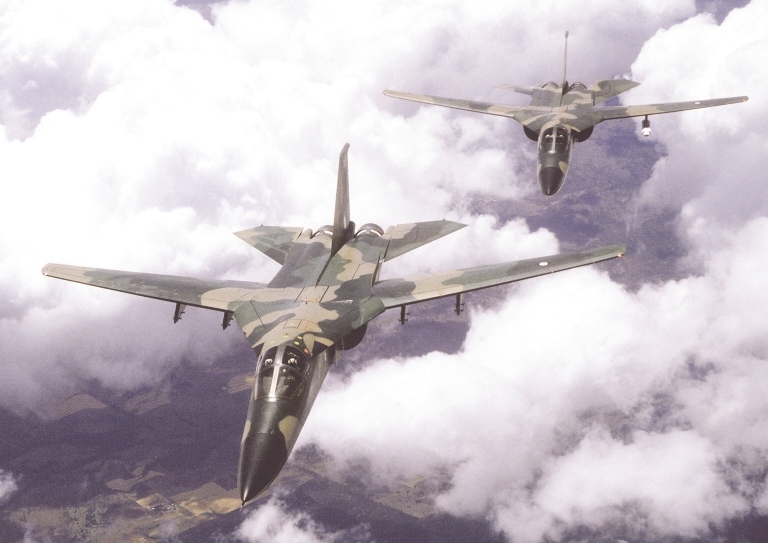
When the Menzies government ordered 24 General Dynamics F-111C tactical fighters in the early 1960s, little could it have anticipated either the longevity or the long term strategic impact of this purchase. Almost four decades later, the F-111 remains as the ADF's single most potent asset and the strategic pillar of the RAAF's force structure. The F-111 is the ADF's sole means of rapidly projecting credible firepower at large distances, and with its significant loiter performance in supporting ground troops, the nearest asset in the ADF inventory to the USAF's B-1B and B-52H fleets. At this time the RAAF operates, nominally, 17 F-111C aircraft, 4 RF-111C aircraft and 14 former USAF F-111G aircraft, the latter FB-111As subjected to the removal of nuclear strike capabilities during the Avionics Modernisation program. Some proportion of the F-111G fleet is mothballed, with the remainder used primarily for training. The F-111 is in many respects the RAAF's most heavily
committed asset, in roles and missions. While the political debate
around the aircraft paints it as a strategic land strike and maritime
strike capability, the reality is that in wartime it would be used as
much for basic battlefield interdiction and close air support as it
would occupy its more politically visible roles. Since the RAAF fielded the F-111C, the fleet underwent a
range
of upgrades and changes. The first was the retrofit of four F-111C into
RF-111C configuration, with a weapon bay pallet containing an AN/AAD-5
IR Linescanner, panoramic and stereo framing cameras. Soon after, the
remaining F-111Cs were retrofitted with the Ford Aeronutronics
AN/AVQ-26 Pave Tack thermal imaging and laser targeting pod, common
only to the USAF F-111F model, and configured to launch the AGM-84
Harpoon sea skimming anti-shipping missile. During the 1990s the fleet
was digitised with the Avionics Upgrade Program (AUP) which saw the
removal of the obsolete analogue AJQ-20 bombing and navigation system
with a fully dual redundant derivative of the USAF's Pacer Strike
upgrade for the F-111D and F-111F models, but also the replacement of
the expensive to run mechanical flight control system with the Digital
Flight Control System (DFCS) introduced under the USAF AMP effort. With
the Keating government acquiring 15 F-111Gs in 1992, to beef up total
numbers and spread flying loads, and four attrition replacement F-111As
rebuilt largely into F-111C configuration, the RAAF has gone through a
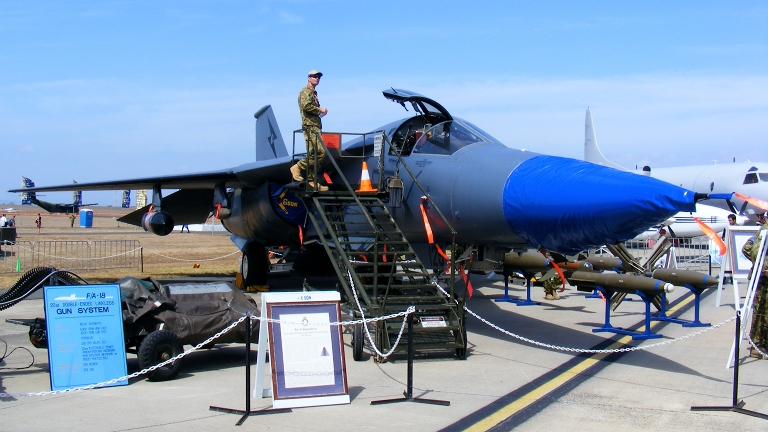
very complex learning process with the aircraft. 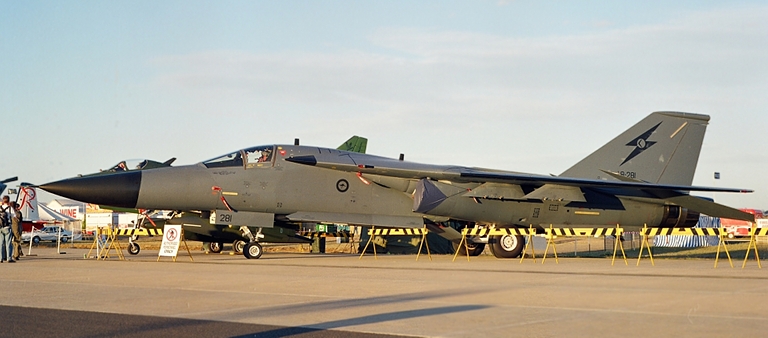 F-111G
A8-281
on
display
at
Avalon
in 1995 (© 1995 - 2010 Carlo Kopp).
The Defence 2000 White Paper is in many respects written around the F-111, as its regional and maritime control strategies pivot around the use of tanker supported and escorted F-111s. The strategic paradigm is based upon the denial model - render the land and maritime environment to Australia's north and north-west unusable to any regional aggressor as a staging area for attacks on Australian territory or operations inimical to Australia's national interest in the region. The White Paper makes explicit commitments to provide boom equipped aerial refulling for the F-111, and install a new Electronic Warfare Self Protection (EWSP) suite, or RWR/DECM/MAWS package. Why the White Paper paradigm is centred upon the F-111 is simple - it carries 34,000 lb of internal fuel, thus making it a frugal consumer of aerial refuelling resources inside a 1,000 NMI radius of Australian continental runways. While the White Paper commits to up to 5 new boom equipped tanker aircraft, the funding pressures since 2001 would suggest that these may be acquired very late against planning of two years ago. A robust tanker fleet implementation meeting the White Paper capability goals would require between 16 and 20 KC-767-200 sized tanker aircraft, assuming the use of the F-111, something which the incumbent government and DoD have yet to address in long term planning. With less than that number of tankers, the F-111 becomes a do-or-die capability for the ADF even with less ambitious national goals than those defined in the White Paper. The USAF mothballed its last F-111F strike variant in 1996, under significant political pressure to downsize its tactical fighter fleet and consolidate types to simplify support - under the threat of funding cancellation for the vital F-22A, planned to replace the F-15C and expected to later replace the F-15E. Around 220 F-111A, F-111E, F-111D, F-111F, F-111G and FB-111A aircraft remain mothballed at the US AMARC facility. The last USAF F-111 variant to go into storage was the superlative EF-111A Raven tactical jammer, of which around 30 remain. Its retirement in 1998 remains a source of controversy in the US, with the overtaxed EA-6B Prowler suffering severe overwork since then with commitments in Iraq, Yugoslavia and most recently, Afghanistan, burning out airframe fatigue life. Since 1998 Australia has remained the sole operator of the F-111, the USAF dismantling the large Sacramento overhaul depo after that date. Current ADF planning envisages the retirement of the F-111 in the 2015-2020 timescale, a somewhat arbitrary number arguably devised to allow follow-on purchases of whatever fighter is chosen under the AIR 6000 program. AIR 6000 aims to replace the increasingly strategically irrelevant F/A-18A with a new capability for maintaining air superiority. As the sole operator of the F-111, the RAAF had to replicate within Australia the whole support infrastructure previously maintained by the USAF. This not only required expansion of the software development and weapon system support facilities, but also required the expansion of fuel tank deseal/reseal facilities and the construction of a Cold Proof Load Test (CPLT) facility. The latter is used to chill the tested airframe down to sub-zero temperatures and stress test it using large hydraulic rams to ensure that fatigue crack propagation in the critical D6AC steel load bearing components does not impair structural integrity. CPLT has been used since the early 1970s to validate the health of the USAF and RAAF fleets. Until recently the RAAF maintained the F-111 using the classical logistical support philosophy, whereby failed components were replaced with identical off-the-shelf stock sourced from manufacturers in the US and Australia. This model, devised during the Cold War, is tied to the availability of a large industry support base, large spare parts manufacture volumes and the funding depth to pay for it all. This model works well with large fleets, preferably remaining in production. For a small fleet it incurs prohibitive costs, and is not well suited to older aircraft no longer in production. Last year the RAAF shifted to a more economical and relevant support model, employing an engineering support philosophy. In this model, a commercial contractor performs the depot maintenance and will engineer out specific components which incur very high failure rates and replace these with alternatives, using current rather than 1960s/1970s production technologies. This is not unlike the support model used by the USAF for types like the B-52H and U-2S. The value added in this approach should not be underestimated - even small components like cable harnesses, connectors, fasteners or valves which fail often or wear out rapidly can seriously impair the reliability of a complex system like an aircraft and produce disproportionate effects against the cost of the component itself. Every hour an aircraft is unflyable is an hour where costs are accrued but no return on investment is generated. The new Weapon System Business Unit (WSBU or whizboo) is operated by Boeing Australia and employs a team of 120 engineers, 11 software developers and further support personnel who in effect replace most of the previous RAAF 501 WG. The RAAF performs its own flightline and deployment support of the aircraft. The WSBU absorbs the Weapon System Support Facility (WSSF) which comprises the system integration and software development facility and personnel. The WSBU/WSSF is unique in Australia, and provides a world class capability in that it allows the RAAF to integrate new weapons and systems in the F-111, but also to refine and improve the aircraft software. Boeing and 501 WG developed a technique of overlapping the prototyping/test phases for F-111 modifications and upgrades, and the progressive fleet modifications, with scheduled depot maintenance tasks on the F-111 aircraft. This is formally termed the Block Upgrade Program (BUP). In this manner, aircraft which are scheduled for depot work come out with a block upgrade performed in addition to the planned maintenance tasks. Since all aircraft are repeatedly cycled through the depot after several thousands of hours of operation, this model minimises the number of aircraft which are in the depot for upgrade modification work. This strategy is now a central part of the new WSBU model. The complexity of the integration and design effort currently in progress on the F-111 has no precedent in Australia and is comparable to work done in the US, UK, France, Germany or Israel. Australia has not been a serious player in this game since the days of the Avon Sabre, and the F-111 Block Upgrade Program is the first serious domestic systems engineering program seen for many decades. It will provide immeasurable long term benefits in producing a pool of engineering experience and knowledge only seen to date overseas. The BUP encompasses the currently planned and previously completed package of upgrades to the F-111:
This series of block upgrades will bring the F-111's core avionic and EWSP systems up to the same standard seen in new build combat aircraft such as the F-15E+, F/A-18E/F, F-16C/B60 or Typhoon, replacing a large proportion of the established seventies technology avionics with state-of-the-art digital equipment. The only remaining analogue components will be the radar package and cockpit instrumentation. What is of key long term importance is that this further phase of systems digitisation will result in a highly maintainable and very reliable core avionic package which will be supportable until at least 2020. The value of the upgrades performed under the BUP cannot be understated, as these provide the F-111 with an avionic system capable of ongoing longer term incremental evolution. The RAAF deserves much credit for this farsighted strategy - the alternative would have been spiralling costs and poor reliability. Part 2 will explore future options for the F-111 fleet.
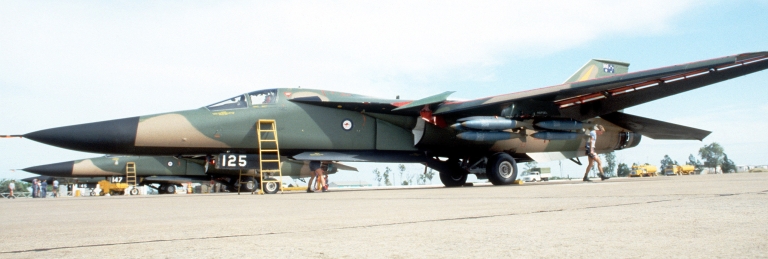
A8-125
on display, Avalon 2009 (© 2009 Carlo Kopp).
Part 2
The Future
The Defence 2000 White Paper envisaged that the F-111 will most likely be retired in the 2015-2020 timeframe, as this could allow the RAAF to replace it with further examples of the fighter chosen for the F/A-18A replacement, but also since the existing pool of engines and engine spares was at that time expected to run out of life in two decades. Engines and Structures The F-111C and F-111G are at this time being retrofitted with new TF30-P-108/9 engines salvaged from the US Air Force F-111D and EF-111A fleets in AMARC. As the F-111G has a unique tailpipe, the P-108 variant of the P-109 was devised, combining an F-111G angled tailpipe with a P-109 engine. This engine is more durable than the old P-103 and delivers better thrust, especially at altitude. Much of the effort in establishing the feasible life of the engines and the airframe structures is being performed by DSTO's Melbourne Laboratories, under the F-111 Sole Operator Program (SOP). The SOP aims to identify structural, propulsion and system components which will or might not last the distance and devise technological fixes to permit the F-111 to fly until 2020. The DSTO SOP will not be fully completed until 2004, however the program has already yielded important findings and cost saving modifications. By the time of writing DSTO had devised modifications to the TF30 combustors, revisions to rotating part inspection and replacement protocols and validated a change in fuel (JP8-100) all of which will permit the existing pool of engines to last at current flying rates until 2020, or perhaps beyond (reports suggest the engine TBO was doubled). The RAAF's safety margin in propulsion is further enhanced by the availability in AMARC of around 80 sets of TF30-P-100 engines in the mothballed F-111F fleet - providing almost double the life available in the existing RAAF pool of engines. In the domain of structures, the F-111 also appears to be in very sound condition, despite incessant mass media reports suggesting the aircraft's imminent structural collapse! While DSTO have yet to release their full findings, early results would indicate that the fuselage structure will remain sound until at least 2020. Some stress corrosion has been found in the forward main fuel tank secondary structure, resulting from poor manufacturing technique when the aircraft were originally built, however it is not clear that this will in any fashion impair the aircraft's integrity. The incident in mid 2002 when arcing in an aged fuel tank cable harness caused an explosion in A8-112, resulting in a large hole being blown out through the fuel tank floor / bomb bay roof, saw these very structural components cope without difficulty. A8-112 is one of the oldest aircraft in the fleet. The principal concern at the outset of the SOP was the wing structure, and especially the crack prone D6AC steel Wing Pivot Fittings (WPF), via which the aluminium alloy wings attach to the D6AC Wing Carry Through Box (WCTB). The WPFs were implicated in a number of US structural failures in the early life of the aircraft, and the F-111's wings are generally considered the most critical component of the aircraft, in fatigue terms. DSTO devised a series of modifications to the WPFs to remove stress cracked material, yet also redistribute the stress in the component. The result is that WPFs modified in this manner are not only returned to defacto new condition, but they are also unlikely to develop fatigue cracks in future usage. The modification remains in test. In early 2002 the F-111 was grounded as a result of a DSTO wing test article breaking in a fatigue test. This precautionary measure reflected the conservative four fold safety factor used by RAAF engineers - the fleet was hardly likely to fall out of the sky despite media suggestions otherwise. While full details of the test failure are not yet available publicly, it is known that the wing failed in an outboard section. Such a failure would most likely result from a crack formed around a Taperlok fastener, large numbers of which are used to hold the wings together. A poorly toleranced hole for the Taperlok will produce exactly this effect - a problem which can be rectified by reaming out the hole and fitting an oversized fastener. The RAAF's response to fatigue life limitations in the original wings has been pragmatic - buy up stocks of low time wings pulled off US Air Force F-111s mothballed at AMARC, refurbish these, retrofit FB-111A/F-111C extended wingtips and replace the original wings. Most of the RAAF's original wings had in the vicinity of 5000-6000 flight hours accrued - while wings recovered from AMARC at a cost in the low tens of thousands of dollars may have less than 3000 hours on the clock. With around 50 F-111D shipsets and around 70 F-111F shipsets available the supply of wings is likely to last a very very long time (one F-111D went to the smelter with around 2,500 hours on its airframe). The F-111's swing wing arrangement yields one important benefit over most other types - a refurbished wing set can be retrofitted in about 3 days by a skilled crew unlike other types where many weeks of structural disassembly and reassembly may be required. It is worth noting that significant flight hours can be further added to all F-111 wings by performing large scale Taperlok reworks and the DSTO WPF modification - for all practical purposes the RAAF has the means to push the structural life of the F-111 significantly beyond 2020. The option also exists of manufacturing new F-111 wing components - with modern NC techniques potentially at lower cost than the originals, and with higher quality. Replacement of fuselage structural or functional components with newly manufactured parts is being already performed for several items. With proper management and selective structural rebuilds, there are no fundament obstacles to pushing the F-111 airframe out to 2040 as the US Air Force intend to do with their B-52H and B-1B fleets. Another interesting dividend from the SOP is the DSTO devised technique for reverse engineering the sometimes corrosion prone aluminium honeycomb panel skins which clad the fuselage and tail surfaces. Flight trials planned for this year will validate new build carbonfibre composite replacement fuselage skin panels. While much of the media (and DoD internal) catastrophising about the F-111 has been focussed on the aircraft's structure, it is actually in many respects in better shape than the F/A-18A fleet and cheaper to life-extend. Given the range of DSTO devised fixes and AMARC spares available, it is clear that structures and propulsion are unlikely to limit the life of the F-111 any time soon. A more likely cause of premature F-111 retirement will be bureaucratic politicking over budgets which seems to characterise the climate in Canberra these days. Avionics and Systems In practical terms the area where the F-111 will require some investment in coming years is the remaining package of 1960s derived analogue technology in the aircraft. The 1990s Avionic Upgrade Program (AUP) and follow-on Block Upgrade Program (BUP) have seen analogue era technology largely purged from the aircraft's weapon system and core avionics. The White Paper mandated EW upgrade is expected to replace the ALR-62(V)6/7 warning reciever and interim EL/L-8222 jamming pod with newer technology. There are compelling practical reasons for getting rid of the remaining analogue components of the avionic suite.
A popular view in some Canberra circles is that the F-111 should be replaced with a brand new interim fighter (depending on which lobby one looks at, this might be an EF2000, F/A-18F or F-15E/K) since the latter will be cheaper to operate. This is a curious viewpoint insofar as the incremental cost of replacing the remaining high support cost analogue hardware in the F-111 is but a tiny fraction of the cost of replacing the F-111 fleet. The only explanation for this viewpoint is that its Canberra proponents have not sat down with a calculator and run the required numbers. Given that most of the would be interim fighters would need to be bought 2 for 1 to fully replace the capabilities in the current F-111 fleet, the economics of this approach beg some serious scrutiny. Three key analogue avionic component areas are relevant. These are the steamgauge cockpit, the AN/APQ-169/171 radar suite and the AN/AVQ-26 Pave Tack targeting pod - all of which are at this time hot spots in F-111 support expenditures and causes of downtime. The pilot's side of the cockpit is an true artifact of the 1960s, with electromechanical instruments, tape indicators and gyro gunsight, many components of which would not be out of place in a Vietnam era F-105D. Many of these instruments are reaching old age mechanical wearout, and many are prone to moisture ingress. The navigator/WSO's side of the cockpit fairs marginally better, with a 1970s technology monochrome CRT Virtual Image Display (VID) for the Pave Tack, and 1980s CRT based MultiFunction Displays. The result is an incrementally grown hybrid with a high failure rate and very limited ability to support modern weapons and mission software. For instance current air to air missiles usually rely on HUD targeting, while colour data fusion displays which overlay RWR tracks, radar tracks, JTIDS/MIDS/Link-16 tracks over moving maps are simply not implementable - despite the significant computing power being fitted under the Block C-4 upgrade. Glass cockpit retrofits are the preferred approach in other aircraft for dealing with the dual impediments of unreliable and inflexible analogue cockpits. Much available technology exists in the market, including smart displays with built in analogue interfaces and analogue/digital converters - defacto drop-in replacements for analogue instrument clusters. A modern Active Matrix Liquid Crystal Display (AMLCD) may have a MTBF (Mean Time Between Failure) of thousands of hours, in effect yielding a hundredfold improvement in support costs/downtime over the analogue relics it replaces. Current wisdom is that a glass cockpit retrofit typically pays for itself in 3-5 years in maintenance savings alone. Available technology includes a wide range of AMLCD panel sizes, including large 14 inch to 17 inch diagonal displays based on industry standard computer displays. An AMLCD based retrofit for the F-111 could incorporate any combination of 4 inch, 6 inch, 6 x 8 inch, 14 inch or larger off-the-shelf Milspec rated AMLCD panels. The existing gunsight (ASG-29 LCOS) is seldom used, and limited in capability. While replacement with a new technology HUD is feasible, providing redundant primary flight instrumentation and the ability to credibly support the new ASRAAM, it could prove expensive due to the geometry of the windshield. A cheaper alternative appears to be the salvage of F-111D SU-46 HUDs from AMARC - replacement of the internal CRT and electronics is a relatively economical task yielding a drop in HUD replacement for the original gunsight. On the navigator/WSO's side of the cockpit the principal change would involve replacement of the old tube based VID display with a newer high resolution colour display, be it AMLCD or other. Digitising the cockpit with flat panel displays thus yields a vastly more reliable and cheaply supportable arrangement which removes all cockpit resident impendiments to integrating any new digital Mil-Std-1760 weapons. Targeting Sensors The F-111's existing radar package comprises an AN/APQ-169 attack radar used for blind bombing, navigation and air-air missile targeting, and an AN/APQ-171 automatic Terrain Following Radar to facilitate high speed low level penetration. Both radars use mechanically steered gimballed reflector antennas, mounted on a roll stabilised antenna pedestal. This package was the pinnacle of mid 1960s tactical radar technology, and migrated upward into the early B-1A prototypes. The F-111's radar package underwent several incremental reliability upgrades, but is expected to become increasingly expensive to support in coming years, especially due to wearout in moving parts. The radar's signal processing capabilities are relatively primitive in comparison with the pulse Doppler radars being fitted to current fighters - integration of functions such as Synthetic Aperture Radar high resolution imaging, or look-down pulse Doppler air-air tracking is virtually impossible. The latest generation of fighter radars, which use Active Electronically Steered Array (AESA - often termed phased array) technology and digital processing, are as far removed from the F-111's analogue technology as the latter is removed from WW2 radar technology. With no moving parts, AESA based radars have typical failure rates a factor of ten smaller than analogue radars, in turn yielding a close to tenfold reduction in support costs. For all practical purposes such AESA radars need a repair once in several years. While the savings in support costs and reduced downtime would justify the typical US$2.5M unit radar cost and extra integration costs to retrofit it, the economic arguments are arguably less important than the capability arguments. This generation of radars typically comes with a full package of built in pulse Doppler air-air modes for the ASRAAM and AMRAAM missiles, and visual delivery modes for dumb bombs and other unguided weapons. More importantly, these radars characteristically include a package of high resolution Synthetic Aperture Radar (SAR) imaging modes and Ground Moving Target Indicator (GMTI) modes, in addition to classical real beam mapping modes. The AESA in most designs permits these modes to be interleaved, thus allowing the pilot to search for aerial threats and the navigator/WSO to prosecute an weapons delivery. The new AGM-142 SOW, the AGM-158 JASSM, the extended range winged GBU-31/38 JDAM-ER and the baseline GBU-31/38 JDAM would all benefit immeasurably from such a radar, as it would permit these weapons to be targeted through an overcast at ranges exceeding the range of the weapon. Moreover, most such radars include internal provisions for a digital data storage device to facilitate recce work - a radar with 12 inch imaging resolution is a competitive all weather recce sensor. A retrofit of recce data store equipped radars to the whole F-111 fleet would transform it into a dual role fleet - recce then becomes a tasking issue rather than payload configuration issue. Other gains accrue from an AESA retrofit. One is that the multiple square metre class nose area radar signature can be dramatically reduced, possibly tenfold or better with a well thought out design. The issue of terrain following bears some examination. Both the F/A-18E/F's APG-79 and F-16C/B60's APG-80 AESA radars will incorporate embedded terrain following functions, interleaved with other modes - a scheme currently used both in the B-1B's APQ-164 and the B-2A's APG-181 ESA radars. Compared to the existing APQ-171 TFR an AESA can produce a narrower beam, lower peak power at the same detection range, and hundredfold or smaller sidelobes. Therefore an AESA based TFR is more capable but also much less detectable by an opponent compared to the relic currently flown in the F-111. An AESA would remove many of the tactical limitations of the existing TFR system - using a single fixed antenna shared with the attack and air-air functions. There is a compelling case for an AESA retrofit, both on reliability / support cost grounds and operational capability grounds. An AESA would transform the capabilities of the F-111. The AVQ-26 Pave Tack targeting pod is carried on a rotating bomb bay cradle, and is used to visually acquire targets for laser illumination and bomb delivery. It is the only targeting pod in service which is retractable, thus permitting the F-111 to egress at supersonic speeds with no drag penalty. The Pave Tack despite its age remains one of the most capable targeting pods in use. It has a field of regard superior to all modern pods, especially in the aft hemisphere which is vital for toss bombing. Its unique optical head design, combining a movable platform and movable lightweight mirror, provides sightline jitter stabilisation equal to or superior to the latest pods in the market - no mean feat for a 1975 design. The Pave Tack's limitations lie not in its superb optical architecture and configuration, but in the obsolescent components used internally. The IBM pi series pod computer is a true relic, as is the Texas Instruments AAQ-9 mechanically scanned longwave thermal imager. The refrigerator is not as reliable as newer designs, and much of the pod electronics are obsolete. A common argument is that the Pave Tack should simply be replaced with a new pod, many of which are available in the market. However, doing so would cause the loss of many of the Pave Tack's unique advantages, such as image stability, field of regard, and drag free internal carriage. An arguably much cheaper alternative is a direct upgrade of the Pave Tack, replacing problematic internal components with new technology replacements. The volume of the existing AAQ-9 thermal imager is so great, that it could be replaced with a multiple band imaging package with volume to spare. The existing pod computer could be replaced with a range of vastly more powerful VME based solutions, similar to the Block C-4 System Integration Processor. It is worth noting that there is no comparison between the picture quality or reliability of a 1960s thermal imager, against modern single chip staring array imagers. The technological advances in this area are of a similar magnitude to those seen in radars - vastly more capability and reliability, at a fraction of the cost. The TV band imaging chips used in a number of current pods cost mere thousands of dollars apiece. The large internal volume of the Pave Tack and the exceptionally well designed optics and stabilisation system raise other interesting possibilities. Perhaps the most important is that a Pave Tack retrofitted with new imaging and computer technology and supplemented with a internal digital storage package could double up as a highly competitive optical imaging recce pod. As with an AESA retrofit, this would convert every Pave Tack equipped F-111 into a dual role strike/recce asset. Yet again recce would become a tasking issue rather than configuration issue. The economies in such an approach should not be underestimated - there are no genuine dual role targeting and optical recce pods in the market. Replacing the Pave Tack with two unique recce and targeting pods results in the need to integrate and support two different items of hardware and associated software, and the operational impediment of swapping pods subject to aircraft tasking. As with the AESA retrofit, a compelling case can be made on reliability / support cost and operational capability grounds for a Pave Tack technology insertion program. Conclusions Where does the future lie for the F-111? As it currently appears, the key issues in maintaining the F-111's structure and propulsion to 2020 or beyond have been solved, or are well on the way to being solved in the near future. The principal impediments to the economical operation of the F-111 to 2020 or beyond lie largely in the remaining artifacts of 1960s and 1970s analogue avionics in the aircraft - artifacts which also act as impediments to the full use of the latest weapons and software technologies. For a very small investment compared to the cost of replacement aircraft, the F-111 could be enhanced to be competitive in key respects against the very latest production fighters. The big question which remains is whether the engineering and strategic realities, favouring incremental technology insertion and longer term retention of the F-111, will prevail over the short term focussed budgetary politicking, groupthink driven crisis creation and panacea solutions which seem to dominate much of the DoD's thinking in recent times. We can only hope that common sense will prevail. Editors Note 2005: Sadly the worst
case predictions outlined in this analysis materialised twelve months
after it was written, evidently for all of the predicted reasons. Pictures:
While current thinking in Canberra favours the adoption of the limited JSF as a single type replacement for both the F/A-18A and F-111, the JSF is a high risk program which may run late and may underperform. Ensuring that the F-111 remains viable past 2020 provides robust insurance should the RAAF remain committed to the JSF and difficulties arise. Even should the F-111 be replaced in 2020, insertion of digital technology to replace remaining analogue hardware would much reduce support costs over the coming two decades.
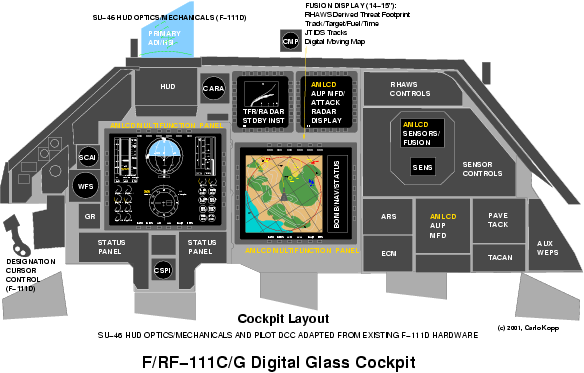 A wide range of options exist for glass cockpit arrangements in the F-111C/G. This diagram illustrates a proposal using two large AMLCD panels and a rebuilt SU-46 HUD from an F-111D (Author).
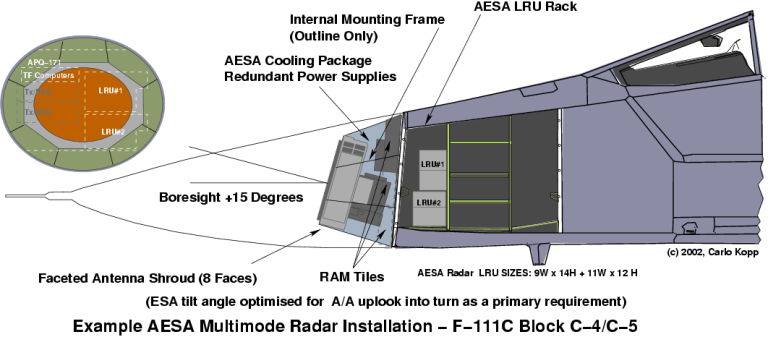
A multimode AESA radar could replace the existing radar package, yet achieve five to ten times greater reliability, and five to ten times lower support costs. A well thought out installation could reduce the radar bay radar signature by an order of magnitude or better (Author).
Despite its age the AN/AVQ-26 Pave Tack still offers sightline stabilisation and field of regard performance superior or equal to the best targeting pods in the market. Replacement of the obsolescent internal thermal imager, computer and other hardware could provide the Pave Tack with competitive reliability and superior imaging performance against production targeting pods, since the unique optical design and low drag internal carriage would be retained. |
||
|
|||||||||||||
|
|
|
|
|
|
|
|
|
|
|
|||
|
|
|
|
|
|
|
|
|
|
|
|||
 |
|
|
|||||||||||
| Artwork, graphic design, layout and text © 2004 - 2014 Carlo Kopp; Text © 2004 - 2014 Peter Goon; All rights reserved. Recommended browsers. Contact webmaster. Site navigation hints. Current hot topics. | |||||||||||||
|
Site Update
Status:
$Revision: 1.753 $
Site History: Notices
and
Updates / NLA Pandora Archive
|
|||||||||||||
|
|
Tweet | Follow @APA_Updates | |||||||||||
|
|
|||||||||||||
|
|
|||||||||||||