|
||||||||||||||||||||||
 |
||||||||||||||||||||||
![F-22A Raptor, FB-22, F-22E, F-22N and Variants Index Page [Click for more ...]](APA/f-fb-22.png "F-22A Raptor, FB-22, F-22E, F-22N and Variants Index Page [Click for more ...]") |
 |
![People's Liberation Army Air Power Index Page [Click for more ...]](APA/pla-air-pwr.png "People's Liberation Army Air Power Index Page [Click for more ...]") |
 |
 |
 |
 |
 |
 |
![Military Ethics, Culture, Education and Training Index Page [Click for more ...]](APA/ethx-culture.png "Military Ethics, Culture, Education and Training Index Page [Click for more ...]") |
 |
||||||||||||
 |
![Russian / Soviet Weapon Systems Index Page [Click for more ...]](APA/rus-weps.png "Russian / Soviet Weapon Systems Index Page [Click for more ...]") |
 |
 |
 |

|
 |
 |
 |
 |
 |
||||||||||||
 |
 |
|||||||||||||||||||||
| Last Updated: Mon Jan 27 11:18:09 UTC 2014 | ||||||||||||||||||||||
|
||||||||||||||||||||||
|
||||||||||||||||||||||
|
||||||||||||||||||||||
|
|
|
|
|
|
|
|
|
|
|
||||||||||||
|
|
|
|
|
|
|
|
|
|
|
||||||||||||
|
|
|||||||||||||||||||||
| Last Updated: Mon Jan 27 11:18:09 UTC 2014 | ||||||||||||||||||||||
|
||||||||||||||||||||||
| E-Bombs
Away! |
| Journal of Electronic
Defense, EC Monitor, March 2003 by Dr Carlo Kopp |
|
Microwave E-bombs designed to electrically destroy or disrupt electronics in computers, communications and other systems, have been widely discussed in the press as a likely feature of a campaign in Iraq. No specifics are available as yet, although some sources suggest the Air Force has adapted a UK design developed for the RAF. An E-bomb would most likely be built to fit a Mk.80 series shape, and mated with a JDAM tailkit. A well designed weapon will flood the target with a GigaWatt class chirped pulse, or short train of pulses, capable of coupling through cables, ventilation grilles or gaps, producing gate punch-though or avalanche breakdown effects in semiconductor electronics. Press disclosures to date suggest that the E-bomb might be used not only for its established role as a first day of the war tool for disrupting C3 and IADS systems, but also as a means of damaging the electrical security and access control systems used on bunkers storing chemical and biological munitions. The latter application is based on the premise that HPM energy will couple into wiring and propagate inside facilities to cause damage deep inside - how successful this application might prove will depend on factors such as the RF lossiness of the cabling, and the power output and frequency of the HPM device. There can be no doubt that unhardened computing equipment, especially COTS hardware, will prove vulnerable to such weapons. Older Soviet era thermionic equipment might be more resilient, but an E-bomb does have the potential to cripple good proportions of any post 1991 digital upgrades to the Iraqi inventory. In terms of deployment means, a range of possibilities exist. Smaller devices could be packaged into cruise missiles, larger devices into established bomb shapes. Two key issues arise for deployment. The first is the need to point the weapon emitter (eg horn) at the target, which favours the use of a guided weapon which can shape its terminal trajectory. The second is the reality that the deliverable energy is bounded by the volume of electrical power generation hardware within the device. Therefore the most likely technique would be a larger guided weapon. One factor which is relevant is the potential for a self kill of the delivery platform by a HPM weapon, favouring solutions with some standoff range or terrain masking of the delivery vehicle. We should not be surprised if a JDAM based E-bomb is deployed with a low level toss profile, not unlike a tactical nuke - although a cruise missile based delivery might also be seen. In assessing the odds of such weapons being used, the key factor will be the maturity of available hardware and the range of feasible targets. Given that very little of substance has been publicly disclosed at this time, we can only speculate as to whether E-bombs will be used, and in what numbers. Should a mature E-bomb be used in combat in respectable numbers, it will represent an important milestone in shifting from physically lethal attack to electrically lethal attack against electronic targets. If used in large numbers, it could produce a crippling effect on a large scale. A recent press interview by former Air Force Chief of Staff Gen. Ronald R. Fogleman discussed aspects of a war plan involving the delivery of around 3,000 guided munitions within the first 48 hours of conflict, a dramatic departure from the Desert Storm campaign in 1991. In that campaign, less than 10% of the munitions delivered were guided, yet these accounted for the majority of the critical damage to Iraq's warfighting capability. The likely upcoming campaign would see more than 75% of the munitions used being guided munition types. By far the numerically most important weapon is likely to be the Boeing GBU-31/32/35 Joint Direct Attack Munition (JDAM), which proved itself convincingly in the Enduring Freedom campaign of 2001, after its initial use during the 1999 bombardment of Serbia. The JDAM kit is currently being produced at a rate of 2,800 rounds per month by Boeing in St Charles, Mo, with public reports of an existing stockpile of close to 6,700 rounds. The munition comprises a standard Mk.83/84 or BLU-109/110/116/118/B warhead fitted with an inertially guided, GPS aided tailkit. Equipped with a Mil-Std-1760 umbilical, the delivering aircraft programs the weapon aimpoint, intended trajectory shape and impact geometry - once released the JDAM is wholly autonomous and oblivious to inclement weather and other traditional impediments to laser and EO/IIR guided munitions. In terms of accuracy, the baseline JDAM is considered a near precision weapon. In practice, techniques such as choosing weapon time on target to coincide with the best possible satellite constellation geometry (GDOP optimisation) can drive the accuracy very close to that of older precision weapons. The Air Force have not disclosed whether the planned Wide Area GPS Enhancement (WAGE) differential GPS facility will be used - WAGE provides accuracies which are in the genuine precision class. A large proportion of the US fighter fleet is now equipped to carry JDAMs, but more significantly, the Air Force heavy bomber fleet is now equipped for JDAM. B-2As carry up to 16 x GBU-31, B-1Bs up to 24 x GBU-31 and the venerable B-52H typically 12 x GBU-31 on external pylons. The combination of a large payload/range and near precision capability has given teeth to the transformation argument in the heavy bombing game - the ability of a single heavy bomber to engage a dozen or more separate aimpoints on a single pass has no historical precedent. The JDAM's nearest contemporary is the Raytheon AGM-154 Joint Stand Off Weapon (JSOW), an inertially guided, GPS aided, gliding submunition dispenser. The baseline AGM-154A with cluster submunitions is likely to dominate production - the anti-armour AGM-154B was reported in LRIP, and the penetrating AGM-154C's BROACH dual charge warhead was successfully tested early 2002. The JSOW has seen limited use to date primarily for defense suppression tasks, permitting the launch aircraft up to cca 20 miles of stand off range. This weapon may be widely used in Iraq. Established guided bombs are also likely to be used extensively. In 1999 the Air Force contracted an Applied Sciences Engineering/Raytheon team to perform a major upgrade on the EO/datalink guided Boeing GBU-15 Cruciform Wing Weapon (CWW) kit stockpile, bringing these up to enhanced EGBU-15 configuration with a GPS receiver, strapdown inertial package and Mil-Std-1760 interface. The EGBU-15 is more flexible, and capable of autonomous all-weather operation should the datalink channel be lost. With the impending loss of the L-band datalink frequencies used by the EGBU-15's AXQ-14 and ZSW-1 pods, the odds are very good that the existing stockpile will be largely expended. The EGBU-15's sibling is the AGM-130 - a rocket boosted derivative of the baseline weapon, which was used extensively in the 1999 campaign. It is also likely to be used widely, especially where standoff range and punch are required. Both the EGBU-15 and AGM-130 are carried only by the F-15E Beagle. Raytheon's Paveway II/III family of Mk.82/83/84 and BLU-109/110/116/118 compatible laser guided bomb kits will be a mainstay of close support and battlefield interdiction work. The basic GBU-10 and -12 variants remain in use, the enhanced GPS equipped EGBU-24 is likely to supplement stocks of baseline GBU-22/B, -24G/B and -27 Paveway III. Like the EGBU-15, the EGBU-24 provides autonomous terminal guidance via GPS should the EO seeker lose the target. The heavyweight in the Paveway III family is the 5,000 lb GBU-28/BLU-113/B bunker buster, often dubbed Deep Throat. Originally carried by the F-111F and first used in Iraq in 1991, this weapon continues to be carried by the F-15E. Based on a modified GBU-24 seeker and GBU-27 tailkit, the enhanced EGBU-28 has a GPS/IMU capability and is reported to have been cleared on the Northrop B-2A's rotary launcher, providing an autonomous GPS aided deep bunker busting capability. The deployment numbers of the new FMU-157/B Hard Target Smart Fuse (HTSF) for the BLU-109/110/113/116 bunker busters are unclear at this time - equipped with an accelerometer, it allows the fuse to be programmed to select a specific cavity within the target for detonation. The original IOC for the HTSF equipped BLU-116/B Advanced Unitary Penetrator (AUP) was March 2003. Recent years have also seen further conversions of retired Air Force Boeing AGM-86B ALCM airframes into the conventional AGM-86C CALCM. This conversion includes a new GPS receiver and a cast explosive warhead fitted to the cavity previously occupied by the nuclear device. This weapon was used initially in 1991, and occassionally since, and is likely to feature in any upcoming air campaign. The WAGE differential GPS system was trialled on this weapon providing a defacto precision capability. The CALCM is carried only by the B-52. The Israeli designed Rafael/LM AGM-142, evolved from the Have Nap / Popeye series, may also be used. Carried by the B-52, this weapon provides EO/datalink guidance and up to 50 NMI of standoff range. Problems observed in 1999 were traced to guidance software and have since been fixed. The Navy is likely to make extensive use of its ship/sub launched BGM-109 Tomahawk cruise missiles, as in previous campaigns. While relatively expensive, the Tomahawk has proven to be a very useful first day of the war weapon for striking fixed targets. Navy F/A-18s are also likely to deliver the AGM-84E SLAM and SLAM-ER, a Harpoon derived shorter ranging cruise weapon. An Iraqi campaign is also likely to see the use of more specialised weapons. The Wind Corrected Munitions Dispenser (WCMD), a kit to provide inertial corrections to SUU-65 TMD cluster dispensers, is apt to be widely used to deliver the Combined Effects Munition (CEM) bomblet and BLU-108/B Sensor Fused Weapon anti-tank submunition. The BLU-116/B penetration warhead may supplement remaining BLU-109/B stocks, and the thermobaric BLU-118/B, another BLU-109/B derivative, is also likely to be used.
|
 |
|
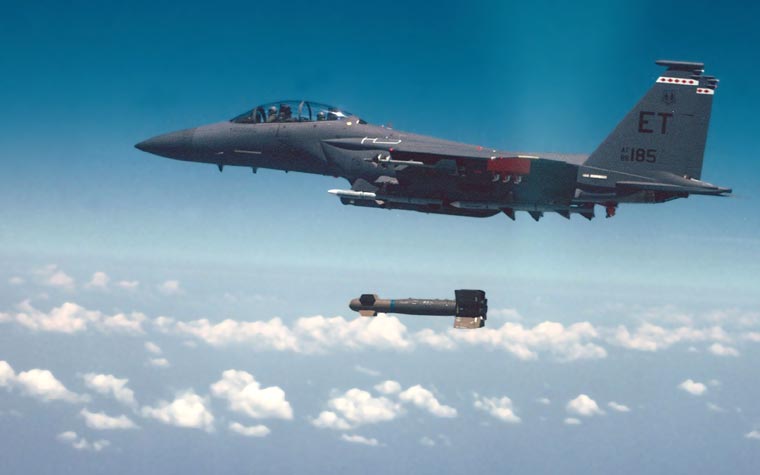
The Air Force rebuilt its stocks of precision GBU-15 glidebombs into the EGBU-15 configuration, to provide additional capability by the addition of GPS and inertial guidance (Air Force). |
 |
|
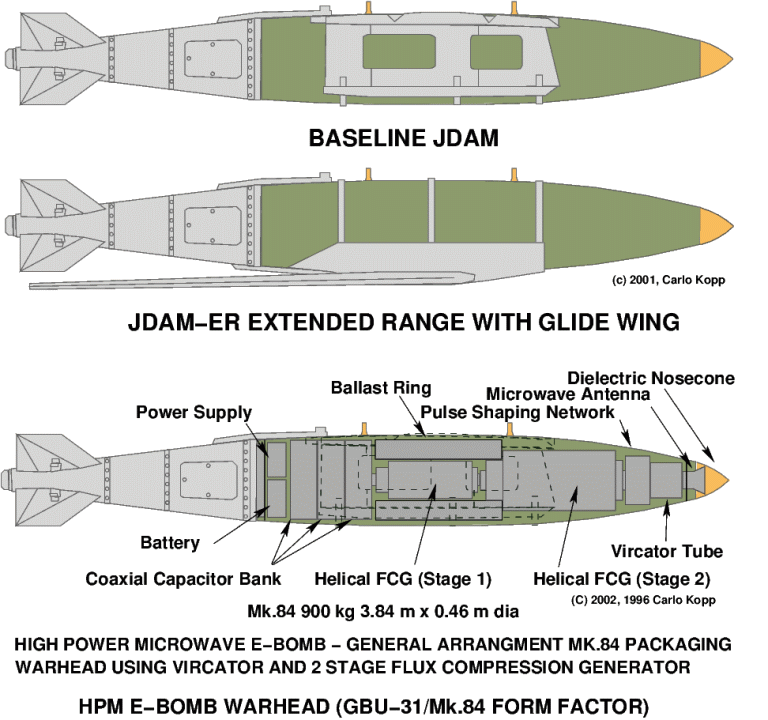
No details on the
deployment means for microwave bombs have been disclosed publicly at
this time. Subject to the type of HPM device used, the weapon could be
integrated with an existing cruise missile, but could also be used with
an existing GBU kit such as the JDAM. The illustration depicts a
feasible internal layout for a Mk.84 form factor E-bomb (Kopp -1996).
|
|
|||||||||||||
|
|
|
|
|
|
|
|
|
|
|
|||
|
|
|
|
|
|
|
|
|
|
|
|||
 |
|
|
|||||||||||
| Artwork, graphic design, layout and text © 2004 - 2014 Carlo Kopp; Text © 2004 - 2014 Peter Goon; All rights reserved. Recommended browsers. Contact webmaster. Site navigation hints. Current hot topics. | |||||||||||||
|
Site Update
Status:
$Revision: 1.753 $
Site History: Notices
and
Updates / NLA Pandora Archive
|
|||||||||||||
|
|
Tweet | Follow @APA_Updates | |||||||||||
|
|
|||||||||||||
|
|
|||||||||||||






