|
||||||||||||||||||||||
 |
||||||||||||||||||||||
![F-22A Raptor, FB-22, F-22E, F-22N and Variants Index Page [Click for more ...]](APA/f-fb-22.png "F-22A Raptor, FB-22, F-22E, F-22N and Variants Index Page [Click for more ...]") |
 |
![People's Liberation Army Air Power Index Page [Click for more ...]](APA/pla-air-pwr.png "People's Liberation Army Air Power Index Page [Click for more ...]") |
 |
 |
 |
 |
 |
 |
![Military Ethics, Culture, Education and Training Index Page [Click for more ...]](APA/ethx-culture.png "Military Ethics, Culture, Education and Training Index Page [Click for more ...]") |
 |
||||||||||||
 |
![Russian / Soviet Weapon Systems Index Page [Click for more ...]](APA/rus-weps.png "Russian / Soviet Weapon Systems Index Page [Click for more ...]") |
 |
 |
 |

|
 |
 |
 |
 |
 |
||||||||||||
 |
 |
|||||||||||||||||||||
| Last Updated: Mon Jan 27 11:18:09 UTC 2014 | ||||||||||||||||||||||
|
||||||||||||||||||||||
|
||||||||||||||||||||||
|
||||||||||||||||||||||
|
|
|
|
|
|
|
|
|
|
|
||||||||||||
|
|
|
|
|
|
|
|
|
|
|
||||||||||||
|
|
|||||||||||||||||||||
| Last Updated: Mon Jan 27 11:18:09 UTC 2014 | ||||||||||||||||||||||
|
||||||||||||||||||||||
| Robot Ravens? |
Journal of Electronic
Defense, September 2002
by Dr Carlo Kopp |
|
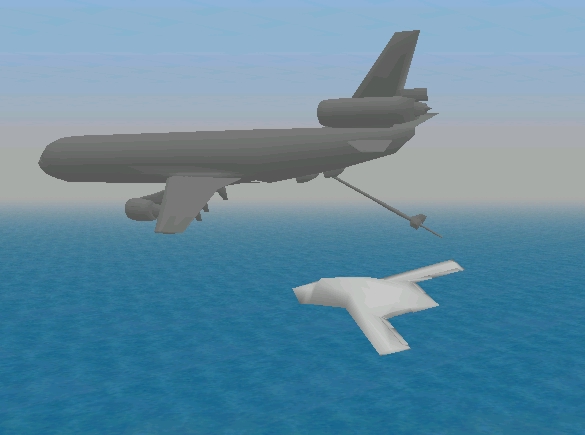
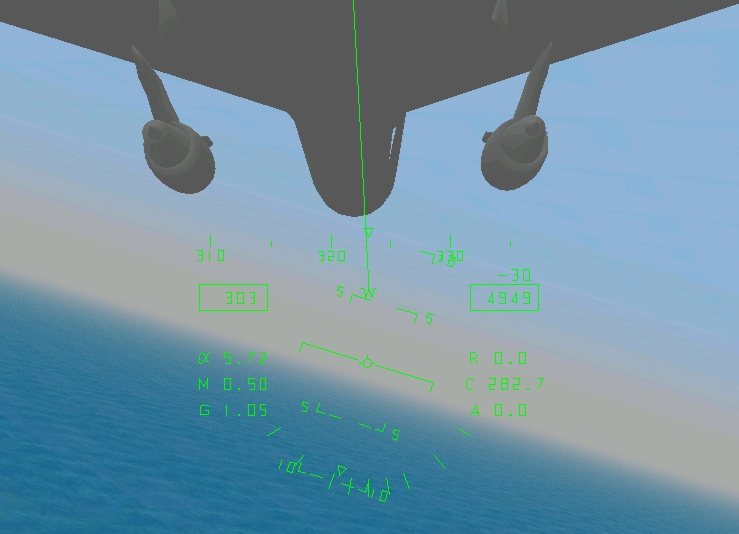
Earlier this year AFRL solicited bids for a research and development program designated the Lightweight Modular Support Jammer (LMSJ). The LMSJ is intended to produce a compact new technology high power jamming system which would permit the scalable integration of jamming packages with varying levels of aggregate power output and band coverage, initially between 20 MHz and 4 GHz. The LMSJ is intended to yield a family of jamming modules suitable for installation in manned aircraft, but also UAVs - in effect a LEGO jammer. The focus of the program will be on back end capabilities - exciters, transmitters and steerable apertures. The statement of objectives for the LMSJ points out the reality that the threat environment faced by USAF warfighters is becoming progressively more severe over time. This is in part due to the gradual proliferation of the mobile Russian/Soviet S-300P/PMU (SA-10/20) and S-300V (SA-12) SAMs in the global market, but also due to the more insidious proliferation of mobility upgrades and modern digital radar/guidance upgrades to older Soviet era SAM systems. Russian and Yugoslav digital enhancements to the very widely used S-75/SA-2, S-125/SA-3 and 9M9/SA-6 can transform these essentially obsolete weapons into yet again formidable elements of a hostile IADS. A recent UK report also details an Iraqi mobility upgrade to the S-125/SA-3, where the classic SA-3 launcher turntable is installed on a 6x6 or 8x8 truck, producing a 3 rail TEL with road mobility, and some off-road mobility. The future threat environment will be characterised by largely mobile emitters, opponents minimising emissions and what is apt to become a thriving market in digital retrofit packages to Soviet Cold War era systems. The provision of spread spectrum digital uplinks and modern digitally implemented Doppler processing and ECCM measures on even an SA-3 presents an entirely different challenge to a penetrating strike package. If we add networking into this equation, via radio datalinks and fibre landlines, the problem only becomes more complicated. The bottom line is that ruggedising commodity 3 GHz Pentium IV PCs and 17" LCD panels is not rocket science - we can expect to see many home grown, as well as Russian, Chinese and Indian upgrades available in the future global arms market. More recently, a report in July 1 AW&ST detailed a strategic policy by the USAF, whereby the most likely future USAF support jammer would be a derivative of the Block 10 Boeing/DARPA X-45 UCAV, equipped with an internal bomb bay jammer package. This system would most likely be initially based upon the ASQ-218 ICAP-III receiver and an unspecified jammer package. Given the aims of the LMSJ program, it is a reasonable conclusion that it will provide the basis of the future X-45 jammer suite. The current X-45A/B demonstration program aims to field a semi autonomous, highly survivable, stealthy unmanned combat aircraft to be used initially for very high risk missions such as the Suppression and Destruction of Enemy Air Defences (SEAD/DEAD), essentially the contemporary Wild Weasel mission. SEAD/DEAD tasked UCAVs would operate individually, and later in mutually supporting packs, under remote control from either a large manned aircraft such as an AWACS/JSTARS/MC2A C3ISR aircraft or a distant ground station. Carrying two internal 1,000 lb GBU-32 JDAMs or twelve internal 250 lb Small Diameter Bombs, the stealthy UCAVs would penetrate contested airspace to engage and destroy opposing IADS elements, either in pre-emptive strikes or reactive engagements. A worthwhile historical comparison is the defunct 1980s Northrop AGM-136A Tacit Rainbow loitering anti-radiation drone, an expendable weapon intended to orbit in a target area sniffing for threat emitters - the UCAV SEAD/DEAD paradigm is considerably more complex in every respect. The X-45A demonstrator, built by Boeing, is an 8,000 lb empty weight vehicle, carrying 2,690 lb of fuel, 1,500 lb of payload and powered by a single Honeywell F124-GA-100 engine. It will be used as a proof of concept vehicle for the larger, production UCAV derived from the X-45B. The X-45B is a scaled up X-45A airframe, with an empty weight of 14,000 lb, carrying 5,400 lb of fuel and a 2,000 lb payload - with an intended gross weight above 19,000 lb. The UCAV is about 2/3 the size of an F-16C. While current DARPA planning is centred on proving the concept of an semi-autonomous SEAD tasked UCAV, strike roles are also envisaged. As a reusable cruise missile for striking fixed point targets, the UCAV appears to be a viable concept. The algorithms required for automonous vehicle routing around emitting and prebriefed threats are fairly straightforward, and dropping a JDAM or SDB against a fixed aimpoint is well proven technology. Perhaps the biggest challenge the USAF will face with the whole UCAV paradigm is achieving viable combat radius and on station loiter endurance. When the UCAV program was conceived during late 1990s, world politics typically saw available basing within 600 or so nautical miles of accessable runways. This magic number was reflected in the basic design parameters used to size the F-35 Joint Strike Fighter and the X-45B UCAV, the former achieves 600-700 NMI radius, the latter is intended to achieve 650 NMI radius. As the Afghan experience has demonstrated, this was a sensitive assumption which for many theatres of operation is clearly unrealistically optimistic - and apt to become more so in time. The AFRL has for some time been working on aerial refuelling for UAVs, and specifically the DARPA/USAF UCAV (refer simulation imagery, courtesy of Bihrle Applied Research Inc, VA). The problem of lining a UCAV up behind a tanker and pumping it full of JP-8 is non-trivial. Effecting a UCAV and tanker rendezvous is conceptually simple and could be implemented using datalinks to transmit GPS/DGPS coordinates or even using beacons. Much more difficult is the problem of maintaining automated stable formation flight behind the tanker, while guaranteeing the safety of the manned aircraft. Aerodynamic interactions between the UCAV and tanker alter handling characteristics, and considerable control bandwidth is required to maintain a stable relative position, especially in turbulence, regardless of the difficulties inherent in measuring the relative positions of the vehicles with an accuracy of inches. Sensor bandwidth is an issue in its own right. While some promising work has been done by Texas A&M using LED based optical techniques, this is centred on the USN probe/drogue technique. AFIT have been working on a CCD imaging technique using pattern recognition which is conceptually much better suited to the USAF's boom refuelling technique. Loiter time is a do-or-die parameter for a support jammer, regardless of the jamming payload, and automated aerial refuelling may be the critical enabler for a viable robotic support jammer. The critical performance and capability issues for any support jammer (refer May '02 JED p42 - 45) can be summarised as:
If we test the X-45B concept against these criteria, it is very clear that producing a viable robotic support jammer will present many challenges. The first major challenge will be in payload capability - a 2,000 lb class payload is marginal under the best of circumstances for a high power jamming package, even if band limited. How much jamming capability can be crammed into 2,000 lb using LMSJ generation hardware remains to be seen. One supporting argument which has been advanced is that the demand for raw jam power will diminish over time as the USAF phases out legacy teen series fighters and replaces these with the F-22A, F-35/JSF and possibly the proposed FB-22 supercruising delta. Escort jamming for tennis ball sized aircraft signatures is much less demanding than jamming for barn door sized targets. Another supporting argument is that the small and stealthy UCAV is survivable enough to get closer to the victim emitter, allowing the inverse square law to work to an advantage. Both are robust arguments if the aim is to provide classical escort jamming support, but are less robust if we broaden the roles and missions package for the UCAV to encompass the Compass Call / Commando Solo comjam / broadcast roles. As Afghanistan demonstrated, it is likely that future campaigns will demand such a capability in airspace where the survivability of a large broadcast / jamming platform will be difficult to guarantee. Radius of action and endurance on station will be critically dependent upon the success of the automated aerial refuelling capability. Without aerial refuelling a UCAV support jammer is a marginal capability in most geographical environments. With viable aerial refuelling, interesting possibilities do arise. Providing that the UCAV's engine and onboard systems can be operated for very long periods without ground servicing, then it becomes feasible for a UCAV jammer to remain aloft perhaps for days. When it hits bingo fuel on station, it flies out to a tanker, refuels and then returns to station. This is repeated until the aircraft does need to be serviced, whereupon it follows a tanker back to its home runway. As the UCAV has no crew, the traditional problems of safe fuel load management to permit diversions over water or contested ground no longer apply - the loss of hardware alone is arguably tolerable. In theory an inflight refuellable UCAV based jammer could provide unlimited radius of action and on station endurance - within some practical limits. A vital issue will be the MTBF of all flight critical system components - it may prove necessary to provide multiple redundancy for all such parts of the system. Power generation and cooling capacity may also prove to be challenging, even for the F404-GE-102D powered variant. While polyalphaolefin liquid cooling of the jammer package may provide a robust means of extracting heat, the issue of dumping that heat overboard remains. A mere 2,700 lb of fuel (at 50%) makes not for a heatsink in the league of the F-22's internal tanks. Whether the basic size of the X-45B / Block 10 vehicle is adequate for the jamming application remains to be proven. The direct growth path from the F404 powerplant is up to the F/A-18E/F's F414 series fan, providing roughly 30% more thrustin a similar 35" dia package. Survivability of a UCAV based jammer will depend on how stealthy the vehicle can be made - with the understandable caveat that while radiating it is a highly visible beacon. It is likely that a range of low RCS apertures designed for other types can be adapted for datalink, communications and sensor antennas. What remains unresolved is how to best design the ventral steerable antennas for the jamming package itself. While the LMSJ program aims to exploit array technology, arrays present interesting engineering problems both in achieving large band coverage and also in multiplexing multiple transmit beams with different wavelengths and directions. Some very creative engineering thought may be required to produce a viable system. Perhaps the highest risk component of the UCAV based jammer will be the mission control and management software and hardware. While it is generally acknowledged that a good proportion of current EWO managed jammer functions can be automated, and controlled with little demand on channel bandwidth, there will be situations where a remote EWO may need to drive the system and this could push up the demand for datalink capacity quite considerably, even if only for short periods. A datalink technology with very short latencies might prove necessary. Integration of a high power jammer on a vehicle which is critically dependent on its control datalinks is an issue in its own right. Spillover of jammer power into datalink receivers could cause serious difficulties - a problem in principle common to the proposed use of the X-45 vehicle to carry a High Power Microwave weapon for SEAD and electronically lethal strikes against C3 facilities and computing infrastructures. Of all of the risk factors in this concept, this is one which has the greatest potential for causing serious development pain. The concept of using the X-45 UCAV as a Robot Raven offers some very promising capabilities for the warfighter, but also presents a range of formidable engineering challenges. What is certain is that this will be one of the pivotal EW programs of the coming decade. |
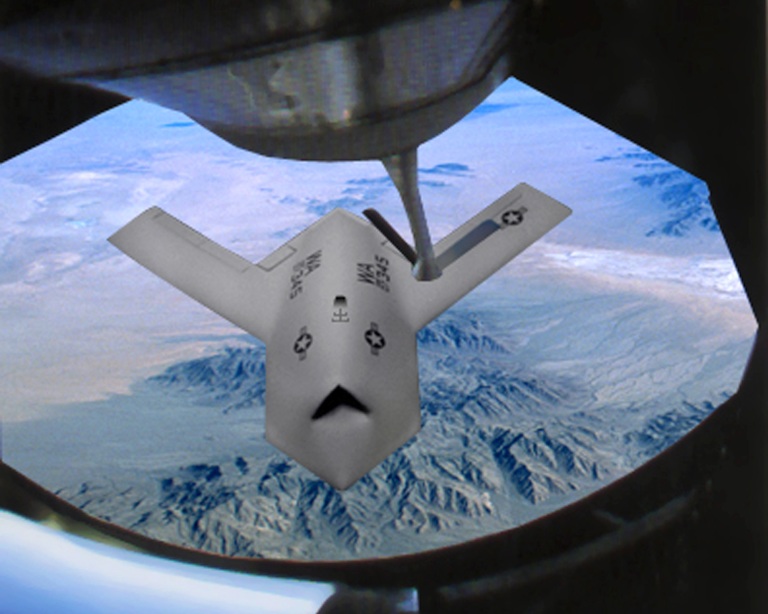 |
| (Boeing
image) |
  |
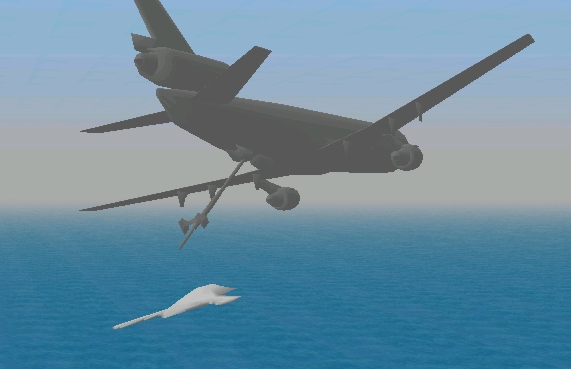 |
| (Bihrle
Applied Research imagery) |
|
|||||||||||||
|
|
|
|
|
|
|
|
|
|
|
|||
|
|
|
|
|
|
|
|
|
|
|
|||
 |
|
|
|||||||||||
| Artwork, graphic design, layout and text © 2004 - 2014 Carlo Kopp; Text © 2004 - 2014 Peter Goon; All rights reserved. Recommended browsers. Contact webmaster. Site navigation hints. Current hot topics. | |||||||||||||
|
Site Update
Status:
$Revision: 1.753 $
Site History: Notices
and
Updates / NLA Pandora Archive
|
|||||||||||||
|
|
Tweet | Follow @APA_Updates | |||||||||||
|
|
|||||||||||||
|
|
|||||||||||||






