|
||||||||||||||||||||||
 |
||||||||||||||||||||||
![F-22A Raptor, FB-22, F-22E, F-22N and Variants Index Page [Click for more ...]](APA/f-fb-22.png "F-22A Raptor, FB-22, F-22E, F-22N and Variants Index Page [Click for more ...]") |
 |
![People's Liberation Army Air Power Index Page [Click for more ...]](APA/pla-air-pwr.png "People's Liberation Army Air Power Index Page [Click for more ...]") |
 |
 |
 |
 |
 |
 |
![Military Ethics, Culture, Education and Training Index Page [Click for more ...]](APA/ethx-culture.png "Military Ethics, Culture, Education and Training Index Page [Click for more ...]") |
 |
||||||||||||
 |
![Russian / Soviet Weapon Systems Index Page [Click for more ...]](APA/rus-weps.png "Russian / Soviet Weapon Systems Index Page [Click for more ...]") |
 |
 |
 |

|
 |
 |
 |
 |
 |
||||||||||||
 |
 |
|||||||||||||||||||||
| Last Updated: Mon Jan 27 11:18:09 UTC 2014 | ||||||||||||||||||||||
|
||||||||||||||||||||||
|
||||||||||||||||||||||
|
||||||||||||||||||||||
|
|
|
|
|
|
|
|
|
|
|
||||||||||||
|
|
|
|
|
|
|
|
|
|
|
||||||||||||
|
|
|||||||||||||||||||||
| Last Updated: Mon Jan 27 11:18:09 UTC 2014 | ||||||||||||||||||||||
|
||||||||||||||||||||||
| Profile - The BAC TSR.2 |
First published in Australian Aviation, June 1997 by Carlo Kopp |
|
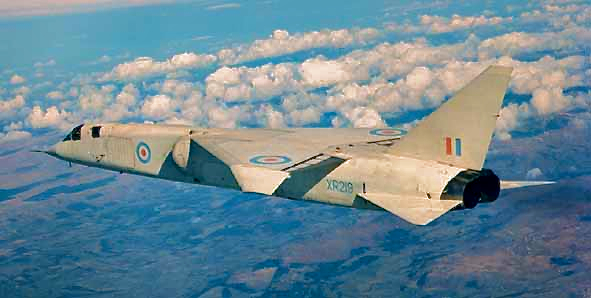
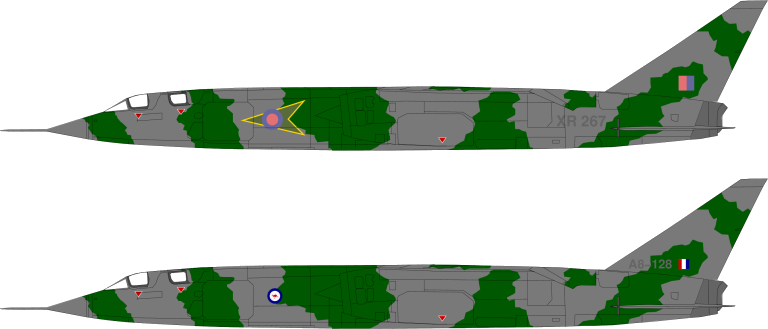
The BAC TSR.2 could easily be regarded as the last significant attempt by the UK to occupy a leading position in top tier military aircraft design. Indeed, virtually all projects which the UK have entered into since have been either collaborative ventures with the US or the Europeans, or projects well behind the technological "bleeding edge". Arguably, the RAF has yet to fully recover from the damage inflicted by the cancellation of the TSR.2, indeed many idiosyncratic aspects of the current RAF force structure are a direct consequence of the now very much historical events of the mid sixties. It would make for interesting speculation were we to consider the air campaigns of this decade, conducted by an RAF equipped with the TSR.2 rather than the short-legged little Tornado GR.1 . The USAF 48th TFW would have had to share its laurels as premier precision tonnage carriers with the RAF ! Alas this was not to be, as the UK's political leadership demolished any hopes of a home grown bomber fleet in the sixties. In hindsight we can now safely use the terms stupidity, myopia and ineptitude to describe the actions of the political players of the day. There can now be no doubt, they did indeed get it very, very wrong, and the British taxpayer and industry were the unfortunate losers in this game. TSR.2 - An Historical Background To an Australian reader the TSR.2 will be of significant interest as it was both a viable candidate for the strategic strike role, eventually performed by the F/RF-111C/G in RAAF service, and also paralleled the F-111 in its development history. In 1957 Britain's Ministry of Supply issued GOR.339 (General Operation Requirement) which declared a requirement for a bomber to replace the incumbent Canberra. This aircraft was to be capable of operating from poor quality strips, and delivering the Red Beard theatre (tactical) nuclear weapon against defended targets up to 1000 NM away, under any weather conditions. The aircraft was also to perform radar and photographic recce, to that effect it was to carry a "Tactical Strike Reconnaissance" or TSR designation. The technical similarities compared to the 1958 USAF SOR-183, which defined the F-111 specification, are clearly very evident. The TSR.2 was perhaps cursed at the very time of its birth, for it was at this time that Duncan Sandys was propounding his rather foolish document in which he declared that manned aircraft were essentially irrelevant and would soon be universally replaced with guided missiles. Forty years hence we can state without fear of contradiction that Duncan Sandys had achieved nothing less than to significantly damage the UK's strategic military interests by imposing a fundamentally wrong policy direction upon the MoD and RAF. The consequence of this policy direction was that it became extremely difficult for the RAF to get the funding they sought for combat aircraft research and development, let alone production. The MoD and Treasury bureaucracies (surprisingly not unlike the US DoD bureaucracy, and many notable elements of our own domestic DoD bureaucracy), was never particularly forthcoming with money to buy bombers with. Given divine providence producing a Minister who sets a policy direction which essentially declares bombers to be "airframes non-grata" , the bureaucracy could not have asked for a more fertile environment to operate in. Moreover, the early sixties were also a period of a painful and forced consolidation of the UK's airframe and systems industry. This clearly hostile environment was not the only challenge to be faced by the embryonic TSR.2, as Blackburn's NA.39 prototype, eventually to become the Buccaneer, was repeatedly proposed as an alternative. That the Bucc lacked the payload radius performance to seriously compete with the GOR.339 does not appear to have been an issue in this matter. Virtually every design office of any substance in the UK responded by early 1958, the Air Staff were most impressed with the English Electric P.17A and Vickers-Armstrong (Supermarine ) 571 proposals. The former for its aerodynamics, the latter for its integrated weapon system design, then a revolutionary idea. After some clever contractual twists and turns, the government awarded the contract to a joint team comprising Vickers-Armstrong and English Electric. It is of some interest, perhaps in anticipation of contemporary trends, that the lead contractor was the originator of the integrated offensive avionic suite rather than the airframe. The 50-50 split contract was awarded in early 1959. Vickers-Armstrong assumed responsibility for the forward and centre fuselage and systems, while English Electric concentrated their design effort on the wings, tail and aft fuselage. The engines were to be designed and built by Bristol-Siddeley Engines. To further complicate organisational matters and lines of responsibility, Vickers-Armstrong, English Electric, Bristol and Hunting merged in early 1960, to form the new British Aircraft Corporation (BAC). The background to the powerplant was particularly interesting, in that the Bristol Olympus 22R Mk.320 was mandated by the government, some reports indicating that Rolls-Royce with their proposed RB.14213 were politically disqualified from the bidding. The Olympus 22R was a reheated turbojet derived from the Vulcan B.2 powerplant, rated at 19,610 lb dry and 30,610 lb under reheat. As the TSR.2 development project got under way, difficulties began to surface. Clearly designing a weapon system of such complexity and conceptual novelty would inevitably produce its share of technical problems. This had later proven to be the case with the F-111, which suffered a similar political attack to that experienced by the TSR.2 . The F-111 lived to win its battles, the TSR.2 never made it. Many UK sources elaborate upon the incessant dabbling by government scientists in the TSR.2 project, over-specification or continuous respecification of design features by air force and government committees alike, and the ongoing problems with the design and manufacture of the avionic suite for the aircraft, all of which had to be custom designed for the type. Whatever the scope of these problems, they paled into meaningless insignificance when compared against the politician's gaming around the contract and frequently hostile coverage by the UK media. The government of the day had perhaps injudiciously described the aircraft at various times as a nuclear strike aircraft, tactical support aircraft, bomber or not-bomber, depending on whose quotes you read. Furthermore, the UK Labour opposition of the day made great mileage out of trashing the aircraft and anybody in any way associated with it. A number of sources suggest that it was made quite clear to potential foreign customers that the project would be chopped if there was a change of government. In hindsight it would be fair to call such behaviour sheer stupidity verging on a treasonous disregard for the UK's national interests, all committed under the protection of parliamentary privilege.
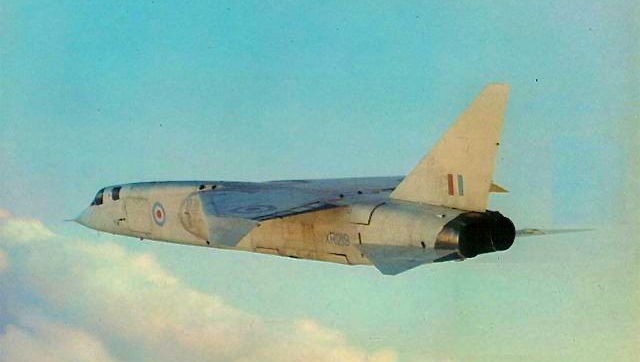
The biggest source of problems during the early testing of the aircraft systems prior to prototype flights was to be found in the engines. Two prototype Olympus 22Rs exploded in testing, one destroying the Vulcan testbed airframe it was mounted to. The cause was ultimately traced to the resonant ringing of a tubular low pressure shaft, which was being excited to resonance by cooling air jets. The aircraft first flew in late September, 1964, in the same year that its US rival flew. Flight testing proceeded at a brisk pace, and the aircraft flew supersonic within 5 months. The most notable troubles during flight test were related to the complex undercarriage, designed for STOL operations into fields with poor quality surfaces. Early in 1965, disaster struck the TSR.2 . Having won the election, the Labour Party proceeded to destroy the TSR.2 project . To position itself, it systematically slandered the aircraft and the project. To ensure that no dissenting views were heard, the government even persuaded the test pilot not to attend a public lecture sponsored by the RAeS, where he was expected to extoll the virtues of the aircraft. God forbid, the truth might just leak out ! Finally, the project was killed in the budget of early April, 1965. Not only was funding stopped, but a large number of partially built pre-production airframe components were destroyed, as were the production jigs, tooling and much documentation. Of the completed prototypes, only two survive in museums. XR220 lives at Cosford and XR222 at Duxford.
The damage done to the UK's aerospace industry, and the RAF's power projection capability, over the subsequent two decades is immeasurable. The industry lost a significant volume of business, international credibility, follow-on export orders and the opportunity to independently keep pace with the US F-111 project. The F-111 became the yardstick for a modern bomber. The result of the TSR.2 project loss was to severely wound the UK aerospace industry at many levels, including a severe blow to its confidence. Until the EAP demonstrator was built, the UK aerospace industry avoided anything which might be perceived to be risky. The RAF suffered equally for its impertinence in wanting a real bomber. The TSR.2 mission was to be performed by the GD F-111K, a variant which was to be similar to the RAAF F-111C or SAC FB-111A. The F-111K was killed in 1968 when it was found that it would be as expensive as the TSR.2 would have been. The RAF ended up flying an inferior variant of the F-4 Phantom, and the Blackburn Buccaneer which they had rejected a decade earlier. The RAF did not acquire its terrain following all-weather precision blind bomber until the late seventies, when the multirole European (UK-FRG-Italy) Panavia Tornado IDS entered service. The Tornado IDS is a toy bomber when compared to the F-111 or the TSR.2, simply as it lacks the payload radius to perform beyond the close-in theatre strike role. The TSR.2 - A Technical Perspective Built for virtually the same mission profile as the USAF and RAAF F/RF-111, the TSR.2 is an excellent illustration of how very diverse technological solutions can yield very similar performance and capabilities. The central driving factor in the design, as with the F-111, was the capability to penetrate supersonically at treetop level, using a terrain following radar. Internally carried "special" devices would then be tossed at the target, or delivered level using a retarding parachute. It should therefore come as no surprise that these very different aircraft had very similar performance, size, weight Importantly, the TSR.2 was designed to operate from poorly supported, short runways with low quality unpaved surfaces. The complete ground support package for the aircraft was to comprise a four wheeled support vehicle, termed a GSV, which would provide ground electrical power, compressed air, hydraulic power, environmental control power and a portable hydraulic fuel pump. The GSV was to be supplemented by a towed universal bomb/engine loading trolley cum servicing hoist and platform, and a towed offboard test system trailer, which would plug into the aircraft via an umbilical and provide diagnostic testing of the avionics and systems. The final component of this standalone air portable support package was a set of air portable fuel bladders, not unlike the type now used as standard by the US Army for FOB helo refuelling. Airframe, Propulsion and Systems The optimal wing for a transonic low level penetration profile has a small area, high loading and very low aspect ratio, all attributes which are fundamentally at odds with the need for sensible take-off and landing distances. While the engineers at Forth Worth opted for an extremely complex variable geometry (ie swing) wing and segmented leading and trailing edge flap system, the aerodynamicists at English Electric opted for a 60 degree swept leading edge delta, with an aspect ratio of 1.96 and an area of 700 square feet. The wing was straight, rather thin at 3.7%, and the tips "anhedralled" to enhance stability. Clearly a fixed geometry wing with these design parameters was optimised for the high speed portion of the envelope, and measures other than geometry were required to achieve viable low speed lift characteristics. The solution chosen was that of "blowing" the full span flaps with high pressure bleed air, a scheme previously used by Supermarine on a number of types and a key factor in the success of the now retired Buccaneer. That this approach worked well is evidenced by a quoted take-off run of 2,400 ft at MTOW. The wing was wholly wet, and employed no less than seven spars, each attached to the fuselage through a flexible link arrangement, intended to prevent flexural distortions in the wing and fuselage travelling through the structure and producing the painful structural fatigue which has been so characteristic of the service life of the F-111 and the B-52 in its latter years. To improve ride quality, the fuselage was designed to flex and the cockpit placed into a node in the flexure pattern. Most of the aircraft structure was produced from machined extrusions of L.65 Al/Cu alloy, with some components made from imported US Al-Li (Lithium) alloys. Much of the aft fuselage was built from RR.5B, a high temperature alloy originally devised for engine pistons, and Titanium was applied in a number of areas. A vacuum smelted Ni/Cr/Mb/Vd alloyed steel was used for the undercarriage. Significantly, many of these materials and associated manufacturing techniques were later to feature in the Concorde. As with the F-111, fuel storage and management was a critical design issue in the TSR.2. Most fuel was carried in the integral fuselage tanks which occupied the upper fuselage fore and aft of the wings. In addition, up to four 450 Imp.Gal drop tanks could be carried on wing stations, increasing the nominal 1,000 NM combat radius to no less than 1,500 NM. A 570 Imp.Gal ferry tank could also be fitted to the bomb bay, yielding a 3,700 NM ferry range. A jettisonable 1,000 Imp.Gal external fuselage "blister" tank, similar in concept to that used by the Lightning, was also under consideration. The fuel was automatically managed by a Lucas fuel system which maintained proper longitudinal trim by pumping fuel between the fuselage tanks. A retractable refuelling probe was embedded in the forward left fuselage, and a transfer rate of 450 Imp.Gals / minute could be achieved, through the probe or a pair of ventral pressure feed ground refuelling ports. At least one source suggests that the fuel system and engines were ultimately to be cleared to use not only JP-4/5 (Avtur) fuels, but also gasoline and diesel blends, for operation under wartime conditions. The undercarriage of the TSR.2 was complex, and specifically designed to allow operation at appreciable gross weights from poorly surfaced strips. To this effect large tubeless tyres were employed for the main gear, and the hydraulically steered nosewheel could be extended by no less than 42 inches to achieve a nose up take-off attitude. The design was created by Vickers, but largely manufactured by Electro-Hydraulics Ltd, although the wheels and disc brakes were supplied by Dunlop and the anti-skid system by Maxaret. To achieve minimal roll-out on a short field, a braking chute designed by Irving was to be used. The aircraft employed an unconventional tail, with all three surfaces built as fully movable slabs, and no fences on the wings or ventral stabilisers used. Roll and pitch control, as with the F-111, was provided by the large stabs, however due the smaller span of the TSR.2 and thus lesser rolling moment required, the control forces were produced wholly by the stabs. To increase the effectiveness of these at low speeds, the trailing edge of the stabs was hinged and actuated, providing in effect a trailing edge flap. The TSR.2 employed a flight control system which was in modern terms, a hybrid fly-by-wire system, using a US Autonetics designed Verdan flight control computer. The US of a US computer rather than a UK design stemmed from Duncan Sandys' edict, which meant that R&D funding for the UK Elliot DEXAN was chopped earlier. The flight control system was redundant, triply and quadruply in some areas, and used a combination of mechanical and electrical signalling. The hydraulic system operated at 4,000 PSI, powered by two accessory drive pumps on the engines, and a Bristol Siddeley Cumulus APU fitted forward of the bomb bay. The electrical system was powered by a pair of engine mounted 400 Hz 55 kVA Rotax alternators, on Plessey constant speed drives. The pair of Olympus engines employed water injection from a 80 Imp.Gal tank for increased take-off thrust. The Lucas designed inlets were reminiscent of the F-104, using a semicircular design with the shock front adjusted by a translating centrebody. Auxiliary inlets would swing open at low speed to increase airflow. The exhaust nozzles were actuated by a redundant hydraulic system, employing fuel as a working fluid. The engines could be started with compressed air from a ground cart, or from the electrically started onboard APU, with cross bleed from a started engine used to start the remaining engine. The cockpits were fully air-conditioned and pressurised, with heat from the cockpits and avionics racks dumped into the fuel by Marston-Excelsior heat exchangers. A stored liquid oxygen system was to be used. The aircrew would wear ventilated suits, and sat on Martin Baker Mk.8A zero-zero seats. The aircraft had a command ejection system, which could eject crew members in sequence, or the navigator individually, with automatic jettison of the cockpit canopies. The windshield was designed to a stringent birdstrike specification. Offensive Avionic Suite The offensive avionic suite on the TSR.2 was to be a hybrid analogue-digital system, well ahead of the analogue system used in the early F-111A/E, and similar in many respects to the F-111D Mk.II system. The complex nav-attack system employed a Smiths air-data computer, a Ferranti inertial platform and a Decca Doppler system for precision velocity updates. Precise navigation fixes were provided by the EMI Side Looking Airborne Radar (SLAR), which provided a high resolution ground map to the navigator. The SLAR employed a pair of 7.5 ft side looking antennas in the fuselage, below the forward cockpit. It was intended the SLAR be used every 100 NM or so, to provide an update only to the nav-attack computer. The TSR.2 employed a dual channel Terrain Following Radar (TFR) conceptually similar to that in the F-111. The TSR.2 system employed a Ferranti monopulse TFR, which fed the dual channel Elliot Automation autopilot/TF computer with terrain profile measurements ahead of the aircraft. A pair of STC radar altimeters complemented the TFR. The system provided not only automated vertical clearance down to 200 ft AGL, but also provided for automatic routing around obstacles. The terrain clearance data was also provided to the pilot as cues on his Rank-Cintel Head Up Display (HUD). Both crewmembers had moving map displays, in addition the navigator had a large radar scope. It was intended that the pilot's station be fitted with three digital cockpit displays (MFDs) in production aircraft. It was intented that the pilot's workload be minimised, to this effect a fully automatic fuel management system was fitted to balance the aircraft's CoG. The TSR.2 was fitted with two forward looking and two lateral F.95 cameras which would be activated at the IP. The Elliot Weapon Aiming Computer (WAC) provided a range of visual and blind dive, level laydown and tossing modes for nuclear and conventional bombs. A fully automatic toss mode was included for nuclear delivery, during which a pitch up, automatic arming and release of the bomb and wing-over escape manoeuvre would be flown by the onboard computers. The aircraft was fitted with a Plessey UHF/VHF radio, Marconi HF radio and Cossor IFF system. A Marconi ILS was fitted for blind approaches. Mission Payload The nominal payload for the tactical nuclear mission was to be a single UK designed Red Beard which was a second generation lightweight tactical fission weapon. It employed a tritium boosted plutonium/U-235 composite core, providing a yield between 10 and 20 kT. The Red Beard was to be tossed. A level laydown weapon to be carried on the TSR.2 was the parachute retarded WE177A, a later weapon reputedly of US design. The WE177 is available in 200 kT tactical (WE177A) and 400 kT strategic (WE177B) yield versions, and is still in service on the Tornado GR.1. Two rounds would be carried. Conventional bombs could be carried internally, a typical payload being six of the standard UK 1,000 lb dumb bombs. The four wing pylons could also carry single or tandem pairs of one thousand pounders, or alternately AJ.168 Martel ASMs or rocket pods. A comprehensive package of recce equipment could be carried. An EMI K-band recce SLAR with Moving Target Indicator (MTI) modes could be fitted to the weapon bay, this sensor would map a 10 NM strip on either side of the aircraft on to a film strip. Another recce tool was to be the Hawker Siddeley Dynamics/Mullard thermal imaging linescanner, which was equipped with a radio datalink to relay pictures in real time to a ground station. A TV camera system was also under consideration, also with a datalink. Up to three FX.126 recce film cameras could also be fitted. The EW fit was never disclosed, but would most likely have comprised similar equipment items to those used on the V-bombers as these were available off the shelf. One UK commentator perhaps cynically remarked that there was no EW suite, as it would have been no doubt blocked by the UK Treasury ! Mission Profile and Performance The TSR.2 has been described as aerodynamically a Mach 3 aircraft, built with materials to a Mach 2+ specification. A nominal mission profile for the TSR.2 would involve an afterburning takeoff and 5,000 ft/min climb to 23,000 ft, followed by a Mach 0.92 dry cruise climb to 26,000 ft. At 630 NM, afterburning thrust would be selected again, and a Mach 1.7 climb to 50,000 ft initiated upon entering hostile airspace. The TSR.2 would then dive at Mach 1.7 down to low level, where it would decelerate to its TF 600 kt/200 ft AGL penetration mode. The aircraft was cleared to TF at Mach 1.2 / 200 ft AGL. A maximum performance takeoff would involve 30 degrees of flap, full reheat, with the nosewheel hydraulically extended at 90 kt, with the aircraft rotating at 145 kt using 1,000 to 3,000 ft of runway. Typical landings would be carried out with 30 degrees of flap with 165 kt on short finals, the parachute deployed on touchdown. Nominal combat radius was 1,000 NM for the specified Hi-Lo-Lo-Hi profile, with 1,500 NM achievable using external tanks and 2,120 NM with a single inflight refuelling. The typical TSR.2 mission would differ little from that of the F-111. As the aircraft was slightly faster and longer ranging, it would offer slightly more punch than any F-111 variant. Whether a production TSR.2 in squadron service could offer the aircraft's nominal performance we will never know. In most areas the TSR.2 was nominally slightly more capable than the F-111, with better thrust to weight ratio, speed, climb rate, range and avionic capability. Whether this would translate into an appreciable advantage in combat capability is open to debate. Conclusions The TSR.2 was a state of the art strike aircraft clearly comparable or slightly better to the F-111 in every respect. Its avionic package in particular was comparable to later models of the F-111 and could be regarded as revolutionary in its day. Were the aircraft to have entered RAF service it would have provided a powerful deterrent to Soviet theatre forces in Europe. As history illustrates, the two USAF F-111 wings in the UK would have been hard pressed to maintain the required operational tempo, bolstered by two to three RAF wings of TSR.2 aircraft the Soviets would have faced an overwhelming conventional and theatre nuclear strike capability. This would have certainly contributed to accelerating the USSR's eventual arms race induced collapse. The TSR.2 would clearly have been a viable alternative to the F-111 for the RAAF, indeed the slightly better range performance would have been greatly appreciated by the RAAF. In hindsight however the Menzies government's choice of the F-111 proved to be better, as we would have no doubt suffered the same fate as the RAF in 1965. The impact of the TSR.2 cancellation on the UK aerospace and avionics industry is immeasurable. Of the 60 firms involved in the project, 57 no longer exist. Were he project to have proceeded many of these manufacturers would be operating today and contributing significant export revenues to the UK economy. The lesson for Australia is that there is no substitute for a robust domestic high technology manufacturing base, and that a significant government commitment to domestic manufacture is required in the short and medium term if the long terms dividends of market dominance in any given sector are to be realised. Another important lesson is that the experts should be allowed to do what they do best, and amateurs in the political and bureaucratic arenas should butt out. There is no useful contribution which can be made by lay participants in high technology systems design and specification. Indeed a number of key ADF programs today suffer the consequences of bureaucratic meddling in the eighties (and the DoD committees responsible for this meddling know this very well). The UK aerospace industry has recovered in the three decades
since the loss of the TSR.2, but the question we must ask today is what
could it have been were the program to have survived ? |
 |
|
|||||||||||||
|
|
|
|
|
|
|
|
|
|
|
|||
|
|
|
|
|
|
|
|
|
|
|
|||
 |
|
|
|||||||||||
| Artwork, graphic design, layout and text © 2004 - 2014 Carlo Kopp; Text © 2004 - 2014 Peter Goon; All rights reserved. Recommended browsers. Contact webmaster. Site navigation hints. Current hot topics. | |||||||||||||
|
Site Update
Status:
$Revision: 1.753 $
Site History: Notices
and
Updates / NLA Pandora Archive
|
|||||||||||||
|
|
Tweet | Follow @APA_Updates | |||||||||||
|
|
|||||||||||||
|
|
|||||||||||||