|
||||||||||||||||||||||
 |
||||||||||||||||||||||
![F-22A Raptor, FB-22, F-22E, F-22N and Variants Index Page [Click for more ...]](APA/f-fb-22.png "F-22A Raptor, FB-22, F-22E, F-22N and Variants Index Page [Click for more ...]") |
 |
![People's Liberation Army Air Power Index Page [Click for more ...]](APA/pla-air-pwr.png "People's Liberation Army Air Power Index Page [Click for more ...]") |
 |
 |
 |
 |
 |
 |
![Military Ethics, Culture, Education and Training Index Page [Click for more ...]](APA/ethx-culture.png "Military Ethics, Culture, Education and Training Index Page [Click for more ...]") |
 |
||||||||||||
 |
![Russian / Soviet Weapon Systems Index Page [Click for more ...]](APA/rus-weps.png "Russian / Soviet Weapon Systems Index Page [Click for more ...]") |
 |
 |
 |

|
 |
 |
 |
 |
 |
||||||||||||
 |
 |
|||||||||||||||||||||
| Last Updated: Mon Jan 27 11:18:09 UTC 2014 | ||||||||||||||||||||||
|
||||||||||||||||||||||
|
||||||||||||||||||||||
|
||||||||||||||||||||||
|
|
|
|
|
|
|
|
|
|
|
||||||||||||
|
|
|
|
|
|
|
|
|
|
|
||||||||||||
|
|
|||||||||||||||||||||
| Last Updated: Mon Jan 27 11:18:09 UTC 2014 | ||||||||||||||||||||||
|
||||||||||||||||||||||
| New Tusks for the Pig | |||
|
|||
 The F-111 Avionics Upgrade Program Pt 1 The
RAAF's F-111 Avionics Upgrade Program (AUP) is finally under way, after
a full half decade of definition and often very partisan debate.
The long overdue systems upgrade will result in a substantial improvement in aircraft combat availability while also reducing crew workload through modern cockpit display technology. In many respects the RAAF had no real choice in its pursuit of the upgrade, as much of the F-111A/C's analogue avionics suite was simply no longer operationally supportable, many modules designed in the early sixties using then mature sixties technology. Wearout aside, simple random component failures will result in a constant demand for sixties technology electronic and electromechanical components which are needless to say, increasingly difficult to source and thus increasingly expensive with time. In practical terms this means that greater stocks of spares must be held, if repair turnaround times are to be kept within sensible limits. Under peacetime conditions this situation is hardly tolerable even if very high life cycle costs are accepted, under wartime conditions increased flying hours will gobble up the spares stocks available leading initially to the cannibalising of grounded airframes and eventually to the grounding of the fleet. With a small fleet of aircraft the operational life time of the fleet will be measured in weeks if not days under such conditions, disregarding combat attrition. The longer term benefit of the RAAF's F-111 AUP will be significant cost savings in the maintenance of the fleet, as the current generation of mission avionics is substantially more reliable than sixties technology. This will translate into better mission availability and a much lower demand for avionics maintenance time as well as spare components. As the mission avionics software will be maintained locally, the RAAF will gain the economies of local support as well as the flexibility of integrating weapons of choice. The F-111 in the ADF Force Structure The RAAF is in the uniquely fortunate position of having operated the F-111 family for two decades and thus having acquired substantial experience in modern defence penetration techniques. The occasional public debate over the usefulness of the F-111 in ADF force structure demonstrates that there are still many individuals within the defence establishment and public who are sadly so technically inept to be willing to seriously question the role of the aircraft. The F-111 is a long range tactical strike platform optimised for low level penetration to heavily defended targets. It has an unrefuelled payload/radius approximately three times greater than that of the lightweight F/A-18A fighter bomber (ie 12,000 lb vs 4,000 lb at 600 NM), and utilising inflight refuelling (boom) can attack targets at substantial radii as demonstrated by the 1986 UK to Tripoli raid and the six weeks of sustained interdiction operations conducted during the Desert Storm campaign. In the ADF force structure the F-111 has traditionally performed the role of the strategic deterrent, allowing the ADF to strike at strategic targets with total impunity. Initially using radar/inertial bombing techniques and dumb iron bombs, the F-111's role revolved largely about striking at high value targets such as airfields, aircraft, command/control/communication facilities, power installations, bridges, railway facilities, naval bases, docks, munitions dumps and other area targets. With a weapon system CEP (circular error probable) of about 150 ft under all weather conditions, the F-111 had the accuracy to destroy all but the hardest point targets in a first pass strike. This was the role which the aircraft performed very successfully during the Linebacker II air campaign over North Vietnam. By the early eighties the RAAF sought to expand the role of the F-111 to encompass both maritime strike and first pass strikes against hardened point targets, both of which required a major improvement in accuracy and thus the use of Precision Guided Munitions (PGM). AVQ-26 Pave Tack Flir/laser targeting pods were subsequently acquired, these capable systems improved the CEP of dumb iron bomb deliveries to about 80 ft, but significantly allowed the use of low cost Paveway 2 laser guided bombs with a CEP below 25 ft, or more accurate Paveway 3 bombs with a CEP of about 5 ft. The accuracy of the Pave Tack/Paveway delivery is such that virtually any target can be destroyed by penetration (GBU-24) or by the overpressure resulting from near direct bomb impact (GBU-10). At the today ridiculously low cost of several thousand dollars a round, Paveway 2 laser guided bombs have virtually supplanted unguided bombs as the bread and butter munition of the 82 Strike/Reconnaissance Wing. The modifications carried out upon the F-111 force involved the installation of fuselage bay cradles for the Pave Tack pods, a cockpit display upgrade and the fitting of additional electronics to support the AGM-84 Harpoon anti-ship missile and the GBU-15 2,000 lb glidebomb. The addition of Harpoon to the F-111's arsenal has vastly increased the strategic importance of the aircraft, its superlative operating radius, capable EW systems and high performance allow the use of Harpoon to best advantage. Supported by Jindalee OTHB/P-3C targeting, the F-111/Harpoon is the most potent anti-shipping weapon system in the Western World today. The GBU-15 was one of the star performers in the Gulf War, used to destroy heavily defended hardened point targets. This weapon carries a nose mounted television or thermal imaging camera which transmits a picture back to the navigator's cockpit display via a Hughes AXQ-14 datalink pod. The navigator can then manually adjust the weapon's aimpoint for maximum effect, his steering commands transmitted to the weapon by the datalink pod. With an accuracy and range much better than laser guided weapons, the GBU-15 was a potent addition to the RAAF's armoury. Land and maritime strike are thus the principal roles of the ADF's F-111 force, although another role of major importance is supported. Four F-111C aircraft were modified during the early eighties to RF-111C strategic photo-reconnaissance platforms. These aircraft carry a range of visible and infra-red photographic sensors in their fuselage bays, with dedicated cockpit controls and displays. Without the drag penalty of external stores, these aircraft offer the full aerodynamic performance of the basic F-111 airframe which is even by today's standards stunning. The recce aircraft are strike capable. With its successor the A-12 Advanced Tactical Aircraft cancelled even before prototype completion, the F-111 is an irreplaceable asset to its current users. There is no other tactical aircraft in existence today which offers its payload/radius and penetration performance, the currently popular use of sensor equipped air superiority airframes suffers from the radius and aerodynamic limitations of designs optimised for turning and acceleration performance in high altitude dogfights. The success of the Allied air campaigns in the latter phase of WW2, and the recent Desert Storm campaign, stemmed largely from the superior tactical radius of Allied aircraft. There are endless instances which illustrate the simple strategic reality that there is no substitute for combat radius performance. Those who choose to ignore this fact will lose air wars, as has happened many times before and no doubt will happen again (if there is any doubt in somebody's mind, consider the Battle of Britain, the North African campaigns, the Battle of Berlin, the whole Pacific Air War, the Korean MiG killing operations, Linebacker II over Hanoi, Israeli Air Force ops during the Eighties, and finally the Desert Storm campaign). Argument is futile in this matter. The USAF F-111 Fleet The upgrade program for the RAAF's fleet of F-111s was under discussion since the early eighties, when the USAF initiated its series of F-111 upgrades. The USAF operated four distinct tactical strike versions of the F-111, the analogue F-111A/E and the digital F-111D/F, supplemented by strategic FB-111As and tacjammer EF-111As, both analogue weapon systems. This resulted in major logistical problems over the years, as Tactical Air Command, and its successor, Air Combat Command, has had to support three distinct avionics suites, the fully analogue A/E, the fully digital D and the mixed analogue/digital F. The history behind this situation is almost entertaining when we disregard the cost to US taxpayers and operational readiness, but serves as a case study in illustrating the disastrous consequences of allowing lay politicians and bureaucrats into the decision loop of a major systems design/definition project (it never ceases to amaze this writer, a systems engineer and integrator by trade, how laymen can seriously seek to involve themselves in a process which systems engineers consider an extremely difficult task to do well. Perhaps they know something which we simple technical dummies don't ...). The mid eighties saw the USAF proceed with its initial upgrade program for the A/E series of aircraft, involving a new attack radar to replace the APQ-113, a new terrain following radar replacing the APQ-110, and a new nav/attack based on the AYK-18 digital computer. This upgrade differed from the early proposals from the late seventies which revolved about bringing all airframes up to F model standard. The late eighties also saw the USAF award contracts for the Pacer Strike D/F model upgrade, also involving mission avionics. The USAF never disclosed how much of the fleet was refitted. The collapse of the Soviet Empire, conventional arms reductions in Europe and the excessive US deficit have led the US DoD to mothball much of the F-111 fleet, much to the unhappiness of those who understand the vital role performed by this type. The first to go were the F-111Ds, most troublesome to maintain and never flown in anger. Then the F-111A went. SAC transferred their FB-111As to TAC, which redesignated them as F-111Gs, these have also been retired, the RAAF benefiting by acquiring no less than 15 low time airframes. The F-111G fleet was subjected to a GD factory upgrade when transferred from SAC to TAC. This upgrade was centred on mission avionics, and saw a new nav-attack system fitted, built around the Honeywell H523 Ring Laser Gyro, and a new mission computer. SAC specific equipment, such as support for the nuclear SRAM defence suppression missile and the nose mounted ASQ-119 astrocompass, was removed. The unusual bulge on the nose of the RAAF F-111G is the only remnant of the astrocompass installation. 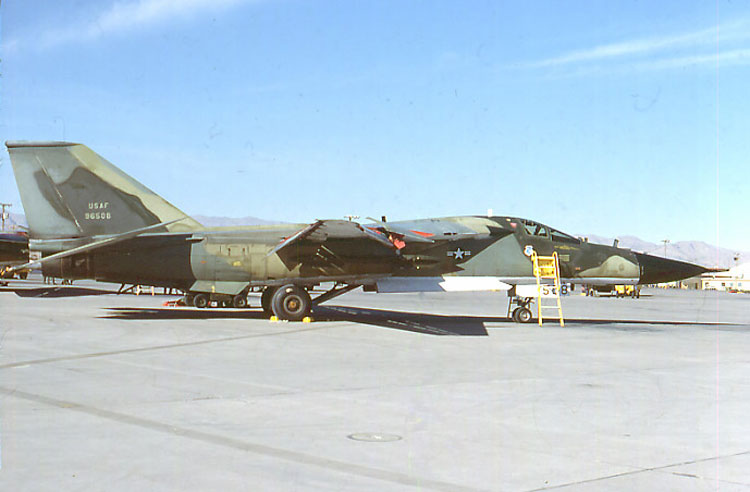 By 1994, the active fleet had been consolidated into the overstrength 27th TFW at Cannon AFB in New Mexico, with the 428th FS flying the F-111E (analogue like the older F-111A/C in RAAF service), the 522nd, 523rd and 524th FS' the hybrid F-111F/Pave Tack and the 429th and 430th Electronic Combat Squadrons flying the specialised EF-111A Raven tacjammer. Growing budgetary pressures have forced the retirement of the remaining strike variants in the 1995 to 1996 period. The role performed by the aircraft will be performed by the shorter ranging F-15E and F-117A. The USAF was however very reluctant to let go of its unique EF-111As, which albeit somewhat behind the Navy EA-6B in electronic capability (mainly due contractor service infighting over upgrades), have far superior aerodynamic performance allowing them to fly escort jamming rather than just standoff jamming missions. Current schedules call for the aircraft's retirement in the 1996 to 1997 period. Losing the EF-111A force is a major blow to the USAF as it is a capability which is near impossible to replace other than by a similar aircraft type. Much has been said in this country about the USAF's phase-out of the F-111 force, mainly in relation to support of our domestic F-111 fleet. The USAF held on to its F-111s for as long as was politically tenable, the ultimate choice the USAF faced was to forgo the vitally needed new F-22A Advanced Tactical Fighter, or the backbone of Air Combat Command's strike fleet. The latter went, with much reluctance and after a long and intensive political battle. An interesting note here is that the USAF first disposed of much of its B-52 fleet, before finally letting the beancounters at the F-111 force, as they considered the aircraft's combination of precision strike capability and payload radius performance to be one of the service's most valuable assets. The retirement of the USAF fleet will not significantly impact RAAF operations. The aircraft which is now in the latter half of its operational life cycle is thus technically mature and what needed to be learned about its idiosyncrasies has been learned. The mothballed US fleet is a fallback source for structural, engine and non avionics systems spares, almost certainly beyond the RAAF's capacity to exhaust. The comprehensive upgrade being done on the RAAF F-111 avionics will mean that avionics spares will be readily available from the manufacturers, moreso since most of the components used are in wider military aviation usage, such as the RLG INS. The G-model aircraft will share a considerable number of avionics components with the new upgraded A/C-model airframes, and thus their support in service will not be an issue, particularly given the abundance of mothballed airframes in the US. The only alternative to upgrading the RAAF F-111 fleet was to acquire either the F-15E or F-117A, the former of which is about to cease production, the latter having been out of production for some years. Acquiring either type would have also required additional tanker support, with refuelling booms to provide the extra radius to match the F-111. The cost of the RAAF's AUP program, against the cost of acquiring a package of F-15Es, support facilities and two to four extra boom equipped tankers, is trivial (those who think otherwise are advised to sit down for five minutes with a calculator). As a result of the RAAF's Avionic Upgrade Program, the ADF will retain the most potent conventional tactical strike aircraft in the Western alliance, an asset which will serve Australia well into the twenty first century. 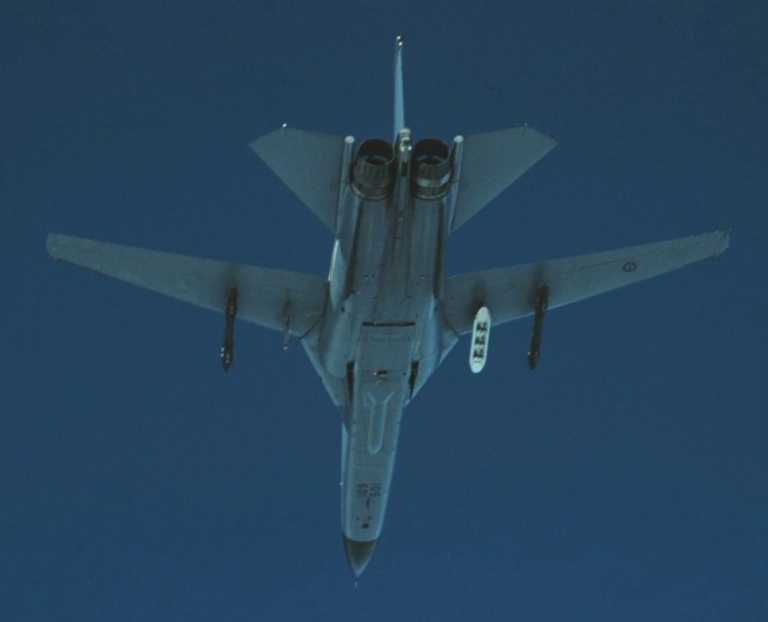 The
F-111 Avionics Upgrade Program Pt.2
The General Dynamics F-111, affectionately termed the "Pig", is one of the RAAF's most important assets. These aircraft are Australia's strategic deterrent, and are tasked with long range land and maritime strike roles. In the event of hostilities, these aircraft would carry the fight to the enemy, destroying targets deep in hostile airspace and threatening hostile shipping to substantial radii. While the F-111's superlative combat radius and high aerodynamic performance are key aspects of its ability to perform its demanding roles, its avionics suite is no less important. The aircraft's offensive avionics, comprised of sensors and navigation equipment, are critical to the aircraft's ability to locate, identify and successfully attack its targets. The defensive avionics, on the other hand, determine whether the aircraft will survive its incursion into contested airspace, to fly and fight another day. When it was first deployed in the late sixties, the F-111 carried the most complex and technically sophisticated avionics systems ever fitted to a tactical aircraft. This complexity translated into substantial support costs, moreso since the system was largely built with analogue electronics which as a technology are somewhat temperamental. As time progressed, the maintenance of this equipment became increasingly expensive, and by the late 1980s the pressure to upgrade the RAAF's aircraft became substantial, particularly as the USAF were expected to convert all of their remaining analogue models to contemporary digital equipment. Cost and operational readiness pressures forced the USAF to upgrade, and some indication of the scale of the support problem can be gained from published US figures (1981) which indicated that the SAC FB-111A had an aggregate aircraft MTBF of 2.2 hrs (still somewhat better than the USN A-6 with an MTBF below one hour). The digital refit of the USAF fleet would have made many analogue spares effectively unobtainable. In seeking approval for an upgrade to the F-111 avionics, the RAAF were largely constrained to retaining existing capabilities, the opportunity to substantially enhance the aircraft's capabilities was unfortunately not to be exploited. The upgrade program is thus focussed on replacing sixties avionics technology with contemporary equipment of broadly similar capabilities, with the objective of greatly increasing reliability and reducing maintenance costs in the latter period of the aircraft's life cycle. Incidental gains have been made, in that contemporary navigation equipment is substantially more accurate, and a digital weapon system can be easily adapted to accommodate new munition types. Aircrew workload is also reduced, as nineties avionics provide for a greater degree of automation. Given the technological complexity required to support the various sensors, munitions, flight profiles and delivery modes inherent in the platform, an avionics upgrade of this scope is not a technically trivial exercise, as some would have us believe. Every major weapon system integration program in the last several decades has been a protracted affair, this is simply the nature of the process. Where dozens of avionics black boxes need to be functionally melded by hundreds of thousands of lines of computer software, in order to create the illusion of a single weapon system, there are simply no easy shortcuts. To believe otherwise is to defy engineering intuition as well as historical experience. In 1990, the RAAF contracted Rockwell Electronics (Australasia) to upgrade the F-111C and RF-111C avionics systems, replacing the Mk.I analogue weapon system with contemporary digital equipment (NB: the RAAF's four F-111A airframes have been retrofitted with the "big" wing and FB-111A undercarriage, thus effectively converting them to F-111C airframes). The choice of prime contractor was substantially influenced by Rockwell's then very recent experience with the F-111D/F Pacer Strike program. Rockwell's first involvement with the F-111 was in the late sixties, when they developed the offensive avionics systems for TAC's F-111D and SAC's FB-111A aircraft, followed by work on TAC's F-111F. The F-111D's Mk.II avionics system was a particularly important technological milestone, as it was the first ever wholly digital airborne weapon system fitted to a tactical aircraft. The nucleus of the Mk.II avionics system was a digital computer, with most weapon system functional integration performed by software. The F-111D's primary sensor, the largely digital AN/APQ-130 attack radar, was also designed by Rockwell. Rockwell as associate contractors thus created the Mk.II weapon system for the F-111D, and later the Mk.IIB weapon systems for the FB-111A and the F-111F. The latter system was blooded during the El Dorado Canyon mission to Tripoli, and most of the aircraft used in the Gulf would have still carried this equipment. It was therefore no surprise to the technical community that Rockwell subsequently won the 1989 USAF Pacer Strike contract to upgrade the USAF's F-111D/F fleet with a new build offensive avionics suite, replacing the Mk.II/IIB systems. The Pacer Strike upgrade replaced the AJN-16 digital bomb nav, the AYK-6 computer and a miscellany of cockpit displays with a pair of 64 kWord Singer-Kearfott AN/AYK-18 Mil-Std-1750A digital computers, the AN/ASN-41 (LN-39/H423) Standard Inertial Navigation Unit (SINU), cockpit MultiFunction Displays (MFD) and an Integrated Communication Navigation Identification System (ICNIS), all tied together by Mil-Std-1553B databusses. Initially Pacer Strike covered 79 D-models and 84 F-models, but this was subsequently cut to 58 F-models, after the collapse of the USSR and subsequent force reductions. The RAAF F/RF-111C Avionic Upgrade Program The RAAF's F-111 AUP has much commonality with the Rockwell F-111D/F Pacer Strike upgrade, and the earlier USAF/Grumman F-111A/E Avionics Modernization Program (AMP) upgrade, particularly in the choice of avionics subsystems. Much of the mission computer software is also derived from the Pacer Strike system software. There are however a number of substantial differences, particularly at a system level, and these have been largely dictated by the RAAF's need for high system reliability on long range sorties and remote deployments. Other important factors which influenced the RAAF's design specification were the need to introduce more commonality between the F-111C and RF-111C, and experience with the USAF upgrades which suggested the need for a better GPS receiver, computers, displays and stores management. The RAAF's support for weapons such as the Harpoon was another influence upon the project, as well as the need to have commonality in stores interfaces with the RAAF's F/A-18 fleet. The RAAF AUP system has been described as 2 to 3 times as complex as the Pacer Strike system, particularly in software. To fully understand the scope of the upgrade it is useful to briefly review the functional aspects of the aircraft's offensive avionics. The aircraft's primary sensor is its attack radar (ARS), which is used both for navigation and blind bombing of surface targets. Penetrating at very low altitudes, the aircraft also employs a terrain following radar (TFR) which allows it to hug the ground. The TFR must be closely coupled to the flight control system (FCS), as it generates automatic pitch control inputs for this purpose. Precise navigational reference is provided by an inertial nav system (and GPS post AUP). If laser guided munitions are to be used, a Pave Tack thermal imager/laser designator pod is carried. Because of the need to provide selective arming and release of stores, a stores management system must be used. These systems must be seamlessly integrated, so that the weapon system provides the capability to navigate and attack targets from low level in precision first pass attacks. The high level of integration is driven by this mission profile, which is also common to the larger B-1 Lancer. Indeed, the B-1A offensive avionics suite shared many components with the F-111F. AN/APQ-169 Attack Radar and AN/AVQ-26 Pave Tack The RAAF's eighties Pave Tack upgrade to the F-111C saw the elderly GE AN/APQ-113 J-band Attack Radar incrementally upgraded to AN/APQ-165 configuration, which incorporated a number of module changes common to the F-111F AN/APQ-161. The AN/APQ-161 was derived from the earlier F-111F AN/APQ-144, and was fitted as part of the USAF Pave Tack upgrade. Interestingly, the USAF had earlier tested an upgrade to the APQ-144 which included MTI for blind attack against surface moving targets such as vehicles, and a higher frequency K-band transmitter, but neither were introduced into service. The subsequent APQ-161/165 upgrade saw the addition of a digital scan converter, which takes analogue radar video signal, digitises it, and remaps it into an EIA RS-170 875 line/60 fps analogue raster scan format suitable for the Pave Tack display, and the Airborne VCR. This allows a single raster scan CRT (tube) display to accommodate radar, Pave Tack and EO/IR weapon imagery, as well as alphanumeric symbology generated by the Pave Tack's onboard computer. The AUP upgrade will see further incremental changes bringing the radar up to the AN/APQ-169 standard. Notable gains in the AN/APQ-169 upgrade are improved signal processing, improved ECCM beyond the APQ-113's frequency agility and sidelobe cancellation, and automatic beacon tuning. The APQ-113 antenna assembly and pedestal are retained. The RAAF F-111G also uses the AN/APQ-169, but is fitted with a different cockpit display, which has only a single but much larger CRT display. Fitted to the F-111C during the mid eighties, the AN/AVQ-26 Pave Tack is a podded thermal imaging turret which is boresighted with a 1.066 um Nd:YAG laser designator and rangefinder. The Pave Tack pod is mounted on a fuselage pallet, which fits in the fuselage weapon bay. While the Pave Tack equipment will be retained unchanged, the analogue and serial digital interfaces in the fuselage pallet will be tied into the new digital avionics system via the ACU unit (see below). The Pave Tack contains its own internal computer, and supports a very wide range of search and tracking modes. This versatility was put to very good use by the USAF during the Gulf War, where the Pave Tack equipped 48th TFW flew both strategic and tactical interdiction sorties at all altitudes, using the 500 lb GBU-12, 2,000 lb GBU-10 and GBU-24 laser guided weapons, as well as the GBU-15 glidebomb and preproduction AGM-130 standoff weapons (see Australian Aviation 7/92). The 48th TFW is credited with kills against 52 bridges, 920 armoured vehicles and a large fraction of the cca 350 HAS destroyed. The Compact Airborne VCR (CAVR) is primarily a Bomb Damage Assessment tool, which records radar, Pave Tack or EO/IR weapon imagery during the attack on the target. The equipment used is a TEAC V-250AB-R, which is equipped with an RS-170/343A video interface to accept radar, thermal imager and cockpit MFD video signals. The CAVR is controlled from the cockpit strike camera control panel (SCACP). The V-250AB-R is a compact, ruggedised two head helical scan 1/4" VCR, built to withstand a Mil-Std-810C environment, and capable of operating at sustained load factors of up to 10G. The CAVR is powered off the aircraft's 28V DC rail. Inertial Navigation and GPS The primary navigation reference of the F/RF-111C AUP bombing and navigation system are a pair of Honeywell H423 Ring Laser Gyro inertial units, termed SINUs (AN/ASN-41) as per USAF terminology. These are highly stable, accurate and mature systems, widely used in USAF and export equipment. The USAF SINU program saw the Standard Inertial Navigation Unit equipment standardised across a wide range of tactical and strategic aircraft, with Honeywell supplying the H423 and Litton the LN-39,as interchangeable Line Replaceable Units (LRU). These are therefore used by all of the USAF's upgraded F-111 variants. The SINUs are supplemented by a Rockwell 3M (MAGR) 5 channel GPS receiver, which provides additional navigational reference. The 3M GPS receiver is a higher performance receiver, in comparison with the 3A model standard to the Pacer Strike upgrade. Kalman filtering techniques are used in the navigation software to provide a best possible position estimate, with GPS position and velocity employed to calibrate the SINU outputs. Accurate position fixes may also be input from the Pave Tack (using its laser rangefinder) and the attack radar. This scheme provides very high accuracy as the system software can selectively choose the most accurate navigational reference from any of the available sources, but also reflects in very high mission availability as failure of multiple sensors or nav references will not disable the system, but merely degrade accuracy. This strategy is very similar to that employed in the F-111G nav system (see June 95 issue Australian Aviation), which uses Doppler velocities to calibrate SINU velocity readings. Mission Computers and Software The nucleus of the F/RF-111C AUP offensive avionics suite are a pair of IBM AP-102 Mil-Std-1750A instruction set 16-bit Mission Computers (MC). The AP-102 is the successor to the AP-101F which is the core of the B-1B weapon system. The two MCs are tied into a pair of dual redundant Mil-Std-1553B databusses, which provide access to the Stores Management System, Avionics Converter Unit (fudge box), SINUs, GPS, Air Data Computer, ICNIS, SC-DDS in the RF-111C and a Programmable Display Generator (EXPDG), which drives the two cockpit displays. The mission computers are a major difference from the AMP and Pacer Strike upgrades, which employed a pair of Singer-Kearfott AN/AYK-18 processors, each dedicated to running a part of the mission software. Failure of either would cause the loss of significant system functionality. The RAAF's AP-102s deliver higher compute performance (~1 USAF MIPS) and have larger memory capacity than the AN/AYK-18, and each runs the full mission software package, thereby providing true dual redundancy. Analogue instrumentation outputs and sensor outputs, and discrete I/O channels, are interfaced to the Mil-Std-1553B bus via the GEC-Marconi ACU, which contains discrete I/O interfaces, analogue to digital and digital to analogue converters, and an embedded processor to manage them. The use of "fudge boxes" such as the ACU is very common in bussed avionics systems, as many smaller items of instrumentation or equipment do not warrant the use of dedicated Mil-Std-1553B bus terminals. The ACU contains a significant amount of board level firmware in EPROMS, as well as non-volatile memory containing configuration data. The configuration code, cca 200 lines of C language and Assembly Code source, allows further integration of any unused channels in the device, or alterations in configuration should this be required in the future. The controller in the ACU has 32kBytes of EPROM and 32kBytes of RAM. This system topology is designed for maximum reliability, and the provision of redundant mission computers and redundant busses ensures that the loss of any single component would not preclude mission completion. Multiple redundancy is a strategy first employed in the F/A-18 and has proven to be particularly robust for mission critical applications. The mission software handles navigation, weapon delivery and control of bus interfaced mission avionics. The software has been written in Assembly Code and Jovial, with some older Fortran modules recoded into Jovial. The use of substantial amounts of Assembly Code is common in embedded systems as this provides both speed and importantly, compactness of executable code. The choice of Assembler and Jovial, an older USAF standard, was almost certainly dictated by the availability of existing code modules from earlier Rockwell F-111 upgrade work, and by performance and compactness in comparison with the newer ADA, not renowned for speed or efficiency of memory usage. The development system is hosted on a DEC VAX/VMS system, using Mil-Std-1750A cross compilers to generate the machine loadable binaries. Binary executable code is loaded into the mission computers' internal non- volatile memory (NVRAM) by Memory Loader/Verifier equipment, which is a conventional approach for this style of embedded system. The Mission Computer software (Operational Flight Program or OFP in RAAF terminology) is a major difference from the Pacer Strike system. As the RAAF required full (hot standby) dual redundancy, both computers concurrently execute the same functions and a hardware failure in either machine must be transparently handled without interruption to function, with the failing unit placed offline. This is a major increase in functional complexity against a single CPU system, or a dual non-redundant CPU system (ie Pacer Strike), and significant effort is needed in the software to ensure a clean cutover between the processors. As either computer has the performance to carry out all system functions without degradations in performance or system accuracy, this approach provides very high mission reliability. The MC OFP is about 50-60,000 lines of source code, and is substantially more complex than its lineal predecessor in the Pacer Strike system. Mission parameters are uploaded into the computers via a Smiths 3200 series Data Transfer System (DTS). This allows mission profiles to be prepared on a ground based Horizon Technologies Mission Planning System (running on a PC) and then uploaded prior to takeoff using a 256kByte capacity NVRAM cartridge. The DTS is a very useful facility, as it saves the Navigator much time otherwise spent punching in waypoints on a cockpit keypad. The RAAF's experience with the test aircraft indicates much shorter pretakeoff times on the taxiways as a result. Stores Management System The Stores Management System (SMS) is unique to the F/RF-111C upgrade and employs hardware used the F/A-18 SMS Update program. The SMS is a major technological improvement over the Pacer Strike system, and the RAAF AUP has seen the first ever software programmable digital SMS fitted to the F-111. Built around a Smiths Stores Management Processor, the scheme uses Smiths digital encoder/decoders to allow the stores management system to individually control and release munitions from specified wing stations. The decoders are tied to a third dual redundant Mil-Std-1553B bus, which allows the mission computer software to control, via the Stores Management System, each pylon. The AUP SMS internal processor runs internal system software specific to the F/RF-111C AUP. This is written in C language and Assembly Code, and at about 40,000 lines of source code is almost as complex as the mission software. The RAAF's decision to use a unique stores control subsystem must be seen in the context of it providing the means to support weapons which are not standard to the USAF F-111 fleet, such as the Harpoon. This coupled with the ability to produce custom mission software and SMS software to support the weapons, will provide the RAAF with substantial flexibility in the integration of new weapon types over the life cycle of the aircraft. The potent radar guided sea-skimming AGM-84A-1C Harpoon anti-shipping missile, which in most airborne installations employs a dedicated HACLC command and launch computer communicating via the US Navy Mk.82 interface, will also be integrated into the new weapon system via the Stores Management System and Mission Computer software, considerably simplifying maintenance. The Harpoon requires unique serial and discrete signals for prelaunch seeker initialisation, as well as seeker and heater power feeds which are not standard to USAF aircraft pylons. Only a handful of USAF B-52Gs were ever fitted for Harpoon. The Harpoon has three range known launch modes, as well as a bearing only launch mode, and is a very flexible and effective weapon in the maritime role (see AA 3/88 for details). An important aspect of the AUP program is the Weapon System Support Facility (WSSF), which will be based at Amberley. This will be a comprehensive systems engineering, integration, software development and testbed environment which will allow the RAAF to maintain the software used in the new avionics suite. Development systems for the MC OFP (above), SMS OFP, ACU OFP, ICNIS OFP and PDG OFP will enable programmers to modify all software items which may require changes. This will allow the RAAF to introduce additional new capabilities with changes in mission requirements, as well as integrate new munitions throughout the life cycle of the system. The core of the WSSF is a mockup cockpit and forward equipment bay, which is driven by a 1 million line of software simulation system. This allows the RAAF to carry out comprehensive testing and debugging of new OFP code, before it is loaded into a "live" computer on a real aircraft. Part 3 completes AA's technical review of the F/RF-111C AUP Program. Readers interested in more information about the operational aspects of the F-111 offensive avionics suite and mission profiles flown are directed to the June, 1984 issue AA (pp 29-37), which details the Mk.I analogue suite and Pave Tack in considerably greater detail. While back issues are unfortunately no longer available, AA can provide photocopies for a nominal charge. The RAAF's F/RF-111C Avionic Upgrade Program is now under way and will see the aircraft fitted with a state of the art digital offensive avionics suite and digital flight control system. This final part completes our technical review of this important RAAF project. Cockpit, MFDs and ICNIS The principal cockpit interface to the new avionics system is provided by a pair of Honeywell Multi Function Displays (MFD), which are driven by a Mil-Std-1553B bus interfaced Honeywell EXtended Memory Programmable Display Generator (EXPDG). The EXPDG generates video signals for the display tubes in the MFDs, based on software commands transmitted over the Mil-Std-1553B bus from the mission computers, while it also reads the pushbuttons on the MFDs to allow command entry to the mission software running on the computers. The use of a PDG driving "dumb" displays is a conventional strategy used also on the F/A-18, and the MFDs used in the AUP are identical to those employed in the USAF upgrades. The software running on the EXPDG is unique to the RAAF, and about twice as complex as that used in the Pacer Strike upgrade, with about 80 display pages stored. It is coded in Jovial. The EXPDG has 32kByte of EPROM and 32 kByte RAM, substantially more than the earlier model PDG used in Pacer Strike, and uses two internal processors, one to manage the device and one to generate display symbology. While the existing AUP MFDs are monochrome CRT based, Honeywell have recently released an active matrix colour LCD version of the MFD. Whether the RAAF choose to later replace the monochrome MFDs with colour remains to be seen, as this would incur some software overhead to integrate. A colour MFD could be used for facilities such as a moving map display, previously fitted only to the F-111D (see photo), and a most useful aid in low level navigation. The Rockwell built Integrated Communications Navigation Identification Set (ICNIS) is derived from the design initially used in the Grumman F-111A/E AMP upgrade. This equipment provides a central shared user interface to the aircraft's comms equipments, navaids and IFF. It allows the Navigator to select equipment modes and enter frequencies from the console Control Display Unit (CDU) or the MFD pushbuttons. The RAAF AUP aircraft will carry a comprehensive suite of HF, VHF and UHF radios. This suite includes the secure UHF ARC-164 Have Quick, and the Selcal KY-58 and KY-75. The ICNIS is another software intensive subsystem, its embedded Intel 8085 processor running about 30,000 lines of PL/M-80 code. The ICNIS CDU can display about 40 pages, which is twice that of the Pacer Strike version. The most visible change to the aircraft cockpit are the pair of MFDs, one in the middle of the auxiliary instrument block and one replacing the AJQ-20A Bomb Nav System controls, beneath the Navigator's Pave Tack/radar display. The pilot's primary instruments are unchanged, and the ASG-23 Lead Computing Optical Sight (ie gunsight) is retained. While a HUD would have been nice, it is not essential for a heads down night IFR environment and the RAAF thus did not specify one. The Pave Tack display, which is retained unchanged in the upgrade, provides a two screen Virtual Image Display (VID), using optics to enlarge the Navigator's view of the screens. One screen displays FLIR imagery and the other a radar image, the upper screen has a 6" diagonal size, the lower screen 4". The Navigator may swap these images at any time, and the larger screen will be typically used for radar imagery during navigation and blind bombing, or FLIR imagery during the delivery of laser guided bombs or TV/FLIR imaging guided weapons such as the GBU-15 or the new standoff weapon (either the AGM-130 or AGM-142). A combination of any two of the three video sources thus may be displayed at any time. The avionics architecture also allows the MFDs to display radar and FLIR imagery redirected from the Pave Tack VID, which provides further failsafe redundancy. The post AUP avionics system will provide a wide range of navigation and delivery modes. These will include modes for automatic level bombing, Continuously Computed Impact Point ("death dot" visual mode) and air to air modes for use with AIM-9 missiles (the M-61 gun is now deleted). The system will allow the aircraft to level bomb, dive bomb, loft bomb, and support the wide range of Pave Tack delivery modes for laser guided and dumb bombs. The weapon system will also support the GBU-15 glidebomb, the Harpoon anti-shipping missile and later the new standoff weapon. Existing support for the AIM-9L/M missile will also be retained, giving the aircraft with a potent self defensive capability and limited offensive air-air capability. Terrain Following Radar and Digital Flight Control System The Terrain Following Radar and Flight Controls are mission critical items which are tightly integrated. The analogue F/RF-111C employed the J-band AN/APQ-128 TFR (common to the F-111D), which was a derivative of the early model USAF AN/APQ-110 (see AA June 1984 for details). This equipment is to be replaced by the dual redundant multimode Texas Instruments AN/APQ-171 TFR which is used in all USAF F-111 models subjected to the late eighties AMP program. The APQ-171 was developed by Texas Instruments in the mid- eighties with the objective of replacing the four different TFR models used across the USAF F-111 fleet with a single type. While the old TFR had an MTBF cca 20 hours, the new TFR was to deliver better than 50 hrs MTBF and a useful in service life until 2010. The new TFR was a substantial redesign. The analogue TF computer LRU (Line Replaceable Unit) was replaced with a new digital computer LRU, the transmitter LRU was replaced, the antenna/receiver subsystem redesigned (90% new), and the amplifier/power supply rebuilt (50% new). The mechanical antenna pedestal and waveguides (ie microwave plumbing) were retained. The new transmitter uses a modern tunable long life magnetron with a magnetic modulator, replacing the original two stage design and providing ECCM via frequency agility. The new receiver is fully solid state and has Automatic Frequency Control (AFC) to match the agile transmitter. It replaces a Klystron and tube based design. The new digital computer accepts INS inputs and radar returns and calculates the proper aircraft flightpath in relation to the TF equation, generating pitch command outputs for the flight control system. The cockpit TF display was retained with internal modifications, and the original control panel is also retained. While the new TFR provides a modest performance and capability improvement, its maintainability and reliability are outstanding. The retired analogue TFRs typically had to be individually adjusted for each airframe, with a total of 115 shop adjustments required to deliver nominal performance. The new TFR allows for line maintenance by swapping arbitrary LRUs between airframes, and only 27 in shop adjustments are required to calibrate the system. The in service MTBF in USAF operation was measured at 163 hours, which is three times the design requirement and eight times better than the analogue APQ-110/128. The F/RF-111C analogue flight controls are being replaced with the triply redundant Lockheed (formerly General Dynamics) Digital Flight Control System used in Grumman AMP upgraded F-111A/E aircraft. Because of the similarity in aerodynamics and performance between the F-111A/E and the RAAF F/RF-111C, this equipment is virtually identical to the USAF standard with no design changes required. The new DFCS is not only a state of the art technology design, but was also built to eliminate many of the known reliability problems inherent in the analogue FCS interface to the aircraft flight controls and flight instrumentation. This has resulted in a system which is 18 times more reliable than its predecessor, with an expected in service abort rate due DFCS failure of one in over 200,000 flight hours. The nucleus of the DFCS are a set of three Lear Astronics flight control processors, each using a 20 MHz Pace Semiconductor Mil-Std-1750A CPU chip. The processor modules have dedicated memory as well as dedicated I/O processors to handle communications between the three DFCS channels and the interfaces to instrumentation and flight controls. The new DFCS will provide autopilot performance previously seen only in the SAC FB-111A, as well as ground collision avoidance (GCAS) with voice warning when following terrain manually or automatically. In the inherently hazardous high speed low flying environment characteristic of F-111 operations, the DFCS offers a major improvement in flight safety by virtually eliminating systemic failures as a cause of accidents. The RF-111C Strategic Recce Aircraft The RF-111C strategic reconnaissance aircraft have gained considerably from the upgrade program. The early eighties RF-111C upgrade saw the installation of an Honeywell AN/AAD-5 thermal imaging linescanner, the Fairchild KA-56E panned tactical camera, the Fairchild KS-87C stereo framing camera, the KA-93A4 high level panoramic camera and a high altitude radar altimeter (this suite shares many components with the USN F-14 TARPS pod, but is substantially better). Hardware to support the recce system included facilities to insert geographical coordinate and time stamp information into camera imagery. The cockpit was modified to accommodate a TV monitor for the recce cameras, which forced the removal of the centre console throttles. These aircraft did not receive the Pave Tack/APQ-165 system upgrade, retaining the APQ-113 with its analogue display, and thus could not support the GBU-15 or the Harpoon. They therefore became unique against the remainder of the fleet. The AUP will see the RF-111C brought up to a high standard of commonality with the F-111C, and will support all weapons used by the standard aircraft, with the exception of self-designated laser guided bombs due the absence of the Pave Tack pod. The differences in the post AUP RF-111C will be confined to the recce camera pallet in the fuselage bay, the installation of SC-DDS recce system controller equipment and its associated cockpit controls, and some recce specific software in the aircraft's computers. It is expected that this will significantly ease both maintenance and transition training to the aircraft. Summary The F/RF-111C AUP avionics system is a well thought out and robust design, built with a very high emphasis on mission reliability, functional integrity and maintainability. The RAAF's choice of system components capitalised on existing USAF avionics upgrade technology, thereby minimising the cost and time delay overheads of designing new system components. This strategy means that the only truly type specific components of the upgrade are the unique system software, firmware and detail components required to tie the system together. The benefit of this approach will become very apparent over time, as the reliability of mature subsystems coupled with the flexibility of locally maintained software will substantially reduce support costs, and contribute to the longevity of the aircraft. As many of the system components are used over a wide range of aircraft types, spares will be readily available and in many instances, competitively priced. Australian Aviation understands that the RAAF in the initial phases of the project produced a highly detailed design specification, which constrained the contractors involved to using the specific equipment types as used in the USAF upgrades. The production of such a design specification is no mean engineering feat, and reflects particularly favourably on the RAAF's engineering and operational skills. Very few air forces are technically competent to produce such documents. Indications at this stage are that the RAAF's specified performance criteria for reliability and accuracy will be bettered by an appreciable margin. It is expected that the post AUP avionics system will provide an order of magnitude better system level Mean Time Between Failure (MTBF) than the Mk.I analogue system, which had an MTBF measured in hours. This translates into a post AUP MTBF of the order of tens of hours (USAF experience has been cca 30 hrs MTBF with the earlier AMP suite). Since the system has a high level of redundancy, the MTBF for faults which would result in non- mission capable aircraft will be substantially better. In practical terms, this translates into much improved operational readiness as well as a vast reduction in required maintenance manhours per flight hour, which results in turn in a major reduction in support costs. At the time of writing Rockwell were in the process of starting the installation of production avionics system kits at RAAF Amberley, after the completion of development work and prototype testing in the US. The installation and testing of all production kits will be carried out in Australia, thus enabling the base of acquired experience to be retained in this country. The F/RF-111C Avionic Upgrade Program is the most complex avionics upgrade program ever carried out on a RAAF tactical aircraft, or any USAF F-111 variant, and will provide the F-111 with a comprehensive and reliable offensive avionics suite in the latter half of its life cycle. Like all projects of this type, it is the end product which is of most importance, and observers of the project should never lose sight of this. It is the author's view that the F-111 AUP represents very good value for taxpayer's money, and end result will be a credit to the RAAF. We can have no doubt that the RAAF's F-111 force will be widely envied in years to come. Acknowledgments: Attempting a technical review of a system as complex as the new F-111 avionics suite is not a trivial task, and could best be described as a team effort. The author would like to thank the RAAF F-111 AUP Project Team, the AUP Production Office, the EW Project Office, the aircrew of 82 Wing, Rockwell Australasia, Honeywell Australia, Hadland Photonics (TEAC) and Martin International (TI) for their respective contributions in the preparation of this article. 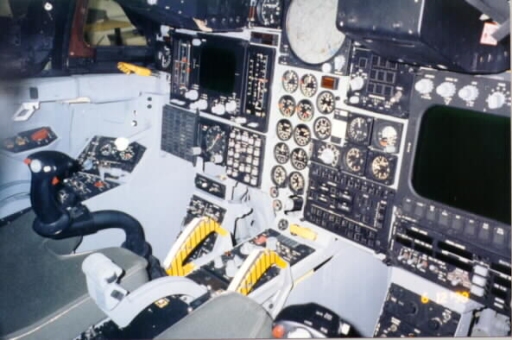 The seventies F-111D was the first digital F-111 variant, as well as being the first ever digital tactical fighter, fitted with a Rockwell Mk.II avionic suite and Norden cockpit display set. The F-111D cockpit included a "glass" ADI, combined moving map/TFR display, dual HUDs and a digital radar display which included frame freeze capability. Unique among USAF variants, the F-111D was designed with an intended air-air role, and was to have initially carried both AIM-7G and AIM-9J AAMs. In service, the aircraft was tasked with strike duties, as its sibling variants (USAF). FB-111A Cockpit @ FB-111A.net The cockpit of SAC's FB-111A was typical of the first generation of F-111 variants, and very similar in appearance to the original F-111C cockpit. The FB-111A used a Rockwell designed Mk.IIB avionic system, which shared the digital AN/AJN-16 bomb-nav system and AN/AYK-6 mission computer with the F-111D, but employed analogue attack radar and TFR displays common to the earlier Mk.I analogue avionic suite in the F-111A, F-111E and pre- Pave Tack F/RF-111C. The post AUP F/RF-111C cockpit will employ a pair of Multi Function Displays, and the Navigator's Pave Tack VID "hood" which is a combined radar and FLIR display (USAF). 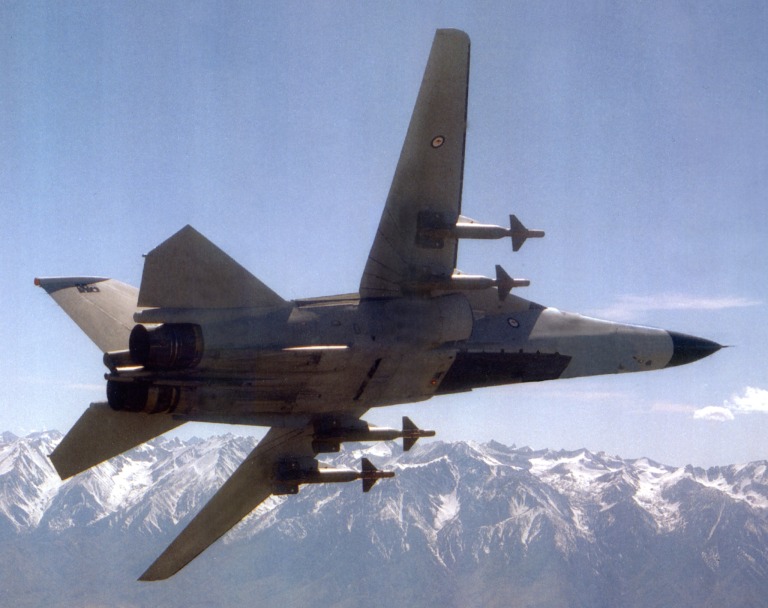 F-111C AUP prototype A8-132, resplendent in low visibility grey, takes to the air for the first time, in December, 1994. This was the first aircraft to be refitted, this performed at Rockwell's facility in California. All subsequent refits will be carried out in Australia, at RAAF Amberley. Flight test experience suggests that system reliability and accuracy will exceed RAAF design specifications (Rockwell). F-111C Crew Module The sixties design crew module of the F-111 airframe presented some interesting challenges during the design of the AUP upgrade. Packaging the new avionics required considerable effort, and the placement of the MFDs was to a large degree influenced by the availability of space behind the instrument panel. One cockpit MFD is placed below the Pave Tack "hood", the other left of the centre of the instrument panel, between the pilot's and navigator's station (Rockwell). F-111C Forward Electronics Bay Some idea of the complexity behind the AUP avionic refit can be gained by looking at the forward electronics bay (FEB) of A8-142, which is currently being worked on. While the most visible aspect of the upgrade are the new systems, it is worth noting that the refit will also see the replacement of much of the aircraft's complex internal wiring, with three dual redundant twisted pair Mil-Std-1553B mux busses (RAAF). Rockwell ICNIS The Rockwell-Collins ICNIS was designed for the F-111A, FB-111A and EF-111A to provide a single cockpit interface to the comprehensive suite of radio, IFF equipment and navaids carried by the aircraft. The Cockpit Display Unit (CDU) to the left provides a cockpit keypad and display, whereas the Bus System Interface Unit (BSIU) to the right contains a processor and Mil-Std-1553B bus interface. The RAAF WSSF environment will allow the RAAF to modify the substantial amount of software running on the BSIU processor (Rockwell). 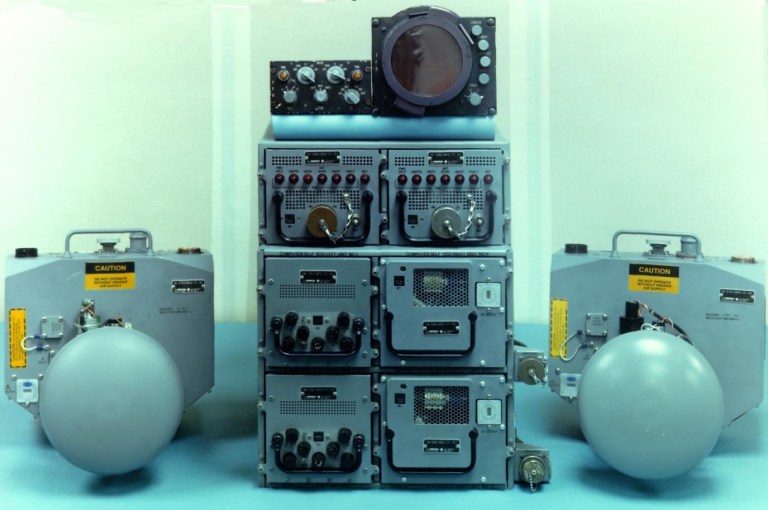 The new TI APQ-171 TFR is a substantial rebuild of the original APQ-110/128, and will provide the RAAF with 8 times the MTBF of the original design, this translating into a major improvement in support costs, operational readiness and safety during low level operations. The APQ-171 is frequency agile and thus far more difficult to defeat by hostile jamming. Hughes AXQ-14 The Hughes AXQ-14 Datalink pod is carried to support the pinpoint accurate Rockwell GBU-15(V) glidebomb, originally integrated with the F-111C during the eighties Pave Tack upgrade. The post AUP F/RF-111C will support the GBU-10, GBU-12 and GBU-24 laser guided bombs, the GBU-15 glidebomb, the new standoff weapon (AGM-130 or AGM-142), the AGM-84 Harpoon anti-shipping missile and dumb gravity bombs such as the Mk.82 and Mk.84. The ability to support such a diverse range of weapons, and integrate new weapon types in short timescales, is provided by the F-18 compatible Smiths Stores Management System (SMS). The SMS is software driven, and the RAAF WSSF environment provides full development support for the system (Hughes). |
|||
|
|||||||||||||
|
|
|
|
|
|
|
|
|
|
|
|||
|
|
|
|
|
|
|
|
|
|
|
|||
 |
|
|
|||||||||||
| Artwork, graphic design, layout and text © 2004 - 2014 Carlo Kopp; Text © 2004 - 2014 Peter Goon; All rights reserved. Recommended browsers. Contact webmaster. Site navigation hints. Current hot topics. | |||||||||||||
|
Site Update
Status:
$Revision: 1.753 $
Site History: Notices
and
Updates / NLA Pandora Archive
|
|||||||||||||
|
|
Tweet | Follow @APA_Updates | |||||||||||
|
|
|||||||||||||
|
|
|||||||||||||






