|
||||||||||||||||||||||
 |
||||||||||||||||||||||
![F-22A Raptor, FB-22, F-22E, F-22N and Variants Index Page [Click for more ...]](APA/f-fb-22.png "F-22A Raptor, FB-22, F-22E, F-22N and Variants Index Page [Click for more ...]") |
 |
![People's Liberation Army Air Power Index Page [Click for more ...]](APA/pla-air-pwr.png "People's Liberation Army Air Power Index Page [Click for more ...]") |
 |
 |
 |
 |
 |
 |
![Military Ethics, Culture, Education and Training Index Page [Click for more ...]](APA/ethx-culture.png "Military Ethics, Culture, Education and Training Index Page [Click for more ...]") |
 |
||||||||||||
 |
![Russian / Soviet Weapon Systems Index Page [Click for more ...]](APA/rus-weps.png "Russian / Soviet Weapon Systems Index Page [Click for more ...]") |
 |
 |
 |

|
 |
 |
 |
 |
 |
||||||||||||
 |
 |
|||||||||||||||||||||
| Last Updated: Mon Jan 27 11:18:09 UTC 2014 | ||||||||||||||||||||||
|
||||||||||||||||||||||
|
||||||||||||||||||||||
|
||||||||||||||||||||||
|
|
|
|
|
|
|
|
|
|
|
||||||||||||
|
|
|
|
|
|
|
|
|
|
|
||||||||||||
|
|
|||||||||||||||||||||
| Last Updated: Mon Jan 27 11:18:09 UTC 2014 | ||||||||||||||||||||||
|
||||||||||||||||||||||
| Pave
Tack and the GBU-15 Greatly Expand RAAF Strike Capabilities |
|||
|
|||
|
The Vietnam conflict saw widespread use of radar targeting in night or adverse weather conditions; though well suited to soft-skinned targets, this technique is limited in accuracy to around 100 feet and thus isn't ideal for hitting hardened point targets. Daylight attacks in the final phase of the conflict often utilised the Paveway laser guided bomb, with a miss distance of several feet, the weapon targeted by the AN/AVQ-10 Pave Knife TV/laser pod. The USAF was more than pleased with the performance of Pave
Knife, but was very unhappy about the inherent daytime only limitation
of the system. This led to the development of Pave Tack, an infra red
imaging laser target designator.
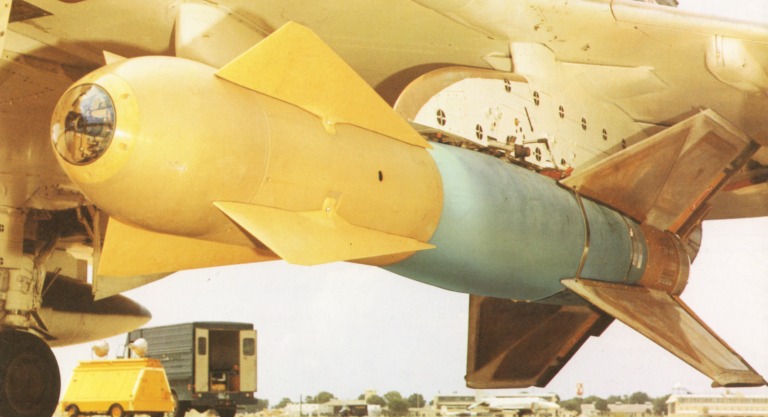
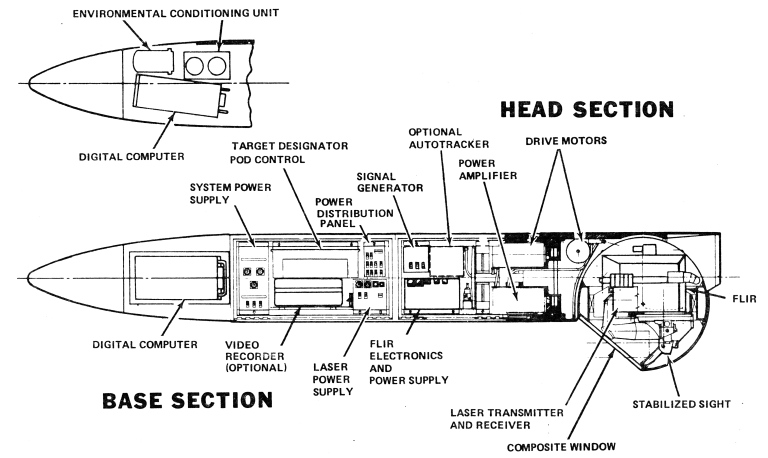
Pave Tack was initially destined to equip the F-4E, RF-4C, F-111E and F-111F in USAF service, however this has since been altered. The analogue F-111E did not receive the pod, and the Europe based USAFE receiving pods only for the F-111F and tactical recce RF-4C. Carried by an F-4 the pod is pylon mounted, the F-111 however employs a more sophisticated mounting, that being a retractable cradle mounting in the fuselage weapons bay. The Ford Aerospace AN/AVQ-26 Pave Tack was designed with performance in mind, above all. To that effect the USAF willingly accepted substantial increases in system weight to get maximum picture quality; to date Pave Tack has not been matched in that respect. Weighing 1280 lb, Pave Tack may be physically divided into two sections, a base section and head section (please see diagram). The head section is comprised of a roll turret with a �92 degree roll angle, the turret constraining the actual FLIR head which may pitch from O to 180 degrees. As a result the pod may view the entire lower hemisphere and small portions of the upper hemisphere. The FLIR head itself contains several systems, most significantly the Texas Instruments AAQ-9 FLIR assembly (see TE March '84). The AAQ-9 operates in the 10 micron IR band, with dual fields
of view of 7.5 and 2 degrees, with further 2X magnification if selected.
The FLIR window then mounts a yaw stabilised yoke, that in turn mounting a pitch stabilised mirror. The mirror is used to stabilise both the FLIR picture and the laser beams, that with an accuracy around 1 / 1000 degree, reference provided by gyros. The AVQ-25 laser designator/ rangefinder mounts on either side of the FLIR, the transmitter with its 1.06 micron solid state Nd:YAG optically pumped pulse mode laser and beam expanding/pulse modulating optics on the left, the receiver with its beam focusing optics and solid state avalanche diode optical detector on the right. Laser range is classified; the range error in rangefinding has been described as 10 ft rms. The laser range is though, far less than the 10 nm+ detection range of the FLIR, against large targets. Both the FLIR and laser equipment see the outside world through a large IR window, with two glass viewing ports for the laser systems. The base section of the pod drives the turret with a motor (just as the turret drives the head) and ring gear, both motors driven by power amplifiers mounted in the aft of the base section. Divided into three areas, the aftmost of which also contains the FLIR electronics, power supply and autotracker, the base section is quite densely packed. The central area houses the laser power supply, system power supply, pod control electronics (both operating mode control and stabilisation) and last but not least the video recorder, which turns Pave Tack into both a damage assessment camera and all weather photorecce tool. The forward area of the pod then contains the environmental control systems and the pod's digital computer. The computer is a 16-bit machine with a modest 32 kbyte of nonvolatile magnetic core memory, which is adequate for built-in-test tasks and the pod's internal housekeeping functions. In RAAF F-111Cs, which are devoid of digital computers, this machine will carry launch software for both the GBU-15 and particularly the AGM-84A Harpoon (most likely block ID) and will carry out the necessary launch sequencing tasks. The pod's systems are very modular, line replaceable units may thus be easily replaced at an intermediate level maintenance shop, such as the unit currently being equipped at Amberley. As is apparent, the pod is driven with digital
signals-controlling pod aimpoint, operating mode, laser mode and laser
coding, together with the analogue signals controlling the FLIR. This
has created problems for the RAAF, as the F-111C's analogue nav/attack
doesn't have available digital reference signals. This has forced the
need to custom design a system of interface circuits,
providing the necessary analogue/ digital, digital /analogue conversion
and clocking functions to tie the pod into the AJQ-20.
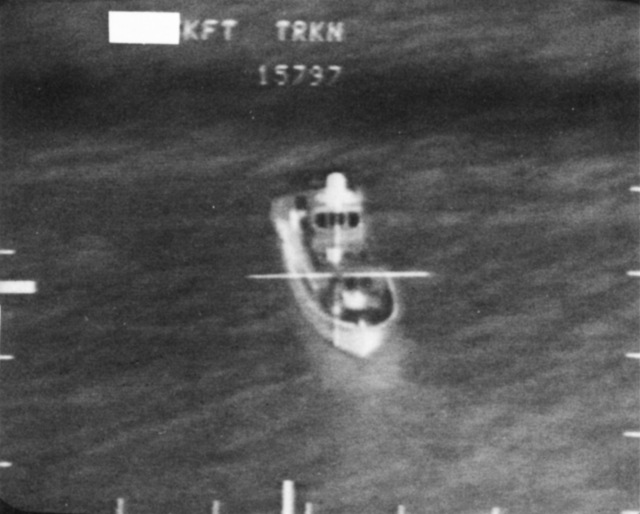
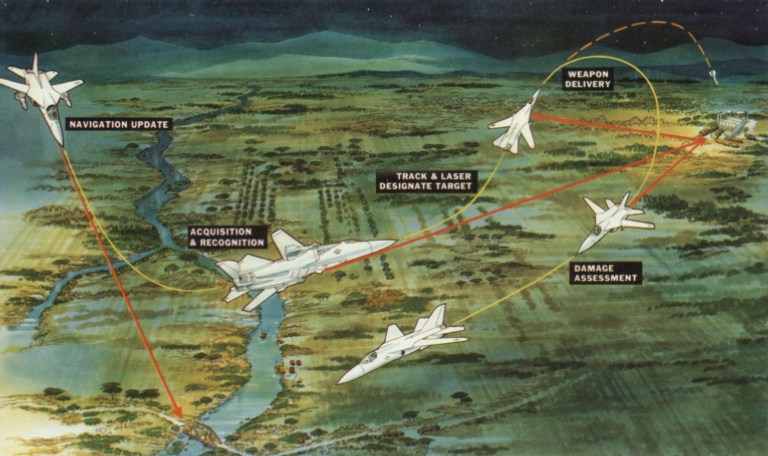
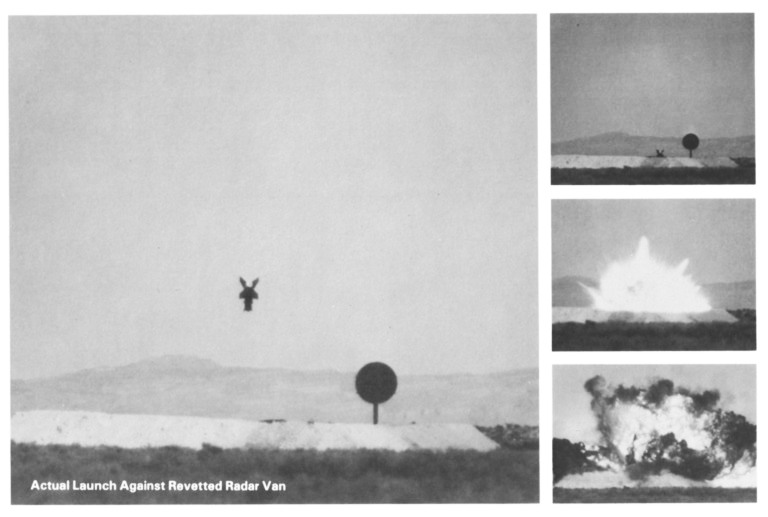
Pave Tack attack profile. Entering the target area, the Pave Tack pod is extended and cued onto a known geographical feature. The laser rangefinder is fired and the computer uses the precise position data to update the INS. The pod is again cued, now onto the target as estimated by the nav-attack system. The navigator will then take a close look at the target, to select the best impact point for his laser guided munitions. This could be a bridge support, a powerplant generator housing, an airbase runway or the command bunker of a SAM site. The Pave Tack crosshairs are placed on the impact point and the navigator initiates tracking, manually or with autotrack. At this stage the pilot will begin a pullup to loft the bomb, as commanded by the nav-attack system. The Paveway laser guided munition is released at a preprogrammed angle and continues to climb, having deployed its wings, along a ballistic trajectory. As this occurs the pilot completes his manoeuvre, turning away from the target while the navigator continues to track the impact point. The laser cannot be fired until the bomb passes the apex of its flightpath, and starts descending, otherwise the seeker would fly the bomb in a straight line toward the target and it would fall short. Once the bomb dives toward the target, the navigator may fire the laser, the seeker locks on and the bomb guides into the target. The whole procedure is recorded on the Pave Tack video recorder, for damage assessment and analysis. Pave Tack is then retracted and the F-111 exits the target area (Ford Aeronutronics images). Rockwell GBU-15. Turning toward a target, this USAF F-111F displays its deadly payload of two GBU-15s and their associated Hughes AN/AXQ-14 datalink pod. GBU-15 isn't cheap, at US$135,000 apiece, but even so is a cost effective tool when dealing with heavily defended targets. The USAF currently has well over 700 rounds in stock with an outlook toward a further increase; Rockwell apparently suggest a unit cost around US$60,000, given the USAF orders another 1300 rounds. The complete weapon weighs in at 2450 lb and some sources suggest up to 20 nm of standoff range, for a high speed launch. (via F-111.net)
The Pave Tack pod is mounted in a roll cradle, which in turn fits into the weapons bay, virtually filling it. The cradle rotates by 180 degrees to either stow the pod inside or extend it for operation, which takes about 5 seconds, and can be carried out at speeds up to Mach 1.4. Extended, the pod's drag cuts off 2 nm of range per minute of extension; retracted its drag is negligible. The RAAF is acquiring 10 Pave Tack pods, a sensible number in view of the 12 aircraft strong nominal strike force and high reliability of the pods. One would anticipate all aircraft but the RF-111Cs being fitted with the cradles and interface systems, allowing the selective fitting of pods to specific aircraft flying specific missions. Pave Tack has been in operational use with the USAF's 3rd Air Force since mid 1982, carried by the F-111Fs of the 48th Tactical Fighter Wing based at Lakenheath in the UK. This significantly increased the lethality of the aircraft in the high threat central European theatre; it is interesting to note that the USAF equipped all of its European F-models with cradles, maintaining though, a 2.5 to 1 aircraft to pod ratio, suggesting the use of the pods only on particular missions. Pave Tack will prove to be a valuable tool, extending the
effective lifetime of the F-111C's analogue nav/attack until a suitable
digital upgrade is carried out, aside from its inherent use as a
reconnaissance system.
Ford
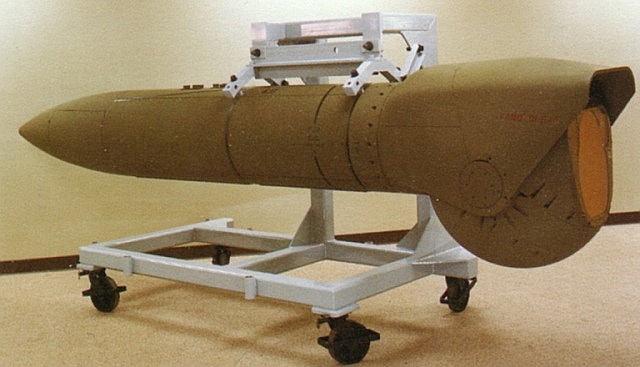
Aeronutronics image. Rockwell GBU-15 Cruciform Wing Weapon The GBU-15 modular glidebomb came into being as the result of the USAF's pressing need for a heavy weight standoff weapon. Though the Paveway laser guided bomb was effective it did
require line of sight to the target, similarly the HOBOS TV guided bomb
had range limitations. Neither weapon was suitable for low level
standoff release. The GBU-15 was the solution to the problem, conceived
as a modular weapon allowing the user the choice of seeker or warhead
(rather bomb body).
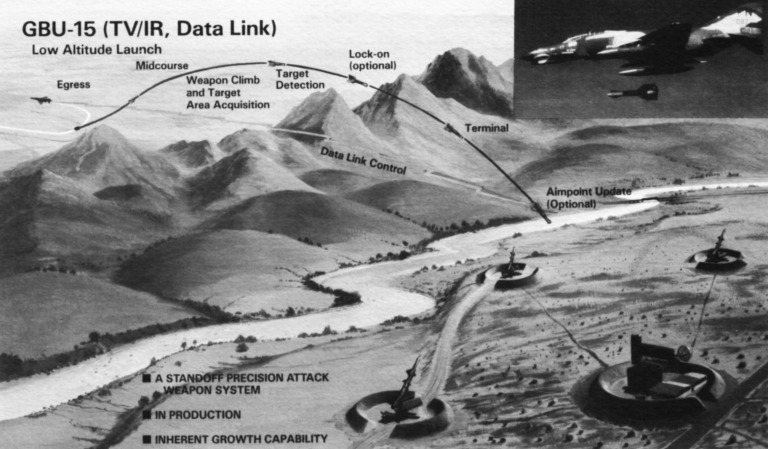
The weapon operates in two distinct modes, direct and indirect attack. In a direct attack the operator on board the launch aircraft views the scene observed by the camera in the bomb's nose on a head down display, he then steers a set of crosshairs onto the desired target and engages a contrast lock. The bomb is then released and glides into the target. The weapon's primary mode of operation is however, indirect
attack. To allow this, the bomb is fitted with a datalink receiver and
transmitter, likewise the launch aircraft carries a receiver and
transmitter in a pod. The transmission links use highly jam resistant
transmission techniques, allowing the bomb to transmit a TV picture to
the aircraft and the aircraft a series of commands to the bomb. In
executing an indirect attack, the aircraft lofts the bomb, preferably
from behind a natural obstacle. GBU-15 will then climb and glide along
a
programmed flightpath, its autopilot receiving midcourse updates via
the
datalink, until it reaches the target area. The operator may then steer
the crosshairs onto a target or part of a target, guiding the bomb in
that direction. The weapon may be locked on and use its contrast lock
for the terminal phase, but the operator may also steer the bomb
manually throughout the attack.
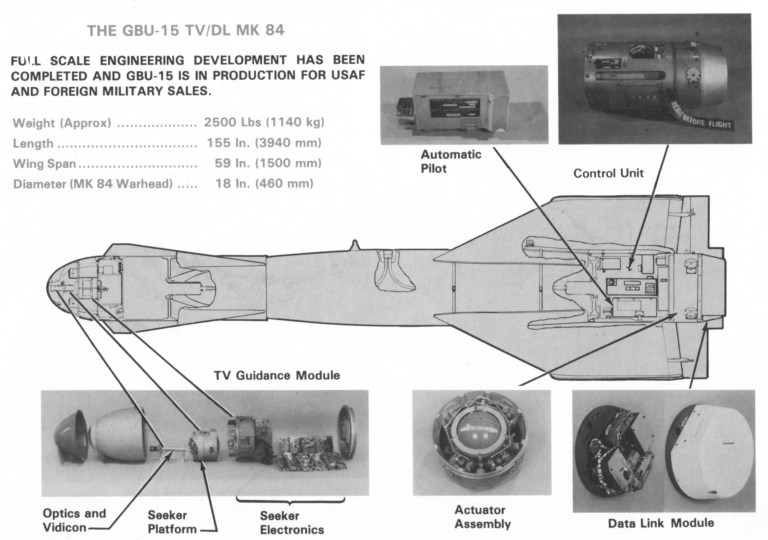
Alternately he may choose to change the exact impact point once the contrast lock is engaged. As is very apparent the weapon is exceptionally flexible in both delivery and configuration. The latter aspect is more evident upon closer examination. Physically the GBU-15 is divided into six modular assemblies. Starting from the nose, we find the TV guidance module, containing optics, a stabilised platform mounting a vidicon and all the electronics for processing the video, together with the contrast lock. This unit is interchangeable with an infra-red (IR) unit which allows day/night/adverse weather attacks. The day only TV unit is in production, the IR unit has been successfully demonstrated. Either unit is then followed by the guidance adapter, in
principle a cowl providing a smooth transition to the bomb body, fitted
with a set of four strakes. The bomb body then follows, that being
either a Mk-84 2000 Ib demolition bomb or an SUU-54 submunition
dispenser, the latter version of the weapon being in late development.
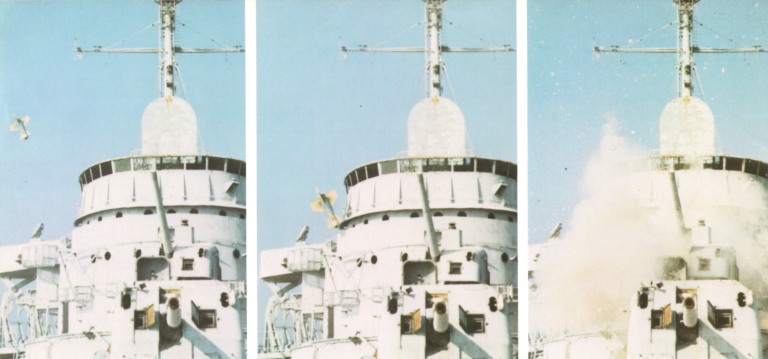
The rear section of the bomb then carries the control unit, that itself mounting the wings, control surfaces and the final assembly, the datalink unit. The control unit houses the autopilot, the gyros, batteries for power and the control actuators. The datalink unit then contains the receiver and transmitter electronics, facing aft. The GBU-15 thus allows the user the choice of both seeker and payload, tailored for a specific mission. Consider counter-air, night attack. The IR seeker combined with the Mk-84 would be used to attack the airfield, alternately the SUU-54 could be used with either cluster bomblets against parked aircraft or mines and penetrators against runways and taxiways. The basic TV weapon with the Mk-84, as acquired by the RAAF, is usually employed against hard point targets, be it bridges, command posts, bunkers, industrial complexes, or even shipping. The SUU-54 version is even more useful, ideally suited not only to counter air but also to anti-armour, anti-vehicular, anti-personnel and defence suppression missions. In terms of performance, the GBU-15 is cleared for supersonic launch and has been extensively tested in a hostile ECM environment, either aspect emphasising its inherent compatibility with the F-111C and its operating environment. The GBU-15 appears at this stage destined for a colourful
future, particularly in view of the current development of an extended
range version, with a ventrally mounted rocket sustainer which is
jettisoned after burnout. The increase in range would thus be subject
only to the burn time of the sustainer and limits of datalink range.
Whether this version eventually enters production, or is abandoned
along
the way, the basic concept of the weapon will remain - modularity. That
will ultimately ensure its survival.
Rockwell
International images. |
|||
|
|||||||||||||
|
|
|
|
|
|
|
|
|
|
|
|||
|
|
|
|
|
|
|
|
|
|
|
|||
 |
|
|
|||||||||||
| Artwork, graphic design, layout and text © 2004 - 2014 Carlo Kopp; Text © 2004 - 2014 Peter Goon; All rights reserved. Recommended browsers. Contact webmaster. Site navigation hints. Current hot topics. | |||||||||||||
|
Site Update
Status:
$Revision: 1.753 $
Site History: Notices
and
Updates / NLA Pandora Archive
|
|||||||||||||
|
|
Tweet | Follow @APA_Updates | |||||||||||
|
|
|||||||||||||
|
|
|||||||||||||