|
||||||||||||||||||||||
 |
||||||||||||||||||||||
![F-22A Raptor, FB-22, F-22E, F-22N and Variants Index Page [Click for more ...]](APA/f-fb-22.png "F-22A Raptor, FB-22, F-22E, F-22N and Variants Index Page [Click for more ...]") |
 |
![People's Liberation Army Air Power Index Page [Click for more ...]](APA/pla-air-pwr.png "People's Liberation Army Air Power Index Page [Click for more ...]") |
 |
 |
 |
 |
 |
 |
![Military Ethics, Culture, Education and Training Index Page [Click for more ...]](APA/ethx-culture.png "Military Ethics, Culture, Education and Training Index Page [Click for more ...]") |
 |
||||||||||||
 |
![Russian / Soviet Weapon Systems Index Page [Click for more ...]](APA/rus-weps.png "Russian / Soviet Weapon Systems Index Page [Click for more ...]") |
 |
 |
 |

|
 |
 |
 |
 |
 |
||||||||||||
 |
 |
|||||||||||||||||||||
| Last Updated: Mon Jan 27 11:18:09 UTC 2014 | ||||||||||||||||||||||
|
||||||||||||||||||||||
|
||||||||||||||||||||||
|
||||||||||||||||||||||
|
|
|
|
|
|
|
|
|
|
|
||||||||||||
|
|
|
|
|
|
|
|
|
|
|
||||||||||||
|
|
|||||||||||||||||||||
| Last Updated: Mon Jan 27 11:18:09 UTC 2014 | ||||||||||||||||||||||
|
||||||||||||||||||||||
| CRUISE MISSILES | |||
|
|||
|
Part
I
The Strategic Cruise Missile
One of the most insidious weapon systems ever conceived, the cruise missile is resurgent and as it appears will hold a significant place in the inventories of both the Free World and the Communist Bloc. After its initial debut in the form of the rudimentary but nevertheless deadly Fieseler V-1 the cruise missile slumped into obscurity, restrained by accuracy and range limitations imposed by the technology of the day. The USAF's Strategic Air Command (SAC) toyed with Cruise Missiles in the late fifties, but these were promptly discarded in favour of the ballistic missile. The Russians had more faith in the concept, developing a family of air launched weapons to arm the Bear, Badger and Blinder bombers. The ultimate Soviet answer to the problem was a fighter sized turbojet driven vehicle with a multi-Megatonne nuclear warhead to achieve some sort of target kill probability, given the limitations in the guidance system. This entire family of weapons was really developed to support the long range high altitude bomber, but as this delivery vehicle became less than viable due to advances in surface-to-air and air-to-air missile (SAM/AAM) technology, the weapons it carried suffered a similar fate (though it seems the Russians still maintain some of their earlier types in service). Emphasis was shifted to low altitude penetration, as evidenced by the deployment of the FB-111A, role revision of the B-52 and development of the B-1, protracted as it was. But technology advanced and the Soviets did eventually acquire look-down/shoot-down capable fighters and this together with advances in radar capability meant that the geriatric B-52, SAC's primary weapon, had little chance of successfully penetrating to heavily defended targets deep in the USSR, to launch its SRAM short range nuclear missiles. The new B-1A bomber was to have assumed the B-52's role, with a quoted 1/30 of the B-52's radar cross section, terrain following capability and very high dash speed. But the mid seventies saw the rebirth of the cruise missile, as inertial guidance, computer and propulsion technologies reached a level of development which allowed a new generation of these weapons. The Carter Administration, eager to gain political mileage, dumped the manned B-1A bomber in favour of rearming the B-52s with the new cruise missile. Conceptually elegant, use an established platform to deliver a large load of missiles to the perimeter of the Soviet air defence system, launch these in numbers sufficient to saturate the defences, and fly home. The missiles would enter Soviet territory, hugging terrain to further reduce their very low detectability, eventually hitting their preprogrammed targets with 200 kT nuclear warheads. The 1,500nm range cruise missile would do away with the need to do the deep penetration missions and thus allow retention of the existing B-52, saving on a new fleet of expensive bombers. In retrospect, it is apparent that the Carter administration
over estimated the true operational effectiveness of the weapon which
though useful could not, just as any single weapon cannot, provide all
the answers, so today we can see a revised B-1B in production to be
armed with a mix of the traditional SRAM missile and the new cruise
missile, flying a mission profile involving penetration and standoff
missile launches. The cruise missile itself has entered its next
generation in development, while still experiencing numerous teething
troubles, the Soviets respond ing in a two pronged exercise of
upgrading
their air defences with AEW and shoot-down capable air defence fighters
and deploying their bomber launched equivalent of the US' cruise
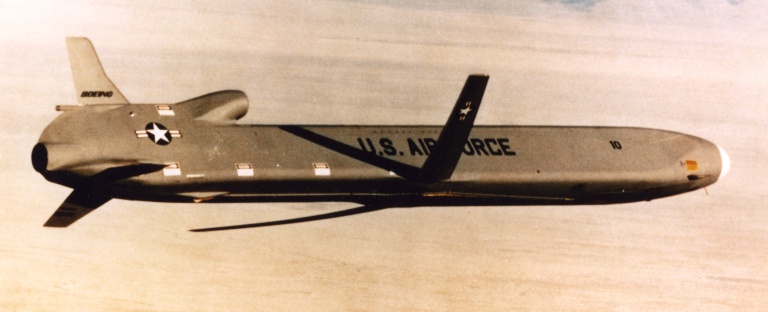
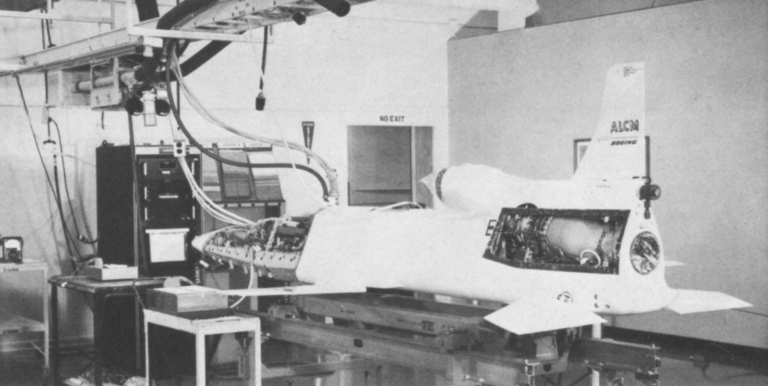
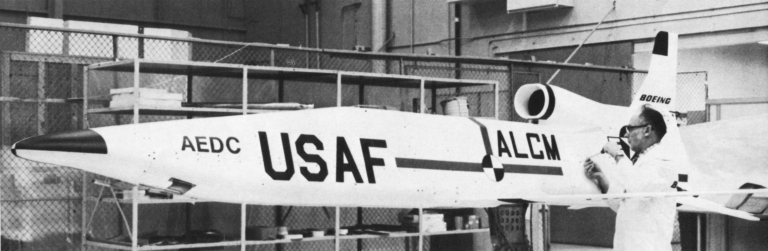
missile. An AGM-86A ALCM (Air Launched Cruise Missile)
undergoing
final pre delivery tests at the Boeing plant. Probably the greatest
benefit of the cruise missile in time will be the financial drain it
has
caused the Soviet Union through having to develop a whole new family of
expensive counter measures to combat the threat, thus taking money away
from offensive programmes (US Air Force images).
The Boeing AGM-86B Air Launched Cruise Missile (ALCM) First of the cruise missile family to enter service and
essentially the only dedicated strategic weapon in the family, the
AGM-86B is a generic development of the early seventies Boeing SCAD
program. That vehicle subsequently developed into the AGM 86A, which
was
supplanted by the longer ranged AGM-86B which became the operational
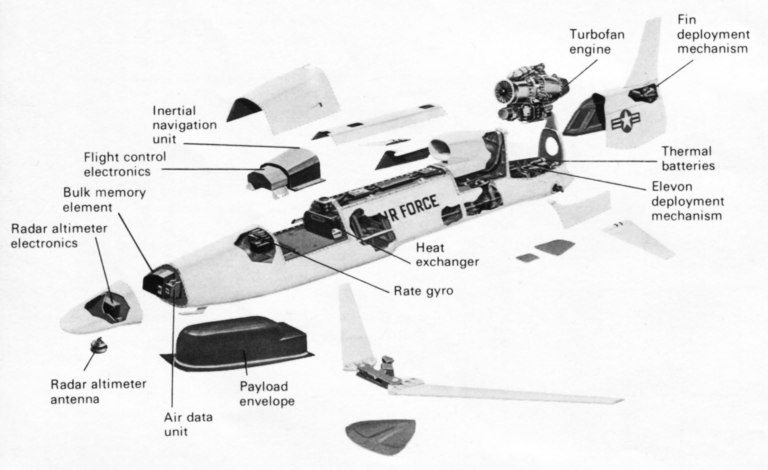
version of the missile. The Current AGM-86B is equipped with the basic TERCOM (Terrain Contour Matching) inertial guidance system and this also reflects in the vehicle's mission profile. A TERCOM equipped vehicle will employ an inertial navigation system (INS) to find its way to the target, however the INS will accumulate a position error with time and this error must be eliminated or reduced if the weapon is to have any sort of useful accuracy. TERCOM does exactly that. The TERCOM system uses a radar altimeter and barometric altimeter to measure the profile of the terrain beneath the aircraft. This information is then compared with stored terrain profile information within the memory of the TERCOM computer to yield a position update. The update is then fed into the INS. The exercise of measuring and matching the terrain profile is carried out only several times during the weapon's flight, this provides sufficient accuracy while limiting the size of the computer memory required to store the terrain maps. The missile is loaded with its position and a file of terrain maps for its flight prior to launch, it is then fully autonomous. It will hug terrain at several hundred to a thousand feet, following a very indirect flightpath through hostile territory, this serves to confuse the defenders as to the exact nature of the target, alternately the flight planner may route the flightpath to avoid known early warning and air defence facilities. The AGM-86B is a 20ft 10.5 in (6.3m) vehicle weighing in at
3,1501b (1,420kg) at launch. Most of the airframe is occupied by the
four fuel tanks which feed the powerplant. That is a Williams
International F107 600 lb thrust class low bypass ratio turbofan,
weighing about 1501b (68kg) and occupying the last three feet of the
airframe. The engine mounts above the set of actuators for the
vehicle's
folding elevons, the tailpipe is shielded by a tailcone which
conceivably blocks infrared emissions from the engine hot end. The use
of a turbofan is advantageous in that it does provide better fuel
consumption than a turbojet, with a reduced infrared signature. The
penalty to be paid is in the thrust limitation, which will force the
vehicle to follow terrain with larger clearance (see June 1984 issue,
Terrain Following).
This tradeoff of signature vs thrust was presumably made in the earlier phases of the weapon's development, when Soviet lookdown radar capability was far lesser. It has since been identified as a major limitation in this weapon's penetration ability and is to be rectified in a $300 million engine upgrade program which will provide a new compressor, combustion system and ignition system. The result should be a 40% thrust increase (SL) to improve terrain following performance in the 100ft altitude region, a speed increase to 0.65 Mach and several hundred miles of extra range. Other than the powerplant, the tail region of the vehicle also houses a thermal battery and the small #4 fuel tank. The engine inlet is on the top of the fuselage, usefully shielded from GCI radars by the airframe. The fuselage of the vehicle, from the rear propulsion section to the forward payload/control section, is roughly equally split into three fuel tanks, #3, #2, #1 from tail to nose. Prior to launch the vehicle's wings, elevons and vertical stabiliser are stowed, they deploy upon release from the launch aircraft. The spine of the fuselage carries the control/instrumentation cables from the nose to the propulsion section. The instrumentation bay houses then the INE (Inertial
Navigation Element), Flight Controller and Radar Altimeter. Aft and
below the instrumentation bay is the payload bay, housing the W-80 200
kT nuclear device and its arming mechanism. The vehicle's nosecone
underwent modification in the early production phase, transitioning
from
the flattish shark nose to the rounded beluga nose, apparently to
reduce radar cross-section. In spite of the fact that the ALCM airframe
was not optimised for minimum radar signature, either in shape or
materials, it has a small cross section which will apparently be
reduced
by the use of stealth technologies in future upgrades. The USAF is also
considering the use of chaff and flare dispensers to further improve
survivability.
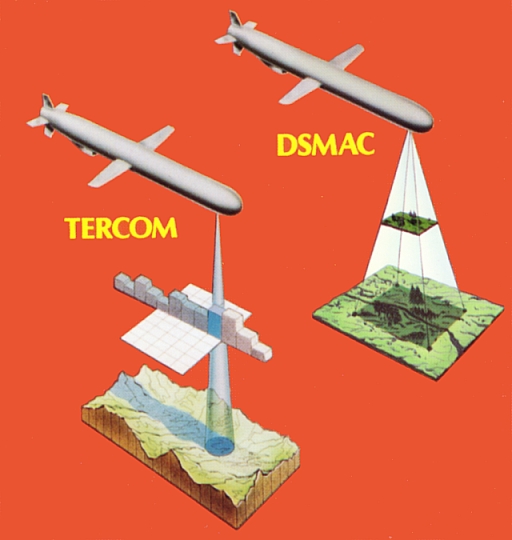
TERCOM
generates position fixes by sampling terrain height using a radar
altimeter, and then correlating the elevation profile against a digital
elevation map in the missile guidance system's memory. DSMAC performs a
correlation between a stored image and snapshot of the terrain beneath
the missile to generate a position fix (General Dynamics).
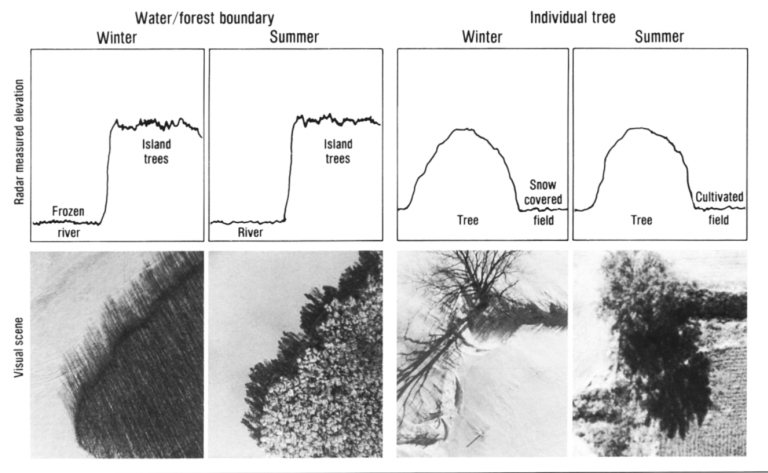
The ALCM Guidance System The core of the ALCM's guidance system is the Litton LN-35 inertial navigation unit, built around a P-1000 inertial platform. The P-1000 uses two dry tuned rotor gyros and three accelerometers (see June 1984, AJQ-20 BNS, F-111C description for INS operation), the set has a combined drift error rate of 0.6nm/hr (the drift error develops through the combined inaccuracies in the gyro and accelerometer pickoffs, mechanical tolerances friction and presumably also A/D quantisation errors, and as such is intrinsic to all conventional inertial platforms). The inertial set is complemented by a TERCOM computer and Honeywell radar altimeter. The radar altimeter, designed with power management, minimised sidelobes and variable PRF (pulse rate) for low detectability, is used to generate a continuous stream of altitude readings. These are used throughout the flight for terrain following, furthermore while the missile is over a known mapped area, they are subtracted from the barometric altimeter reading to generate terrain elevation readings. The mapped areas are stored as MxN matrices of point elevation readings (further matrices) in the computer memory. The terrain contour matching is then carried out by the computer, which takes the series of height readings and uses a mathematical algorithm to find the best fit of the flightpath/position in the matrix (map) and thus determines the position of the vehicle with some known (subject to the quality of the altimeters and maps) error. This position information is then used to reduce the inertial set's error. To get the best possible update, the computer uses a technique termed Kalman filtering. The Kalman filter is a mathematical algorithm that, accounting for the INS errors and TERCOM matching errors with a mathematical model, allows optimum mixing of the inertial set's reading and the TERCOM system's reading. Thus the Kalman filter will take readings from both systems to enable the calculation of a better position estimate, which is then loaded into the inertial set. One of the nicer aspects of this technique is the fact that the algorithm apparently calibrates against the gyros, as with each updating it gets a better and better idea of what the particular gyros drift rates are. Furthermore, the matrices become finer and finer in resolution as the missile nears its target.
Thus the TERCOM guided missile becomes more accurate the closer it gets to the target (see Gelb A., Sutherland A.A.; Software Advances in Aided INS, Navigation, Vol. 17, 70/71). As is intuitively obvious, the TERCOM system performs best over rugged terrain and is useless over ocean. In operation the ALCM would fly on inertial guidance between individual matrices, where it updates its position and changes heading if required, therefore it is only really necessary to have a series of well known rugged/unique areas which can be used as matrices. Critics of the cruise missile have focussed strongly on the TERCOM system. The first target was the radar altimeter, allegedly easy to detect and jam. The second target was the software/system error. Northern Siberia is very flat and covered with annually variable ice therefore critics believe that uniqueness cannot be guaranteed. The TERCOM system does have built in measures to deal with fix problems, specifically it will take three TERCOM fixes and check if at least two of the three agree in position before it commits itself to an update of the inertial set. Only if no agreement can be found will the missile degrade down to pure inertial guidance, disarm itself and function as a decoy, effectively. One option under review as an alternative to TERCOM is the use of the Navstar Global Positioning System (GPS) L-band satellite navigation system. GPS offers 15m positioning accuracy virtually worldwide and would eliminate the need for a costly global mapping exercise. On the other hand it can be jammed and many SAC commanders are apprehensive about the ability of the 18 satellite constellation to survive the initial phases of a nuclear exchange, not to mention the GPS receivers coping with atmospheric phenomena and EMP effects. Two Tomahawk cruise missiles have been fitted as testbeds for GPS, though little has been published on test results to date [Editor's Note 2005: GPS was introduced using a single channel receiver, it was replaced during the 1990s with jam-resistant multi-channel receiver.]. Another option being developed at this stage is a Laser Terrain Following Radar. Laser based radars have been tested in the past, using eg C02 lasers and offer both precise narrow beam pointing and precise range gating. The USAF funded development program envisages the use of a high range resolution laser radar for cruise missile terrain following, navigation and terminal targeting. Hughes Aircraft are currently involved in the 42 month advanced development phase for the system, General Dynamics will be providing a Tomahawk flight test vehicle. Each B-52G will carry 12 ALCMs externally and 8 more on a bomb bay mounted rotary launcher. The ALCMs only deploy their small wings and tail when released from the launch aircraft. All 168 B-52Gs will be AGM-86A armed while the eventual 100 strong B-1B force will also be equipped with this and the Advanced Cruise Missile (US Air Force).
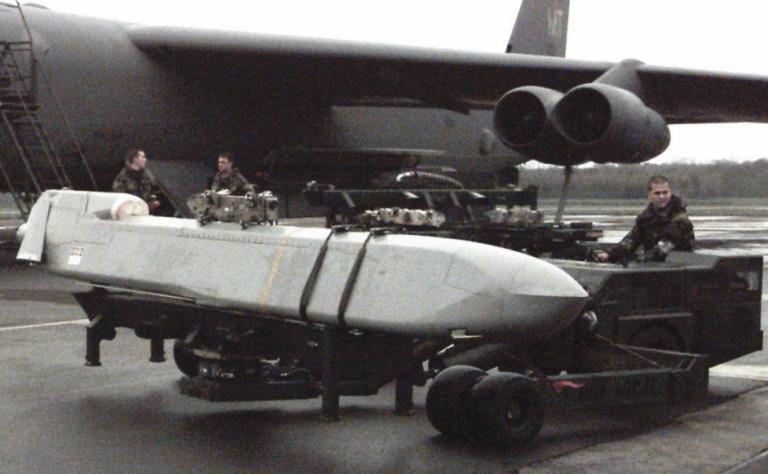
Earlier demonstrations of laser radar have shown the ability to easily resolve objects such as wires, power lines, telephone poles and trees. With sufficiently powerful signal processing this information can be exploited both for very low level terrain follow ing, TERCOM and target recognition from its geometry. Limitations may however exist due to atmospheric absorption under some (eg water vapour laden) conditions. ALCM/Launch Vehicle Interface The AGM-86B is currently carried by the Boeing B-52G bomber and will also equip the Rockwell B-1 B bomber. The SAC B-52s carry twelve ALCMs, six per underwing pylon and will eventually carry a bomb bay mounted internal rotary launcher with another eight rounds. This launcher, termed the CSRL (Common Strategic Rotary Launcher), is compatible with ALCM, the current SRAM defence suppression missile and the future ACM (stealth cruise missile) and AASM (Advanced Air-Surface Missile, SRAM replacement). The B-1B will carry ALCM internally on its CSRL and also externally, twelve rounds carried tangentially attached beneath the fuselage; flanking the aft bomb bay, forward bomb bay and flight deck access well. The Northrop ATB 'Stealth Bomber' will also be fitted with the CSRL. The ALCM/Launch vehicle interface is typified by the installation being developed for the B-1B. The Boeing designed OAS (Offensive Avionics System) is built around an IBM AP-101F 16-bit computer, which ties into two Sundstrand data transfer units and the ALCMs. The OAS will load the terrain matrices (up to twenty) into the ALCM prior to launch, the IBM computer having the ability to communicate with each missiles LN-35 INS and computer to provide the OAS operator with exact status information on each round. Though currently limitations in the number of available matrices apparently restrict targeting to a set of prebriefed targets, SAC's eventual objective seems to be the ability to select targets at will if necessary at the discretion of the launch aircraft crew. Once the matrices and flightpath/target data have been loaded into the missile, it is ready for launch. Once the launch aircraft reaches its release point, the LN-35 is updated with the final position supplied by the bomber's nav/attack and the missile can be launched. Mission Profile In the event of a SAC strike against the USSR, the ALCM armed B-52Gs (later also B-52Hs) would scramble from continental US airbases and head for the Russian coastline. Typical approach paths would be over the North Pole as the far North of Russia is sparsely populated and thus difficult to effectively monitor. The aircraft would cruise at high altitude until several hundred miles from the Russian coastline, where the large GCI radars come into play. To elude these, the B-52s would descend to a low altitude and activate their ESM/ECM systems. In theory this would allow them to approach to within 200nm of the coastline, where they would launch the ALCMs. This tactic would certainly apply to attacks on targets within the Leningrad-Moscow-Kuybyshev-Sverdlovsk arc, with weapon release over the Barents sea. Aircraft targeted for the Sverdlovsk-Novosibirsk-Irkutsk zones, including the Abalokovo battle management radar and ICBM fields, would presumably cross the Russian coastline between the Taimyr Peninsula and Bering Straits, hitting PVO and C3 installations on the way in, using SRAM missiles (200kT). They would release their ALCMs over the Siberian landmass. One would presume this attack profile would also apply to strikes on Far Eastern targets, with a convenient approach over land mass rather than ocean. The ALCMs would after launch, be it over ocean or land, head for their initial matrix and update. The first matrix is very coarse and is quoted at 26nm, successive matrices are smaller and smaller, the terminal matrices being described by some sources as a mere 1 nm wide. The weapon would then zig-zag along from matrix to matrix, penetrating deeper and deeper. Presumably it would avoid PVO defences and populated areas, approaching its target from a bearing least convenient to the defender and probably with little or no warning. Only 85% of prospective targets can be hit from offshore launch zones and it is certain that many aircraft would be expected to penetrate. It was that limitation in the weapon's range that prompted SAC to reinitiate the B-1B, which would upon introduction take over the penetration role, leaving the B-52 with only the standoff launch role. SAC intends to arm 168 B-52Gs with the ALCM and all B-1Bs,
though it is not clear at this stage how many of the B-52Hs may be
armed. As one can see, a full scale strike would present the Russians
with a sizeable headache, to the tune of several thousand terrain
following missiles.
The Russians have responded strongly, they have deployed the new S-300P/SA-10 SAM, phased array air defence radars, the Il-78 / A-50 SUAWACS airborne early warning platform, the new MiG-31 Foxhound and Su-27 Flanker fighters, both with lookdown radar and shootdown missiles. The vigour with which they have pursued the development of their AWACS illustrates the importance they place upon the cruise missile. One could presume the ultimate goal would involve setting up an AEW barrier along the Northern coast of European Russia, to hit launch platforms and incoming missiles over the ocean, together with AEW cover for key Siberian and European targets. Another move involves the deployment of Russian ALCMs [RKV-500/Kh-55], carried by the massive Blackjack bomber and the trusty Tu-95 Bear, this is currently being countered by increased US deploy ment of AWACS and F-15 aircraft from continental US bases. Over-The-Horizon (OTH) radar and orbital infrared surveillance platforms are both currently under review as options for early detection of incoming cruise missile carriers, prior to handoff to the AWACS/interceptors. Though the ALCM has had numerous teething troubles, both in software (resulting in the recent flight tests over Northern Canada serving to acquire calibration data on flat polar terrain performance and Coriolis effect compensation) and in powerplant performance, it is an effective system. Not every target will have the optimum set of defences or the appropriately 'non-unique' terrain profiles along its approach paths. The current development of the General Dynamics ACM (Advanced Cruise Missile) is bound to create further problems for the Russians. This composite/polymer skinned/structured missile, equipped with a low heat signature Williams International F112 engine will offer a 40% range increase over the ALCM, at a fraction of the ALCM's radar and IR signature. Whether it will use TERCOM or GPS is not clear at this stage, it is though expected to carry extensive ECM and ECCM systems. The ALCM achieved IOC in December 1982, production was cut in April 1983, bringing the total to 1,700 rounds at $4.3 billion. SAC plans to further acquire 1,300 ACMs, with a projected IOC of 1989. The deployment of the ALCM has had a considerable effect in increasing the US' ability to hit the Soviet hinterland - deployment of even partial defensive measures has cost the USSR considerably and if continued is certain to further resources from offensive weapons programs [Editor's Note 2005: it ultimately became a key factor in the bankruptcy of the Soviet Empire]. The overall significance of the ALCM is however far lessened when one considers also the effects of submarine and ground launched theatre nuclear cruise missiles, weapons of comparable capabilities with very flexible modes of deployment. These together with conventional derivatives of the cruise
missile family will be the subject of Part II.
Part II 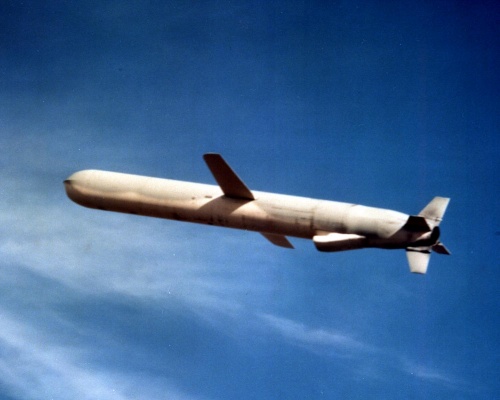
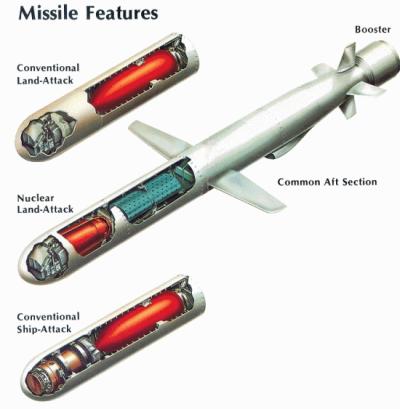
The impact of this family of weapons has been and will continue to be significant, as the USSR has little choice other than to spend on advanced air defence and early warning facilities. It is hardly surprising therefore that the Soviets have engaged in an unprecedented propaganda campaign to stop deployment of these weapons, as propaganda is intrinsically cheaper than buying AEW/AWACS platforms by the dozen. The vehicle central to this whole issue is the Tomahawk cruise missile or rather any one of its numerous derivatives. A very compact missile, the Tomahawk lost to the AGM-86 ALCM in the USAF's quest for an air-launched strategic cruise missile, but instead picked up the ultimately more significant roles of the Ground Launched Cruise Missile (GLCM), the Sea Launched Cruise Missile (SLCM) and the joint USAF/USN MRASM (Medium Range Air-Surface Missile). The latter roles have in particular resulted in a series of warhead/airframe/guidance derivatives which are certain to keep General Dynamics', the prime contractor's and McDonnell Douglas', the guidance subcontractor's, production lines running for some time yet. The General Dynamics AGM/BGM/RGM-109 Tomahawk Developed in the seventies as GD's answer to the Boeing ALCM, the Tomahawk although functionally similar to its competitor is aerodynamically and structurally a very different beast. The Tomahawk was designed from the very beginning to coexist with a naval multimission environment, this reflects in the airframe shape and structural modularity of the vehicle. These two attributes offered a basing/role flexibility, albeit gained at the expense of flat-out maximum speed, which not only secured the weapon's future in the naval arena but also won it the role of the GLCM. The basic Tomahawk is a 21 ft (6.4m) vehicle with a launch weight in the 26001b (1200kg) class, subject to specific missile version. The missile airframe is essentially circular in cross section from nose to tail, with most of the structural modules being cylindrical in shape. The aftmost section of the Tomahawk is the tailcone, which houses both the control surface actuators, these driving the four symmetrical folding control surfaces, and the powerplant. Here is where a difference does exist between the basic Tomahawk and its air launched MRASM derivative. The baseline Tomahawk is fitted with a 600lb thrust class low bypass ratio Williams International F107 turbofan, common also to the ALCM (see Sept TE, Strategic Cruise Missiles). As the Tomahawk is somewhat lighter than the ALCM, the thrust-to weight-ratio limitation due to the use of this powerplant is not so apparent. The MRASM missile is then fitted with a Teledyne CAE variable speed turbojet, also 6001b class, somewhat thirstier but far cheaper (cca 60%) than the turbofan. The powerplant thrust line is depressed by several degrees and offset below the longitudinal axis of the missile. Forward of the tail cone is the cylindrical aft body section of the weapon, it houses the ventral engine inlet/inlet duct assembly in all versions. Prior to launch the inlet is flush with the missile's skin, but deploys upon reaching a programmed point in the launch sequence. In MRASM the upper half of this section houses the TERCOM, INS and central computer, in baseline Tomahawk situated in the nose. The aft body is then mounted on the missile mid-body section. The mid body is split into upper and lower halves (containing JP-10 fuel), with a wing stowage space between them. The pop-out wings pivot at the front of the mid-body ends just forward of the wings' leading edge and at this point the forward module section mounts to the above basic airframe.
In the nuclear versions of the missile, the rear half of the
forward module contains a fuel tank, the forward half a W-84 200 kT
tactical nuclear device and the guidance electronics in the nose.
Conventionally armed Tomahawks and MRASMs carry a large WDU-18/B 10001b
HE warhead, as used in the obsolete Bullpup missile, or a submunition
dispensing payload bay. In either instance this is at the expense of
fuel tank volume and results in a major reduction in range. The
immediate nose section in the MRASM houses only the terminal guidance
electronics. In those Tomahawk versions which use TERCOM aided INS for
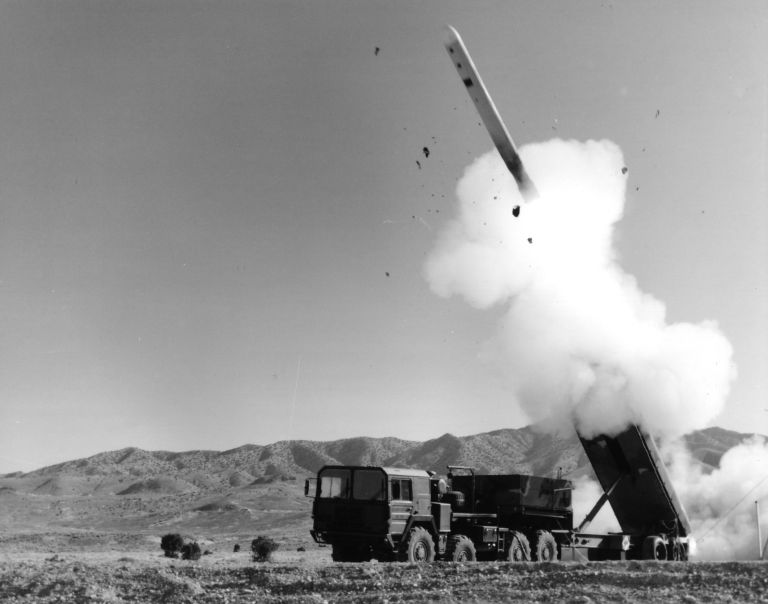
guidance, the guidance system is common with that of the AGM-86 ALCM. The General Dynamics BGM-109G GLCM The ground launched GLCM is the best known of the Tomahawk family due to both the political upheavals associated with its deployment and due to staggering program development cost overruns. The GLCM was conceived in the seventies to enhance the theatre nuclear strike capability of the USAFE, essentially limited to the F-111 wings in the UK. The requirement grew in urgency very rapidly, as the Soviets deployed the SS-20 Intermediate Range Ballistic Missile, The SS-20 is essentially a scaled down MIRVed ICBM (some sources suggest it was in fact derived from an ICBM airframe utilising both the payload, guidance and upper stages of the original missile), as such it has the capability to deliver three Megatonne class nuclear warheads from Western Siberia to Western Europe, with a respectable CEP (miss distance). A BGM-109C Ground Launched Cruise Missile bursts out of its launcher. The GLCM provides NATO theatre nuclear commanders with a precise retaliatory weapon capable of striking 1500nm deep into Russian held territory. Already deployed, it is an effective deterrent to the Kremlin's SS-20 IRBM strike force which now number nearly 400 units targeted on Western Europe alone (US Air Force). The missile is carried on a mobile launcher which is also air transportable in a C-5 class transport. Without intercontinental range it is exempt from ICBM limiting treaties and once field deployed out of its hardened base shelter, is extremely difficult to locate and thus near impossible to knock out in a pre-emptive strike. With a flight time far lesser than that of ICBMs targeted for the US, the SS-20 provides the Soviet theatre nuclear commander with a very rapid surgical strike capability against any European target (or if deployed in Vietnam as suggested by some sources, against any Northern Australian target). Initial US plans called for deploying single GLCMs towed by light vehicles, but this soon yielded to the idea of four round launchers, operated in flights of four launchers. This arrangement was finally adopted by the USAF. GLCM flights are based each in a hardened concrete shelter, theoretically impenetrable to conventional PGMs. Each flight has thus four Transporter Erector Launcher (TEL) units and is controlled by two Launch Control Centers (LCC).
The TEL is a 56ft (16.9m) semi-trailer, the forward third of which is an armoured Forward Equipment Box, containing a generator and launch interface electronics. The remainder of the TEL trailer is then the hydrauli cally raised four round launcher. The 57ft (17.3m) LCC trailer is the nerve centre of each GLCM flight. LCCs provide nuclear, biological, chemical (NBC) protection for the two operators and house the launch control computers a software target library and HF, VHF, UHF, satellite, landline communication equipment. GLCMs can be targeted and launched only from the LCC, the TEL electronics allow disarming only. The TELs are tied into their LCCs with optical fibre EMP immune cables. Both the TEL and LCC weigh around 80,000 Ib (36 tonnes), both are blast and small arms hardened, both are air transportable by C-141 and C-5, and both are towed by a common eight wheeled 400 HP V-10 10-ton diesel tractor. Prior to launch the actual launcher is raised and the rear blast doors opened, the missile is fired from its tube with a 7,000 lbf class Atlantic Research Corp solid propellant booster, breaking through a tube cover and climbing until sufficient speed is attained for wing/control/inlet deployment and engine startup. It then descends to a programmed altitude, locks on to a heading for its initial TERCOM matrix (see Sept TE, ALCM) and follows the characteristic attack profile of the TERCOM guided cruise missile, flying from matrix to matrix until its target is reached, where the W-84 is then airburst at a programmed altitude. The GLCM has comparable range to the ALCM at 1,500nm (cca 2,500km) but is marginally slower at 485kt against the 530kt of the ALCM. In the event of 'increased readiness', the TELs and LCCs would deploy out from their shelters, splitting into two groups each with two TELs and an LCC, and disperse by road to presurveyed launch sites within 100 miles of the shelter. Opera tionally the weapon has had few of the TERCOM related problems of the ALCM essentially because the mountainous terrain of Eastern Europe is unique and well mapped, the biggest problem surfacing with the GLCM being the excessive program cost of the order of $4,000 million (virtually a whole order of magnitude against initial estimates). The GLCM offers an identical mode of deployment to the SS 20 with all of the inherent immunity to a pre-emptive strike (unless of course a fifth columnist followed the convoy to its dispersal site...), but compared to an SS-20 it is far inferior in throw weight and response time and thus is really no more than a retaliatory deterrent weapon [Editor's Note 2005: subsequent disclosures identified numerous Russian civilian participants in the protest movement to be junior Spentznaz officers]. Even so the Russians are uncomfortable about it, SS-20 is easily detectable and can be hit (in theory) with Patriot class SAM/ABM missiles, whereas the GLCM is quite difficult to detect and equally difficult to hunt down. With the ability to hit moderately hard targets in the Moscow
area from West European bases the GLCM has quite considerable deterrent
value, the manner in which the Soviets responded to its deployment eg
initiating large scale antinuclear hysteria throughout Western Europe
testifies to this convincingly. The USAF intends to deploy 29 GLCM.
flights in Europe by 1988, most of these based in the UK, Italy and
West
Germany. IOC was attained initially in December, 1983, at Greenham
Common in the UK.
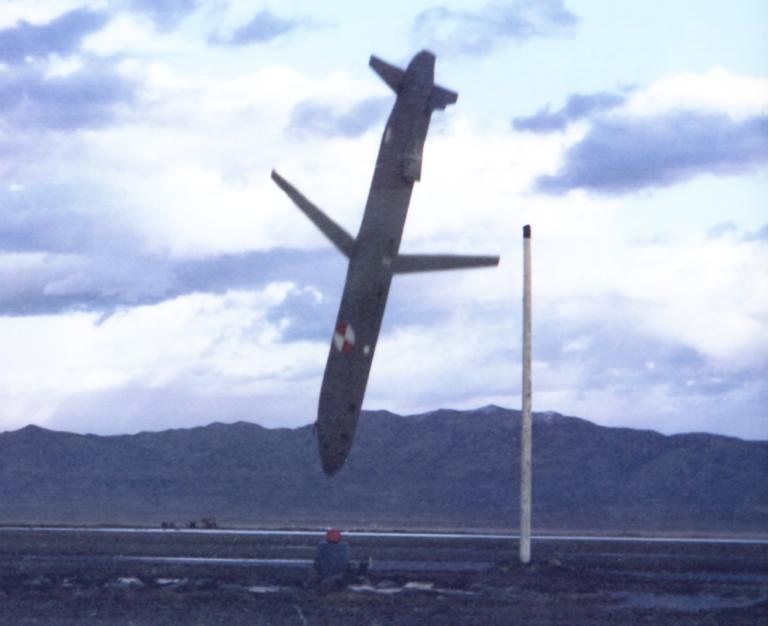
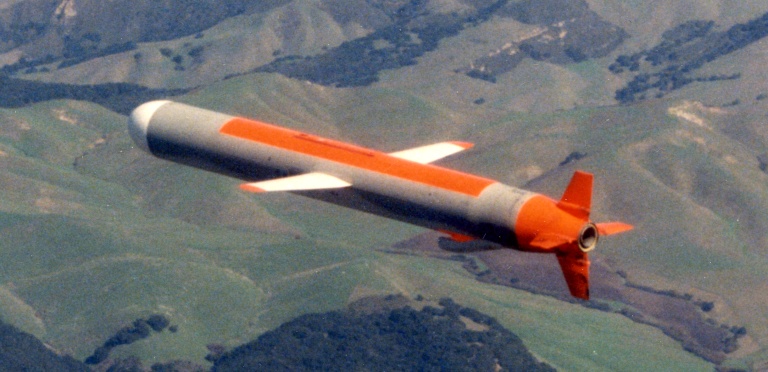
The General Dynamics RGM-109A/B/C/D SLCM The SLCM cruise missile family satisfies many of the US Navy's diverse surface attack needs. Initial studies for the submarine launched Tomahawk began in 1972, the missile first flew in 1976. The weapon was originally intended for launch from the torpedo tubes of nuclear attack subs, however the weapon's launching modes and payload/range characteristics have since diversified. At this stage four launching modes are anticipated or in use. Torpedo tube launch is currently used with SSN-637 and SSN-688 class attack subs, but newer 688 class vessels from 719 on are expected to carry twelve vertical launch tubes in the forward ballast tanks, freeing space for torpedoes or Harpoon rounds. Armoured box launchers are currently in use with surface vessels, the DD-963 class and the Iowa class (eg New Jersey) being fitted. The DD-963s are to however undergo a future refit, with Vertical Launch System (VLS) installations, SLCM/ Harpoon/Standard compatible with rapid launch/reload capability. The same installation will be used also on the newer CG-47 class Aegis cruisers. One of the reasons why the USN strongly favour the VLS is that it is virtually impossible for a potential opponent to establish, eg through observation/recce, the nature of the vessel's weapon mix. Furthermore a failed launcher cannot disable the weapon system as in eg FFG-7 class vessels. The SLCM is equipped with the same 7,000 lb launch booster as the GLCM, the launch sequence is virtually identical aside from torpedo tube launch where a steel protective shell is discarded upon leaving the tube. The nature of the weapon's attack profile will however depend on the specific type of guidance and warhead fitted. Cruising above the Mojave Desert, this BGM-109 Tomahawk passes a cement factory, a potential wartime target. With Australia's sparse infrastructure and virtually non-existent early warning and surveillance facilities, submarine and air launched cruise missiles represent a considerable threat to isolated civilian and defence facilities. The RGM-109A TLAM/N (Tomahawk Land Attack Missile/Nuclear) is virtually equivalent to the USAF GLCM employing both the TERCOM guidance and 200kT warhead of the ground launched weapon. Though this missile was initially intended to perform a strategic role it was subsequently decided to the role into theatre nuclear strike and strategic reserve. As such it would be employed primarily against high value land targets such as airfields, missile sites and naval installations, the weapon providing the USN with its desired surgical capability against post-nuclear exchange targets and with a flexible tool for use in Third World contingency situations. Significantly it offers the attack sub fleet a near strategic retaliatory strike capability which due to the nature of the attack submarine is highly survivable and extremely flexible. The USN intends to acquire 800 rounds which will arm 32 SSN class boats and about 100 surface vessels.
The BGM/RGM-109B TASM (Tomahawk Anti Ship Missile) is a
stand-off anti-ship weapon with a conventional warhead. The basic TASM
design employs an inertial midcourse guidance system with a terminal
active radar guidance set modified from the MDC AGM/RGM-84 Harpoon
missile. A 1,000 lb high explosive warhead is employed, this has cut
range down to the 250nm class. TASM performs similarly to Harpoon,
after
launch it will drop to a low cruise altitude and using target
bearing/range data loaded just prior to launch, aim for the immediate
target area. Cruising at a low altitude conceals the location of the
launch vessel. As TASM approaches the target area it will climb steeply
and initiate a target search, flying a preprogrammed pattern. It is at
this stage that the radar seeker is turned on, the previous flight
being
under inertial guidance (strapdown kit). Once the target is located,
TASM locks itself on, drops to a sea skimming altitude and moves in for
the kill, manoeuvring to evade defences and finally punching through
the
side of its victim.
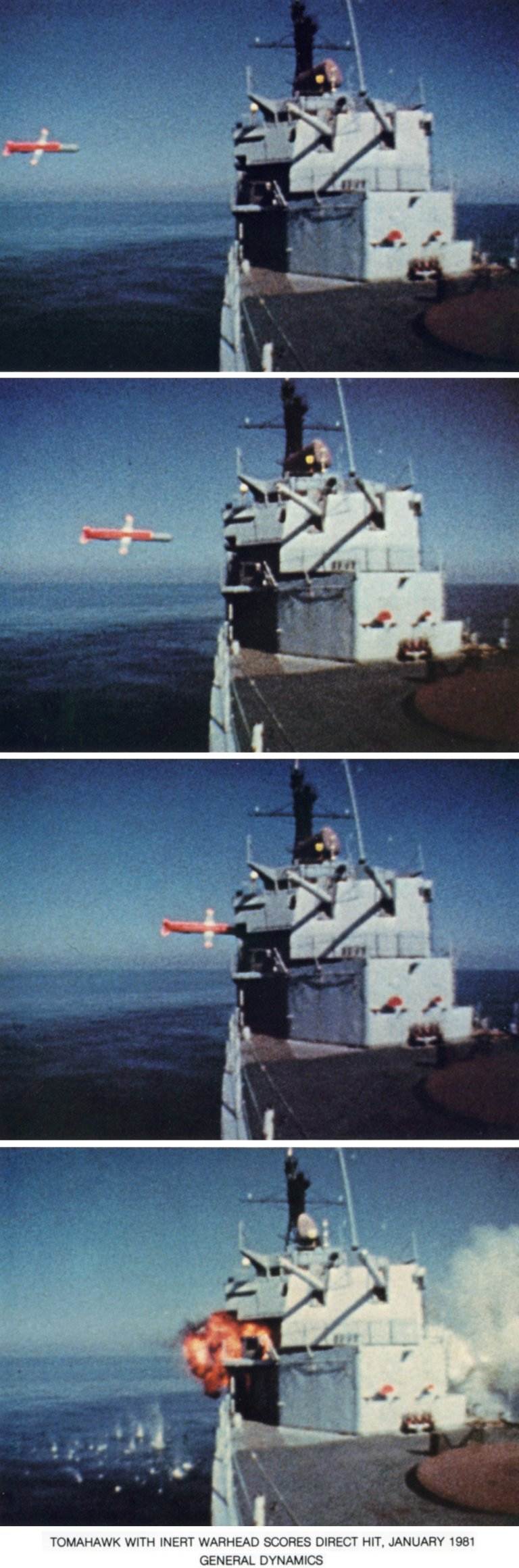
The radar seeker is frequency agile, is credited with the ability to selectively choose high value targets and may have a home on-jam capability. The missile has no IFF capability, however. This aspect of the missile's guidance, together with its considerable (250nm+) stand-off range and apparently observed difficulties in target resolution/ECCM have raised a considerable amount of criticism. Essentially the issue revolves about the all important rules-of-engagement in surface-surface but particularly submarine-surface strike situations. The problem lies in acquiring positive target identification, already limiting the effectiveness of existing Harpoon this restraint is a big problem with TASM. Suggested solutions essentially revolve about the use of LAMPS III helos or orbital radar platforms to provide the launch vessel commander with Over-The-Horizon (OTH) target data. Another option under review is ship/sub TASM launch and hand-off to a targeting aircraft (eg P-3). All of these options really limit the flexibility of the weapon [Editor's Note 2005: the TASM warstock was later rebuilt into TLAM-C variants as the targeting issues were never really resolved]. The BGM/RGM-109C TLAM/C (Tomahawk Land Attack Missile/Conventional) is a non-nuclear precision land attack weapon. TLAM/C is the heaviest of the SLCM family at 2,8001b, it carries the large 1,000 Ib warhead of the TASM, the TERCOM/inertial guidance of TLAM/N and an additional DSMAC II terminal guidance set. DSMAC (Digital Scene Matching Area Correlator) compares an optical view of the target area to stored images in the computer memory in order to eliminate the final TERCOM/inertial errors. Though the USN have not quoted CEPs for the missiles, numerous trial shots illustrate the missiles burying themselves into target walls (eg AWST, 20/08/84, p17) or screens (eg Flight 16/10/82, p1113), which for given warhead size (960 lb) and nominal target hardness would suggest 15 to 25ft. this pin-point accuracy combined with the missile's 700nm + range suggest its use against high value targets, typically naval bases (including static shipping), airbases, SAM/ASM launch/C3 installations, command posts and other non-nuclear hardened point targets. 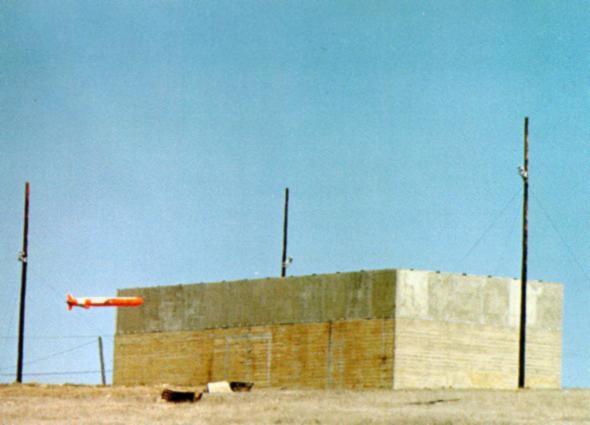 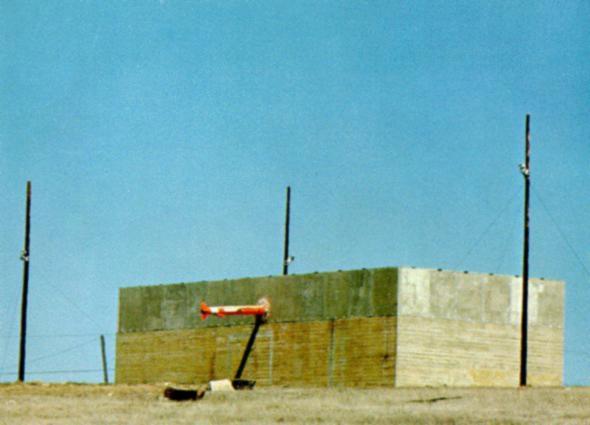 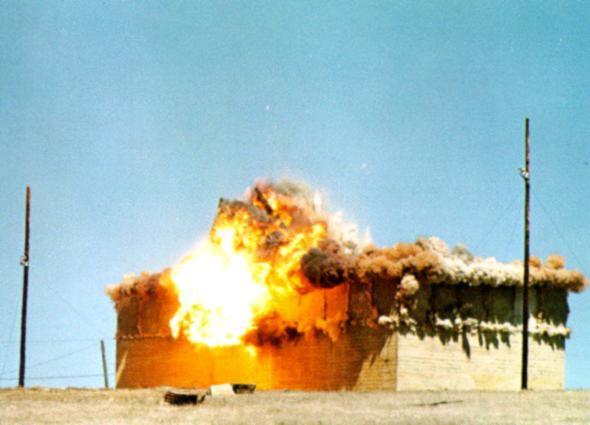 Current growth capabilities envisaged are a pop-up vertical attack terminal trajectory for the weapon and also a submunition dispensing payload bay replacing the HE warhead for airfield attack or defence suppression. The attack profile resembles that of TLAM/N, with the exception of the terminal phase when DSMAC provides the final update. The SLCM family provide the USN with a very versatile group
of
weapons, particularly the submarine launched land attack missiles offer
an entirely new capability, both in nuclear and conventional warfare.
The USN intends to acquire a total of 4,000 rounds by 1992, IOC was
initially attained in 1983.
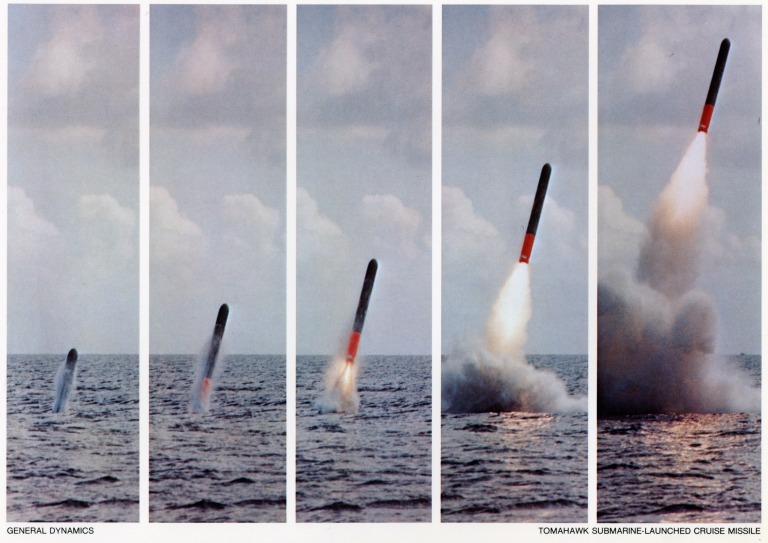
The General Dynamics AGM-109H/L MRASM MRASM is a low cost air launched derivative of the Tomahawk family, conventionally armed and intended for both USAF and USN use. As outlined earlier, the propulsion was changed to a turbojet to cut costs, but other measures were also taken. The LN-35 inertial set was replaced with a low cost strapdown ring laser gyro set, the redundant launch booster was eliminated and the core weapon guidance (TERCOM/inertial) relocated to the aft body, freeing the front of the missile for a fully modular payload bay with terminal guidance only. All versions have 250 nm+ class range, the land attack versions using TERCOM/INS/DSMAC guidance, the antiship version using datalink midcourse and Imaging Infra-Red (IIR) terminal guidance. The AGM-109H is the USAF's airfield attack weapon. It is the heaviest of the Tomahawk family, at 3,1001b at launch. MRASM is to be carried primarily by the B-52G and F-16, though other aircraft will be compatible, and is intended for stand-off counter air or defence suppression missions. The weapon's forward payload bay is modular, built around a 'backbone' beam into which individual payload modules are plugged into. These modules are tailored to the target, carrying submunitions such as mines, CEBs (Combined Effects Bomblets) or in particular, runway attack submunitions (eg BKEP). These are usually rocket boosted and will punch holes into concrete surfaces or in some instances penetrate beneath the concrete surface and lift it upon detonation. The attack profile is typical, again the launch aircraft loads the missile with target particulars, TERCOM matrices and DSMAC scenes, it then releases the missile within 250nm of the target. The surfaces and inlet deploy, inertial guidance is activated and the weapon is off to its first matrix. Upon reaching the target, however, MRASM activates its Pattern Controller subsystem. This unit uses the exact position data provided by DSMAC and flies the missile over the target, eg runway/taxiway, along a programmed flightpath during which it dispenses the submuni tion payload in a programmed pattern. As the payload may be mixed, both surfaces and facilities/aircraft may be attacked and area denial mines may be also used. 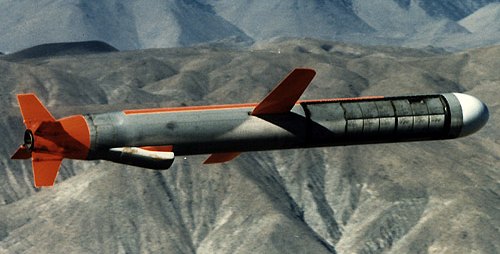 The technique used for expelling munitions from the payload bay is commonly termed 'air-bag' technology and is simple and robust. Munitions or clusters of munitions are fixed in the bay with a strap; this strap has a link in it designed to fail at a certain tensile loading. An 'air bag' of a high strength fabric (Kevlar?) is placed beneath the munition, it is tied to the nozzle of a gas generating cartridge. Upon cartridge ignition the air bag fills with hot gas and applies an outward force to the munition. At some instant the pressure in the bag will generate enough force against the munition to break the link in the strap and the munition is then ejected. Cheap and nasty, but cost effective. The DSMAC guidance is credited with night/adverse weather capability. Costing about 60% of a baseline Tomahawk, MRASM is nevertheless an expensive tool, one would therefore expect the USAF to employ it only in very high density scenarios or perhaps for surprise counter-air strikes, to lock in enemy aircraft prior to a large scale air strike with fighter bombers. The modularity of the weapon does allow for future upgrades with more advanced submunitions and thus it may eventually acquire other roles. The AGM-109L is the USN's air launched weapon and is configured in two basic versions. The land attack version uses the same TERCOM/inertial/DSMAC guidance as TLAM/C and also the standard warhead, the mission profile and type of target are also identical. The anti-shipping version uses a data-link for midcourse guidance and an IIR seeker, modified from the AGM 65D Maverick missile, for terminal guidance. The primary launch aircraft is envisaged to be the A-6E Intruder, though there should be compatibility with other aircraft. The attack profile for the anti-shipping version is probably unique in the Tomahawk family, The A-6E would launch at distant targets from prebriefed data or closer targets from attack radar data, the missile would then receive datalink updates until within line-of-sight to the target; after which the seeker would be cued onto the target and a TV contrast lock engaged to provide a terminal launch-and-leave capability. Navy MRASM is shorter and lighter than the USAF weapon, it is easily recognised by its swept wings in which it is also unique. The weapon will basically supplement existing Harpoon and also provide a vast improvement over earlier, eg Walleye, standoff land attack weapons [Editor's Note 2005: shortly after the publication of this article the MRASM was cancelled, and soon after the AGM-137 TSSAM program launched. TSSAM was then cancelled and the AGM-158 JASSM program launched. At this time JASSM in is LRIP]. Proposed Tomahawk Applications The flexibility and modularity of the basic Tomahawk airframe must be a delight for the weapon system designer. As a result, numerous other applications for the basic weapon have been proposed. The strategic anti-shipping or Sea Control role is probably the most significant. In this role the anti-ship (AF Sea Control) MRASM would be carried by the B-52, which would serve as a long range patrol aircraft, using its extensive ESM systems to sniff for enemy shipboard radar and communication transmissions. It could then attack targets with MRASM from outside the opponent's air defence umbrella. Yet another proposal along similar lines envisages the use of anti-ship SLCM type round, fired from ground based TEL trailers as used with the GLCM. In this arrangement, the missiles would be targeted at shipping by their flight LCC as with the GLCM, the LCC would acquire its targeting data from aircraft, ships and particularly surveillance satellites. If using a longer ranged missile such mobile anti-shipping forces could be airlifted rapidly to key areas, such as Norway, Iceland, Turkey, Korea or Japan, to bottle up Soviet battle fleets inside their home ports, eg Murmansk, Sevastopol, Vladivostok. During operation, the flights would regularly relocate to thwart enemy reconnaisance and subsequent air attacks. Another potential role for the weapon lies in standoff anti-armour attack, where typically a MRASM style weapon would carry autonomously guided anti-armour submunitions, in the class of the TGSM or Skeet, with tanks costing over $1 million apiece it could become eventually cost effective [Editor's Note 2005: the ground launched TASM never materialised as the Soviet position began to crumble]. In the context of Australia's force structure the cruise missile with its strategic flavour definitely appears as a luxury. To effec tively use any weapon in the class, one really requires extensive long range surveillance and communication systems, something which is very much out of the reach of Australia's DoD at this instant [Editor's Note 2005: long range ISR remains as a major gap in ADF capabilities twenty years after this was written]. 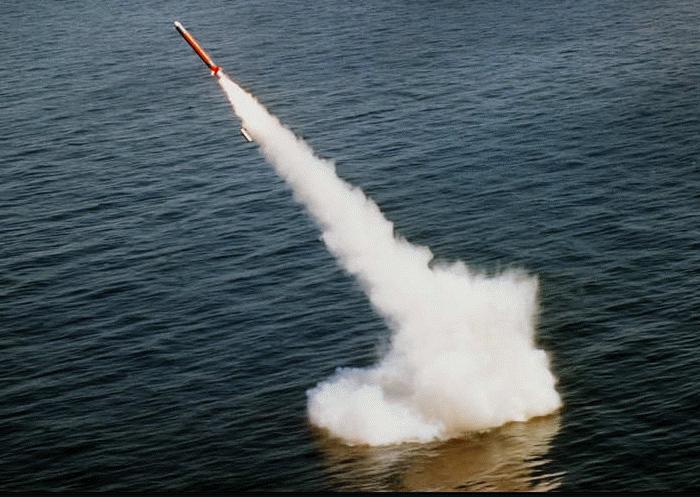 A Sea Launched Cruise Missile emerges from the ocean depths, launched from the torpedo tube of an attack submarine. The TLAM/N and TLAM/C land attack cruise missile provides the attack sub commander with an entirely new offensive capability, be it nuclear (1500nm) or conventional (700nm). The land attack versions are complemented by a 250nm + range anti-ship version, all being available for ship and submarine launch. Later antiship versions of Tomahawk, hopefully with an OTH targeting capability using the P-3, could certainly be useful. No regional powers, excluding Vietnam, really have the sort of air defence system which would merit the use of MRASM or TLAM/C in preference to a traditional low level night air strike. The Soviets are certainly unhappy about the cruise missile weapon family - it forces them to spend heavily in defensive areas such as AEW/AWACS and PVO as a whole. With the recent Soviet trend to invest more in offensive weapons, pouring roubles into expensive (and expensive to support) systems which are inherently defensive must be very unpleasant for Soviet leadership. As the US holds the lead in key technologies associated with cruise missile development (propulsion, electronics, stealth) and anti-cruise missile defences lookdown radar signal processing, IR planar arrays) the Soviets can only come out even with inside assistance, until then the cruise missile will continue to bleed their resources. A final point for us to ponder is our future Australian air
defence structure, as deployment of a sub launched TLAM-ski is not that
far away and it will certainly be available on the Third World arms
market in due course. The ultimate implications are more than obvious. Further Reading: Early Tomahawk Variants @ APA [Editor's Note 2005: while it has
taken two decades for this summary conclusion to materialise in
substance, with regional deployments of 3M-14E, and Chinese equivalents
to the RKV-500/Kh-55M, the substance of the argument holds. Australia's
northern geography is not disimilar to Russian geography in terms of
density and strategic importance.] |
|||
|
|||||||||||||
|
|
|
|
|
|
|
|
|
|
|
|||
|
|
|
|
|
|
|
|
|
|
|
|||
 |
|
|
|||||||||||
| Artwork, graphic design, layout and text © 2004 - 2014 Carlo Kopp; Text © 2004 - 2014 Peter Goon; All rights reserved. Recommended browsers. Contact webmaster. Site navigation hints. Current hot topics. | |||||||||||||
|
Site Update
Status:
$Revision: 1.753 $
Site History: Notices
and
Updates / NLA Pandora Archive
|
|||||||||||||
|
|
Tweet | Follow @APA_Updates | |||||||||||
|
|
|||||||||||||
|
|
|||||||||||||