|
||||||||||||||||||||||
 |
||||||||||||||||||||||
![F-22A Raptor, FB-22, F-22E, F-22N and Variants Index Page [Click for more ...]](APA/f-fb-22.png "F-22A Raptor, FB-22, F-22E, F-22N and Variants Index Page [Click for more ...]") |
 |
![People's Liberation Army Air Power Index Page [Click for more ...]](APA/pla-air-pwr.png "People's Liberation Army Air Power Index Page [Click for more ...]") |
 |
 |
 |
 |
 |
 |
![Military Ethics, Culture, Education and Training Index Page [Click for more ...]](APA/ethx-culture.png "Military Ethics, Culture, Education and Training Index Page [Click for more ...]") |
 |
||||||||||||
 |
![Russian / Soviet Weapon Systems Index Page [Click for more ...]](APA/rus-weps.png "Russian / Soviet Weapon Systems Index Page [Click for more ...]") |
 |
 |
 |

|
 |
 |
 |
 |
 |
||||||||||||
 |
 |
|||||||||||||||||||||
| Last Updated: Mon Jan 27 11:18:09 UTC 2014 | ||||||||||||||||||||||
|
||||||||||||||||||||||
|
||||||||||||||||||||||
|
||||||||||||||||||||||
|
|
|
|
|
|
|
|
|
|
|
||||||||||||
|
|
|
|
|
|
|
|
|
|
|
||||||||||||
|
|
|||||||||||||||||||||
| Last Updated: Mon Jan 27 11:18:09 UTC 2014 | ||||||||||||||||||||||
|
||||||||||||||||||||||
| The
Agile Gliding Weapon |
|||
|
|||
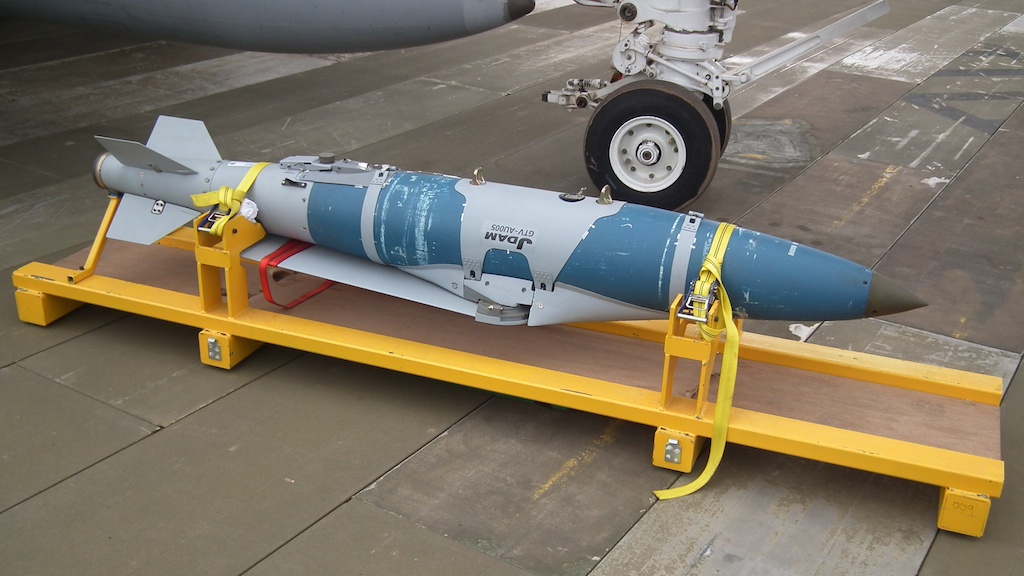 Boeing GBU-38 JDAM-ER prototype in
2011. It is
based on the Kerkanya wing kit design (© 2011 Carlo Kopp).
Shrouded in secrecy for many years, Australia's indigenous glidebomb has finally been revealed to the public in some detail. Australian Aviation had the pleasure of being briefed on the project by BAeA (then AWA Defence Industries AeroSystems Division), who at this time are seeking to commercialise the design. Australia's defence industry has had somewhat mixed fortunes over the years, often producing technologically innovative designs, but very seldom achieving stardom in the international marketplace. There are numerous reasons for this, but key issues have been a traditionally unhelpful finance sector, often poor support by government and little effort expended in marketing. In a marketplace which is highly competitive, technologically innovative, and inherently political, all facets of the development, production and marketing process must be addressed in a focussed fashion for success to follow. Overseas governments will often spare no effort in promoting indigenous products, and the French Alphajet deployment to Avalon in 1995 is an excellent example. A good example historically is the Ikara standoff torpedo delivery system, which could deliver a guided torpedo to twice the range of its overseas contemporaries. Whilst technologically superior to its competitors, it acquired only a small share of the lucrative worldwide ASW weapons market. We are now seeing what may be a turnaround in this historical trend, with AWADI very much leading the charge with its export oriented Nulka EW decoy project, radar warning system projects, and ongoing cooperative design involvement in the Evolved Sea Sparrow Missile (ESSM) project. Having recently acquired commercial rights to the DSTO glidebomb design, AWADI are now seeking customers for what is arguably the best weapon in its class, worldwide. The GTV Project The Kerkanya glidebomb owes its origins to some farsighted technical thinking at DSTO. During the late seventies, DSTO researchers produced the idea of a glidebomb which would use an energy management algorithm to maximise its glide range. Existing glidebombs, such as the USAF GBU-15 and USN AGM-162 Walleye, typically achieve glide ranges of about 13 nmi if launched from altitude. While such glide range may defeat terminal defences, it still exposes the aircraft to area defence SAMs and fighter aircraft. The 1977 AFRR 2/77 research request from the RAAF, then very interested in the idea, led DSTO to proceed with the Generic Test Vehicle (GTV) program, which was intended to validate the theoretical modelling with tests of a prototype vehicle. The prototype GTV was built around the Mk.82 warhead geometry, as this munition was readily available and would not create carriage problems for the ARDU/Mirage trials aircraft. With the customary Australian shoestring R&D budget, DSTO demonstrated in 1988/89 trials that the GTV could outperform existing and planned glidebombs in the US and NATO inventory. A 20,000 ft altitude release at 0.8 Mach yielded a 34 nmi glide range to impact, which was about three times the range of existing cruciform wing glidebombs, and similar to the then planned USN AIWS (now AGM-154A JSOW) linear wing glide weapon. The results were clearly outstanding and DSTO sought to further refine their results with the planned series of Kerkanya trials, which would involve an improved derivative of the tested GTV design. Sadly, funding was cut and the trials never eventuated. DSTO had at this early stage envisaged a modular glidebomb kit, using a standard airframe, a standard Mk.80 series warhead and a role specific seeker. An effort was made to commercialise the project through an arrangement with ASTA. An overseas partner was found in UK based GEC-Marconi, and a potential Middle-Eastern customer expressed a strong interest in the project. The intention at this stage was to integrate the anti-radiation seeker from the BAe ALARM missile with the Kerkanya airframe, to produce an extended range anti-radiation weapon. Due the the high cost of the sophisticated seeker, this weapon was expected to cost cca $250k per round, the high cost offset by considerably greater lethality than that offered by conventional rocket propelled ARMs such as HARM and ALARM. The high cost of the planned weapon and potential for technical risk dissuaded the RAAF from further funding R&D on the project. In the political climate of the late eighties any perceived difficulty with a project could lead to political problems for the service, resulting in withdrawal of funding. The RAAF, strapped for cash with the ongoing upgrades to the F/A-18 and F/RF-111C soaking up resources, opted for established production weapons in their Stand-Off Weapon (SOW) program. At the time of writing the AGM-130 and AGM-142 were still under evaluation. When the Middle-Eastern export program fell through for commercial reasons unrelated to weapon development, the project was suspended. At this time AWADI, buoyed by their success with the Nulka hoveroc, ALR-2002 and ESSM, decided that the Kerkanya concept had very good potential and subsequently acquired rights to commercialise the technology. Discussions with SouthEast Asian countries soon followed. The AWADI Agile Gliding Weapon Melbourne based AWADI AeroSystems Division (shortly thereafter acquired by BAeA) are now in the early development phase of their Agile Gliding Weapon (AGW) project, which is substantially derived from the Kerkanya technology base. AWADI's primary objective is to produce a weapon kit design which is cost competitive with the USAF GBU-31/32 JDAM weapon, and cheaper than the USN AGM-154 JSOW (both will be reviewed in detail in a four part series on GPS guided weapons, which is currently in writing). Inevitably the AGW will be compared with JSOW, however it should be noted that both are very different weapons in terms of performance, capabilities and intended usage. The AGW project seeks to combine a number of conceptual ideas from past projects to produce a highly potent and affordable glidebomb, which can be used as a "bread-and-butter" munition rather than an expensive tool for hitting high value targets. The first idea is that embodied in the defunct US Inertially Aided Munitions (IAM) program, which sought to improve the delivery of bombs tossed from below the radar horizon of the target. The IAM project aimed to equip conventional bombs with a low cost inertial autopilot and actuated control surfaces. Such a weapon would be programmed with target coordinates before release, and correct its trajectory to impact, achieving accuracies far better than those of dumb bombs, although not as good as optically guided munitions. While the IAM was never built, the current GAM and JDAM projects have further exploited the idea by using GPS aided inertial guidance. The second idea is that of a modular guided weapon kit, first proposed in the NATO Modular Stand-Off Weapon (MSOW) project. The MSOW project was intended to produce a kit based weapon, which allowed users to mix and match seeker kits, warheads, fuses, propulsion and airframes to provide a family of weapons which could be flexibly adapted to target types and operational environments. MSOW never eventuated, arguably due the complexity of Euro-US defence politics, however the basic concept was adopted by the USN for the Advanced Interdiction Weapon System (AIWS). AIWS was intended as a Walleye replacement, with a cluster warhead and range in excess of 5 nmi. The AIWS program was subsequently redesignated JSOW, with the USAF becoming a customer for the eventual weapon. The third idea is that of advanced control algorithms to maximise glide performance, as demonstrated by the DSTO GTV trials. The AGW is conceived as a weapon which blends all of these ideas into a single package. The core of the design is a wing and tail kit, using an inertial autopilot, supplemented by specific guidance and seeker kits, and warheads. The baseline warhead is a Mk.82 or Mk.84/BLU-109. AWADI are aiming at a cheap design, with an intended production cost of under A$60k per kit, which is about the projected cost of a JDAM kit. Unlike JDAM, the AGW is a 25-75 nmi standoff range glidebomb, sufficiently cheap to allow JDAM like saturation attacks from ranges where area defence SAMs are ineffective. The AGW may be delivered from low level, using a toss manoeuvre, or from medium to high altitudes for maximum standoff range. Airframe and Midcourse Navigation The AGW airframe is intended to exploit the aerodynamic design of the DSTO Kerkanya, and will use a similar arrangement. This configuration combines a bomb tailcone with control surfaces with a centre-section fairing which mounts the folding scissor wing assembly. The DSTO Kerkanya design was to be carried and launched inverted, after which it would roll itself upright, deploy its high wing configuration wings and commence its glide to eventual impact. This arrangement was used to simplify carriage, as the vehicle could use the standard attachment lugs on the Mk.82 body without having to adapt the centresection design to carry the structural loads which the lugs do. The GTV prototype was a low wing design, launched upright. The tailcone will mount the moving control surfaces, their internal actuator servos, a battery, and the inertial guidance package. It is envisaged that the guidance processor used will be an existing 68k architecture design, as this will be a proven production design and thus will save the R&D overheads of producing one specifically for the glidebomb. There are a wide range of inertial reference packages which may be used in the design, be they types built by DASA, Honeywell, Rockwell or GEC-Marconi. The accuracy of the inertial package will be driven by the size of the terminal seeker acquisition basket, ie a seeker with a large acquisition footprint will reduce the required accuracy of the inertial package. The option of using a GPS receiver to provide the inertial package with position and velocity corrections is seen to be highly attractive, particularly given recent US experience with Differential GPS and GPS Carrier Phase techniques, which have produced positioning accuracies as good as 18 inches. The use of a suitable GPS based scheme would allow for a cheap all weather weapon with a CEP cca 20 ft, which is similar to the accuracy of a laser guided bomb. The basic systematic error of the proposed guidance package, excluding GPS position errors, is under 15 ft. The availability of a wide range of commercial and military GPS receivers with varying accuracy and jam-resistance performance means that a range of accuracies and hostile jamming environments could be accommodated by the baseline design. The cheapest option is to use the relatively inaccurate (~300 ft) civilian C/A GPS code. Importantly, the use of more advanced DGPS and GPS-CP techniques would allow the weapon to be used without a terminal seeker, significantly reducing costs. This is indeed the central idea behind the US GAM and JDAM programs. The design philosophy pursued by AWADI is to focus on modularity in the inertial guidance package, and this would allow a production design to accommodate a range of GPS receiver types, specific to customers and required weapon performance. Warheads The modular design of the AGW is intended to allow the fitting of a wide range of warhead types. The baseline warheads envisaged are the 500 lb Mk.82, 1,000 lb Mk.83 and 2,000 lb Mk.84 general purpose demolition bombs, which are widely used by Western Alliance nations. While Mk.80 series bombs are cheap, readily available and provide a good ratio of explosive to bomb mass, they are also considered crude aerodynamically and poorly toleranced geometrically. The latter can influence weapon aerodynamics and impair achievable range. Other alternatives are under consideration. Two of these are the bunker busting 2,000 lb BLU-109 and 1,000 lb BLU-110 forged steel casing warheads, which are more accurately toleranced than the Mk.80 series. The larger of these warheads were the standard munition of the F-117A during the Gulf War, scoring some spectacular kills against supposedly "bomb proof" bunkers and shelters. An issue with bunker busting warheads is speed of impact, which must be high to provide the required penetration through reinforced concrete. The AGW concept addresses this by providing for a steep terminal trajectory, at some expense in range. The modular design of the weapon should allow AWADI to accommodate other warhead types, such as cluster munitions or terminally guided submunitions. Both of these warhead types would require suitable navigation software to achieve the required delivery pattern, as well as a custom dispenser design and suitable submunitions. Terminal Seekers The AGW is intended to accommodate, if required, a terminal seeker attached to the nose of the warhead. Whilst the standard version may employ only one or another form of GPS/inertial guidance, it is envisaged that special purpose derivatives could employ a wide range of seeker types. One of these is the ALARM ARM seeker originally planned for the ASTA/GEC-Marconi joint venture. A glidebomb with an ARM seeker would offer substantially higher lethality than a conventional ARM, as the target radar would be literally obliterated with a Mk.80 series warhead. Other alternatives do exist. These are Television and Thermal Imaging seekers, using contrast lock schemes (lock-on-before-launch), or datalink schemes similar to that used in the GBU-15/AGM-130. Radio frequency schemes such as MilliMetric Wave Imaging (MMWI) seekers, used in the BAe Merlin and proposed for the JDAM would provide highly accurate autonomous all-weather operation, without GPS. Moreover, anti-shipping radar seekers, and Home-On-Jam (HOJ) seekers are also viable alternatives. Performance What distinguishes the AGW from its foreign competitors is its superlative aerodynamic performance, which allows an unpowered weapon to achieve delivery ranges similar to far more expensive powered weapons. Importantly, AWADI's performance figures are based on validated tests carried out in the GTV trials, ie these are real rather than vapourware numbers. The performance of the Mk.82 and Mk.84 versions of the weapon is very similar, ie there is no range penalty associated with the heavier weapon. Glidebomb performance is typically judged in two areas. One is ultimate delivery range, and the other is crossrange performance. The first is important because it determines the performance limits of the weapon, the latter is important because it determines performance under heavy crosswind conditions, and for off-boresight launches. The AGW, as noted previously, can be delivered in level flight or tossed. For a 2,000 ft release low level toss at 45 degrees and 0.82 Mach, the weapon has a maximum range in excess of 24 nmi, twice that of existing powered glidebombs. Should a steep trajectory be required to penetrate a hard target, cca 30% of range will be sacrificed. High altitude subsonic delivery provides far more impressive results. Released at 27,000 ft and 0.68 Mach, the weapon will fly in excess of 67 nmi (120 km). At 30,000 ft and 0.9 Mach TAS this is further improved to a number in excess of 75 nmi (140 km), which is about twice the published range of the USN JSOW weapon. Cross range performance is equally impressive, for a soft target and 30kft/M 0.9 release the beam aspect range performance is 67 nmi, for a hard target under the same conditions in excess of 50 nmi. The latter assumes an 84 degree terminal dive at 0.63 Mach. These are figures which compare very favourably with much more expensive powered weapons. AGW for the RAAF ? The RAAF rejected the original anti-radiation glidebomb because it was a special purpose weapon, which would never be purchased in sufficient quantities to amortise the required R&D and operational evaluation costs required to bring it into service. Without a viable basis for volume export sales, the "bang-per-buck" equation was heavily stacked against it, and we can understand the RAAF's reluctance to invest its thinly stretched resources. The new look AGW is however in many ways a very different beast, as it is in effect a winged equivalent to the GBU-31/32 JDAM, a low cost accurate or precision all weather "bread-and-butter" general purpose munition. As such it is both cheaper to acquire in volume, cheaper to maintain, cheaper to fully evaluate and test and eminently more exportable than a specialised anti-radar weapon. As a general purpose munition it would be purchased in higher quantities than a specialised munition. Sized to fit into an F-111 internal weapon bay, a 2,000 lb or 1,000 lb warhead 75 nmi range GPS/inertially guided AGW would very nicely complement the the RAAF's precise but expensive powered Stand-Off Weapon. Moreover should the RAAF at any time decide to apply stealth materials to the F-111 to reduce the range at which it can be detected (as the USN have done with the F/A-18C and E), then the AGW becomes a very nice proposition as its range is likely to be greater than the detection range of the aircraft. This would provide the ADF with a capability similar to that of the F-117A, the ability to engage a target undetected and thus with total surprise. The interface required for the weapon is a standard Mil-Std-1553B bus to the pylon ejector, a facility provided for in the F/A-18A+ and the F/RF-111C AUP aircraft. Software modifications to the weapon delivery and stores management OFPs would be required, to download GPS parameters and target coordinates to the weapon before release. Carried externally by the F-111 and F/A-18, the AGW would allow the engagement of targets defended by most existing area defence SAMs without any risk to the launch aircraft. Because GPS guidance is autonomous and all weather capable, a single aircraft could engage multiple targets in a single sortie, and once the weapons are released, immediately run for home. We can therefore hope that the RAAF will take another look at the AGW/Kerkanya. The potential is certainly there. Export Potential Australia has traditionally been a conservative defence exporter, providing products only to a limited range of government approved customers. Moreover, any equipment built in Australia is likely to use a large proportion of US or European components, all of which are subject to further export approvals. Providing therefore that AWADI's customers fall within the domain of politically acceptable sales targets, it is not envisaged that the Federal Government would block the sale. AWADI are optimistic that the Federal Government will support their effort to market the product regionally. The recent events in the Straights of Taiwan have needless to say set alarm bells ringing throughout ASEAN, and this will inevitably result in a massive weapons purchasing spree by our regional neighbours. This could produce some good opportunities for Australia's defence industry, and the AGW project should be treated as such. Were Australia to gain a significant share in the regional glidebomb market, it would not only bring in export revenues but also improve our regional credibility as a supplier of high technology products. In the export context, the AGW will necessarily be compared against the US JSOW and JDAM. The simplest comparison between the baseline AGW and the the US weapons is that the AGW is a "winged JDAM", whereas the JSOW is primarily an intelligent gliding munitions dispenser adapted to carry a single penetration warhead in one of its three variants. The AGW will be evolved from a JDAM-like configuration to a dispenser configuration if customers are found, whereas the JSOW is by design aimed at the submunition dispensing mission, and is being evolved to support the JDAM-like single warhead mission. In the JDAM-like mission the baseline AGW will in the 500 lb version offer a cost advantage over the more complex JSOW, whereas in the 1,000 lb and 2,000 lb versions it would also offer substantially greater lethality due a much bigger warhead. In all variants it offers a significant range advantage over JSOW, but in a cost driven market this may not be a decisive parameter. Given the competition presented by a mass produced JSOW in the submunition dispensing mission, and the significant engineering overheads required to support such a capability, AWADI will have to compete very hard for this segment of the market. The AGW/Kerkanya glidebomb is another good example of innovative Australian technical thinking and systems engineering. Like many other projects, it has suffered from very limited funding and political indifference by the previous Federal Government. AWADI's proposal to manufacture a GPS/inertial guided derivative of DSTO's technology demonstrator has considerable technical merit, good long term export potential and would allow the RAAF to exploit the coming GPS centred revolution in guided munitions without the balance of payments penalties associated with importing US or European munitions. We can hope that the RAAF and their political masters take a good hard look at this project, and take the long term view rather than embracing the short term expediency which has characterised earlier funding for the program. It would be very sad to see yet another clever Australian idea go overseas. Author's Note: Since the writing of this article, HdH in Melbourne (Boeing) acquired rights to the GTV/Kerkanya project and have used it to develop the JDAM-ER, using RAAF ACTD funding. 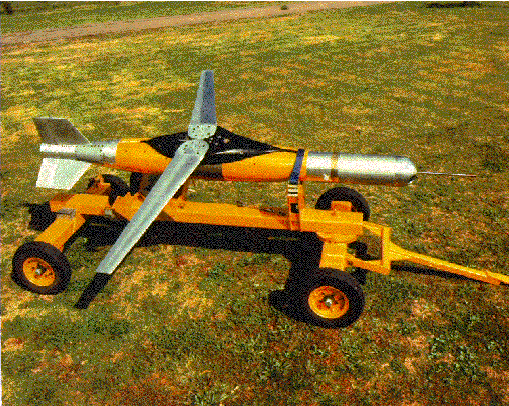 The DSTO GTV technology demonstrator was trialled during the late eighties, demonstrating glide range performance well in excess of any then existing or planned glidebomb. The GTV provided the aerodynamic and control algorithm designs used in the AWADI AGW/Kerkanya design, which delivers performance comparable to powered glide weapons. 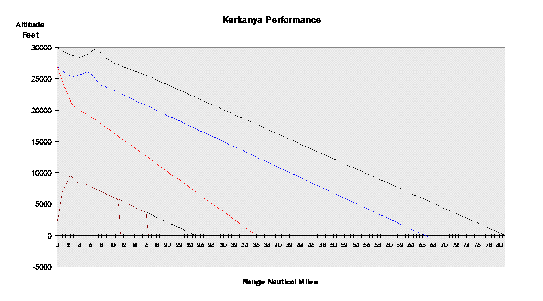 This plot illustrates the achieved glide range performance for the GTV and Kerkanya designs, for a range of release conditions. A low level release will involve a conventional toss manoeuvre, whereas a high altitude launch can be done with a conventional level delivery. Where a high speed impact is required to punch through a concrete target, the weapon will fly a steep terminal dive with some penalty to range performance. 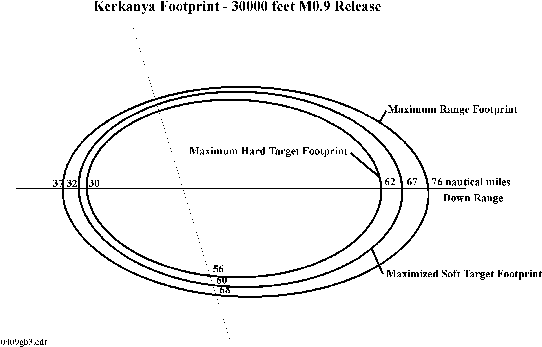 The Kerkanya design provides excellent cross range performance, almost as good as the weapon's performance for an on boresight delivery. This offers a tactical advantage as the defending side cannot infer the intended target from the launch aircraft track, if the weapon is released on an off-boresight heading. 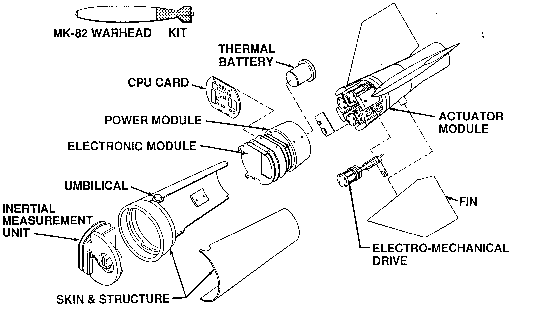 AGW Tailkit Cutaway. Carried internally, a suitably packaged Kerkanya variant would be a useful addition to the F-111's armoury. Internal carriage offers the advantage of lower drag and thus better range performance, as well as removing the radar signature of pylon carried stores. An earlier Kerkanya proposal using an ALARM anti-radiation seeker was rejected by the RAAF as funds were not available to complete the development of the weapon in Australia. AWADI are now proposing the AGW, a much cheaper Kerkanya derivative which utilises JDAM style GPS/inertial guidance. |
|||
|
|||||||||||||
|
|
|
|
|
|
|
|
|
|
|
|||
|
|
|
|
|
|
|
|
|
|
|
|||
 |
|
|
|||||||||||
| Artwork, graphic design, layout and text © 2004 - 2014 Carlo Kopp; Text © 2004 - 2014 Peter Goon; All rights reserved. Recommended browsers. Contact webmaster. Site navigation hints. Current hot topics. | |||||||||||||
|
Site Update
Status:
$Revision: 1.753 $
Site History: Notices
and
Updates / NLA Pandora Archive
|
|||||||||||||
|
|
Tweet | Follow @APA_Updates | |||||||||||
|
|
|||||||||||||
|
|
|||||||||||||






