|
||||||||||||||||||||||
 |
||||||||||||||||||||||
![F-22A Raptor, FB-22, F-22E, F-22N and Variants Index Page [Click for more ...]](APA/f-fb-22.png "F-22A Raptor, FB-22, F-22E, F-22N and Variants Index Page [Click for more ...]") |
 |
![People's Liberation Army Air Power Index Page [Click for more ...]](APA/pla-air-pwr.png "People's Liberation Army Air Power Index Page [Click for more ...]") |
 |
 |
 |
 |
 |
 |
![Military Ethics, Culture, Education and Training Index Page [Click for more ...]](APA/ethx-culture.png "Military Ethics, Culture, Education and Training Index Page [Click for more ...]") |
 |
||||||||||||
 |
![Russian / Soviet Weapon Systems Index Page [Click for more ...]](APA/rus-weps.png "Russian / Soviet Weapon Systems Index Page [Click for more ...]") |
 |
 |
 |

|
 |
 |
 |
 |
 |
||||||||||||
 |
 |
|||||||||||||||||||||
| Last Updated: Mon Jan 27 11:18:09 UTC 2014 | ||||||||||||||||||||||
|
||||||||||||||||||||||
|
||||||||||||||||||||||
|
||||||||||||||||||||||
|
|
|
|
|
|
|
|
|
|
|
||||||||||||
|
|
|
|
|
|
|
|
|
|
|
||||||||||||
|
|
|||||||||||||||||||||
| Last Updated: Mon Jan 27 11:18:09 UTC 2014 | ||||||||||||||||||||||
|
||||||||||||||||||||||
| McDonnell-Douglas
AGM-84A Harpoon and AGM-84E SLAM |
|||
|
|||
|
While PGMs such as the laser guided bomb and TV guided bomb introduced unprecedented accuracy, the increase in the concentration of hostile defences relative to the number of strike aircraft increased the risks inherent in overflight of the target. Glidebombs such as the GBU-15 and Walleye I/II family were a partial answer as they allowed the strike aircraft to attack from outside the target's terminal defences, often fortified with large amounts of visually aimed AAA (guns) which are understandably immune to electronic countermeasures. While the glidebomb packs a lot of punch, its limited range at low altitude and restricted terminal trajectory render its launch platform vulnerable to newer types of SAM. In particular the SA-11 Gadfly and late SA-6 Gainful have a known capability to hit low level targets at ranges of several nautical miles. The solution to this problem lies in the use of standoff PGMs with sufficient range to allow attacks from below the radar horizon of the target's area defences. This strategy has been often used in the design of antishipping missiles and the attacks on the Sheffield and Stark demonstrate its effectiveness. While there are numerous types of standoff anti-shipping missile in use today, few of these have been adapted to the land strike role. The Russian AS-4 Kitchen may have even followed the opposite development path, starting as a strategic land strike missile and eventually shifting to the anti-shipping role. Key types in the Western inventory are the AGM-109 Tomahawk
family (see TE November, 1985) and the AGM-84 Harpoon family.
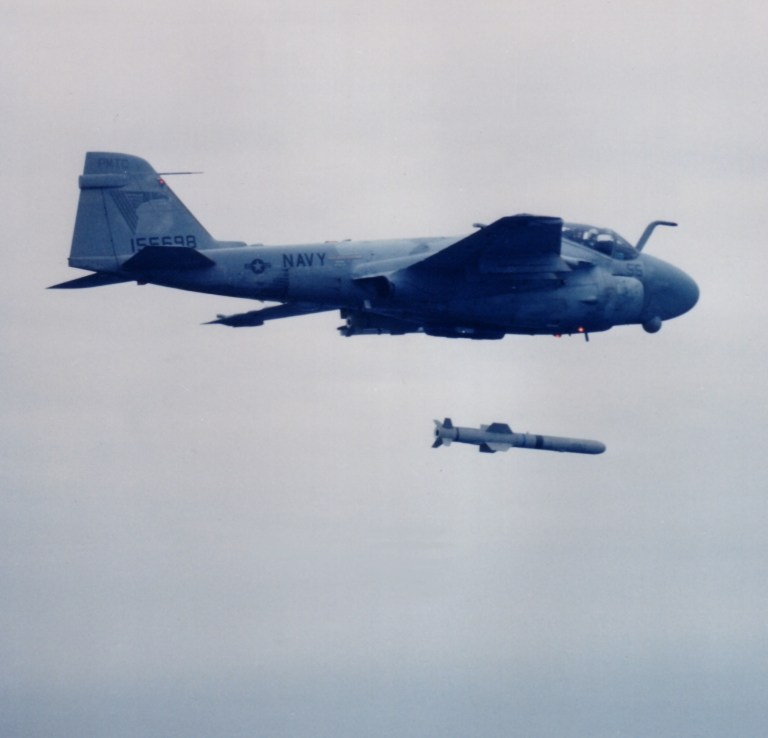
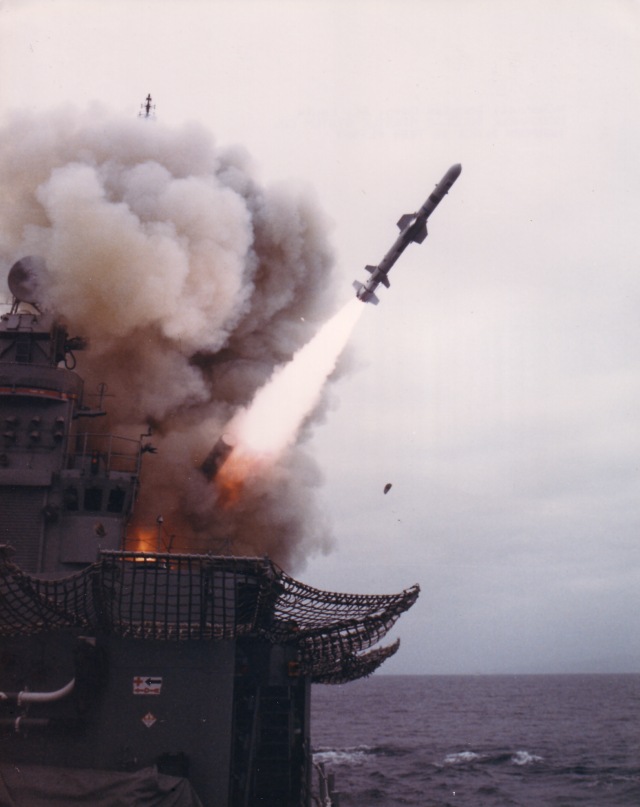
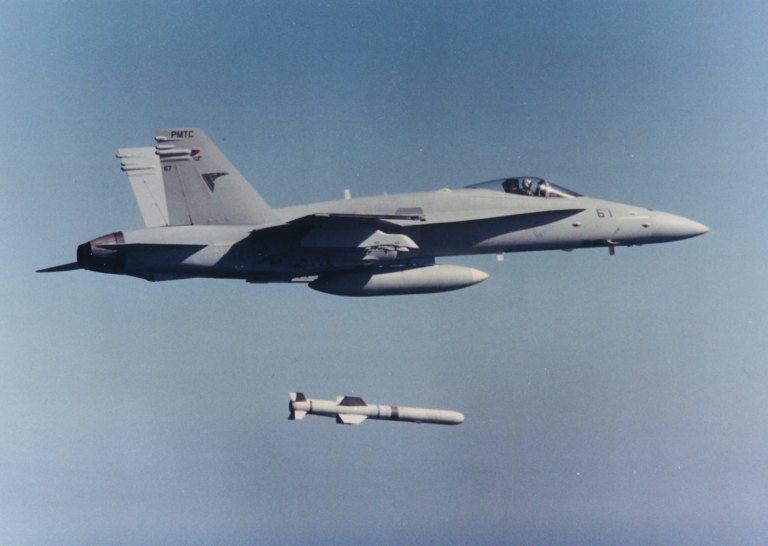
The McDonnell-Douglas AGM-84A Harpoon The radar guided turbojet powered sea skimming Harpoon is the primary anti-shipping missile in the inventories of most Western powers. Harpoon was first deployed in the mid seventies and has built up a credible record over the years, including several live kills claimed by the US Navy in the Gulf of Sidra. The Harpoon is also the RAAF's primary anti-shipping missile, arming the P-3C, F-111A/C and F-18A/B. Development of the Harpoon took place during the early
seventies, when the US Navy recognised the need for a low cost sea
skimmer with all weather capable radar terminal homing. This missile
would provide destroyers, cruisers, frigates and submarines with the
ability to attack surface targets independently: this eliminated the
constraints imposed by the need for naval strike aircraft to attack
surface targets. The use of a sea skimming attack was particularly
clever as it defeated the Russians' point defence SAM systems. The
simple turbojet powerplant allowed the missile to be compact while
reducinq the infra-red and visual signature of its exhaust plume.
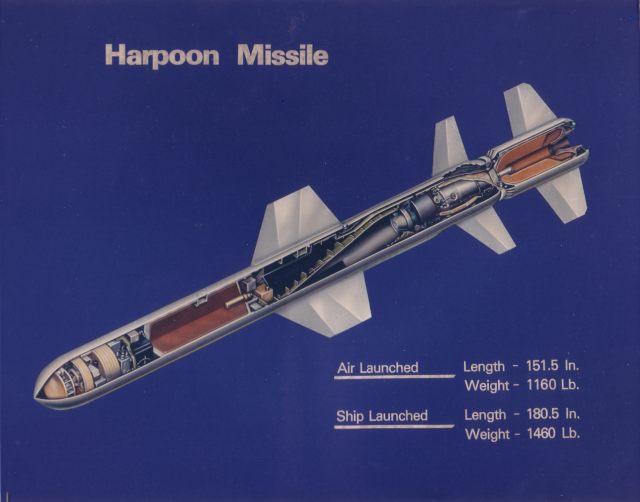
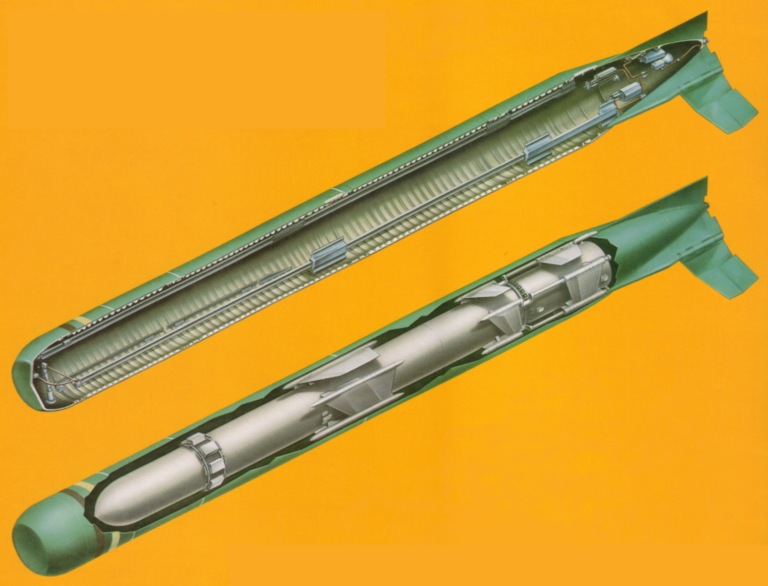
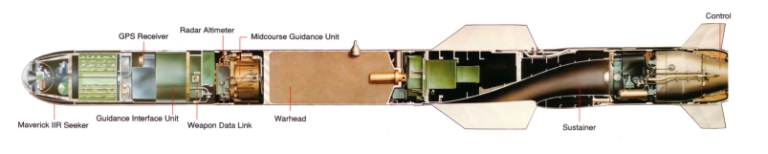
The fuselage of the Harpoon is cylindrical with an ogival/conical nose and slightly tapered boat-tail. The cruciform wings are slightly aft of the airframe CofG, with the flush ventral low radar cross-section inlet between the lower wings. The all moving cruciform control surfaces are attached to actuators in the boat-tail section. Functionally the fuselage is divided in the Control, Sustainer, Ordnance and Guidance Sections (see cutaway). The Control Section is wrapped around the tailpipe of the engine and structurally supports the control actuators and attachment points for a booster in ship/sub launched versions. The Simmonds ATU-72 (or Singer-Kearfott) actuators contain a motor, gear train, clutches and a brake providing ~30 deg of movement for the aluminium alloy surfaces. The Sustainer Section encompasses the fuselage between the boat-tail up to the warhead section. The aftmost part of this section is occupied with the Teledyne CAE J402-CA-400 turbojet. This miniature 98lb axial/centrifugal compressor turbojet has a pressure ratio of 12.5, an SFC of 1.12 (Ib/Ib/hr) and delivers over 600lb of thrust at sea level. It draws inlet air through a cast aluminium alloy inlet duct (note the stiffening ribs) which runs though the cylindrical fuselage cavity. This cavity is sealed and forms an integral fuel tank containing over 100lb of JP-10 fuel. The engine is started by redundant cartridges and ignitors and will reach full thrust in about 7 seconds. Fuel pressure is initially provided by spring loaded bellows with bleed air providing pressure once nominal thrust is attained. The Sustainer Section provides structural support for the missile wings and the fuel tank cavity is used to house two oneshot silver zinc batteries, once activated these provide power for the avionics. The Ordnance (warhead) Section is a separate structural assembly, with the warhead penetration casing used as a load bearing structure. The casing is designed to penetrate into a ship's structure before the delayed fuse fires the high explosive in the warhead. The warhead assembly weighs in at 488lb which places it in the class of a 500lb demolition bomb. The Guidance Section of the missile occupies the forward fuselage and is unique to specific versions of the missile. The aftmost assembly is the Midcourse Guidance Unit (MGU), built up with an IBM 4PiSP-OA general purpose digital computer and a Northrop or Lear Siegler 3-axis strapdown inertial Attitude Reference Assembly (ARA). A Honeywell AN/APN-194 short pulse radar altimeter is mounted fore of the MGU, with a receiver antenna mounted under the warhead section. The MGU functions as an autopilot, while also interfacing to the launch aircraft for downloading of mission parameters. Terminal guidance is provided by a Texas Instruments
PR-53/DSQ-28 active radar seeker, which is a solid state, two-axis
frequency agile design. Frequency agility can defeat some forms of
jamming and chaff (ie: the threat must use more jam power,or image
jamming, and broadband chaff) and is a useful form of ECCM, while
preventing interference between multiple rounds in a salvoed Harpoon
attack. Harpoon also employs azimuth proportional terminal homing to
directly hit manoeuvring targets, while also offering various pop-up
and
sea skimming terminal trajectories.
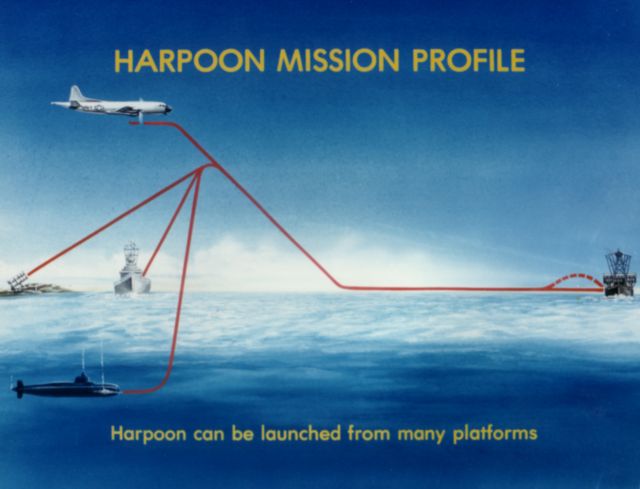
Harpoon Mission Profile With four basic operating modes, a range of terminal trajectories, launch platforms and targeting data sources, it is impossible to tag any particular mission profile as typical. However, a P-3C pop-up targeting/launch manoeuvre is a common RAAF tactic and will be covered. Newer aircraft such as the F18A have fully integrated digital fire control and stores management systems in which the software handles Harpoon initialisation and launch sequencing; the P-3 is the opposite extreme with a dedicated Harpoon Aircraft Command and Launch Set (HACLS). The HACLS is comprised of a launch control panel at the TACCO's station, a digital computer and several black boxes which interface the aircraft's reference signal outputs and power to the HACLS and Harpoon. In a typical scenario, a RAAF P-3 tasked with maritime strike
would sweep an area using its Electronic Support Measures to detect
hostile shipping without being detected. Upon detecting a hostile
signature, the P-3 would drop to low level and approach below the radar
horizon to within Harpoon range, which is about 60 nm. At this stage,
the Harpoon is prepared for launch. The HACLS will power up
identification circuits in the missile which will reply with a missile
present signal. Selection of the missile is the next step, and this
results in the application of heater power to the missile to bring the
battery, seeker and MGU up to nominal operating temperature. Once this
occurs, the seeker and MGU heaters are turned off and electrical power
from the aircraft applied.
The gyros in the ARA spin up to speed. At this stage targeting is required. While ESM bearing and range data are adequate, better discrimination can be gained with radar. The P-3 will therefore pull up steeply until it crosses the radar horizon of the target, after which it sweeps the target several times with its radar to get a fix and then dives down back below the radar horizon. The threat has had only several seconds to detect the P-3, during which time the HACLS has reformatted the target coordinates and passed them serially to the Harpoon, together with selected mode, launch sequencing information and attitude/position. The Harpoon will return a GO signal upon accepting the data. From this instant the missile is ready to launch and depressing the firing button initiates the launch. The HACLS sends a launch signal to the Harpoon which activates its battery and returns a ready signal. The missile is now committed and the HACLS removes aircraft power and does a final check on missile status. If the missile returns a GO, it is released. If airspeed/altitude are below a set limit the engine is fired up on the pylon otherwise it starts during the missile's dive. The umbilical detaches, unshorting all of the electroexplosive devices and an arming lanyard enables the warhead arming system. The missile descends in a 33 degree dive commanded by the MGU, until cruise altitude is attained and the missile pulls out, entering its midcourse cruise toward the target. The four basic modes are Bearing Only Launch (BOL) and Range and Bearing Launch (RBL) with small, medium and large search patterns. At a range given by the set mode, the seeker is activated and searches for the target. Once a target is acquired lock-on occurs and Harpoon descends for its low level run-in. Subject to preloaded parameters, the missile enters its terminal trajectory, punching through the skin of the target and exploding inside. Harpoon has to date demonstrated a good kill probability, the probability of a failed launch is low as the launch platform fire control system verifies that the target is within the missile envelope and that the launch aircraft is within the missile launch envelope prior to committing to a launch. The operator can also initiate a Built-In-Test prior to committing to a launch, BIT verifies actuator speed, power system and MGU function. Combined with a high performance launch platform equipped
with
a digital fire control system and capable radar and ESM, Harpoon is a
potent and flexible anti-shipping weapon. Its better attributes are
common to its land strike capable derivative, SLAM.
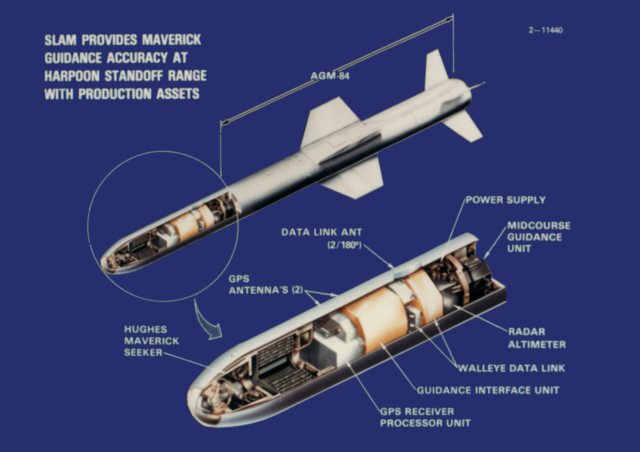
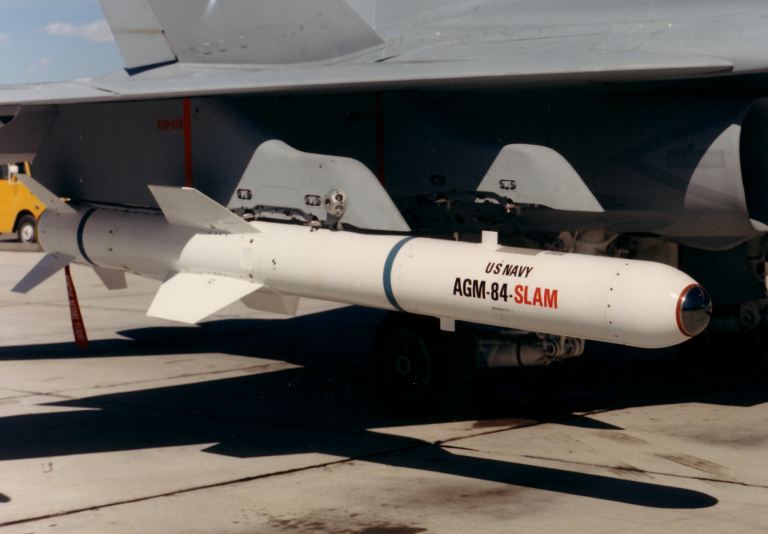
The development of the McDonnell Douglas AGM-84E Standoff Land Attack Missile (SLAM) was initiated in early 1987 with the US Navy committing US$70.6m to an 18 month development program, fixed price, for the development/test of SLAM and the production of 14 missiles. Eventual production of 300 rounds is envisaged. The development program will end in 1989 with a series of seven test/demo flights. SLAM employs a Harpoon airframe/warhead equipped with a Maverick Imaging Infra-Red (IIR) seeker and a Walleye glidebomb datalink (conceptually similar to the RAAF's GBU-15/ AXQ-14 glide bomb/datalink). This has resulted in a weapon with many of the attributes of the MRASM land attack cruise missile but with the flexibility of an operator in the loop to select the missile aimpoint on the target. The airframe of SLAM differs little from Harpoon, using
unmodified Harpoon control and sustainer sections. The SLAM warhead is
almost identical to the Harpoon standard, with a wiring change to
implement either instantaneous or delayed fusing.
The guidance section of SLAM is unique, retaining only the Harpoon ARA and radar altimeter and adding 25.5 inches and 200lb to the basic missile. The Harpoon MGU is modified for SLAM, with changes to the CPU, memory and new missile specific software. In SLAM it is coupled to a GPS Receiver/ Processor Assembly (Global Positioning System - a precision navigation system which tracks a constellation of transmitting satellites; it offers positioning errors of the order of fifty feet). The Collins GPS Receiver/Processor is a precision navigation reference which uses GPS outputs to correct for drift in the inertial ARA. It employs a Kalman filterinq alqorithm much like a cruise missile and uses ARA outputs to aid in satellite tracking; this allows the low cost single channel GPS receiver to maintain track at more than twice the maximum manoeuvre rate of the airframe. The GPS Receiver/Processor has a Mk 82 interface to facilitate downloading of mission parameters from Harpoon capable platforms. Terminal guidance is provided by the maverick IIR seeker coupled with an unmodified Walleye Phase II datalink. These interface to the MGU via a Guidance Interface Unit which translates datalinked commands into a Maverick compatible format.
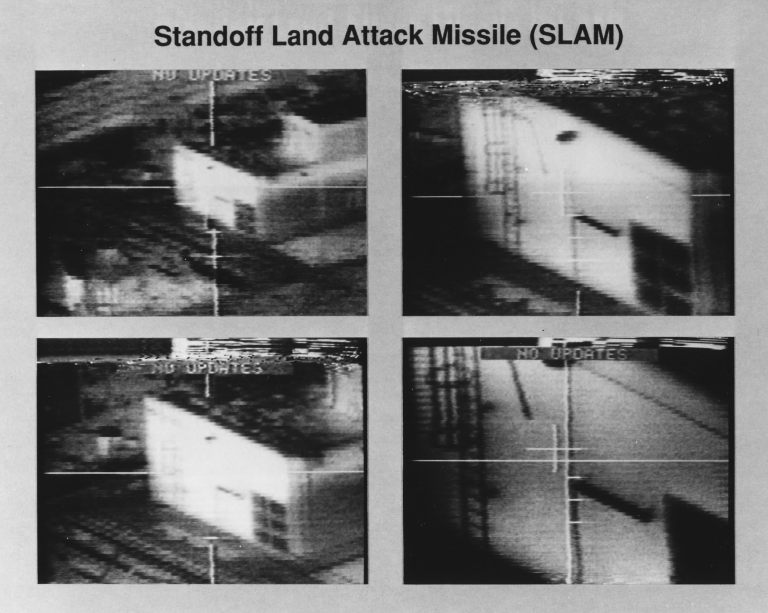
The Hughes AGM-65D IIR Maverick missile seeker assembly is used unmodified. The AGM-65D is a mature product, with eventual USAF purchases expected to reach 60,000 rounds. The seeker includes a miniature FLIR assembly and a processor which executes an aimpoint tracking algorithm for fire-and-forget Maverick launch. The Maverick seeker assembly attaches to the SLAM airframe via a seeker support flange which is directly compatible with the Maverick clamp ring: the existing Maverick indexing bushing is used for alignment. The use of mature subassemblies in the SLAM design will cut the development cycle while containing costs and offering a predictable reliability performance. SLAM Mission Profile SLAM offers two basic operating modes, Preplanned for land strike and Target-of-Opportunity for maritime strike. Used in the latter mode, SLAM allows a selective attack on the most vulnerable part of the target vessel, particularly useful when hitting tankers. When Preplanned Mode is used, target coordinates, waypoints, terrain clearance settings and terminal trajectory options must be loaded into the missile prior to takeoff. This is achieved using a Missile Initialisation Unit (MIU) which transfers four alternate mission profiles via the umbilical interface into the GPS Receiver/Processor's nonvolatile memory. This strategy allows routing the approach path around known and suspected defences. A typical mission involves two aircraft; one is the launch platform, the other the control aircraft carrying the 685lb AN/AWW-13 Walleye datalink pod. Both aircraft would penetrate hostile airspace at low level, avoiding detection. At some point, given the tactical situation, a decision is made as to the choice of mission. Using the Harpoon interface, the mission is selected and the SLAM powered up. Three minutes are required to bring the ARA gyros to speed and cool down the IIR seeker. Once the ARA is stable, GPS satellite acquisition occurs and the missile is ready for launch. A BIT can be performed. When the aircraft reaches the release point, the final launch sequencing occurs and SLAM is launched. The missile approaches its target much like a cruise missile, from waypoint to waypoint with appropriate terrain clearance. The continuous GPS updates ensure accurate navigation while the ARA assisted tracking can defeat hostile jamming of GPS transmissions or momentary loss of signal. The accuracy of the GPS nav allows the cueing of the IIR seeker on to the target thus avoiding a lengthy visual search for the target. At a set distance the datalink is activated and video from the IIR seeker transferred to the operator's CRT display in the control aircraft. Both launch and control aircraft are well outside of the target's area defences. The operator will use his tracking control handle to steer,
via datalink commands, the SLAM IIR seeker track gate on to his
selected
aimpoint. Once this has occurred, the seeker may be locked on and SLAM
will autonomously track the aimpoint until impact. The short duration
of
the datalink transmission phase gives the threat little time to detect
and jam. The accuracy of the Maverick seeker is adequate for most
targets and the penetration casing can cope with a wide range of target
types.
The compatibility of SLAM with Harpoon capable aircraft, a Harpoon support infrastructure and the Harpoon anti-shipping role, vastly reduces the cost and complexity of integrating SLAM into a Harpoon capable strike force such as that of the RAAF. SLAM offers cruise missile like defence penetration capability with the pinpoint terminal accuracy of a day/night anti-tank missile, this coupled with the punch of a penetrating 500lb warhead. Carried by high performance strike aircraft such as the F-111 or F/A-18, SLAM provides a surgical strike capability at a substantial operating radius. SLAM seems to fit in nicely with the RAAF's existing doctrine on PGMs and would offer a credible capability against any regional threat. Whether the RAAF shares this perception remains to be seen. REFERENCES
|
|||
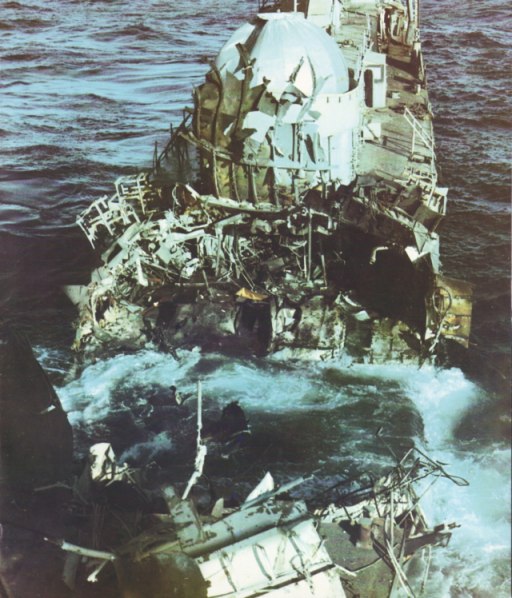 Effect of Harpoon hit on a target destroyer vessel (US Navy) |
|||
|
|||||||||||||
|
|
|
|
|
|
|
|
|
|
|
|||
|
|
|
|
|
|
|
|
|
|
|
|||
 |
|
|
|||||||||||
| Artwork, graphic design, layout and text © 2004 - 2014 Carlo Kopp; Text © 2004 - 2014 Peter Goon; All rights reserved. Recommended browsers. Contact webmaster. Site navigation hints. Current hot topics. | |||||||||||||
|
Site Update
Status:
$Revision: 1.753 $
Site History: Notices
and
Updates / NLA Pandora Archive
|
|||||||||||||
|
|
Tweet | Follow @APA_Updates | |||||||||||
|
|
|||||||||||||
|
|
|||||||||||||