|
||||||||||||||||||||||
 |
||||||||||||||||||||||
![F-22A Raptor, FB-22, F-22E, F-22N and Variants Index Page [Click for more ...]](APA/f-fb-22.png "F-22A Raptor, FB-22, F-22E, F-22N and Variants Index Page [Click for more ...]") |
 |
![People's Liberation Army Air Power Index Page [Click for more ...]](APA/pla-air-pwr.png "People's Liberation Army Air Power Index Page [Click for more ...]") |
 |
 |
 |
 |
 |
 |
![Military Ethics, Culture, Education and Training Index Page [Click for more ...]](APA/ethx-culture.png "Military Ethics, Culture, Education and Training Index Page [Click for more ...]") |
 |
||||||||||||
 |
![Russian / Soviet Weapon Systems Index Page [Click for more ...]](APA/rus-weps.png "Russian / Soviet Weapon Systems Index Page [Click for more ...]") |
 |
 |
 |

|
 |
 |
 |
 |
 |
||||||||||||
 |
 |
|||||||||||||||||||||
| Last Updated: Mon Jan 27 11:18:09 UTC 2014 | ||||||||||||||||||||||
|
||||||||||||||||||||||
|
||||||||||||||||||||||
|
||||||||||||||||||||||
|
|
|
|
|
|
|
|
|
|
|
||||||||||||
|
|
|
|
|
|
|
|
|
|
|
||||||||||||
|
|
|||||||||||||||||||||
| Last Updated: Mon Jan 27 11:18:09 UTC 2014 | ||||||||||||||||||||||
|
||||||||||||||||||||||
| JDAM
Matures Parts 1 and 2 |
|||
|
Australian Aviation, December 2002 - January 2003 Updated August, 2008. by Dr Carlo Kopp |
|||
|
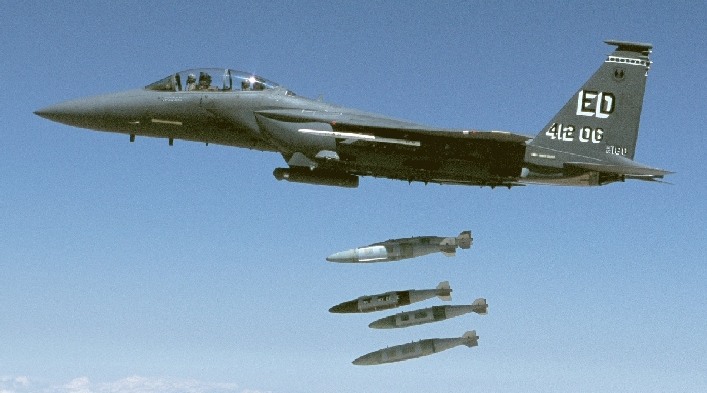
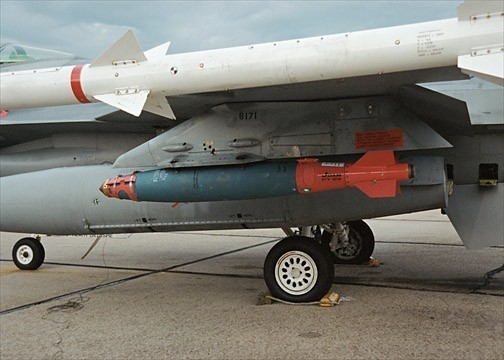
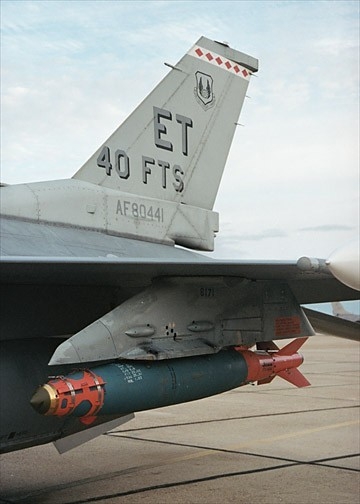
The JDAM will greatly expand the capabilities of theatre deep strike fighters such as the F-15E and F-111C, by providing near precision or precision strike capabilities through an overcast. Laser guided bombs such as the baseline GBU-10/12 and GBU-22/24 are unusable under conditions where the laser illumination is impaired, conditions which are of no consequence to a JDAM tracking L-band microwave emissions from low orbiting satellites. The use of platform referenced and wide area differential GPS techniques push the accuracy of the JDAM into the domain traditionally occupied by laser guided bombs. This Boeing F-15E is pickling off no less than five 2,000 lb GBU-31 JDAMs, each of which can autonomously fly to its preprogrammed target (Boeing). The US Joint Direct Attack Munition (JDAM) family of inertial/GPS guided bombs became a household word with the extensive use of these weapons during the Enduring Freedom air campaign in Afghanistan. This was not the first use of the JDAM, delivered by the B-2A during the Allied Force campaign in 1999, the JDAM is credited with providing a critical all weather strike capability during periods of dense cloud cover, when the primary laser guided weapons used by the NATO force proved ineffective. The JDAM has proven to be a highly effective weapon, offering new capabilities and very significant long term growth potential, but it is not without its critics. This two part feature will explore the current status of the JDAM and a number of related growth programs currently under way. Inertial/GPS Guided Bombs The origins of modern GPS guided bombs such as the JDAMs lie not in the domain of GPS satellite navigation, but in inertially guided bomb experiments performed during the 1980s. Until that period, the dominant guided bomb technology was the laser guided weapon, first introduced like television guided weapons during the Vietnam war period. That conflict saw a long running and sustained war of attrition conducted by the US Air Force and US Navy against North Vietnam. While average loss rates of US aircraft to Russian supplied AAA and SAMs were fairly low, the cumulative effect over a decade long war was telling. This produced significant pressure for precision weapons, and the early GBU-2 laser guided bombs and GBU-8 HOBOS television guided bombs evolved primarily to reduce the number of aircraft exposed to defensive fire. The GBU-8 and the GBU-2 had significant limitations but were nevertheless highly successful compared to dumb bombs. The guidance packages in these weapons were trivially simple by contemporary standards, reflecting the low density of period electronics. The cheaper and simpler laser guided weapons rapidly displaced the more complex television guided bombs, despite the higher accuracy of the latter. The standard low cost GBU-10/12/16 series Paveway II laser guided bomb kit is a case study in simplicity. The quadrant seeker is fitted under a thick lens, and embedded in an aerodynamically aligned seeker head. Electronics in the guidance package sense the angular error between the bomb's velocity vector and the laser spot, illuminated by an aircraft of ground based laser designator. The angular error is then used to control solenoid valves which vent gas from piston / cylinder actuator assemblies, pressurised by a burning gas cartridge. The canard controls are either fully deflected or neutral in position, providing the simplest possible bang bang or non-proportional guidance. The relatively dumb guidance technique in such weapons results in aggregate guidance errors of the order of several metres, generally irrelevant for a 2,000 lb bomb lethal radius. Laser guided weapons have some very important limitations. Perhaps the most important of these is their dependency upon continuous laser illumination of the target aimpoint. If the laser is shut down, or the target is obscured by rain, water vapour (cloud/fog), dust or smoke, the bomb seeker is blind and the weapon is apt to follow a ballistic trajectory like a very ordinary dumb bomb. This limitation was less important in the latter portion of the Cold War since low altitude delivery was considered an acceptable risk in a central European battle with the Soviets. Therefore fighters and bombers delivering these weapons would typically attack from short distances, well below cloud cover in most situations. With the end of the Cold War tactics shifted. Loss of aircraft and aircrew became politically unacceptable, and bombing campaigns were mostly prosecuted from medium altitudes, well above the reach of AAA and shoulder fired SAMs. The latter accounted for the largest number of coalition aircraft losses in the 1991 Desert Storm campaign. Medium altitude delivery presented serious issues for laser guided bombs. Loss of the sightline to the target would cause the weapon to go ballistic and frequently impact hundreds of metres from the intended aimpoint. In urban areas this would result in serious collateral damage, and politically damaging loss of civilian lives. Another issue was the robustness of a simple non-redundant laser guidance system. Whether the guidance signal was lost through hardware failure, or loss of illumination, the weapon was almost guaranteed to go astray. Adverse weather conditions and embarrassing collateral damage incidents in Desert Storm created the impetus for a production all weather inertial/GPS guided bomb kit. Inertially guided bomb technology was the subject of intense US Air Force interest during the 1980s. Such a weapon would be initialised over a digital umbilical with target and aircraft coordinates before release, and then it would autonomously fly to impact using flightpath position and velocity information produced by its onboard Inertial Measurement Unit. Microprocessor and Kalman filter technology permitted these weapons to use very refined guidance and autopilot algorithms. The weapon's trajectory could be optimised for range, impact velocity or impact angle. Since the inertial system was self contained, the weapon could not be jammed. An inertially guided bomb presented the prospect of a robust, digitally programmable, highly reproducable weapon which was jam proof and wholly oblivious to ambient weather conditions. The perfect precision guided bomb? No inertially guided bomb ever entered production, since the cost of inertial units with the required accuracy proved to be prohibitive. The perfect yet unaffordable guided bomb. The great enabler for inertially guided bombs was the US Air Force Navstar GPS satellite navigation system. By using a GPS receiver to bound the cumulative error produced by the inertial unit, an inertial bomb with GPS could achieve equal or better accuracy at very low cost, compared to a purely inertially guided bomb. The first GPS aided inertially guided bomb to be built and deployed was the US Air Force's Northrop GBU-36/B GAM84 (GPS Aided Munition) 2,000 lb weapon, deployed on the B-2A as a gapfiller prior to production of the then embryonic JDAM. While the GAM was a relatively expensive weapon at cca USD 40k / round, engineered for early deployment rather than minimal mass production cost, it did prove the concept convincingly. More over, it also proved an important refinement for improving the accuracy of such weapons. This refinement was the use of platform referenced differential GPS, or GATS (GPS Aided Targeting System). When the B-2 programmed its GAMs before release, it included a list of which GPS satellites it was tracking. The bomb would track only these satellites, ignoring all others, and thus would see identical GPS position errors to the bomber. A GPS aided bomb without differential techniques would have a circular error probable of the order of 7 to 12 metres, using differential techniques the B-2A/GAM combo repeatedly demonstrated 6 metres or less, making it directly competitive against the established precision GBU-10 Paveway II. The Joint Direct Attack Munition The JDAM was the result of a hotly contested flyoff between McDonnell-Douglas (Boeing) and Martin-Marietta (Lockheed-Martin), bidding the GBU-31/32 and GBU-29/30 respectively. Boeing won what is likely to prove in time to be one of the most lucrative contracts for decades. The baseline JDAM was to be an accurate rather than precision weapon, with a planned CEP without enhancements of 12 to 13 metres, corresponding to the systemic GPS P-code error and some guidance loop error. The initial plan was to enhance this basic weapon with future seeker technology to provide genuine precision capability. The heart of the JDAM is a Honeywell HG1700 Ring Laser Gyro (RLG) inertial unit, which measures position, velocities and accelerations in all three axes. The brain of the JDAM is in its Guidance and Control Unit (GCU), which contains an embedded microprocessor running a Kalman filter, which accepts position measurements from the GCU's HG1700 and a Rockwell GEM-III low cost military GPS receiver. The Kalman filter continuously computes a best estimate of the bomb's position in space. This information, and the preprogrammed target GPS coordinates, are then used to feed a flight control algorithm. HR Textron actuators are used to drive three of the four tail surfaces. Power is provided by a thermal battery in the JDAM tailkit. Most JDAM variants employ a set of strap on aerodynamic strakes, intended to increase body lift and also reduce the weapon's stability to improve its pitch and yaw rates, and thus manoeuvrability. The flight control algorithm can be configured before launch for vertical or horizontal (ie shallow dive) terminal trajectories, selected by the user for a specific type of target. A weapon intended for the basement of a tall building could be programmed to enter at ground floor level, wheres a weapon intended to enter a bunker shaft could be programmed for a vertical trajectory. The use of Kalman filter technology allows for refined midcourse flight algorithms, which can manage the weapon's kinetic energy and maximise glide range. Compared to the primitive analogue guidance in a baseline Paveway II, the JDAM achieves close to twice the glide range under similar launch conditions. The JDAM employs the US standard Mil-Std-1760 umbilical interface, incorporating the Mil-Std-1553B digital multiplex bus. Before launch the JDAM's embedded software communicates with the launch aircraft's stores management processor, no differently than a computer peripheral. Prior to release the JDAM is powered up using an umbilical feed from the launch aircraft. The JDAM executes an internal self test, warms up and aligns the HG1700 inertial unit. Once the JDAM is ready, it communicates status information to the launch aircraft, which then downloads GPS timing, GPS Almanac (ie nav message), GPS Ephemeris (constellation) and the GPS PPS crypto key. This information is used to initialise the GEM-III receiver. Once the inertial unit is aligned and the GPS receiver initialised, the launch aircraft can download into the bomb the target GPS coordinates, fuse settings and impact parameters, all of which can be reloaded at any time before release. Prior to release the aircraft's position and velocities are downloaded. After the weapon is released, the thermal battery is initiated, the GPS receiver acquires a satellite constellation, and the weapon autonomously flies itself to impact, using pre-programmed parameters, penetrating cloud with no loss in accuracy. Should the GPS signal be impaired, lost or jammed, the weapon can rely on its inertial unit and will suffer some modest loss in accuracy, dependent upon how late in the flight the signal was lost, and also depending on the tolerance errors in the HG1700 (some units may be slightly more accurate than others). The autonomous capability in the JDAM is without precedent and a key advantage of this weapon against laser guided bombs. The latter are dependent upon laser illumination, as a result of which the aircraft can engage only one target at a time. While a good operator can pickle off bombs several seconds apart for a level medium altitude strike, and move the laser spot from aimpoint to aimpoint during an attack, in practical terms this permits strikes only on clusters of targets and depends critically on operator proficiency. The JDAM has no such limitation. The JDAM can fly a boresight trajectory similar to a ballistic drop, but can also fly off axis trajectories, to engage targets to either side of the flight path, with some loss in range. Therefore, an aircraft can pickle off multiple JDAMs almost simultaneously, each independently targeted, with the sole limitation that the targets must be within the kinematic footprint of the weapon. The weapon can be released from altitudes as high as 50 kft, at speeds up to Mach 1.3, with medium altitude drops yielding standoff ranges of several nautical miles. A supersonic high altitude drop (F/A-22A) almost doubles range performance due to the much higher initial energy of the bomb. A heavy bomber carrying dozens of JDAMs can obliterate dozens of targets within a given footprint, in a single large drop, as each bomb can be independently preprogrammed before release. The catchcry for the laser guided bomb was one aircraft, one bomb, one target - in the JDAM era this becomes one aircraft, many JDAMs, many targets. Integration of the JDAM is relatively simple, the principal prerequisite being that the launch aircraft is equipped with a Mil-Std-1760 digital weapon station interface. With this capability, software changes are the only modification to the launch vehicle. Clearance testing is required since the JDAM is aerodynamically different to the Mk-84/83/82 series slick bombs. The JDAM GCU module was sized from the outset to fit the internal volume of a Mk.84, Mk.83, Mk.82, BLU-109/B and BLU-110/B tailcone. At this time production of the JDAM encompasses the GBU-31 (Mk.84/BLU-109), GBU-32 (Mk.83), GBU-35 (BLU-110) models, with the GBU-38 (Mk.82) in development with a planned 2004 IOC. The GBU-31 has been most widely used, primarily as a replacement for the GBU-10 in strategic strike (Serbia/Afghanistan), battlefield interdiction and close air support roles (Afghanistan). The US Navy has used the GBU-32 and GBU-35 widely during the Afghan campaign. It is expected that the GBU-38 will become a preferred weapon for battlefield interdiction, close air support and especially urban combat - in these roles low collateral damage is more important than lethal blast effect. Directly interchangable with the Mk.82 slick, the GBU-38 will provide aircraft like the B-52H, B-1B, B-2A, F-111C and F-15E with formidable firepower. To date the JDAM has been used only in its basic configuration, without additional seekers installed. Even with this limitation, the weapon has proven to be a robust replacement for the Paveway II. The capability of the JDAM to punch through a solid cloudbase has revolutionised close air support and battlefield work, since historically such combat required either very low level strikes using dumb bombs, or medium to low altitude strikes using laser guided bombs. Inclement weather offered cover to a clever opponent. The JDAM has closed this strategic loophole forever. JDAM Accuracy and Jam Resistance The accuracy of the JDAM is frequently criticised, the bomb being often described as much less accurate than the widely used GBU-10/12 Paveway II weapons. This argument is lame and not representative of more recent developments in technique and technology. The baseline accuracy of the weapon cited in mid 1990s glossy brochures is a very pessimistic number, based on worst case GPS accuracy for the period. Since the 1999 Allied Force campaign, the US Air Force has generated predictions of GPS accuracy variations over a 24 hour cycle for targets of interest, or areas of interest. These computer models analyse an effect termed Geometrical Dilution Of Precision (GDOP), which arises as a result of the relative positions of satellites in the constellation a reciever can see at a given point in time and space. As the orbital positions of the satellites in time, the GDOP error increases or decreases. Where and when an unusually favourable constellation is seen, the GDOP error can be very low, and GPS errors resulting can be a fraction of the textbook figure. The practice followed by the US Air Force since 1999 is to plan non-time critical strikes to fall into time periods of minimal GDOP for the target of interest, to achieve defacto precision accuracy. The US Air Force planned in the late 1990s a series of Product Improvement Program (PIP) incremental block upgrades to the JDAM guidance package, but no details have been disclosed more recently as to which have been implemented to date. One candidate is the use of platform referenced differential GPS, which is relatively undemanding to implement since it involves only software changes to the aircraft and bomb embedded code (OFP), and GPS receiver operating code. These force the bomb to acquire only a programmed constellation of satellites. The principal errors in bomb delivery are then dominated by the accuracy of the synthetic aperture radar or thermal imager/laser rangefinder used to produce target coordinates, and the guidance loop error in the bomb. Experience with the B-2A suggest this technique results in 6 metre or better CEPs, with the GDOP error dominating the GPS error under most circumstances. Another more potent candidate is the use of Wide Area Differential GPS (WADGPS) techniques, pioneered in the US Air Force EDGE and WAGE trials. This family of techniques involves the deployment of a network of precisely calibrated GPS receiver ground stations surrounding the theatre of operations, which continuously measure the error in the recieved GPS signal against the precisely surveyed location. Data from these ground stations is fed over low data rate landlines or satellite links to a central ground station, which runs a complex computer model incorporating parameters such as solid earth tide (bulge) and wet / dry tropospheric delay. The system continously computes a set of correction parameters for use in an enhanced Kalman filter, these are encrypted and broadcast via a radio link (EDGE) or unused encrypted GPS Almanac page (WAGE). The compensated GPS errors achieved using this technique are as low as several inches in all three axes. An aircraft and JDAM configured to use WADGPS techniques can achieve true precision accuracy, 100% of the time, without the cost penalty of a seeker package. Experience from Afghanistan suggests that the most frequent cause of JDAMs going astray were either bent fins resulting from mishandling, or more frequently the fat finger factor to use the colourful americanism. Human errors in entering aimpoint coordinates on keypads, entry of other than the intended coordinates, and in one instance possibly a ground forward air controller mistakenly transmitting over the radio his own coordinates rather than those of the enemy! Like the alleged inaccuracy of the JDAM, its vulnerability to jamming is very frequently overstated by its critics. To date there is no published evidence of successful use of jamming to defeat a JDAM, or indeed any GPS aided weapon. The baseline GEM-III receiver has built in provisions to resist GPS jamming. Regardless of these, successful jamming of a GPS guided bomb is not as simple as JDAM critics like to suggest. For a jamming effort to work properly, the jamming signal must be coupled into the mainlobe of the bomb's antenna, preferably from the very instant the bomb is released, or even earlier. This is easier said than done, since the GPS antenna on the JDAM is mounted on the tail, and therefore if the jammer is colocated with the target, the antenna mainlobe is always pointing away from the jammer. The only jamming signal which can couple in is what little attaches to the skin of the bomb and tailkit as a creeping wave. Creeping waves tend to be weak in magnitude, and are easily suppressed with coatings. Even should GPS jamming increase in popularity (US reports suggest more recent AGM-88 HARM versions will have provisions for homing on GPS jammers), the installation of improved GPS antennas and receivers would defeat most techniques. Neither represent unusual integration challenges for a modular design such as the JDAM. One issue JDAM critics seem to universally overlook is the reality that it takes very little effort in any inertial/GPS system to incorporate code which monitors the difference between the GPS and inertially predicted bomb positions. Should the GPS position read from the receiver suddenly change by a large amount, the software can simply reject the GPS measurement and continue to fly the bomb using inertial data until impact, or until the GPS signal behaves as it ought to. Unless the jammer is unusually effective, odds are that gaps in jamming will occur and the bomb guidance can use these to grab valid GPS measurements. With a flight time of mere minutes or tens of seconds, the cumulative inertial system error seen since the last valid GPS measurement could be very small indeed. It is worth noting that a JDAM is potentially more robust than an analogue laser guided bomb in the event of a guidance component failure. For instance a hardware failure in a GPS receiver or inertial unit could be handled by rejecting its output and flying to impact on the remaining source of position and velocity data. Boeing have not disclosed whether this technique is used. In summary, most of the criticisms directed at the JDAM (and very popular in some Canberra circles) are very lame and assume a very clever technological peer competitor opponent. Whatever limitations the JDAM might have, these are generally of less significance than the enormous gains in capability and firepower offered by this weapon. At unit costs under USD 20M, the JDAM is one of the best bang for buck choices in the market today. |
|||
 |
|||
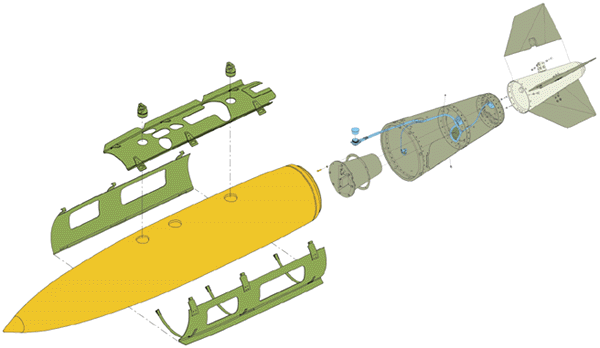
JDAM Cutaway. The JDAM is a GPS aided inertially guided bomb. The Guidance and Control Unit containing a HG1700 RLG, GEM-III GPS receiver and computer package is installed inside the bomb tailkit. The GCU was designed from the outset for tailkit volumes compatible with the Mk.84, Mk.83 and Mk.82 low drag bombs, and has been adapted to the tungsten tipped bunker busting BLU-109/B and BLU-110/B warheads (Boeing). |
|||
|
|||
|
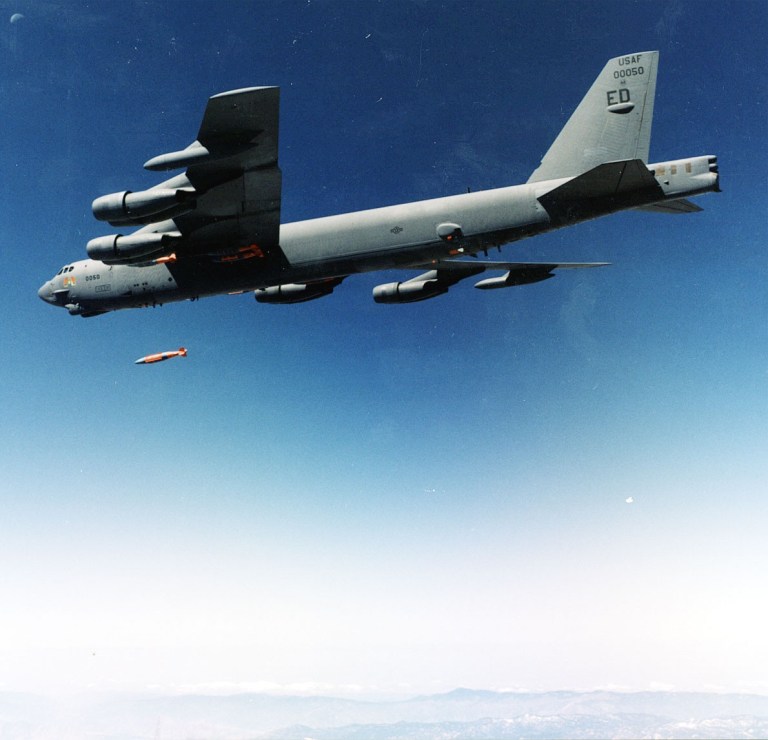
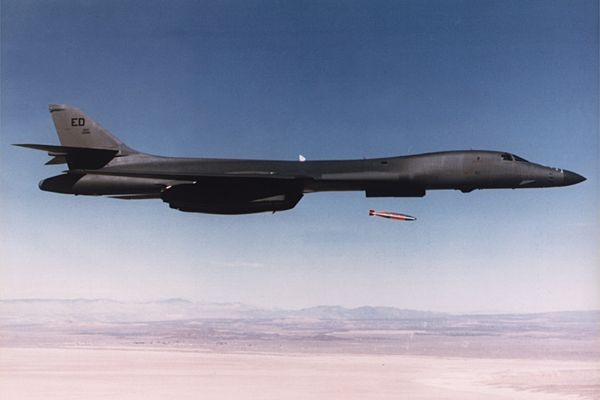
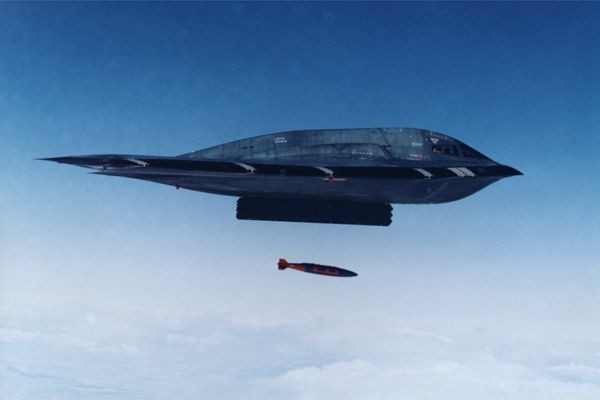
Without doubt the most important near term application of the JDAM has been its use as a near precision conventional weapon for US Air Force heavy bombers, previously limited to dumb bombs. The 2,000 lb GBU-31 fitted to the Mk.84 or BLU-109/B warheads was the first to see widescale combat use. The JDAM was blooded in 1999 when the B-2A bombed Belgrade with the weapon. In 2001, the decisive blows to the combined Taliban/Al Qaeda ground forces in Afghanistan were inflicted by B-52H and B-1B bombers delivering GBU-31s against a wide range of battlefield targets (Boeing/USAF). |
|||
 |
|||
|
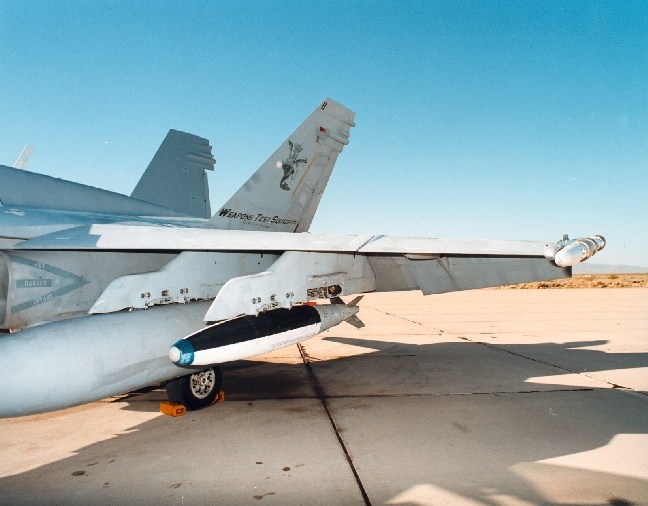
The US Navy's primary JDAM variants are the GBU-32 and GBU-35, designed for the 1,000 lb Mk.83 and BLU-110/B warheads standard for this service. The Boeing F/A-18C/D/E/F will be the primary near term delivery platform for naval JDAMs. Loadouts are likely to be identical to the existing Mk.83, but using smart Mil-Std-1760 racks with Mil-Std-1553B bussing to the bomb umbilical connectors. The baseline JDAM can be retargeted up to the point where it is released (Boeing). |
|||
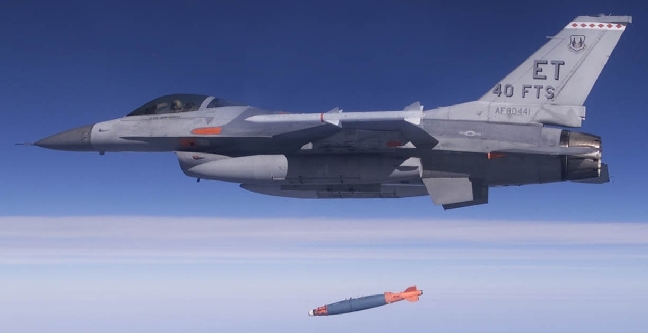 The smallest member of the JDAM family is
the new GBU-38 500
lb weapon, designed for the Mk.82 warhead. This weapon is easily
identified by the absence of the large cruciform strakes used on the
2,000 lb and 1,000 lb variants, with small nose mounted vanes
substituted. The 500 lb JDAM will become a mainstay of close air
support, battlefield interdiction, airfield attack and urban
bombardment
roles, as it offers good lethality against soft targets yet a much
smaller collateral damage footprint than its larger siblings. A B-52H
carrying 48 rounds, or an F-111C carrying 24 rounds, each independently
targeted, offers a dramatic increase in deliverable precision firepower
on a single pass. It is not unreasonable to argue that this weapon will
revolutionise bombing technique (Boeing).
|
|||
| Part 2 |
|||
The Joint Direct Attack Munition family of GPS aided inertially guided bombs represents perhaps the most important single development in bombing technique over the last two decades, and will in time supplant the established laser guided bomb as the most widely used low cost guided munition. Providing aircraft with the ability to attack multiple aimpoints in a single pass, JDAM provides a force multiplying effect unseen in scale since the laser guided bomb displaced the dumb bomb during the latter part of the Vietnam conflict. In this month's final part, growth derivatives of the JDAM will be explored. 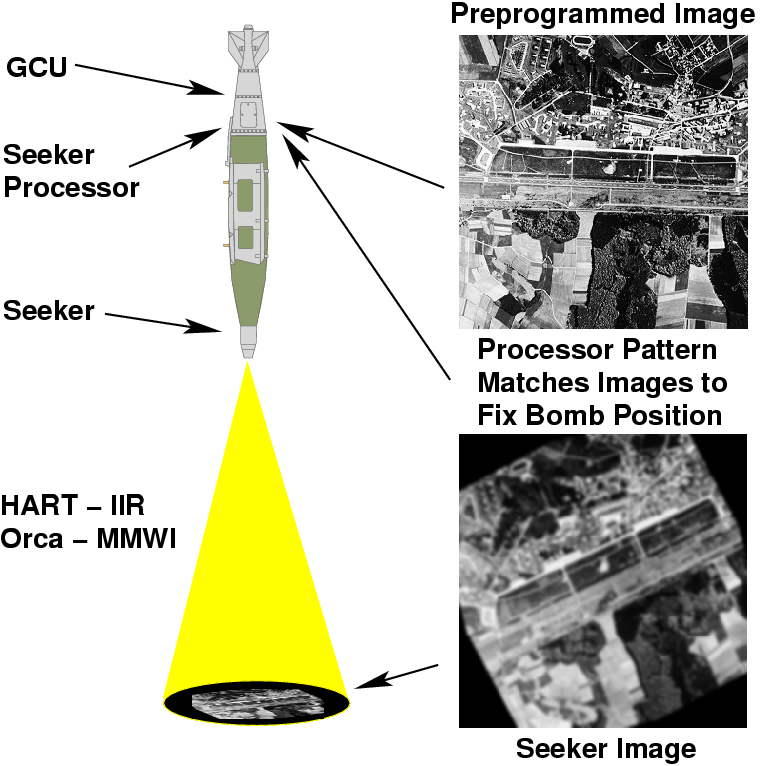 Imaging seekers are one technique which will provide the JDAM with genuine precision capability. A typical design for such a seeker will see the JDAM seeker take a snapshot of the target surroundings, which is then compared with a preprogrammed image to fix the bomb's position. Once the error is found, the target aimpoint is corrected and the bomb dives into the target. MilliMetric Wave Imaging techniques were demonstrated in the Orca program, while DAMASK demonstrated an IIR seeker. Both techniques have growth potential for attacks on moving targets such as vehicles or shipping (Author/USAF). JDAM Precision Seekers From the very outset of the JDAM program, the intention of the US Air Force was to equip the basic weapon with a range of precision terminal homing seekers. The basic idea was to provide an accurate basic weapon, with the terminal seeker providing the remaining precision capability. To that effect, the JDAM Guidance Control Unit (GCU) was designed with additional growth capacity in empty slots for more cards, but also with unused spare interfaces to permit additional hardware to be integrated with minimal effort. In this fashion, specific software could be written for seeker equipped variants and loaded into the standard low cost mass production GCU. A unique seeker would then be plugged into the unused GCU interfaces via an umbilical routed from the nose of the bomb. This highly flexible model was devised to accommodate as many different options in seeker technology as the user might ever want. By dividing the system into discrete modules, where the mass produced baseline hardware is kept unchanged, it is possible to achieve the large economies of scale which are characteristic of very large, uniform and mature mass production builds. Cost has traditionally been the greatest impediment to the large scale use of precision munitions. While a well guided GBU-10/12 Paveway II laser guided bomb can be very accurate, and is cheap due to its primitive seeker design, the weapon is also in many respects fragile since the seeker's simplicity denies redundancy to protect against hardware failures, and the guidance technique is vulnerable to the loss of laser illumination. Opting for more sophisticated proportional navigation style laser semiactive homing, with an inertial capability, as used in the later GBU-22/24 Paveway III bombs drives up the cost. Television guided bombs have also proven expensive. The GBU-8 HOBOS, which evolved into the cruciform wing GBU-15 family of weapons, proved to be amongst the most expensive guided bomb kits ever mass produced. The requirement to provide a stabilised platform for the bomb's seeker, and robust radio datalinks, resulted in a cost structure which effectively compromised these capable weapons in large scale use. The key difficulty with the GBU-15 series was its uniqueness - the airframe components were unusable for other purposes and this drove up the unit cost. The advent of the JDAM as a platform for range of precision seekers or guidance packages changes the basic economic equation. The unique portion of the precision weapons kit is the seeker hardware/software alone, with the remainder of the weapon being essentially standard low cost mass production hardware. Therefore nearly all of the investment in developing and producing the precision weapon is concentrated into the seeker alone. To date no precision seekers have been deployed operationally, or at least not announced in the public domain. In part this is because the basic JDAM has proven generally more accurate than originally expected. Operational use of techniques such as strike planning in optimal GDOP windows, deployment of improved later generation GPS satellite vehicles have clearly driven accuracy close to the GBU-10 class, and with the eventual use of wide area differential GPS (eg WAGE) and B-2 derived platform referenced differential GPS, there will be little pressure for precision seekers. Why add US$10k to 20k to the cost of each bomb if you can get 80% of its accuracy via cheaper techniques? However, this does not by any measure mean that seekers are dead. On the contrary, many situtations will demand seekers. Moving targets in a jamming environment will almost certainly require seeker technology to retain precision accuracy if the GPS channel is lost. JDAM Radar Seekers The US Air Force ran two technology demonstrations during the late 1990s. The classified Raytheon/Sandia Hammerhead program demonstrated the use of Synthetic Aperture Radar (SAR) active seeker for the JDAM, with a 3 m CEP. While details have not been released as yet, it is reasonable to speculate that the design uses a scene matching area correlation technique to fit a SAR map against a preprogrammed target area map. At that time the US Air Force also sponsored the classified Orca program, to demonstrate a millimetric wave (MMW) radar seeker with a 3 metre or better CEP. MMW seekers have been used for instance on radar guided anti-tank mortar rounds, and the technology is central to the latest variants of the Hellfire missile carried by the AH-64D Longbow Apache. No details have been released on Orca to date. Given the potential of the technology, an MMW seeker could be used for attacking moving targets like shipping or armour, and using scene matching area correlation techniques in the manner of the Pershing II IRBM, it could also be used for precision strikes on fixed targets. Clearly there is considerable potential in radar seeker technology for the JDAM, and many possibilities exist. JDAM Electro-Optical Seekers At this time there are very few electro-optically (EO) guided bombs in operational service. The US Air Force retains residual stocks of the GBU-15, which have been since upgraded to EGBU-15 configuration by the additional of a GPS receiver and IMU to provide JDAM-like midcourse guidance. The Israelis have a range of weapons, but stocks and configurations remain largely undisclosed. A key obstacle to the use of autonomous and datalink supported EO guidance techniques has been cost. To achieve a respectable acquisition range of several miles, the seeker optics must be stabilised down to tens of microradians or better jitter performance. Typically multiple fields of view are required. The result was an expensive to produce gimballed optical package with the additional encumbrance of cryogenic cooling if infrared day/night capability was needed. If the weapon was to be remotely guided from a cockpit, then the weapon would also require an expensive jam resistant wideband video datalink to carry the seeker image to the launch aircraft. While autonomous target recognition techniques have matured in recent years, one to two decades ago they were both expensive and unreliable. Much has changed since in basic technology. In daylight imaging, high resolution CCDs and CMOS imagers are now much cheaper and immeasurably better than the vidicon tubes of the 1970s. In infrared imaging, bolometric uncooled and cryogenically cooled Indium Antimonide, Mercury Cadmium Telluride, Platinum Silicide and Aluminium Gallium Arsenide Quantum Well Imaging Photodetector (QWIP) focal plane or staring arrays are now available. Of particular interest is the QWIP technology since it permits high resolution imaging chips operating in the MWIR (midwave or 4-5 micron band) and LWIR (longwave or 8-12 micron band), but also allows a single imaging chip of the proper architecture to concurrently image in both the MWIR and LWIR bands - effectively two band specific thermal imagers in one slab of Aluminium Gallium Arsenide semiconductor producing two video signals at the same time. Not surprisingly, the leading wave of QWIP imagers is in the high volume commercial medical/industrial markets rather than low volume military market. No less important is the uncooled bolometric thermal imaging technology, which is much less sensitive than cooled semiconductor imaging chips, but also much cheaper, and not requiring the dollar hit of a refrigeration package. It's principal market lies in automotive thermal imagers, popular in top tier US limousines. Electro-Optical guidance, be it autonomous or datalink aided, is potentially valuable to the JDAM family of weapons. While it cannot penetrate cloud, it is compact and extremely precise. With the weather immune GPS/IMU guidance, an EO seeker equipped JDAM can fly under the cloudbase to acquire its target. Widely available EO targeting pods, especially on US aircraft, provide a source of good quality infrared imagery which can be downloaded to a seeker equipped JDAM before release. With satellite and UAV generated high resolution imagery, and datalinks to combat aircraft, there are few obstacles to target imagery being tranmsitted in seconds from a source to a bomber, and through the Mil-Std-1760 umbilical, to a seeker equipped JDAM before release. The first EO seeker demonstrated on a JDAM was the DAMASK (Direct Attack Munitions Affordable Seeker), sponsored by the Office of Naval Research (ONR) under a USD 15M contract. The aim of the DAMASK project was to demonstrate a very cheap yet highly accurate low cost EO seeker, with no moving parts. 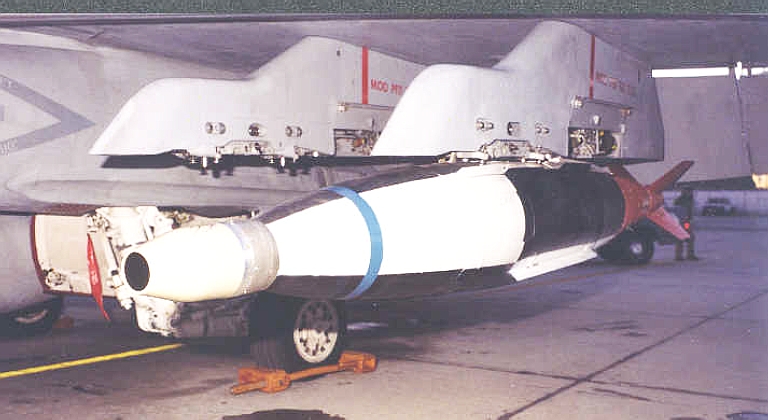 The DAMASK program demonstrated the viability of an uncooled autonomous thermal imaging seeker on the baseline GBU-31 JDAM. The DAMASK would take a snapshot of the target scene, and pattern match the image against a stored image of the target area to refine its position estimate. The result is accuracy of the order of several feet, and trials drops as good as 2 ft from the intended aimpoint. The HART program will see this technology incorporated into a production weapon (US Navy). 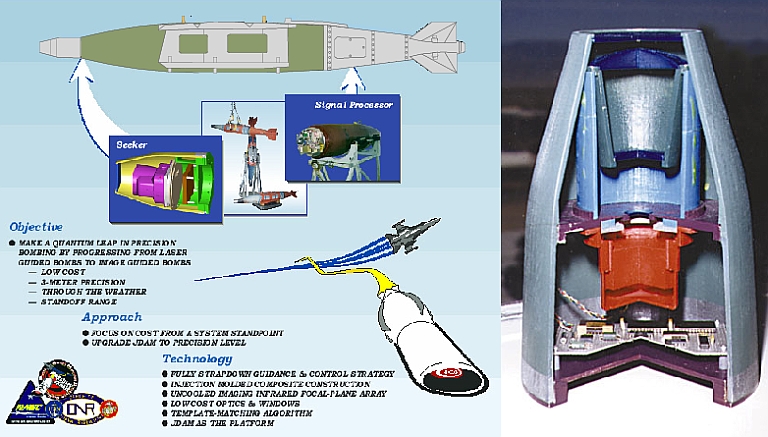 The DAMASK design was innovative in many respects. The low cost seeker was designed around an uncooled imaging-infrared focal plane array (UIIFPA) device, using low cost optics and a molded composite casing. The imaging array is based on the same technology used in the Cadillac Seville 2000 head up FLIR, to achieve exceptionally low unit costs. A commercial signal processing module was adapted to support the seeker, and installed in the unused tailkit volume. The US Navy estimated the unit cost of a DAMASK kit at US$12.7k in mass production. The DAMASK employs scene matching techniques well proven in systems such as the Tomahawk. Before the bomb is released, the launch aircraft downloads an image of the target, produced by satellite, the aircraft's SAR or FLIR. When the bomb is released is flies over the target and then noses over to point down at a very steep angle. In this terminal flight phase it images the area surrounding the target, and then performs the correlation operation to determine the bomb's actual position against its intended position. The system was to calculate weapon alignment to 100 microradians accuracy, for a 2.6 metre error at impact. Once the JDAM's position is updated from the target scene, the weapon will correct its donwward trajectory, pulling multiple Gs if required as it is travelling down very quickly at several thousand feet of altitude at this point. Once the trajectory adjustment is completed, the weapon continues on inertial/GPS guidance to impact. The DAMASK demonstration presented some interesting problems. The issue of seeker alignment was demanding, especially since the minute flexure in the bomb body was enough to introduce potentially problematic errors. Image roll alignment proved to be an issue, as did motion induced image blurring and image distortion resulting from lens behaviour. Image processing speed also presented challenges, since the time window for processing the acquired image was very short. DAMASK proved to be a resounding success, with trial weapon drops including simulations of GPS jamming by disabling the bomb's GPS receiver. The first drop saw the weapon impact within 2 ft of the intended aimpoint. The DAMASK program was essentially a technology demonstration to prove that the concept of a simple EO seeker worked effectively. The current US Navy HART (Hornet Autonomous Real-Time Targeting for F/A-18C/D/E/F) program builds on the DAMASK effort. HART is aimed at providing a production EO seeker for the JDAM, which incorporates the capability to download the image from the aircraft's FLIR/EO targeting pod (AAS-38 or ASQ-228 ATFLIR/Terminator) providing the ability to precisely target pop-up and relocatable targets. The formal FBO statement for the program specifies Boeing as the sole source. Whether the HART seeker package will incorporate the Autonomous Target Recognition (ATR) algorithms devised by Boeing for the AGM-84E SLAM family of missiles is unclear from published materials. HART will run until 2007. Whether the US Air Force adopt the HART seeker, or indeed it becomes available to export clients, remains to be seen. The nature of the design lends itself to integration on any FLIR/EO pod equipped Mil-Std-1760 capable aircraft, which both the RAAF's F-111C Block C-4/5 and F/A-18A HUG will become in the timelines of interest. 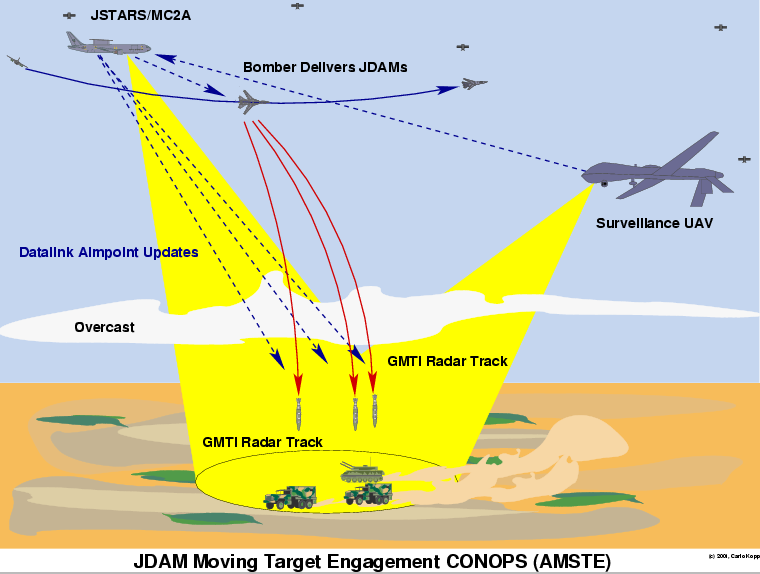 The DARPA AMSTE program recently demonstrated a successful strike against a moving target using a JTIDS datalink aided JDAM. The target was tracked by two separate airborne GMTI radars, providing a continuous stream of target coordinates which were fused and then tranmitted over a JTIDS channel to the JDAM in flight. The weapon is reported to have impacted within the lethal radius of the target (Author). Datalink Guided JDAMs The limitation of the baseline JDAM guidance package is that it was designed to engage fixed targets, the original intent being to fit precision seekers for attacking moving targets. More recent developments in the US suggest that a radical change may be afoot in this area. The Affordable Moving Surface Target Engagement (AMSTE) technology demonstration program is a complex effort which is intended to develop and prove techniques for the engagement of moving ground targets, using cheap munitions and standoff radar targeting techniques. In particular, AMSTE is exploring Ground Moving Target Indicator (GMTI) radar techniques, target position refinement using information from multiple radars on multiple aircraft, and the use of datalinks to guided weapons. Perhaps the most dramatic outcome of the AMSTE effort was the August 22, 2002 demonstration, in which a JDAM modified with a JTIDS datalink receiver successfully engaged a moving vehicle in a column, using target coordinates produced by a distant E-8 JSTARS and a second radar on an airborne testbed. The inert JDAM was dropped by an F-16C at 20,000 ft, the target was part of a vehicular column travelling at 30 km/h. Once released, the JDAM acquired the JTIDS signal and continuously updated its aimpoint position as it flew toward the target. DARPA have not disclosed the frequency of updates, but it is likely that a whole JTIDS net was reserved for this purpose. The AMSTE demonstration is important since it proves the feasibility of continuosly datalinking a moving target's position to a JDAM in flight. The position information could be produced a GMTI radar on a distant aircraft, be it a fighter with a larger radar, an ISR platform or a UAV, or it could be produced by a FLIR/EO/laser targeting system on a fighter or an endurance UAV such as a Predator or a Global Hawk. Once the targeting sensor is measuring the location of the target vehicle, it takes little effort to pump this information out on a datalink radio channel to a bomb in flight. Handling the target coordinates at the bomb end is perhaps the most challenging aspect of such systems. The guidance software will have to incorporate a Kalman filter which estimates the position of the target vehicle based upon a track history of continuously transmitted coordinates. A prediction of the target's position based on this data is then used to adjust the bomb's aimpoint. Since the JDAM is flying blind toward its target, the quality of the prediction algorithms is critical to success. Another important aspect of seekerless JDAM engagement of moving targets is the accuracy of the transmitted coordinates, since these are added to the JDAM's guidance error. While many radars support GMTI techniques, very few support the more accurate multi segment Differential Phase Centre Antenna (DPCA) techniques, as these require specific adaptations to the radar antenna design, and feed designs. As a result, the range and bearing accuracy of GMTI radars usually does not match that achieved in SARs. The AMSTE program works around this limitation by fusing GMTI tracks from multiple airborne radars, to yield a best estimate of target position. The target bearing error can be modest, and triangulation of the target using bearings from two or more radars separated by several miles evidently makes the difference. When the AMSTE derived technique does eventually become operational, it will permit the concurrent engagement of multiple ground vehicles in all weather day/night conditions. Whilst it may not match the accuracy of seeker equipped JDAMs, it makes up for that limitation in much lower weapon costs. Combining a datalink midcourse system with a cheap autonomous short range seeker, such as a device derived from an anti-armour submunition, of course yields the best of both worlds. What is clearly evident is that the sanctuary of motion will not last long for evaders of the JDAM. 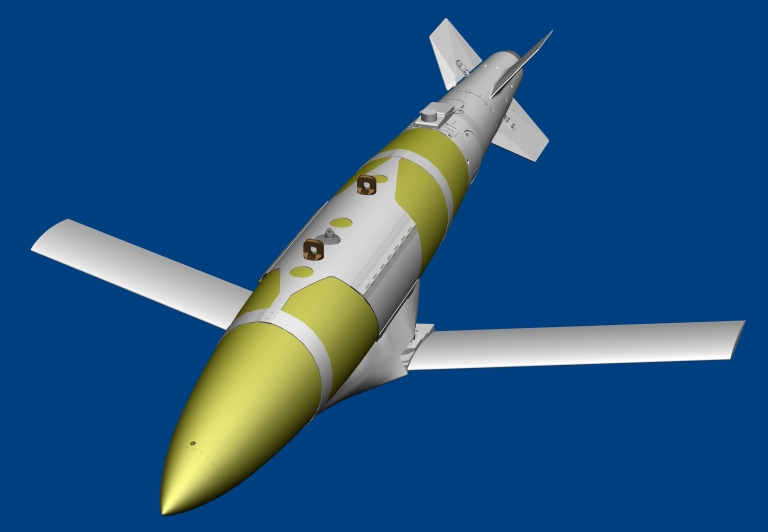 The HdH JDAM-ER is being designed for very low mass production unit cost, which is reflected in a number of design features. The most evident is the revival of the DSTO GTV untapered wing planform, which sacrifices a little range performance but is significantly easier to manufacture. The baseline GBU-31/32/35/38 tailkit is used, with software alterations to support the changed aerodynamics and wing deployment functions (HdH). Additional HdH JDAM-ER line drawings here [1], [2], [3] (HdH). 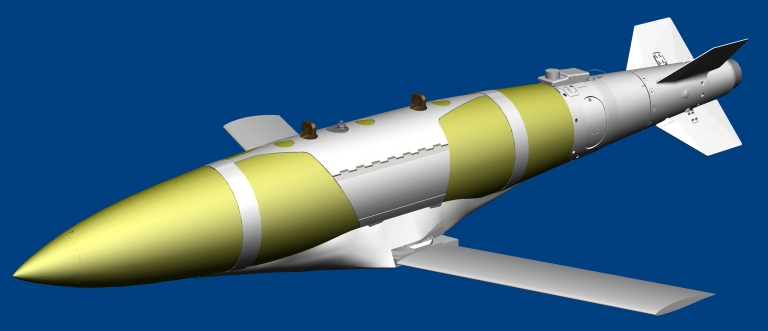 Australia's Winged JDAM-ER The notion of a GPS aided inertially guided glide bomb is nothing new, but fielding one has proven to be a time consuming task. Australia is in a unique position insofar as the DSTO GTV/Kerkanya demonstration put it in the forefront of glide bomb kit research - until recently this innovative DSTO effort sat in limbo. The first attempts to convert the GTV/Kerkanya concept into viable production weapons never got off the ground, in both senses of the phrase. During the 1990s Hawker de Havilland pursued the Icarus I and II concepts, the former using a BAe ALARM anti-radiation seeker, the latter using a JDAM-like GPS/inertially guided tailkit. A lack of funding saw both efforts confined largely to paper studies. AWADI also pursued the idea of a production GTV/Kerkanya derivative, but aimed from the outset at a GPS/inertially guided tailkit solution under the Agile Gliding Weapon (AGW) designation. With the entry of the JDAM into full scale production, the idea of fusing the AGW wing kit with the JDAM tailkit was explored as a joint effort between AWADI and Boeing. The AWADI effort collapsed after the company was acquired by BAeA. Thus, it appeared, the effort to revive the GTV/Kerkanya as a production effort was doomed to failure. Last year Hawker de Havilland (now Boeing owned) at Fisherman's Bend were awarded RAAF funding to pursue a Concept Technology Demonstration of a GTV/Kerkanya derived wing kit for the GBU-38 500 lb JDAM. HdH licenced the DSTO intellectual property in the GTV/Kerkanya and acquired all archived DSTO design data, reports, and remaining demonstrator hardware components to support this effort. HdH have received great support from DSTO, RAAF Capability Development, the DoD CTD program office and DMO. Over the last 2 years, the HdH development team at Fisherman's Bend have been working in earnest to convert the GTV/Kerkanya research findings into a viable design for mass production. This effort has involved analysing the basic design issues for the wing from the ground up, and re-evaluating nearly all basic design assumptions. The current intent is to perform a critical design review at the end of 2002, resulting in a qualified design by mid 2003 and flight trials in late 2003. Should no unforseen difficulties arise, the HdH Range Extension Kit for the GBU-38 JDAM (JDAM-ER for Extended Range) could enter Low Rate Initial Production (LRIP) some time in 2004. The basic JDAM tailkit is well suited to such an adaptation since the Guidance and Control Unit (GCU) has available internal growth capacity, and spare unused interfaces to permit the control of additional hardware. The wing kit would thus be connected to the GCU via an umbilical, and additional code added to the baseline JDAM to provide for release of the wing, and provide a unique autopilot for the winged variant. In the simplest of terms, the JDAM tailkit hardware would remain unchanged, but software would be added to adapt the tailkit to the glide wing. The HdH design uses an untapered wing planform like the GTV demonstrator, but differing from the later tapered wing planform on the Kerkanya. This reversion loses a few percent in aerodynamic efficiency, but improves the radar scattering behaviour of the wing, and is much easier to mass produce at low cost. Unlike the DSTO demonstrators which used differential pressure sensing ports and a pitot tube to achieve optimal gliding performance, the baseline HdH design will derive its velocity from GPS/inertial outputs. While this does not extract the full glide range potential from the design, it does reduce cost and complexity considerably, and improves the reliability of the wing kit. Key design objectives for the HdH product are lowest possible mass production cost, zero hardware changes to the existing GBU-31/32/35/38 tailkits, best possible performance, modularity, ease of maintenance and especially shortest possible assembly time in the field. The latter will be critical to user acceptance of the kit, the less time expended and the fewer errors in assembly when deployed in the middle of nowhere, the more popular the kit will be with its users. The design philosophy is centred on producing a flexible product which can further grow as customers request additions. Should a customer pursue a high wing configuration, improved glide range, or a different wing sweep angle, the basic design is aimed at accommodating such changes at the lowest incremental cost. HdH intend to offer scaled variants of the kit for the Mk.82, Mk.83, Mk.84, BLU-109/B, BLU-110/B, BLU-118/B warheads, and any future warheads in this weight class. At the time of writing the external design was frozen with detail design currently progressing to design review. Available illustrations reflect the current configuration, but are likely to change in detail areas to reflect future customer requirements. The importance of the HdH effort cannot be understated. In strategic terms, a JDAM-ER with 30 to 50 NMI of standoff range for a high altitude release provides a very cheap mass production standoff weapon which defeats all but the largest and most capable area defence SAMs in service. As the range of the weapon is well matched to typical combat aircraft radar SAR modes, it provides a genuine standoff all weather capability. Should the JDAM in the future acquire a standard datalink, this capability would be expanded to encompass moving targets. The JDAM-ER is not a substitute for the AGM-142 SOW, as the latter is a supersonic weapon with a pinpoint precision imaging seeker and remote datalink control. When dealing with well defended very high value targets, such as radar installations, mobile command posts, command bunkers or communications nodes, or targets of opportunity, the AGM-142 permits positive operator control of the weapon to impact with a fairly short flight time. This contrasts with the less precise, much slower but also much cheaper JDAM-ER. The low cost of the JDAM-ER permits its use against much lower value targets, even if these are well defended. In practice the RAAF would use the AGM-142 to engage air defence and command-control-communications targets, while concurrently using the JDAM-ER to engage the fixed targets being defended by those same assets. 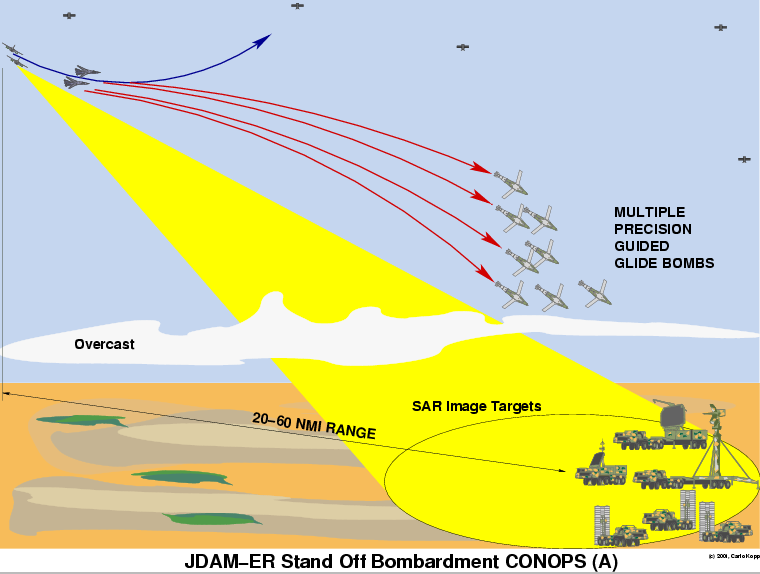 The HdH JDAM-ER effort builds on the DTSO
GTV/Kerkanya glidebomb
effort, using the standard JDAM tailkit with suitable software
alterations. With a standoff range likely to be well in excess of 50
NMI, the JDAM-ER will revolutionise much of the bombing game. The
weapon will be suitable for medium/high altitude drops, and low level
toss deliveries, placing the bomber outside the range of most air
defence weapons (Author).
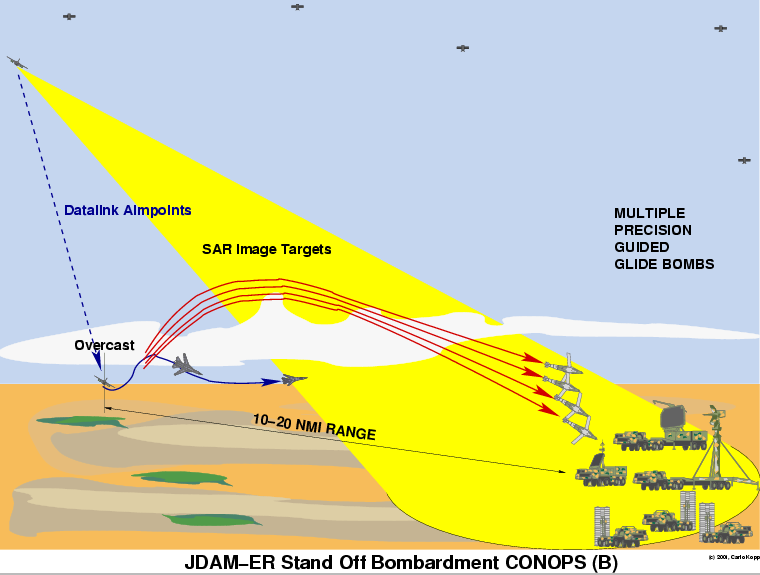 Like all other variants of the JDAM, the JDAM-ER will permit massed attacks against prebriefed targets. A fighter could pickle off an arbitary number of these weapons, and turn tail while the bombs each autonomously fly to their targets. Even with a 50 NMI glide range, the footprint the fighter can hold at risk encompasses roughly a 100 NMI circle. A key issue for the RAAF will be achieving a mature Mil-Std-1760 capability on its F-111C/G and F/A-18A fleets before the weapon becomes available. Exploiting the full potential of the JDAM-ER, especially the 500 lb GBU-38 varianant, will require smart bomb rack technology, with a Mil-Std-1760 capability on each ejector. For the F/A-18A this would require a dual or triple rack, for the F-111C/G a modified BRU-3/A six hardpoint rack. The GBU-38/JDAM-ER would be especially well suited to the F-111C/G as with four 6 hardpoint smart racks it has to potential to engage 20-24 aimpoints on a single pass, subject to clearances. Autonomous targeting of the JDAM-ER will require either a good Synthetic Aperture Radar or a high resolution thermal imager with exceptional jitter performance. The latter makes a good case for some technology insertion into the Pave Tack, since no existing thermal imaging pods come near the required performance (doubters might consider looking up the jitter specifications of such if they choose not to believe this author). Most observers consider the introduction of the JDAM into the RAAF inventory as a forgone conclusion, under the AIR 5409 Bomb Improvement Program, although the JDAM has had its fair share of doubters and critics in Russell over recent years. One hopes that repeated 6 o'clock news observation of BBC and CNN TV footage from Afghanistan will have dispelled their fears or indeed dislike of the weapon! Whether one likes the JDAM or not, it has proven its effectiveness very convincingly. 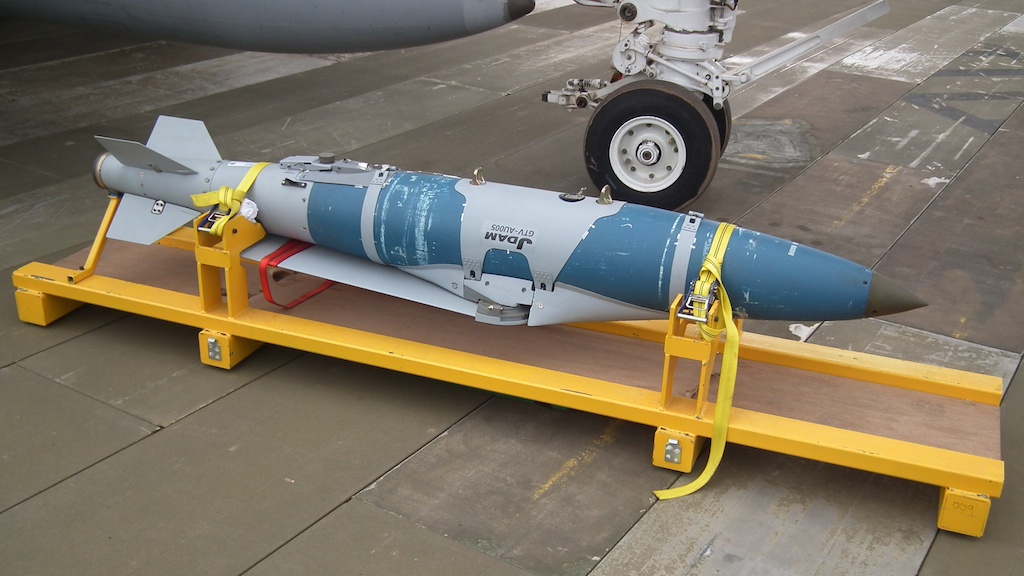 Boeing GBU-38 JDAM-ER prototype in
2011. It is
based on the Kerkanya wing kit design (© 2011 Carlo Kopp).
In conclusion the JDAM is the vanguard of a new generation of low cost, digital, autonomous weapons, designed for genuine all weather use. It is revolutionising air warfare in a manner analogous to the laser guided bomb three decades ago, and promises to develop into a diverse family of derivative weapons adapted to a range of demanding niche roles. Air forces without JDAM capability today will be as handicapped as air forces without laser guided bomb capability were two decades ago. |
|||
|
Notes (2008): Since this
article was produced there have been numerous developments in Australia
and the United States. The JDAM-ER ACTD progressed and trial drops of
the weapon were performed in August, 2006. Also initial JDAM
integration work was performed on the F-111C, funded from internal
Boeing Australia budgets [Click
for more ...]. The
baseline JDAM is being integrated on the F/A-18A/B HUG Hornet. In late
2006 then Defence Minister Nelson sold to Federal Cabinet the idea of
replacing front line F-111s with F/A-18F Super Hornets, the latter more
suited as advanced trainers given the regional environment [Click for more ...]. The JDAM
HART/DAMASK achieved IOC in 2007, with claims that the US Navy would
acquire up to 6,000 seeker kits. The AMSTE system was trialled in 2004
as an alternative maritime strike capability CONOPS, during the
Resultant Fury Sinkex [Click for more ...].
The GBU-39/B Small Diameter Bomb achieved IOC and is being flight
tested on the F-22A Raptor [Click for more ...].
|
|||
|
|
|||
|
|||||||||||||
|
|
|
|
|
|
|
|
|
|
|
|||
|
|
|
|
|
|
|
|
|
|
|
|||
 |
|
|
|||||||||||
| Artwork, graphic design, layout and text © 2004 - 2014 Carlo Kopp; Text © 2004 - 2014 Peter Goon; All rights reserved. Recommended browsers. Contact webmaster. Site navigation hints. Current hot topics. | |||||||||||||
|
Site Update
Status:
$Revision: 1.753 $
Site History: Notices
and
Updates / NLA Pandora Archive
|
|||||||||||||
|
|
Tweet | Follow @APA_Updates | |||||||||||
|
|
|||||||||||||
|
|
|||||||||||||







![[1]](XIMG/HdH-JDAM-ER-Line-Drawing-1S.png)
![[2]](XIMG/HdH-JDAM-ER-Line-Drawing-2S.png)
![[3]](XIMG/HdH-JDAM-ER-Line-Drawing-3S.png)