|
||||||||||||||||||||||
 |
||||||||||||||||||||||
![F-22A Raptor, FB-22, F-22E, F-22N and Variants Index Page [Click for more ...]](APA/f-fb-22.png "F-22A Raptor, FB-22, F-22E, F-22N and Variants Index Page [Click for more ...]") |
 |
![People's Liberation Army Air Power Index Page [Click for more ...]](APA/pla-air-pwr.png "People's Liberation Army Air Power Index Page [Click for more ...]") |
 |
 |
 |
 |
 |
 |
![Military Ethics, Culture, Education and Training Index Page [Click for more ...]](APA/ethx-culture.png "Military Ethics, Culture, Education and Training Index Page [Click for more ...]") |
 |
||||||||||||
 |
![Russian / Soviet Weapon Systems Index Page [Click for more ...]](APA/rus-weps.png "Russian / Soviet Weapon Systems Index Page [Click for more ...]") |
 |
 |
 |

|
 |
 |
 |
 |
 |
||||||||||||
 |
 |
|||||||||||||||||||||
| Last Updated: Mon Jan 27 11:18:09 UTC 2014 | ||||||||||||||||||||||
|
||||||||||||||||||||||
|
||||||||||||||||||||||
|
||||||||||||||||||||||
|
|
|
|
|
|
|
|
|
|
|
||||||||||||
|
|
|
|
|
|
|
|
|
|
|
||||||||||||
|
|
|||||||||||||||||||||
| Last Updated: Mon Jan 27 11:18:09 UTC 2014 | ||||||||||||||||||||||
|
||||||||||||||||||||||
| Mid
Life Refits The Affordable Option |
|||
|
|||
|
One of the significant events of 1985 was the unveiling of the Su-27 Flanker, the Russian answer to the F-14 and F-15. This highly capable air superiority fighter was largely inspired by the F-14A, examples of which have been flown and tested in the USSR courtesy of Iran. The availability of flying examples of US aircraft and illegally acquired supporting documentation on US look-down/shoot-down radars has thus allowed the Russians to eliminate the generation gap between frontline Allied and Warpac fighters. The MiG-29 Fulcrum has been described as an F-18ski - the description may be closer to reality than one realises as Fulcrum is equipped with an analogue of the F-18's AN/APG-65 multimode radar, not to speak of its similarities in layout. These developments have major implications for Allied tactical air power as the sizeable performance margin enjoyed by the teen series fighters against the mediocre Floggers and Fitters has been eroded and air superiority is no longer a foregone conclusion. Until the next generation of air superiority aircraft, the ATF, EFA and Lavi arrives, Allied air forces must face the threat with a mix of late sixties and mid seventies aircraft many of which lack the capability and mission availability to effectively balance the new threat. The option of increasing the number of teen series fighters to gradually supplant older types is favoured by TAC but is unlikely to occur given the cost involved. Many older aircraft such as F-4s and A-7s have adequate performance for the ground attack role but given the cost of maintaining them at high levels of availability they simply cannot fill the gap left by the newer types. Concentration of forces as well understood by the Russians is a very useful means of winning battles, often more useful than increasing performance (Lanchester's laws). Multirole tactical fighters have allowed Allied commanders the option of concentrating resources where appropriate but have also had the unfortunate side effect of overcommitment; a specific threat such as the Fulcrum and Flanker will tie up specific resources and flexibility is lost. The result in this instance is that the older types must carry more of the burden of ground attack duties. Advances in Russian air defence technology have also affected the US Navy - their primary air superiority fighter, the F-14A was first deployed in 1972. The aircraft's AN/AWG-9 weapon system has been completely blown as a result of events in Iran. The cost of developing a replacement aircraft is well beyond the Navy's budget as the 1400 strong F/A-18A buy is soaking up resources. The replacement of the dedicated A-7 strike aircraft with the multirole F/A-18A has also cut into the specialised ground attack resources of the carrier air wing. This is further exacerbated by the demands which the F/A-18A places upon inflight refuelling resources. In both the instances of the USAF and USN, resources are not available for new aircraft yet operational requirements demand an increase in force capability, both performance and availability for combat. The option of increasing force size by retaining older types in front line service while expanding inventories of newer types (as practised by FA-VVS) is also unattractive as we will shortly find. Under these circumstances one of the most useful options available is the mid-life refit. RELIABILITY AND MAINTAINABILITY OF COMBAT AIRCRAFT Reliability and maintainability are issues which are critical in the deployment and application of air power yet they are also among the least understood issues. As a graphic example the author will point to the failure of the US attempt to rescue the Teheran hostages where the mission was aborted after system failures in several of the assault helicopters, a contingency not wholly allowed for. Modern aircraft are complex systems built up of several mechanical, electrical and electronic subsystems. The components which make up these subsystems will fail in particular ways and therefore must be treated appropriately. In practice one finds that components will fail in one of three ways. The first kind of failure we shall look at is the wearout failure. Wearout failures usually occur as a result of cumulative strain on a component. This strain can be mechanical, thermal, electrical or a combination of these. At a certain stress level any component will have a certain safe lifetime after which it fails. If the stress level is increased the lifetime is shortened, if a critical stress level is exceeded the component will fail immediately. Under fixed operating conditions a wearout time can be established with some confidence level for most types of component, usually by one or another form of accelerated life test. The second kind of failure we will encounter is the chance or random failure. Random failures will occur throughout the life of a component and by definition bear no relationship to wearout. The basic parameter used to judge random failure is the Mean-Time Between-Failure (MTBF; at a system level, often at a component level the term Mean-Time-To-Failure is used as it may not be repairable as a system is), which is self explanatory. The MTBF of a component doesn't change over its lifetime, a failure of this sort can and will hit a user at any time. The last kind of failure is battle damage which is by nature random but will depend very much on the weapon used against the aircraft. Most battle damage is mechanical due to the shockwave of detonating projectiles, though thermal damage can occur and will be a future problem with battlefield lasers.
Image Rows of late model A-4 Skyhawk fighter bombers await inevitable updating and zero-timing at the massive Davis Monthan storage facility. The trusty A-4 provides an ideal platform for updating which can extend from medium level avionics upgrades (RNZAF) to major system upgrading and re-engining, a cost effective option currently being considered by the Singaporians. Random and wearout failures are the dominant cause of the high support costs associated with modern aircraft. Significantly each part of the system has its idiosyncrasies. Airframe fatigue is essentially wearout failure. Each structural component eg; spars, skins, frames has a nominal life unless overstressed by excessive manoeuvre loads. This is a common problem in combat as pilots can and will bend the aircraft when evading terminal threats such as SAMs or fighters. Modern tactical aircraft are designed with airframe lives between 3,000 and 6,000 hours though exceptions either way do exist. Bent or out-of-life components can be replaced but it is usually an expensive affair and is thus to be avoided where possible. Powerplants are highly stressed components in combat aircraft and will exhibit both wearout and random failures. Most jet engines have some specified time for major overhauls during which worn or out-of-life components are replaced preventively to preclude catastrophic in-flight failures. Turbines and hot ends are notorious as sources of failure but this isn't surprising given the treatment they receive. Fans and compressors may also experience Foreign Object Damage (FOD) upon ingesting solid items (nuts, bolts, tools...) though this is outside of our discussion. Significantly newer digital electronic engine controls have served to extend engine lifetime by intelligently monitoring the engines' operating conditions and reducing instances of surge or overspeeding. The avionics in modern tactical aircraft are together with the powerplants the major cause of maintenance action. Though most electronic components are on a one by one basis extremely reliable, putting several thousand of them together inevitably results in a very observable MTBF. Modern solid state electronic devices have lifetimes of the order of decades (though vacuum tubes so popular in the USSR traditionally go after hundreds to thousands of hours) as a result of which their failures are primarily random and thus continuous over the life of the equipment. Significantly one of the major sources of failures are interconnections; either chip to chip, circuit to circuit or box to box. Today's tendency to concentrate more and more of the circuits inside chips has had a highly beneficial effect through reducing the number of connections and thus improving reliability. Other aircraft subsystems such as hydraulics, bleed air, electrical power generation and environmental control tend to be mixed mechanical/electrical/electronic and may exhibit either type of failure. High temperature bleed air lines and high pressure hydraulic lines are known to rupture. As a result of these factors maintaining a combat aircraft in a serviceable state will require (other than turnaround/service tasks) regular scheduled replacement of components, particularly in the propulsion area, and also continuous repairs to randomly failing subsystems most of which will be electronic. A basic measure of success in this effort is availability which can be determined from the MTBF and a lumped parameter called Mean-Time-To-Repair (MTTR; self explanatory) as follows: AVAILABILITY = (MTBF)/(MTBF + MTTR). Essentially it is a measure of the fraction of time during which the aircraft is serviceable. High availabilities are better than 85%, while 60% is common for front line fighter aircraft and lower than 40% means that somebody has problems. As a crude extension, availability is a measure of what fraction of a combat force is ready for use: having 100 aircraft maintained to 40% availability means you have about 40 aircraft available for use. In practice this isn't clear cut as aircraft will function and often are flown with unserviceable subsystems, these are referred to as mission capable aircraft. Availability costs money. One approach to improving it is that of using more technicians, mechanics and engineers to maintain the aircraft which certainly works but runs up enormous costs in manhours. The other option is to buy aircraft with a large MTBF and low MTTR as exemplified by the F-18. The designers of the F-18 minimised the number of components used and rigidly derated loads applied to many of them. Compared to an earlier aircraft such as the F-4J (its forerunner) it has 40% less parts in its radar alone contributing to a MTBF of about 100 hours rather than 10 or so, it also has 36% fewer engine parts in a powerplant described as four times as reliable. The result is an MTBF (flight hours) 4.7 times greater while requiring on average 40% of the manhours demanded by an F-4J. This comparison is a good measure of the scale of change possible by a systematic effort to design reliability and maintainability into an aircraft. There is a penalty as the initial purchase price is greater and though it may be offset in the long term it certainly will hurt in the first years of use. Supporting older aircraft which are no longer in production can be difficult. Spares for scheduled replacements can be stockpiled well ahead with safety margins. That however may not be the case with avionics. If a black box fails it is usually replaced by a spare while the ailing box is sent to a depot for repair if possible. The average time for this repair is called the Repair Turnaround-Time (RTT). If a front line combat unit has adequate stocks of spares and the RTT is much shorter than the MTBF of the component all is well. If however repairs drag out (RTT increases) and/or flying activity increases (random fails and battle damage) stocks will soon run out. The front line commander has then little choice other than cannibalising damaged aircraft for spares. Once those run out the force is grounded. A major problem even under peacetime conditions is lead time on older electronic components, particularly specialised chips and modules. The commercial life cycle of most chips is about seven years after which they will go out of production. Once that occurs remaining stocks become a highly prized item for which the supplier is free to name his price.
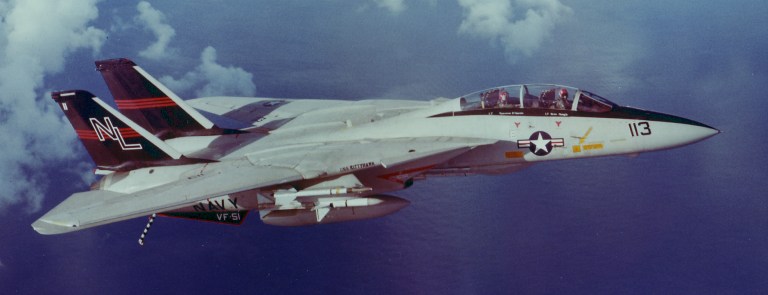
The F-14A Tomcat will be greatly improved by its upgrading to D specifications. New, fuel efficient engines of enhanced reliability combined with digital avionics and vastly upgraded systems will allow this proven air superiority fighter to remain as the primary vehicle of fleet air defence through till the 21st century. The situation with spare modules can be worse as stocks will be far lower; original manufacturers may sell off the design to a smaller organisation which then becomes the sole source. Due to economies of scale a small supplier will only manufacture a batch when outstanding orders accumulate beyond some threshold number, usually in the hundreds. In many instances the end product may also be subjected to poorer quality control and burn-in procedures. The end result is a turnaround time of the order of months while prices steadily hike upward. If we add to this factor the escalating cost of manhours the outlook for older aircraft is not favourable. Another factor must however by considered: after about twenty years of operational life wearout will begin to affect the reliability of the electronics, with the apparent effect of an increase in random failures. In summary the frequency of repairs will increase steadily while the price and duration of repairs is likely to increase. As the combat utility of the aircraft gradually drops in the face of newer threat technology the combat capability it offers per dollar of operational costs will nosedive. The aircraft will then soak up a disproportionately large fraction of its owner's resources. REFITS AND UPGRADES One of nicer features of current digital avionics is flexibility and adaptability which allows the use of common subassemblies over various types of equipment. This has also made refits and upgrades of existing equipment far more attractive than in the past as the need to purpose design assemblies is minimised. The case for or against upgrading or completely refitting an aircraft is based upon several factors. Amongst the advantages in upgrading, one must view user familiarity very strongly, after years of service the aircraft is well understood, its strengths and weaknesses have been tried and tactics have been fine tuned. Deficiencies are well known and can be targeted when defining the upgrade. Obviously prerequisite conditions for upgrading are sufficient airframe life left in the fleet and the ability of the basic airframe to meet the aerodynamic performance requirements of its mission in future threat situations. The opportunity to employ subsystems from newer aircraft in service can usually be exploited saving considerable long-term costs. On the negative side the enemy knows the aircraft well and many of its undesirable features may be too expensive to eliminate. Certainly no amount of black box swapping will change factors such as poor access through airframe geometry, therefore the full gain in availability possible with new technology may not be realisable. Several levels of upgrading up to a full refit may be considered. A simple upgrade may involve the fitting of a HUDWAC (Head Up Display Weapon Aiming Computer) to supplant a gyro gunsight. Inertial navigators are also a commonplace option. A step further has one considering a radar and nav-attack upgrade which will lead to resculpturing the cockpit, modifying the nose structure and revising cabling, electrical and environmental control subsystems. Fortunately modern avionics tend to consume far less power and dissipate far less heat than their predecessors. The next stage would involve a revision of cockpit displays and the fitting of a mission computer. Powerplant changes are costlier as they require not only structural modification but also changes to the electrical, bleed air and hydraulic systems which may be substantial. It may be necessary to compensate for shifts in the centre of gravity and thrust line. This really brings us to the point of structural modifications such as fitting new wings, canards, conformal fuel tanks and the like. At this instant flight control refits to digital fly-by-wire are also under review. As the reader may observe there will be some level of upgrade beyond which further expense does very little. A well defined upgrade will sharply focus on those parameters which are critical to the future mission, be it in terms of capability or maintainability. Upgrades usefully illustrate the idea of force multiplication which is very popular today. For instance a bomber with a nav/attack bombing error of some size will need to fly some number of sorties to destroy a target with a level of confidence. Improving the accuracy of the nav/attack system can reduce the number of sorties under the same conditions dramatically. The nav/attack upgrade therefore provided force multiplication as one aircraft suffices to perform the task of several aircraft. As another instance one has the fitting of conformal fuel tanks and turbofan engines in place of turbojets. The improvement in payload/range means that more bombs can be carried at a given range reducing the number of sorties required. In the first instance force multiplication was demonstrated against hard point targets, the effect would be less pronounced for soft area targets. In the second instance the improvement was greater as it was effective relative to all classes of target. At this instant in time several major upgrade programs are under way some of which clearly demonstrate the underlying principles. GRUMMAN F-14D SUPER TOMCAT Although not strictly a refit in that the F-14Ds will be built as new airframes, the program illustrates the technical aspects of a refit exceptionally well. The largely analogue F-14A was rushed into service in the beginning of the seventies with low thrust 20,000 lb class TF30 turbofans and a state of the art automated weapon system.
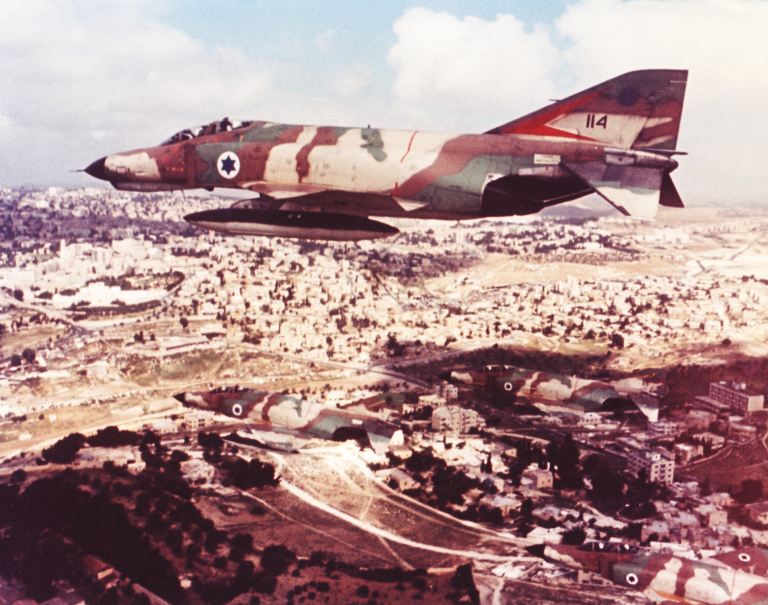
The legendary Phantom looks set to live on in first line service with a number of primary operators thanks to its ability to ultimately enjoy major performance gains via a mid life refit. Israel, Japan, West Germany and more latterly the USAF are all planning varying degrees of updating that will transform the type's basic mission capabilities. The Navy's intention to refit with F-401 (essentially P&W F100) turbofans to an F-14B specification failed to materialise due to funding problems in the seventies resulting in continuous production of the A model. The threat on the other hand did materialise: Fulcrum on sale to the Third World, Backfire well equipped with jammers on long ranging maritime strike sorties, low flying Fencer to complement it at short range. The Iranian debacle didn't help. Interim improvements were limited, TCS (television camera system) telescopes on some aircraft and minor engine improvements, a Grumman/Hughes attempt to fit a digital radar processor and display set foundered. Faced with a serious problem the Navy eventually conceded and in July 1984 ordered design upgrades to all new aircraft, the final 30 F-14As to be fitted with 27,000 lb F110-GE-400 turbofans and the following 300 aircraft designated F-14D both with F-110s and a fully digital avionic system [Editor's Note 2005: the up-engined F-14A was then designated the F-14A+, and then redesignated the F-14B]. The avionic system is largely derived from the F-18A and employs the same AYK-14 computers, ASN-130 inertial set, ALQ-165 jammer, stores management set, cockpit displays (3 fore, 3 + 1 aft) all tied into a similar triple 1553 bus architecture. A new APG-71 digital radar and fire control system, using many modules from the F-15E's APG-70 set, will be fitted and complemented by a new chin pod with a TCS TV telescope and a new infrared search & track set. The digital avionic suite can be expected to cope with a future jamming environment, while the increase in thrust and lower fuel consumption of the F110s (by 30%) provide 35% longer CAP time on station and a 60% growth in intercept radius. It is unclear whether all the older F-14As will be rebuilt-this may depend on future budget levels. Two other USN refits are also under way. The Grumman A-6F Intruder program will see the same computer/databus/display/jammer/stores management set core avionic suite as fitted to the F-18 and F-14D installed under a drive for commonality and maintainability. A new coherent synthetic aperture radar (see TE March 85) will be fitted capable of supporting AIM-9M Sidewinder, possibly AIM-120 Amraam and providing the pilot with a synthetic 3-D terrain avoidance image. The AGM-88 HARM radar suppression missile will be carried. The A-6F will be powered by two unreheated F404-GE-400Ds which are 99% common with the F-18 (4hr conversion time). Structural changes include an aft stretch, engine bay revision and several wing modifications. The Lockheed S-3B Viking program is primarily an avionic upgrade to the S-3A Viking antisubmarine aircraft, improving ASW capabilities and adding a surface strike capability. In the former area the number of sonobuoy system channels was tripled, a new UYS-1 spectrum analyser was added and the signal processing and computer capability improved. In the latter area changes were more significant. The Electronic Support Measures (ESM) system (essentially radar warning receivers) was improved to provide far higher resolution while operating over a broader band. The ALR-76 ESM also ties into a ALE-39 chaff, flare and jammer dispenser and the central computer. An offensive capability was provided by fitting the aircraft with a new APS-137 Inverse Synthetic Aperture Radar which can generate high resolution images of surface vessels in any weather. Resolution is claimed to be good enough for target classification at ranges well beyond the SAM umbrella of a warship. This capability together with the ESM coverage enables standoff launch of Harpoon missiles which are also being fitted as part of the upgrade. Significantly the carrier bound USN has an acute real estate and space problem at sea, refits providing commonality are therefore very attractive. The USAF, not subjected to these constraints (or degree of budget constraint) is less attracted to upgrades, though the MDC F-15C/D Eagles are undergoing a multistage improvement program (see AA p39 Sept 84) and the GD F-111A/D/E/F fleet is to undergo a comprehensive avionic refit. The F-111 is a case study in maintenance and support problems as much of its hardware pushed the technology of the day to the limit and it is a functionally complex weapon system. It was conceived well before the maintenance oriented design philosophy of the seventies emerged, the USAF operates four different versions of which only the A and E have reasonable commonality. Being an extremely useful piece of equipment though the F-111 will have to serve another two decades, therefore a refit to common systems was seen as necessary (see AA p34 June 84) both to cut maintenance costs, improve availability and system capability. The program has a fairly low profile (and will be examined in a later issue) given the USAF's heavy spending on new F-15E Dual Role Fighters for a complementary role. The RAAF is awaiting a major policy decision (the Dibb Report) before commitment to an F-111 C upgrade though the aircraft are currently receiving Pave Tack targeting pods. Two possible upgrade programs may however be awaiting the USAF. One involves the LTV A-7D/E/K Corsair which has been proposed as a new TAC (Tactical Air Command) close air support aircraft. Fitted with an F-15/16 F100-PW-200 afterburning fan the A-7 Strikefighter would be Mach 1.2 capable and fitted with manoeuvre flaps, strakes and Lantirn pods (see TE March 85). At a unit cost of US$4.9 million for 462 existing airframes it is likely to find many supporters. The other potential is the venerable MDC F-4E/EJ/F Phantom.
West German F-4Fs will receive the F-18's APG-65 radar in a refit,
Japanese F-4EJs on the other hand being fitted with the F-16's
APG-66/68
set. These system upgrades may be complemented by a major
powerplant/structural upgrade which though initially resisted by the
USAF has since been accepted for evaluation.
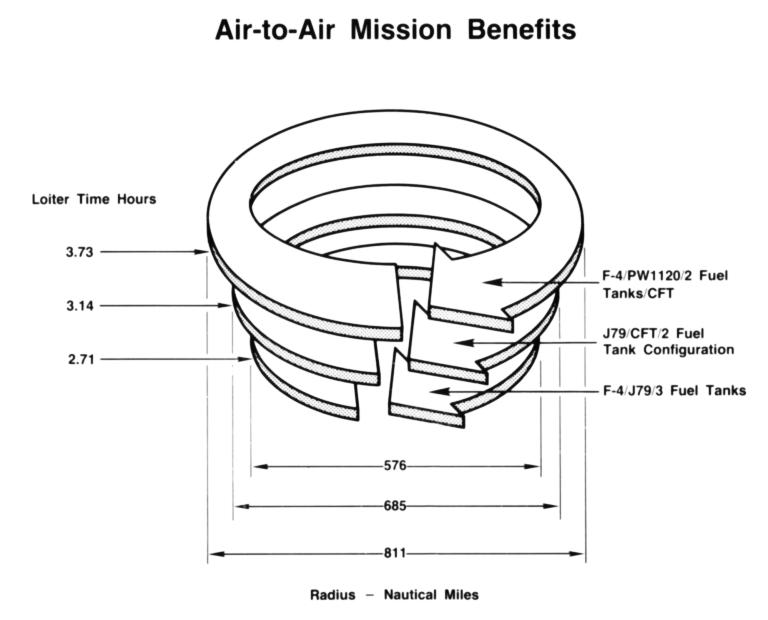
Initially a Boeing/Pratt & Whitney private venture that was targeted at the Israeli's and other major F-4 users (over 800 F-4s may be suitable) the upgrade involves fitting 20,000 lb PW 1120 turbojets derived from the F100 fan and the option of a ventral conformal fuel tank. BMAC/P&W claim 27% better acceleration, 1.03:1 combat thrust/weight ratio and 13% tighter turning though to many users the lower maintenance cost of the PW1120 against the complex fifties technology J79 may be the deciding factor. Given the balance of forces in the European theatre, the F-4 upgrade may become a cheap means of buying time while the ATF and EFA programs mature. Midlife or multistage upgrades are certain to become a very common occurrence given the rate of development in systems and the growing cost of development of new airframes. Certainly the rate at which the Soviets are stealing and reimplementing Western designs will force a much shorter life cycle in areas such as radar and jamming equipment, this combined with the lengthening life cycle of airframes will support the trend. Refits can serve to improve capability and/or cut life cycle costs of equipment, preoccupation with the former though often obscures the latter. Refits can be the low cost option. References
Further Reading: Kopp, C., System Reliability and Metrics of Reliability |
|||
|
|||||||||||||
|
|
|
|
|
|
|
|
|
|
|
|||
|
|
|
|
|
|
|
|
|
|
|
|||
 |
|
|
|||||||||||
| Artwork, graphic design, layout and text © 2004 - 2014 Carlo Kopp; Text © 2004 - 2014 Peter Goon; All rights reserved. Recommended browsers. Contact webmaster. Site navigation hints. Current hot topics. | |||||||||||||
|
Site Update
Status:
$Revision: 1.753 $
Site History: Notices
and
Updates / NLA Pandora Archive
|
|||||||||||||
|
|
Tweet | Follow @APA_Updates | |||||||||||
|
|
|||||||||||||
|
|
|||||||||||||