|
||||||||||||||||||||||
 |
||||||||||||||||||||||
![F-22A Raptor, FB-22, F-22E, F-22N and Variants Index Page [Click for more ...]](APA/f-fb-22.png "F-22A Raptor, FB-22, F-22E, F-22N and Variants Index Page [Click for more ...]") |
 |
![People's Liberation Army Air Power Index Page [Click for more ...]](APA/pla-air-pwr.png "People's Liberation Army Air Power Index Page [Click for more ...]") |
 |
 |
 |
 |
 |
 |
![Military Ethics, Culture, Education and Training Index Page [Click for more ...]](APA/ethx-culture.png "Military Ethics, Culture, Education and Training Index Page [Click for more ...]") |
 |
||||||||||||
 |
![Russian / Soviet Weapon Systems Index Page [Click for more ...]](APA/rus-weps.png "Russian / Soviet Weapon Systems Index Page [Click for more ...]") |
 |
 |
 |

|
 |
 |
 |
 |
 |
||||||||||||
 |
 |
|||||||||||||||||||||
| Last Updated: Mon Jan 27 11:18:09 UTC 2014 | ||||||||||||||||||||||
|
||||||||||||||||||||||
|
||||||||||||||||||||||
|
||||||||||||||||||||||
|
|
|
|
|
|
|
|
|
|
|
||||||||||||
|
|
|
|
|
|
|
|
|
|
|
||||||||||||
|
|
|||||||||||||||||||||
| Last Updated: Mon Jan 27 11:18:09 UTC 2014 | ||||||||||||||||||||||
|
||||||||||||||||||||||
| DESERT
STORM Precision Guided Munitions |
|||
|
|||
|
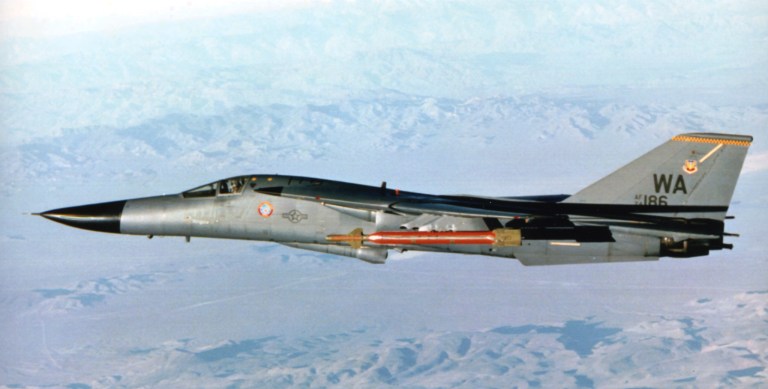
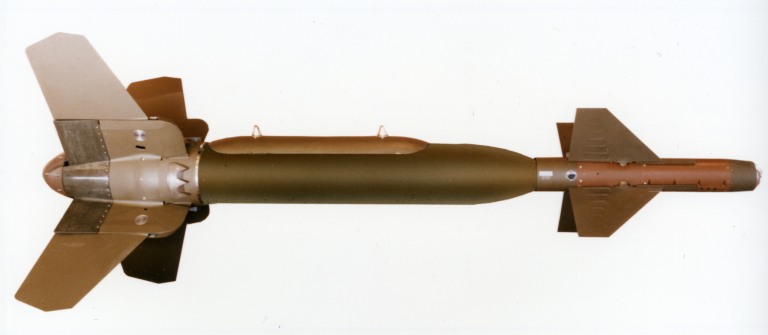
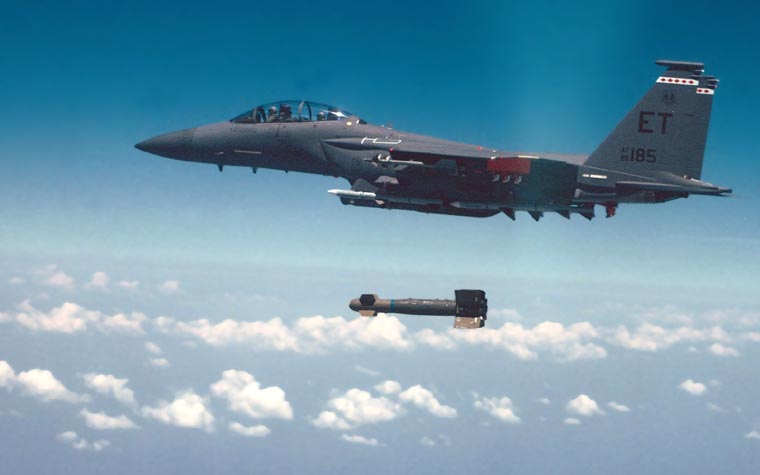
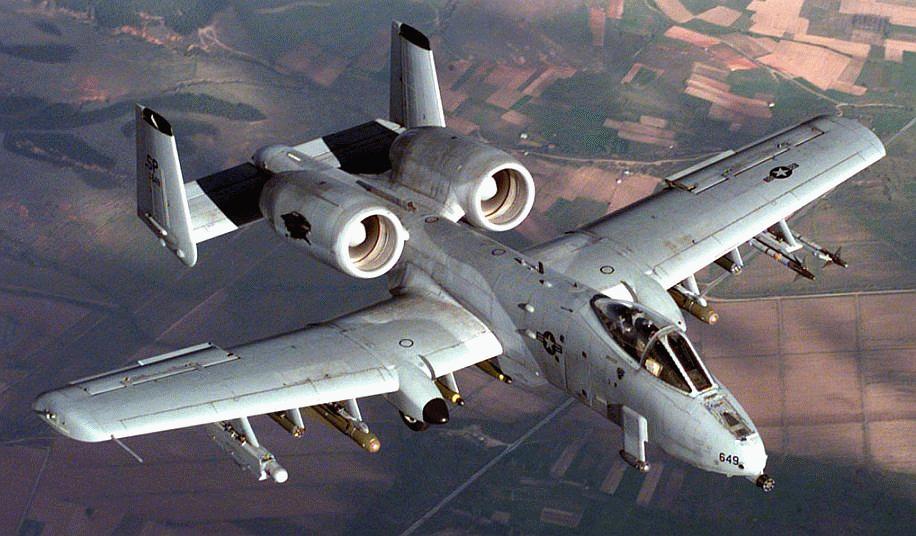
Much has been said about the decisive role of PGMs (precision guided munitions) in last year's Gulf war, what is however of greater interest is that most such weapons used in the campaign have been in service for some time and some as earlier subtypes even as far back as the Vietnam war. Australian Aviation will examine the more established and newer types which proved that this technology has truly come of age. Laser Guided Bombs The LGB made its debut in the latter phase of the Vietnam war, when USAF F-4Ds and F-4Es carrying Martin AVQ-9 Paveway and Ford AVQ-10 Pave Knife laser designators destroyed a wide range of strategic targets with Texas Instruments Paveway laser guidance kits on Mk.84 (2,000 lb), M-117 (750 lb) and M-118 (3,000 lb) bombs. The earliest AVQ-9 designators were direct view optical systems, but these were later superceded by television based systems, with a vidicon camera boresighted to an optically pumped Nd:YAG pulse mode laser, and tracking being accomplished manually by the F-4's back seat WSO. While the weapon made a key contribution to the Linebacker II campaign, its accomplishments were overshadowed by political events and this created a perception of a lab technology item rather than established weapon type. The next opportunity for the LGB to go to war came over a decade later, in 1986, when F-111Fs of the 48th TFW struck a range of targets in Tripoli, Libya, in a retaliatory raid following Libya's involvement in a terrorist bombing. The nature of the target and tight RoE resulted in the weapons performing less than effectively and the raid did little to further the case for the LGB. The Gulf War saw the first massed application of this family of weapons, used as a standard rather than special purpose munition, and clearly demonstrated the robustness and effectiveness of this method of guidance. More than 8,000 rounds were used in the Gulf. The most numerous weapons used in the Gulf were the TI Paveway II family of LGB kits, the GBU-10, GBU-12 and GBU-14, attached to Mk.84, Mk.82 and Mk.83 bombs respectively. These were supplemented by the newer GBU-24 and GBU-27 Paveway 3, attached to Mk.84 or BLU-109 penetrating warheads. The RAF employed the TI CPU-123B kit attached to the RAF 1,000 lb bomb, while the French employed the indigenous Matra BGL kit. The are substantial differences between the two generations of weapon, and this reflects in substantial improvements in accuracy and ease of delivery in the later types. The Paveway II (covered in detail in AA 9/1981) is a seventies development of the Paveway I, employing a bang-bang seeker and folding wings. The Paveway II kit is an exercise in simplicity, and its guidance system reflects this. The optical seeker employs a four quadrant detector, a maltese cross arrangement of four silicon 1 micron band detectors under a glass dome. When pointed at a spot of illumination in the 1 micron band, produced by shining a laser at a target, the convex lense formed by the dome focusses a spot of light on the detector array. If the seeker is boresighted on the target, this spot is evenly spread across all four quadrants and produces an equal electrical signal from each, whereas if the seeker is off boresight, the illumination and hence signals are unequal, in a ratio proportional to the off boresight angle. This method generates the error signal for the guidance electronics. To avoid the need for an inertially (gyro) stabilised platform, the whole optical assembly is gimballed freely and attached to a plastic ring tail airfoil, which due aerodynamic forces always aligns with the velocity vector of the weapon. The laser illumination is pulsed, and the pulse trains are coded, to provide both discrimination between multiple target/weapon pairs and to provide ECCM against seduction by optical beacons. Therefore, the electronics which are fed by the detectors provide not only video amplification, but also discrimination of the pulse codes. A thermal battery powers the electronics. The error signal from the electronics is used in a simple non-proportional control loop (bang-bang) which recognises only zero or full deflection of the canard control surfaces. This is used to reduce the cost, as the actuator can then be very simple, the Paveway II employs piston-cylinder actuators pressurised by hot gas from a burning cartridge, with appropriate control ports opened and closed by electrical solenoids. The whole guidance system is thus contained in a single nose mounted assembly, with the tail being a simple sheetmetal spring actuated assembly, which deploys the wings on weapon release. The Paveway II is very cheap, with a kit in mass production being worth about $15,000 apiece, while the accuracy of about 20 ft CEP (CEP - Circular Error Probable, a measure of weapon accuracy. The CEP is defined as the radius of the circle into which there is a 50% probability that the weapon will impact) is easily adequate for most targets. The limitation of this weapon is in its restricted delivery envelope, as the primitive bang-bang guidance will attempt to fly the weapon along the line of sight to the target. This is not a problem for a high altitude level delivery, particularly if the operator biases the control system by positioning the laser spot slightly behind the target, but during low level deliveries the the bomb may simply fall short by flying an inappropriate trajectory for its glide ratio. Where the tactical situation allows, lofting deliveries can be far more accurate, with the bomb being lofted at the target and illumination commenced only several seconds before impact. Under these conditions the bomb is flying along a very steep glidepath and this effectively circumvents the weapon's dynamic limitation. The toward low level operations in the eighties exacerbated the limitations of the Paveway II and the Paveway III or Low Level Laser Guided Bomb was designed to remove these restrictions. A far more sophisticated weapon, the Paveway II began flight testing in 1986 but did not see combat until the Gulf War. The core of the Paveway III guidance system is a digital autopilot based on microprocessor technology, which supported by barometric sensors and an inertial reference unit, allows the weapon to fly an optimal midcourse trajectory after release. The controls are proportional thus providing smooth flightpath control unlike the jerky trajectory of the Paveway II. Control surface power is provided by a cold gas accumulator, which feeds the electrically controlled actuators. The seeker assembly of the Paveway III is substantially better than that of its predecessor. The optical subsystem is far more sophisticated, with greater sensitivity, a range of scanning modes to acquire the target and a much larger instantaneous field of view. This coupled with the digital autopilot, provides the weapon with the capability to fly an optimal glidepath during the midcourse phase, then transition to a shaped terminal trajectory, while employing a proportional terminal homing algorithm to achieve a CEP of several feet. The seeker will automatically sense the delivery trajectory after release, dive, level or loft, and select accordingly the midcourse trajectory algorithm. Glide performance was improved by the use of a new folding tail assembly, with much larger wing area and a low drag tailcone, yielding a 5:1 glide ratio. The increase in glide range, intelligent autopilot and greater seeker sensitivity allow for a much wider release envelope, particularly at low altitudes, in comparison with the Paveway II. Tactically this provides the pilot of the launch aircraft with more manoeuvring options and lesser requirements for positional accuracy at the weapon release point. Texas Instruments claim the increase in seeker sensitivity has improved poor weather performance significantly. The principal subtype of the Paveway III used in the Gulf was the GBU-24A/B, which employs a BLU-109/B (I-2000) hardened case penetrator warhead. Software changes in this subtype provide for optimal impact angle on a given target type, to provide for maximum penetration. No reports are available on the use of the smaller GBU-22, fitted to the 500 lb Mk.82 warhead. The F-117A carried the GBU-27, a derivative of the GBU-24 with a modified tail assembly to fit inside the small weapon bay of this type. Some sources report the GBU-27 is coated with a radar absorbent paint.
Another derivative of the GBU-24 is the GBU-28, an improvised 4,800 lb earth penetrating weapon designed to fill the role of Barnes Wallis' Tallboy. The GBU-28 employed a special warhead, created by welding a hardened nosecone on a piece of bored out 8" gun barrel, and filling the cavity with cast explosive. The Paveway seekers used employed software changes to the autopilot to increase loop gains to compensate for the additional moments of inertia in yaw and pitch due the heavier warhead. What is astonishing is the speed with which the weapon was developed, a true case of improvisation in weeks, and once an initial test was flown, several rounds were loaded still warm on to a MAC airlifter and shipped to the Gulf. Two of these were dropped against live targets within seven hours of delivery, destroying two hardened bunkers. The French contingent in the Gulf employed the 880 lb Matra BGL (bombe a guidage laser), a weapon conceptually similar to the Paveway II, with a similarly aerodynamically stabilised seeker head and folding tail assembly. These were dropped by the Jaguars, supported by Thomson-CSF ATLIS targeting pods. The ATLIS is a TV based system similar to the Pave Spike but newer. The Iraqis had stock of this weapon but it is not known to have been used. The RAF contingent used the TI Paveway II kit, in a specific RAF version fitted to the standard RAF 1,000 lb bomb body. Typical Tornado loads were two or three rounds on fuselage stations. Television Guided Bombs TV guided bombs are a mature technology which, like the LGB, saw their initial debut in Vietnam. The US Navy employed the AGM-62 Walleye TV guided glidebomb family, whereas the USAF used the GBU-8 HOBOS (HOming BOmb System). Both weapons performed well in spite of their immaturity, and this led to further development effort. The Navy Walleye has since undergone several development upgrades, which were possible as the weapon was a cruciform winged glidebomb with datalink providing respectable standoff range, and usable for low altitude standoff launches. The HOBOS, lacking range due its short winged configuration and contrast lock fire and forget guidance, slipped into obscurity as the USAF pursued the cruciform winged GBU-15 weapon. The GBU-15 and Walleye both employ stabilised nose mounted cameras which feed a video signal to a datalink which carries the signal to the guiding aircraft, where it is displayed in the cockpit. Both weapons employ autopilots which receive steering commands via datalink from the guiding aircraft. In this fashion the operator can remotely steer the weapon to acquire a target and then steer the weapon to impact. The GBU-15 also uses a contrast lock to provide for hands off automatic terminal homing (see AA 6/84 and 5/88 for details), and a DME transponder is fitted to provide the launch aircraft with bomb position. Typical operations will involve a launch aircraft and a guiding aircraft, the latter standing off at altitude to provide for best possible datalink antenna coverage. The launch platform will penetrate to the target and release the weapon from outside the range of the point defences. Both the Walleye and the GBU-15 were used in the Gulf. The USN released no less than 124 AGM-62s against a range of targets, while the GBU-15 was extensively used by the F-111 force for attacking bridges and other high value hardened targets, with over 75 weapons expended. The best publicised GBU-15 mission (incorrectly reported as LGB) involved the destruction of pumping station manifolds used by the Iraqis to dump crude into the Gulf. The two versions used were the GBU-15(V)1/B with a DSU-27A/B daylight TV seeker, and the GBU-15(V)2/B with a WGU-10/B thermal imaging seeker. Electro-Optically Guided Missiles The Gulf saw the combat debut of two new electro-optically guided missiles, the AGM-84E SLAM and the AS.30 Laser, and also saw the first massed combat use by the US of the AGM-65 Maverick family of missiles. The AGM-84E Standoff Land Attack Missile (see AA 3/88 for detailed description) is a derivative of the Harpoon anti-shipping missile, using essentially the same airframe, warhead and powerplant, but employing a composite guidance system which has a IR imaging terminal seeker taken from the Maverick, an inertial autopilot tied to a GPS satellite navigation receiver, and a datalink taken from the Walleye to provide video transmission to and command transmission from a guiding aircraft. The first combat mission flown by the type saw two rounds fired by an A-6E, and subsequently controlled by an A-7E, both aircraft flying from the USS Kennedy. The attack on a powerplant involved the first round blasting a hole in the facility, and the second round being flown into the hole to cause maximum damage inside the target. Later reports suggest that some problems were encountered with the weapons' tracking software, although from the results it isn't apparent. Several rounds were fired in the Gulf, but due to the immaturity of what is essentially a still a development program it is not reasonable to draw too many conclusions. The AS.30L Laser is a weapon with no equivalent in the current US or RAF inventory, best approximating the defunct TI AGM-83A Bulldog, a laser guided derivative of the AGM-12 Bullpup. A derivative of the command link guided AS.30, it employs a semi-active laser homing seeker and hardened penetrating warhead, to provide a potent capability against hardened targets. The AS.30L is a much bigger and more sophisticated weapon than its nearest competitor, the AGM-65. Structurally the weapon is divided into a seeker, warhead and propulsion and control subsystem. The Thomson-CSF ARIEL laser seeker has a gyro stabilised platform mounting a concave mirror which focusses incoming 1 micron band energy on to a detector assembly, which generates electrical signals to feed the guidance electronics. A separate gyro unit provides midcourse steering commands to keep the missile along its initial launch flightpath, a gravity bias signal is injected to ensure that the round maintains altitude. Once the seeker has acquired the laser spot on the target, the AS.30L commences terminal homing using a proportional nav algorithm to provide CEPs claimed to be better than 5 feet. The warhead is a large 530 lb hardened case penetrator, equipped with a delayed fuse to ensure detonation inside the target. The fusing mechanism ensures the round will not detonate until at least 5,000 ft from the launch aircraft. The combination of the missile's supersonic velocity and hardened warhead allows penetration of reinforced concrete with thickness in excess of 6 ft. The AS.30L has a set of highly swept cruciform wings, slightly canted so the round revolves at 2.5 RPM during its flight. An additional set of tail mounted stabilisers are fitted to improve weapon stability at launch, these are retracted by springs one second after booster firing. The propulsion used is not conventional, as two separate solid rocket motors are employed. The aftmost section of the cylindrical rear fuselage contains the guidance computer/autopilot, a thermal battery and control actuators for the exhaust vanes. The central section of the rear fuselage is occupied by two wraparound solid rocket boosters, with individual exhausts venting through a pair of symmetrically placed nozzles faired into the tail section. These high impulse rockets are fired at launch for 2 seconds and accelerate the missile rapidly to supersonic speed. The forward section of the rear fuselage contains the sustainer rocket motor with a 21 sec burn, which exhausts through a central tailpipe running through the axis of the aft section. The exhaust nozzle contains a set of steering vanes, which are actuated by the guidance system to steer the airframe by deflecting the exhaust efflux. French Jaguars fired about 60 AS.30L rounds against hardened shelters in Kuwait and Southern Iraq, with impressive results. Laser designation was provided by the Atlis pod, and the complete weapon system allowed standoff ranges typically around 6 NM for low level launches. The typical engagement will see the Jaguar execute a hard 4G turn after launch, designating the target with the aft looking Atlis pod. The Gulf also saw the first serious use of the AGM-65 Maverick missile, particularly its later subtypes, such as the thermal imaging AGM-65D. The Maverick is a fire-and-forget lock-on-before-launch optically guided weapon, with transonic speed, typically a 130 lb shaped charge warhead and a video contrast lock terminal homing seeker coupled to a TV or thermal imaging camera. Typical Maverick launches involve the pilot placing the aircraft in a shallow dive to centre the target in the cockpit display crosshairs, which are boresighted with the missile, while the display is fed with video from the seeker. Once the pilot is satisfied with the position of the crosshairs on the target, he engages the contrast lock and fires the missile. The electronics in the seeker will track the area of contrast where the lock has been placed until impact. The US had considerable stocks of this weapon, with 17,000 of the early A-model TV weapon and B-model scene magnification TV weapon built, in addition to several thousand of the later thermal imaging D-model. Few reports are available concerning the use of the US Marines' AGM-65E which employs a semi-active laser homing seeker and 300 lb warhead. The US military fired over 5,500 Mavericks during the course of the Gulf War. Combat use of the AGM-65 saw mainly F-16s and A-10s firing the B and D model, with typical payloads being a mixed pair of the two subtypes. Where target contrast was inadequate for the A/B model, the more expensive D-model was used. Most weapons were used to engage armour and fixed targets which didn't require a heavyweight GBU-10. Operations - the F-117A The 37th TFW's F-117A aircraft (see Profile AA 12/90) were used extensively during the war for precision strikes on heavily defended targets, using the GBU-27 LGB. Target tracking and designation was carried out by the aircraft's built in Texas Instruments thermal imaging/laser tracking system, which employs a retractable ventral turret. The missions covered a broad spectrum of targets. Notable strikes include clearing a corridor for a B-52 strike by destroying all SA-2 and SA-3 SAM sites along the way, destroying various command bunkers, a raid by six aircraft which destroyed 12 pumping stations used to support fire trenches in Western Kuwait, destroying a hardened ammunition shelter by dropping four consecutive bombs on the same spot and the destruction of a squadron of Iraqi Badgers (Tu-16/B-6D) being readied for a chemical strike. Other missions included strikes on key government buildings and nuclear facilities. Typical tactics saw ingress at 20,000 ft, acquisition and tracking of the target by Flir, level release of one or two GBU-27s, followed by designation to impact and subsequent egress from the target area. Operations - the F-111F/Pave Tack The 48th TFW's F-111Fs were without doubt the workhorses of the deep interdiction campaign, involved in attacks on airfields, bridges, strategic targets, bunkers and armour. Employing the AVQ-26 Pave Tack thermal imager/designator (see AA 6/84) these aircraft combine precision delivery with unequalled payload radius performance. Flying from Taif near Mecca in Saudi Arabia, the 48th was involved from the outset. Raids by groups of 4-6 aircraft on the night of the 17th January saw hits on Scud shelters at Ali al Salem, Al Jaber, Balad and Jalibah and hits on chemical weapons stores at H-3, Salman Pak and Ad Diwaniyah and Sadam's summer palace at Tikrit. Tactically these involved trail bombing runs with aircraft spaced at 1-1.5 minute intervals, with munitions including LGBs, GBU-15s and CBU-89 mine dispensers. The early phase of the counterair battle saw a large number of raids on HAS (hardened aircraft shelters), with the 48th claiming no less than 245 of the 375 destroyed in the campaign. Once air superiority was achieved, tactics altered, and the inboard pylons were used for bombs rather than AIM-9Ms. Single target complexes were attacked by forces of 20 to 24 aircraft flying the 'Wagon Wheel', with pairs being assigned racetrack orbits at 12,000-20,000 ft centred on the target, like the spokes of a wheel. This allowed the aircraft to make repeated passes dropping single weapons on chosen aimpoints until all were used up. A notable instance was the Latifiyah munitions plant, which received four visits by such forces on separate occasions [Editor's Note 2005: this tactic was developed by 82WG at Amberley and migrated to the 48th TFW via exchange postings]. By the end of January the 48th TFW was tasked with road/bridge interdiction, subsequently striking 52 bridges of which 12 were destroyed. Tactics usually involved again racetrack patterns, with GBU-24s and GBU-15s used against the bridge supports. Pontoon bridges were deemed easy kills with single GBU-10s. By early February the 48th had also taken on tank busting, dropping GBU-12s from racetrack orbits against dug in tanks. The trial mission saw two aircraft kill 7 tanks for 8 GBU-12s, and subsequent successes saw 90% of the 48th's tasking in the last week taken up by tank busting, for a total of 920 tanks/AFVs confirmed. The tanks were hit by vertically descending GBU-12s from above, secondary explosions were always observed and recorded by Pave Tack. The key to this role lay in Pave Tack, which was sufficiently sensitive to detect temperature differences between the undisturbed topsoil and soil dug out during the building of the emplacements, as the soils had different cooling rates each emplacement was clearly marked by bulldozer scrapes. The F-111 force played a key role in the campaign, and much of its accomplishment is due the performance of Pave Tack and the GBU-10/12/15/24 weapons. Operations - the Tornado/TIALD and Buccaneer/Pave Spike The Gulf War was ill timed from the RAF's perspective, as its new TIALD targeting pods for the Tornado GR.1 were still in development. The RAF deployed a mixed force of 42 GR.1s and 6 GR.1As, from squadrons based at Laarbruch, Bruggen, Marham and Honnington (2, 4, 13, 14, 15, 16, 17, 27, 31 and 617 Sqns), supported later by 12 Buccaneer S.2Bs of 12 and 208 Sqns. The Tornados commenced the campaign with counterair and interdiction strikes at night/low level, but by the beginning of February shifted to daylight interdiction of bridges with designator support from the geriatric Buccaneer. The Buccaneers are fitted with the now obsolete AVQ-23E Pave Spike, an early seventies follow-on to the Pave Knife. The Pave Spike is a daylight system with TV and designator boresighted in a turret, housed in a pod. Typical raids involved sections of four 'bomber' Tornados supported by a pair of 'designator' Buccaneers, dropping 1,000 lb LGBs from level formation flight at medium altitudes, above AAA. These raids saw the destruction of no less than 24 bridges for 169 LGBs and fifteen airfields/HAS installations. As the campaign progressed, the Buccaneers would loiter after the Tornados had dropped and departed, designating targets for attack with their own LGBs, a total of 48 were so delivered. Subsequently, a pair of GEC-Ferranti TIALD (thermal imaging airborne laser designator) pods were deployed and used in combat. These were trials units, one of which was removed from a testbed aircraft and fitted to hurriedly wired/modified Tornados, of which 5 were adapted. The crash program saw the pods and aircraft declared operational on the 6th February, after a major effort in preceding weeks by GEC-Ferranti with software support by EASAMS. Named 'Sandra' and 'Tracy', the two pods were rapidly pressed into action. The first raid saw a section of 4 'bomber' Tornados led by a pair of TIALD equipped aircraft attack the H3 airfield with 1,000 lb Paveways. While one of the pods malfunctioned due stabilisation problems, the other successfully designated for all aircraft in the strike. Thereafter the two pods worked overtime on airfield, bridge and bunker interdiction missions, with a total of 72 sorties flown and 23 aborted. The most notable raid was probably a hit on a large ammunition store at Ubaydah al bin Jarrah, which resulted in a fireball and smoke cloud rising to 15,000 ft. While clearance to carry the US GBU-10/Mk.84 was received late in the campaign, hostilities ceased before the weapon could be used. Operations - the F-15E/Lantirn The Martin Marietta Lantirn pod set, comprised of the AAQ-13 Pathfinder navigation pod with Flir and TFR (terrain following radar), and the AAQ-14 Sharpshooter targeting pod with Flir and laser ranger/designator turret, are planned for use in pairs on the F-16C/D and F-15E to provide a similar penetration and attack capability to that of the Pave Tack equipped F-111. At the time of the Gulf campaign, however, production and final integration of the targeting pod was lagging severely, and therefore only a handful of pods were available to equip the F-15Es of the 335th and 336th TFSs of the 4th TFW at Al Kharj. The immaturity of the pods reflected in power supply and laser failures and software problems with tracking targets (not unlike TIALD). Soon after the commencement of hostilities the F-15Es were tasked with Scud hunting patrols, using the Flir and synthetic aperture groundmapping radar (see AA 3/85 for details) to search for the elusive mobile missile launchers. Typical sorties saw two aircraft sections equipped with a mixed load of four GBU-10s on the Lantirn carrying lead aircraft and six CBU-87 cluster munitions or 12 Mk.82 on the wingman's aircraft, the aircraft flying search patterns along roads using the targeting pod to look for Scud launchers. Attacks involved a first pass with LGBs followed up by a second pass with conventional weapons. A typical Iraqi tactic for hiding Scuds involved digging a trench and driving the vehicle into it, covering both with a tarpaulin and coating of sand. These trenches showed up well on SAR (radar) and Flir and were easily hit with LGBs. Later in the conflict the role of the F-15E also included anti-armour strikes and airfield attack, during which pairs of aircraft would carry GBU-12s for anti-armour and GBU-10 for airfield attack. Bridge busting missions were also flown, with aircraft searching along rivers for pontoon bridges which were then attacked with LGBs. A Lantirn pod can also take credit for being the first ever designator pod scoring an air-air kill, in this instance a helicopter hit with a GBU-10 while hovering. Operations - the Night Attack F/A-18D/AAR-50/AAS-38 The Night Attack F/A-18D is a two seat F/A-18D equipped with night vision goggle (NVG) compatible lighting, and carrying the AAS-50 thermal imaging pod, which projects on the HUD, and the AAS-38 targeting Flir/designator pod on the fuselage Sparrow stations. The crew wear GEC Avionics Cat's Eyes NVGs, which have miniature HUD like combiners for each eye. The USMC deployed all weather fighter/attack squadron VFMA(AW)-121 to the theatre with these aircraft, tasked initially with adverse weather/night strike. Soon however the squadron was tasked with night Fast FAC (forward air control), which saw the aircraft loiter deep over the battlefield, armed with a pair of AIM-9Ms for self defence and a mixed load of phosphorus and HE rockets. The Marines used the NVGs and Flir to search for targets, marking these with phosphorus rockets for attack by F/A-18s and AV-8Bs of the USMC and USAF F-16s, A-10s and Navy A-6s. If no other aircraft were available, targets were attacked with HE rockets. In addition, designator support was also provided for other aircraft. In summary it is fair to say that the Gulf campaign
conclusively proved the value of precision guided munitions, hopefully
silencing forever the critics of this class of weapon. The evidence is
irrefutable and counterarguments are futile. PGMs are a must in a
modern air war. |
|||
|
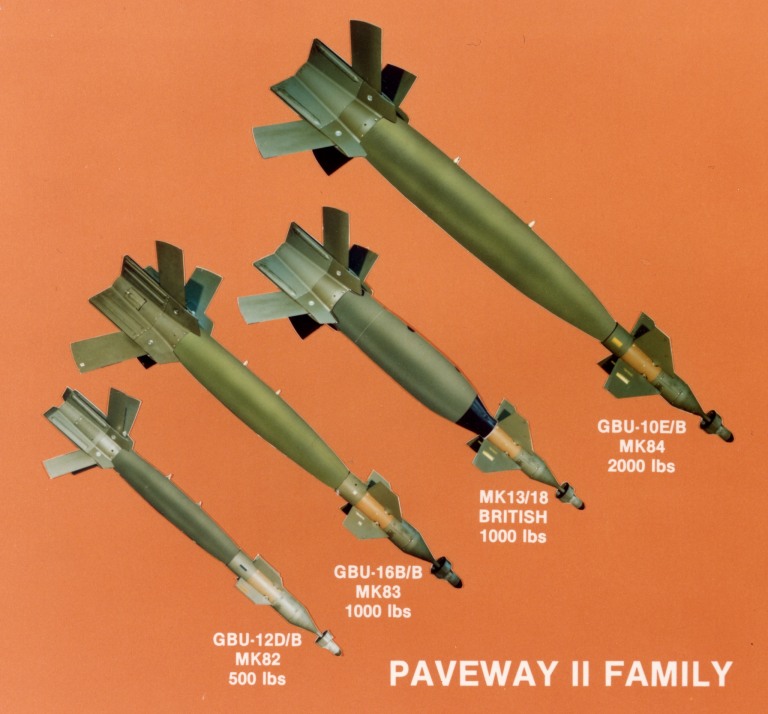
The Paveway II was the
principal
PGM used in the Gulf campaign, with several thousand rounds dropped by
USAF F-111Fs, F-15Es, Navy A-6Es and RAF Tornado GR.1As and Buccaneer
S.2Bs. F-111Fs of the 48th TFW destroyed 920 AFVs using the 500 lb
GBU-12, using the bigger GBU-10 for larger targets (TI).
The Paveway II is an
incremental
development of the Vietnam era Paveway I, and uses a simple
non-proportional guidance kit which is the key to the weapon's low
cost.
The folding tail assembly is deployed upon release, the optical seeker
head is aerodynamically aligned to the weapon's velocity vector thus
saving the cost of gyro stabilisation. CEPs are typically about 20 ft
for the GBU-10 (TI).
The GBU-24A/B with its
sophisticated digital autopilot and proportional seeker offers
substantially better range and accuracy than the Paveway II, with a
much
wider release envelope. Fitted to the hardened BLU-109/B warhead, this
weapon was used for busting hard targets such as bunkers, HAS and
bridges. Two derivatives were used, the GBU-27 carried by the F-117A
and
the GBU-28 4,800 lb earth penetrating bomb, two of which were dropped
by F-111Fs on the last day of the air campaign. CEPs are usually only
several feet.
Pic 4 (Rockwell GBU-15 - to be supplied) The deadly accurate GBU-15
glidebomb was used for precision attacks on point targets. Using a TV
or
thermal imaging terminal seeker tied to a two way video/command
datalink, the GBU-15 is remotely steered on to its aimpoint by an
operator in a guiding aircraft tens of miles away, who has DME
indication of weapon range to target. The weapon is supported by an
AXQ-14 datalink pod, carried under the rear fuselage. Most GBU-15s were
dropped by F-111Fs of the 48th TFW against bridges and other high value
targets, in excess of 75 were expended. The weapon has a CEP of several
feet under typical delivery conditions.
An F-15E here fitted with
both
the
Lantirn navigation and targeting pods fires an AGM-65B Scene
Magnification Maverick. The shortage of targeting pods meant that only
lead aircraft carried them, designating for all aircraft in a section,
when dropping GBU-10 or 12 weapons. The Maverick was the principal
anti-armour missile used, with over 5,500 rounds launched. Most were
either AGM-65A/B TV versions or the thermal imaging AGM-65D, although
some laser guided AGM-65Es were also fired by the USMC.
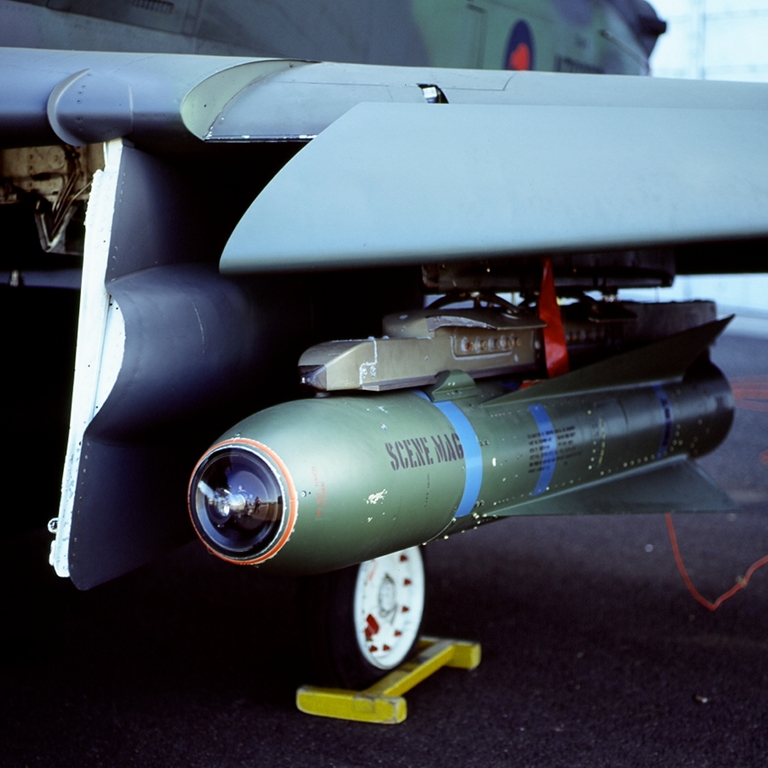
AGM-65E Scene
Magnification
Maverick here attached to an RNZAF A-4K Skyhawk (© 1993 - 2010 Carlo
Kopp; M645/1000S).
The very new AGM-84E SLAM,
a
Harpoon derivative, saw limited use in the Gulf mainly due its relative
immaturity. Using an inertial autopilot with GPS satnav support for
midcourse guidance, the weapon employs a Maverick thermal imaging
seeker
tied to a video/command datalink, common to the Navy Walleye glidebomb,
for its terminal homing phase. The weapon performed particularly well,
demonstrating CEPs of several feet at standoff ranges of tens of miles.
Pic 7 (SLAM FLIR Imagery) The Gulf proved the worth of thermal imaging systems beyond any doubt, these allowing around the clock attacks on all classes of target. The only aircraft fully equipped with such systems were the Pave Tack fitted F-111Fs of the 48th TFW, which became the principal night interdictors in the campaign, and the F-117A Stealth Fighters which supplemented the F-111Fs. Thermal imaging terminal seekers were used in the GBU-15, the AGM-65D and the AGM-84E SLAM, which also used a Maverick seeker. Imagery here taken from a SLAM seeker terminal phase. |
|||
|
|||||||||||||
|
|
|
|
|
|
|
|
|
|
|
|||
|
|
|
|
|
|
|
|
|
|
|
|||
 |
|
|
|||||||||||
| Artwork, graphic design, layout and text © 2004 - 2014 Carlo Kopp; Text © 2004 - 2014 Peter Goon; All rights reserved. Recommended browsers. Contact webmaster. Site navigation hints. Current hot topics. | |||||||||||||
|
Site Update
Status:
$Revision: 1.753 $
Site History: Notices
and
Updates / NLA Pandora Archive
|
|||||||||||||
|
|
Tweet | Follow @APA_Updates | |||||||||||
|
|
|||||||||||||
|
|
|||||||||||||