|
||||||||||||||||||||||
 |
||||||||||||||||||||||
![F-22A Raptor, FB-22, F-22E, F-22N and Variants Index Page [Click for more ...]](APA/f-fb-22.png "F-22A Raptor, FB-22, F-22E, F-22N and Variants Index Page [Click for more ...]") |
 |
![People's Liberation Army Air Power Index Page [Click for more ...]](APA/pla-air-pwr.png "People's Liberation Army Air Power Index Page [Click for more ...]") |
 |
 |
 |
 |
 |
 |
![Military Ethics, Culture, Education and Training Index Page [Click for more ...]](APA/ethx-culture.png "Military Ethics, Culture, Education and Training Index Page [Click for more ...]") |
 |
||||||||||||
 |
![Russian / Soviet Weapon Systems Index Page [Click for more ...]](APA/rus-weps.png "Russian / Soviet Weapon Systems Index Page [Click for more ...]") |
 |
 |
 |

|
 |
 |
 |
 |
 |
||||||||||||
 |
 |
|||||||||||||||||||||
| Last Updated: Mon Jan 27 11:18:09 UTC 2014 | ||||||||||||||||||||||
|
||||||||||||||||||||||
|
||||||||||||||||||||||
|
||||||||||||||||||||||
|
|
|
|
|
|
|
|
|
|
|
||||||||||||
|
|
|
|
|
|
|
|
|
|
|
||||||||||||
|
|
|||||||||||||||||||||
| Last Updated: Mon Jan 27 11:18:09 UTC 2014 | ||||||||||||||||||||||
|
||||||||||||||||||||||
| RADAR
WARNING RECEIVERS AND DEFENSIVE ELECTRONIC COUNTERMEASURES |
|||
|
|||
|
Born in the darkest hours of the Blitz, weaned during the night bombing offensive and matured in the skies above Hanoi. Electronic Warfare has become a military discipline within itself with a pervasive influence upon the strategy, tactics and technology of modern warfare. No more is this evident than in the modern air battle where Electronic Warfare (EW) drives penetration strategy and tactics, while fundamentally influencing airframe and weapon system design. The outcomes of the last three major air battles, the Falklands, the Bekaa Valley and the Tripoli Raid were largely determined by the application of EW techniques with the losers suffering in every instance overwhelming defeat. Not surprisingly EW has acquired an image of being black box magic which is in reality hardly deserved as the vast majority of EW techniques involve no more than clever application of established electrical engineering principles to the problem of defeating the opponent's electronic equipment. This aspect of the electronic battle is often underplayed but imposes an implicit need for restricting access to weapon system design parameters and constraints. Understanding the inner workings of an opponent's design allows you to defeat it regardless of its initial development cost. There is no such thing as a weapon system without a vulnerability; ample illustration to this point is given by the USAF meticulously digging pieces of a Stealth fighter out of a Californian hillside. By definition EW is military action involving the use of electromagnetic energy to determine, exploit, reduce or prevent hostile use of the electromagnetic spectrum and action which retains friendly use of the electromagnetic spectrum. More specifically it is the application of technology, strategy and tactics to deny the opponent the partial or full use of those electronic systems which rely upon the transmission of electromagnetic energy, primarily radar and communications. Needless to say radar and communications are pivotal components in any modern air defence system and it is in this area that EW has found its most dramatic application. Historically EW emerged as a discipline during the Luftwaffe night blitz and credit for its development as a discipline goes without any doubt to the British. The British successfully degraded the performance of the Luftwaffe's Knickebein and Wotan radio navigation systems by jamming and followed this with the successful application of communications jamming, radar deception jamming and chaff (window) during the night bombing offensive. Sadly Bomber Command was unable to match its success in the application of offensive EW with effective defensive countermeasures which resulted in a horrendous sustained loss rate (refer p122 Mar 88 AA). Ignorance of EW kills which history proves repeatedly, yet decision makers blindly persist in their rejection of the discipline, remaining oblivious to the vital issues. The significant aspect of the early British EW effort was the emphasis on offensive techniques rather than defensive systems, this past and current trend seems to stem from the greater publicity associated with major offensives rather than an appreciation of sustained loss rates. The next major phase in EW development took place during the early sixties when the USAF and USN equipped their fleet of tactical aircraft with the first generation of defensive systems; radar warning receivers and defensive jammers. While such equipment was carried by RAF and SAC bombers, it rapidly became a necessity for tactical aircraft operating over the increasingly hostile North Vietnamese air defence system. Massed deployment of Russian radar guided SAMs led to the most protracted electronic battle in history. Understandably, most attention was attracted by the USAF's specialised EB-66 jammers, F-100F and F-105G Wild Weasels and the Navy's EA-6A, EA-6B tacjammers and A-6B intruder, F-4F Iron Hand aircraft. Less apparent but no less important was the proliferation of various defensive systems such as the podded USAF ALQ-75, 77 and 87 jammers, the podded USN ALQ-76 and 81 jammers, the APR-25 series warning receivers and later digital ALR-46 radar homing and warning equipment. EW had come of age and EW equipment had become an integral part of new tactical aircraft system design. The Americans left Vietnam with valuable experience and promptly initiated the development of a new generation of defensive systems and the EF-111A, F-4G Wild Weasel and HARM anti-radiation missile. The Russians left Vietnam with valuable booty in the form of stockpiles of US EW equipment and spares held in South Vietnam, this led to a major qualitative leap in Russian equipment by the late seventies. The Middle East had meanwhile become the arena for electronic warfare and the Yom Kippur war of 1973 saw the Israelis lose over a hundred aircraft to radar directed AAA and SAMs - failing to heed the US they fitted their aircraft with very limited EW equipment. Nine years down the track it was clear that the Israelis had typically learned well, the Bekaa Valley air battle saw the Israelis destroy 19 SAM batteries and down over eighty aircraft all within a few days, for the loss of two aircraft. The Israelis had integrated EW techniques into their operational doctrine and applied it to every facet of the air/land battle with stunning results. The short but sharp TAC F-111 raid on Tripoli in 1986 also reiterated the point beyond any doubt, the only casualty an F-111 lost in an accident. At this instant it appears that NATO has finally taken notice with Germany and Italy seeking dedicated Tornado Electronic Combat/Recce aircraft and the UK progressing with its sophisticated Alarm ARM, these systems complementing the USAF's EF-111 A/F-4G/HARM force and the USN's EA-6B/ HARM force. F-111 aircraft carry the most extensive electronic
warfare
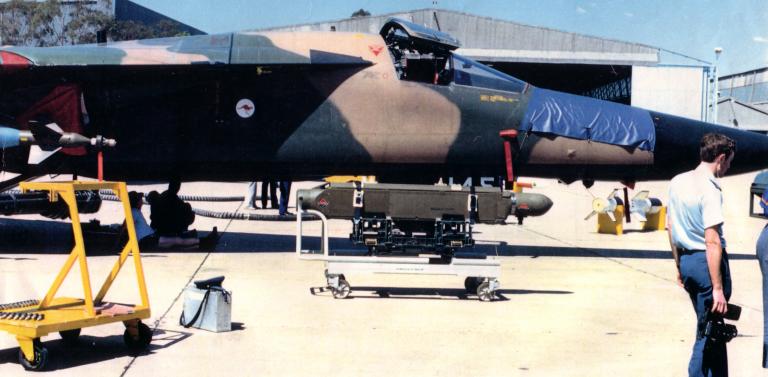
suite fitted to a tactical aircraft. The large ALR-62 RHAW is
complemented by a range of homing/warning receivers such as the
ALR-31/39/41 and an infra-red tail warning system. Defensive jamming is
provided by the ALQ-94/137 jammer which is effective against pulse mode
and continuous wave threats and additional ALQ-119 or ALQ-131 jamming
pods can be carried on an aft ventral centreline attachment. Newer pods
such as the ALQ-131 are modular which allows a pod to be tailored to a
particular threat environment which threat specific hardware modules
and
software. Below Westinghouse ALQ-131 jamming pod fit check on F-111C (Westinghouse).
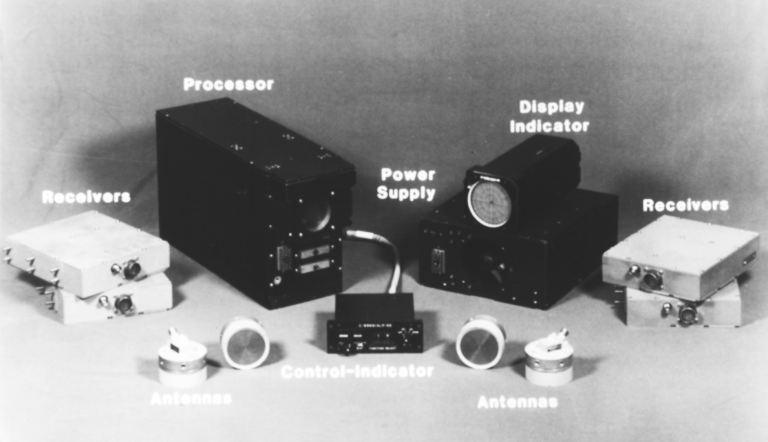
The electronic battle is however very fluid and every measure has a countermeasure and every countermeasure a counter-countermeasure and so on ... it will be interesting to see whether the commitment exists to sustain this long overdue growth in capability. Radar Warning Receivers EW systems can be broadly divided into self protection systems and support jamming systems. The former are those pieces of equipment which are carried by an aircraft to protect itself from hostile electronic systems, the latter are those systems carried by dedicated jamming platforms. Self protection systems in turn fall into two categories, passive Radar Warning Receivers (RWR) which alert the pilot to illumination by hostile radar and defensive Electronic Counter Measures (ECM) which jam specific hostile weapon systems. The sophistication and degree of integration of RWRs and ECM are role dependent and the systems carried by light tactical aircraft such as the F-16 and F-18 cannot compare with those carried by heavyweights dedicated to deep penetration such as the F-15 or F-111. The RWR is the simplest and most essential component of any EW suite. The simplest and most commonly used RWR is the crystal video receiver which offers respectable performance in spite of its basic conceptual simplicity. In a crystal video receiver, the impinging microwave transmission from a hostile radar falls upon a wide band receiving antenna from which it is fed into a bank of simple filter/detector/amplifier receivers each of which is much like the receivers used by motorists to detect police radars. The receivers are each tuned to consecutive slices of the covered band which allows simultaneous reception and discrimination of radars operating in various parts of the band. The output signal from each of the constituent receivers is an electrical signal which represents the envelope of the detected microwave signal - if the microwave signal was a train of pulses (typical in radar) the output is like pulses. Such an RWR can indicate, with high probability of intercept, the presence of a radar signal impinging upon its antenna. This alone is of limited use as in practice it is desirable to know in which direction the radar is. This is accomplished by using a set of four identical matched crystal video receivers each fed by an antenna which covers a quadrant of space about the carrying aircraft. By comparing the strength of the output signals from the receivers, the direction of the radar can be estimated with reasonable accuracy. The raw output from such a RWR must be interpreted. The simplest technique is to feed it into a headset and listen for the characteristic buzz, chirp or whistle of the sought radar type. In practice interpretation is the task of an analogue or digital signal processor which identifies the pulse trains associated with particular radars in specific modes of operation. Understandably this is a task demanding considerable computing power in a high density signal environment and this accounts for much of the cost in a RWR. Once the signals have been identified they must be prioritised as threats and sorted. For instance a SAM fire control illuminator locked on to the aircraft is a far greater threat than a surveillance radar. Modern RWRs employ microprocessors to perform this task often in conjunction with the signal processing function. The prioritised threat data is then fed to a cockpit display usually as synthetic symbols. This provides the pilot or weapon system operator with plan position indication of threats to facilitate defensive manoeuvring. The threat data can also be fed to onboard jammers which can improve the potency of the jamming system. A well established RWR type is exampled by the Litton ALR-45 family, developed from the Vietnam era APR-25 RWR and much the standard USN RWR carried by the A-6, EA-6B A-7, F-14A and F-18. The ALR-45 comprises four cavity backed spiral antennas feeding four crystal video receiver (detector/video amplifier) assemblies which are in turn tied to a hard wired threat processor. The threat processor is interfaced to a cockpit display and control panel. The late model ALR-45F employs a computer based threat processor and a MIL-STD-1553B bus compatible display terminal, both of which are interchangeable with the successor to the ALR-45, the newer ALR-67. While the crystal video receiver coupled to a capable threat processor is a very effective defensive tool, its low sensitivity limits its application to detecting close and therefore immediate threats to the aircraft. More sensitivity can be gained by the use of superheterodyne receivers. This will however impose the need for a far more capable threat processor as the area covered about the aircraft increases with the square of detection range. This vastly increases the number of threats to be identified
and sorted. The additional capability is often well worth while and can
be exploited to give a threat a wide berth or to track it and attack
it.
Systems in this class are understandably more complex and expensive and
are usually carried by deep penetration aircraft: the F-15's Loral
ALR-56 falls into this category.
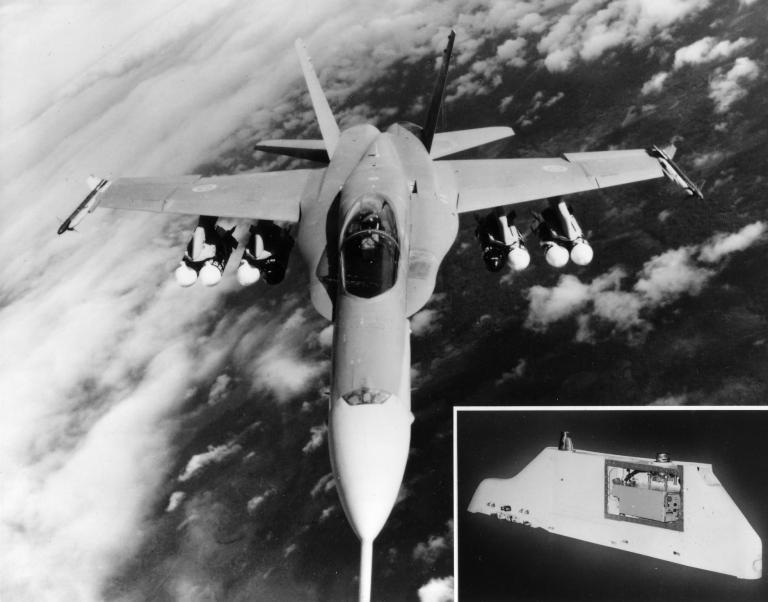
Amongst the most extensively equipped F-18A aircraft in service, Canadian/NATO CF-18s carry the ALQ-162 continuous wave jammer in addition to the aircraft's basic EW suite. Standard F-18A aircraft carry the ALR-45D/F warning receiver and the ALQ-126A/B trackbreaker defensive jammer effective against pulse mode threats. Exposure to PVO SA-6B SAMs and other continuous wave threats necessitates the fitting of additional defensive jammers such as the pylon mounted ALQ-162 (see inset). While the primary function of the RWR is detection of threats to facilitate evasion, the RWR can also be used to support ECM (jammers) which are another key part of an electronic armoury. Defensive Electronic CounterMeasures Jammers can be broadly divided into two categories, noise jammers and deception jammers. In either instance the jammer comprises a receiver which listens for threat radars, a processor to make decisions and a tunable transmitter. The transmitter is automatically tuned to the frequency of the hostile transmission and jams it by transmitting a commanded signal. A noise jammer will transmit a signal much like electrical noise which results in the radar return (echo) from the aircraft being obscured and at range may cause the aircraft to disappear from the threat operator's scope. At closer range however considerable power is required to outshout the return from the jamming aircraft and distinct radial lines termed strobes will appear on the victim's scope. The operator will know he is being jammed and may attempt to tune the radar to a slightly different frequency which may or may not defeat the jammer (a technique used to defeat an ECM system is termed an Electronic Counter CounterMeasure or ECCM). At some even closer range the victim radar will 'burn through' the jamming as the return becomes more powerful than the jamming transmission, the aircraft will then become distinguishable from the jamming. A deception jammer doesn't attempt to conceal the presence of the aircraft but rather transmits signals very much like the real return to deceive the radar or its operator. The number of deception jamming techniques is immense and every type of radar and specific design of a radar has some exploitable vulnerability. Broadly, deception jammers can be divided into false target generators and track breakers. A false target generator is usually employed against a track-while-scan surveillance radar with the objective of confusing the operator or saturating the tracking computer. It achieves this by transmitting false radar returns, usually delayed retransmitted versions of the radar's actual pulses. This creates the illusion of a whole formation of aircraft rather than the single real target which vastly complicates interpretation of the tactical situation. Because of the difficulty involved in generating credible false target signals this technique is often combined with noise jamming which degrades the performance of the victim radar so that the false targets are impossible to distinguish from the real target, if not concealing the real target completely. Track breakers are usually employed against tracking radars in single target track mode, these are typically fire control radars associated with SAMs, AAMs and AAA. Track breaking techniques are therefore of major importance in tactical and strategic aircraft. Track breakers attack the automatic tracking mechanism of the victim radar. If the threat is a pulsed radar a track breaker will usually transmit a 'cover pulse' at the same time as the return pulse. This masks the return and the victim tracking mechanism is then allowed to lock on to the cover pulse rather than the weaker real return. The jammer has then seduced the tracking mechanism and can, within limits, move the target about its real position and typically turn it off to break lock. The target will often be made to erratically jitter which makes it impossible to accurately guide a missile or fire a gun at the target. This is termed gate stealing and can be applied in various ways to many diverse radar types (angle/range/velocity gate walk-off/pull-off/stealing) including Continuous Wave (CW, ie non-pulsed radar, often used in fire control illuminators for SAMs) radars (FM-CW ranging). Other track breaking techniques disrupt the angular tracking of the target by attacking the antenna scan mechanism. Conical scan radars (common in missile seekers and AAA) can be jammed by rapidly varying the amplitude of the jamming signal at a rate close to the rotation rate of the antenna, this will drive the antenna wildly off target and is termed Amplitude Modulation or AM ECM. Monopulse radars are notoriously difficult to jam and require more cunning techniques such as cross eye jamming. A cross eye jammer employs two deception repeaters which retransmit the impinging radar signal with set time delays. By situating the transmitting antennas at the extremities of the aircraft (eg out on the wings) and manipulating the time delays, the cross-eye jammer distorts the shape (and hence perceived direction) of the returned echo (wavefront). A monopulse track ing system aligns itself with the direction of the incoming return from the target and is thus driven off the target. ECM equipment is usually carried internally although podded jammers are available for older aircraft or as a supplement to an internal system where required by a specific threat. Tactical aircraft which must grapple with threats at close quarters rely primarily on track breaking ECM to penetrate terminal defences and equipment such as the Sanders ALQ-126B carried by the F-18A is typical of this class. The ALQ-126 family of jammers succeeded the earlier USN standard ALQ-100 jammers and is carried by the A-6, EA-6, A-7, F-14 and F-18. The B model provides E, F, G, H, I/J band coverage and implements several techniques effective against pulse mode and conical scanning radars. Delivering over 1 kw of jam power per band in pulse mode the 126B can be operated autonomously or tied in with an ALR-45F/67 RWR. In a high threat environment the ALQ-126 would be supplemented with a Northrop ALQ-162 Compass Sail/Clockwise continuous wave jammer which is effective against CW threats such as the SA-6 Gainful family of semi-active radar guided SAMs. Deep penetration aircraft carry more extensive systems with noise jamming capability against radar (ALQ-94/F-111, ALQ-155/ALT-2B/B-52, ALQ-161, B-1B), missile tracking downlinks (B-52) and false target generating capability (ALQ-122/B-52). Expendables While RWRs and ECM represent the sophisticated side of EW, expendables must not be overlooked. The most commonly used expendable is chaff (window) which is finely chopped metal foil or metal coated plastic strands. Dumping chaff from an aircraft creates a radar reflective cloud which can be of at least nuisance value although it is often most effective against simpler radar guided missile seekers. Chaff is often supplemented by expendable jammers. These are usually small battery powered noise jammers or deception repeaters built into a small capsule which is suspended on a parachute. Expendable jammers are dispensed by an aircraft to degrade threat radar performance or seduce radar guided weapons. A further class of expendables are flares which are dropped to seduce or confuse heat seeking missiles. Often all expendables are dispensed by a single countermeasures dispenser, controlled by the RWR. A typical device is the USN standard AEL ALE-39 carried by the A-4, A-6, A-7, F-14 and F-18 aircraft. The ALE-39 can be configured with a mixed load of up to 60 expendables, chaff, jammers and flares, dispensed selectively or mixed and under RWR control if necessary. The F-111 Electronic Warfare Systems The demanding role of unescorted deep strike performed by the F-111 family requires an extensive EW system with greater capability than that of smaller tactical fighters such as the F-16 or F-18. This reflects in complexity, maintainability and hence cost, the F-111 carries the most elaborate EW system in any tactical aircraft today. The core of the system is the Dalmo Victor ALR-62 Radar
Homing
And Warning (RHAW) system which superceded the earlier APS-109A/C RHAW.
The ALR-62 has forward and aft antenna sets, the forward pair are flush
inset in the skin of the forward avionics (radar) bay and provide high
and mid band coverage. Antenna outputs feed forward and aft receiver
sets which in turn feed a digital signal processor.
Threats are displayed on a circular cockpit CRT display next to the TFR E-scope and on a combined indicator/countermeasures control panel above the radar/Pave Tack display. The ALR-62 is complemented by a Cincinnati Electronics AAR-34 Infra-Red Receiving Set unique in a tactical aircraft as it tracks the infra-red emissions of a pursuing missile's exhaust plume and provides an azimuth indication to the pilot. In USAF aircraft the ALR-62 is complemented by a Loral ALR-41 SAM warning receiver and some aircraft also carried Loral ALR-31/39 homing receivers. Expendables are dispensed via a Lundy ALE-28 unit controlled from the navigator's starboard console. The F-111 carries the Sanders/Varian ALQ-94 ECM and in some versions its upgraded derivative the ALQ-137 which is one of the most sophisticated ECM equipment suites carried on a tactical aircraft. The ALQ-94 was developed in the late 1960s for TAC F-111 A/E/D and SAC FB-111 A aircraft, with SAC aircraft and TAC EF-111As later receiving the 137 with improved rear coverage. The ALQ-94/137 is split into low (E/F), mid (G/H) and high (I/J) band subsystems with independent control on a central panel. Receiver and transmitter antennas for all three bands are mounted on the nose, wing gloves and horizontal tail booms providing broad forward and aft coverage. The ALQ-94/137 is effective against SAM and AAA fire control radars and airborne intercept (AI) radars. It uses a crystal video receiver and signal processor to provide prioritised power managed deception and noise jamming of multiple threats in a dense signal environment, with pulse powers greater than 1 kW and CW power of 100W. In a high threat environment the ALQ-94/137 may be supplemented with external jammer pods, either the established Westinghouse ALQ-119 or newer ALQ-131. The ALQ-131 is a self contained noise/deception jammer with integral environmental control, a programmable central computer and a modular jammer in 16 available configurations specific to threats. Superheterodyne and crystal video receivers are used although the pod can be slaved to the aircraft's RWR. The ALQ-119 and 131 are carried on a ventral centreline attachment just aft of the main undercarriage well [Editor's Note: a later modification adds a small pylon for the pod to the Pave Tack cradle exterior or the weapon bay door]. The F-111's EW systems enabled the aircraft to penetrate deep into the North Vietnamese air defence system without any escort jamming or defence suppression aircraft, although more recently the aircraft is operated in conjunction with dedicated escort jamming EF-111 A aircraft. This has become necessary in some situations due to the high concentration of advanced SAM and AAA systems, eg the Tripoli raid. A planned upgrade to the internal ECM has however fallen victim to unusually intense infighting between the USAF and the US Senate (how unusual for the F-111 ...) with the proposed replacement ALQ-189 first cancelled in favour of the new lightweight ALQ-165 Advanced Self Protection Jammer (ASPJ, itself planned for use on most USAF and USN tactical aircraft) and then reinstated in a competition with the ASPJ and a modified ALQ-161 (B-1) and at last count put on hold. The RAAF have also sought an upgrade to the F-111A/C strike wing, however, given the RAAF's unusually tight security on this subject it is not very clear where the program is except that initial programme funding is expected before 1991. In a tactical situation the RHAW and ECM are critical to the evasion of fighters and SAMs. The ability of the RHAW to identify and classify threats and their respective operating modes provides the navigator with a clear picture of the tactical situation. On a typical strike mission the aircraft would encounter both radar directed AAA and SAMs both covering the immediate target and in some instances the most favourable approaches to the target as constrained by local terrain. While low level penetration at 600kt itself can defeat many SAM acquisition and tracking radars, newer versions of established SAMs are capable of hitting targets down at 200ft, mainly by virtue of new solid state Doppler look-down radar technology. This raises the importance of ECM in defence penetration, the jammers may well be all that is realistically standing between survival and destruction. The penetrating F-111 would almost certainly evade the long range search radars (eg: E/F band Bar Lock, E/F band AN/TPS-43 or AR-3D) but would be detected by well placed SAM/AAA acquisition radar (eg: C band Flat Face) which would hand it over to the area defence SAM system (typically an SA-6A/B supported by G/H band Straight Flush and I-band CW illuminator, SA-11 Gadfly supported by I-band Flat Lid or MIM-23 Hawk supported by an I-band CW illuminator). The intruding aircraft could jam although it may choose not to at this stage to avoid passive tracking of its transmissions. If jamming takes place it could also serve to actually prevent a SAM launch. SAMs are often salvoed in twos, threes or fours to complicate evasion and saturate the jammers and crew with additional workload. Assuming that jamming and, if necessary, manoeuvring are successful the SAMs would be defeated and the aircraft would run into the terminal defences.
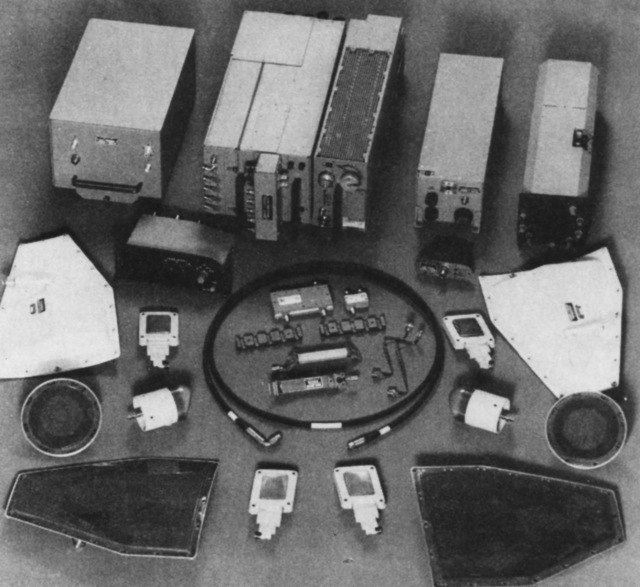
Black Box Magic - The ALR-66(VE) is typical of current Radar Warning Receiver design practice. This RWR is a conventional crystal video receiver providing C through J band coverage of pulse mode and continuous wave threats, with a digital threat processor. The threat processor internal memory contains a library of over 1,000 emitter signa tures, detected emitters are displayed with synthetic symbology on a CRT display. In its ALR-66(V)2 version it is carried by P-3B/C aircraft. The (VE) version is fitted to USN SH-2F ASW/Targeting helicopters and is suitable for tactical aircraft (General Instrument Corp.) These would be a mix of SAMs (eg mobile command link guided SA-8A/B Gecko supported by G/H, I/J band Land Roll, mobile heat seeking SA-9 Gaskin supported by J-band Gun Dish, heat seeking/anti radiation SA-13 Gopher, command guided Rapier supported by I/J band Blindfire or command guided Crotale) and AAA (eg ZSU-23-4P aimed by J-band Gun Dish). We have included Western systems as unfortunately the modern adversary will not always be restricted to Soviet supplied hardware. Power managed jamming and chaff would be used against the radar guided weapons while flares are employed against the heat seeking missiles, launch warning provided if necessary by the aft mounted IR receiver. In this scenario command guided SAMs are of concern as they usually carry backup optical tracking systems to circumvent jamming of the fire control radar. The SA-8 was responsible for one of the very few Israeli aircraft that were lost over the Bekaa Valley. Speed and surprise are therefore of the essence and could make the big difference. Assuming then that the crew pressed all the right buttons, all the black boxes worked as advertised and all the right manoeuvres were flown the terminal defences are penetrated and the F-111 drops its ordnance on top of the target. Clean and 6,000 lb lighter it quickly accelerates to supersonic speed and heads out of the target zone. Fighters would probably appear at this stage, vectored by no doubt a very agitated ground control to pursue the penetrator. Jamming of the fighter's AI radar at this stage can be most effective due to the strong clutter return seen by the radar although recently deployed MiG-29 Fulcrum and Su-27 Flanker aircraft have reduced this advantage with their high powered look-down shoot-down pulse Doppler radars. Care must also be taken with the use of afterburner to avoid lock-on by Infra-Red Search and Track (IRST) and heat seeking missiles. Heat seekers cued by passive systems provide no warning other than an exhaust plume. Manoeuvring and speed are therefore an essential part of evasion, coupled with clever use of the RHAW to avoid detection if possible. At some point the fighter will break off its attack having guzzled far too much fuel in afterburning intercept and pursuit. The complexity of the electronic battle even in conceptually simple single aircraft unescorted strike missions illustrates the critical nature of EW in the modern air battle. Those air forces which fail to keep their EW systems and tactics up to date cannot expect to survive beyond a week of battle. As Israel's painful experience in 1973 proves, even the best are not necessarily immune. (The author will cover other Electronic Warfare topics in future issues .) REFERENCES:
|
|||
|
|||||||||||||
|
|
|
|
|
|
|
|
|
|
|
|||
|
|
|
|
|
|
|
|
|
|
|
|||
 |
|
|
|||||||||||
| Artwork, graphic design, layout and text © 2004 - 2014 Carlo Kopp; Text © 2004 - 2014 Peter Goon; All rights reserved. Recommended browsers. Contact webmaster. Site navigation hints. Current hot topics. | |||||||||||||
|
Site Update
Status:
$Revision: 1.753 $
Site History: Notices
and
Updates / NLA Pandora Archive
|
|||||||||||||
|
|
Tweet | Follow @APA_Updates | |||||||||||
|
|
|||||||||||||
|
|
|||||||||||||