|
||||||||||||||||||||||
 |
||||||||||||||||||||||
![F-22A Raptor, FB-22, F-22E, F-22N and Variants Index Page [Click for more ...]](APA/f-fb-22.png "F-22A Raptor, FB-22, F-22E, F-22N and Variants Index Page [Click for more ...]") |
 |
![People's Liberation Army Air Power Index Page [Click for more ...]](APA/pla-air-pwr.png "People's Liberation Army Air Power Index Page [Click for more ...]") |
 |
 |
 |
 |
 |
 |
![Military Ethics, Culture, Education and Training Index Page [Click for more ...]](APA/ethx-culture.png "Military Ethics, Culture, Education and Training Index Page [Click for more ...]") |
 |
||||||||||||
 |
![Russian / Soviet Weapon Systems Index Page [Click for more ...]](APA/rus-weps.png "Russian / Soviet Weapon Systems Index Page [Click for more ...]") |
 |
 |
 |

|
 |
 |
 |
 |
 |
||||||||||||
 |
 |
|||||||||||||||||||||
| Last Updated: Mon Jan 27 11:18:09 UTC 2014 | ||||||||||||||||||||||
|
||||||||||||||||||||||
|
||||||||||||||||||||||
|
||||||||||||||||||||||
|
|
|
|
|
|
|
|
|
|
|
||||||||||||
|
|
|
|
|
|
|
|
|
|
|
||||||||||||
|
|
|||||||||||||||||||||
| Last Updated: Mon Jan 27 11:18:09 UTC 2014 | ||||||||||||||||||||||
|
||||||||||||||||||||||
| ACTIVE
AND SEMIACTIVE RADAR MISSILE GUIDANCE |
|||
|
|||
|
Radar guided air to air missiles currently represent the best of what state of the art technology can offer, both in terms of range, accuracy and resistance to countermeasures. This reflects in the fact, that these weapons are only used by the world's frontline air forces, the maintenance of the complex fire control systems required being beyond the abilities of the average Third World country. In comparison with the Western World, even the Warpac air forces use few of these weapons, up to the mid seventies only the USSR using a number of types on air defence aircraft of the IA PVO-Strany. However, the situation is changing, as the Russians are currently equipping tactical aircraft with radar guided versions of the AA-7 and AA-8 and low level penetration will become more difficult, for Western interdiction aircraft as the new Super Foxbat, with its lookdown shoot-down capable 25 nm AA-X-9, or rather AA-9, is deployed. On the brighter side, ... a competitive shoot-off ended between Hughes and Raytheon for the Amraam (Advanced Medium Range Air-Air Missile), Hughes winning the contract. Amraam is the replacement for the Western air forces' radar guided Sparrow. The weapon is a fire and forget, active radar guided missile with inertial midcourse guidance, enabling launches against targets pursuing the launch aircraft. With a range and speed better than the Sparrow, this overall capability is packaged into an airframe comparable in size to the IR Sidewinder, allowing the F-14 and F-15 to carry eight of these weapons, instead of the customary four radar guided weapons. Some reports also indicate that the late eighties Sidewinder replacement, the ASRAAM, may also be fitted with active radar guidance, in preference to the IR guidance of its predecessor. Radar guidance systems detect and home in on their targets by sensing electromagnetic energy reflected from the target's surface. The source of the reflected radiation is a radar transmitter; in the instance of weapons with active radar guidance, this transmitter is situated within the missile; in the case of semiactive guidance, it is carried by the launch aircraft. In either case the transmitter must beam electromagnetic radiation at the target, this radiation must travel to the target, reflect, travel back to the receiving antenna of the missile, be amplified, demodulated and analysed to determine the direction of the target, this information then enables the guidance computer to steer the weapon toward the target to achieve a kill. An effective weapon must have the ability to discriminate between the target's return and reflections from its background, i.e. the surface of the Earth or ocean, it should also be capable of resisting jamming or deception and be able to penetrate through adverse weather conditions. Radar Radar theory is an extremely complex subject requiring a good understanding of electromagnetism, and wave theory, fortunately though, the basic principles are fairly straightforward. Electromagnetic waves are generated whenever we induce changes, typically oscillations, in an electric or magnetic field. These waves then propagate outward at the speed of light, 3.108 msec '. The rate at which the oscillation occurs then determines the wavelength, by the relationship lambda = c/f ( lambda = wavelength, c = velocity of light, f = frequency of oscillation). For practical purposes, if we intend to create directional means of these waves, we must employ a wavelength shorter than the dimensions of our antenna (an antenna being a device which radiates or receives electromagnetic waves), current radar applications involving wavelengths of the order of a metre down to centimetres, these corresponding to frequencies from 1 GHz (109 cycles/sec) to around 60 GHz (classified as the microwave band). The term radar is an acronym - Radio Detection And Ranging. A radar is comprised of two basic subsystems - a transmitter and a receiver. A transmitter is a device which generates a microwave signal, this signal is usually modulated (typically pulsed on-off), amplified and fed into a transmitting antenna. As compared to low frequency electromagnetic energy, microwaves cannot be conducted by conventional cables, they require waveguides (waveguides are hollow [rectangular or circular] sections with inner walls coated with conducted layers - the common term used is plumbing), these must have extremely low losses because the power output of the transmitter is usually of the order of Kilowatts (or tens to hundreds of kW in pulsed applications). Pulsed outputs are used for a number of reasons, the main factors being rangefinding and peak power output. The range of a target can be easily determined by measuring the time it takes for a pulse to travel from the transmitter to the target and back. In considering the power output, the more power delivered = the greater the range and ability to resist jamming, on the other hand the larger the demands on the transmitter's main output amplifier (or oscillator). The solution is found in pulsing the output, the time between the pulses being much longer than the duration of the pulse (consider a peak output of 100 kW, pulses 10 msecs long 100 msecs apart - the average power output is only 10 kW). The output power is then fed into an antenna, which focusses it into a beam. Surveillance radars usually employ fairly wide beams, the objective being the detection of the target, tracking beams, on the other hand, must be very narrow, as they serve to accurately measure the position of the target with respect to the radar. Antennas may be conventional parabolic dishes or in newer systems, phased arrays, which may scan electronically without the need to point the antenna. The transmitted microwave energy then propagates through the atmosphere toward the target. Like all forms of electromagnetic radiation, microwaves are attenuated by the atmosphere - both absorbed and scattered. Scattering is primarily due to water particles in the atmosphere, however, as the wavelength of the radiation is much larger than the size of the water droplets, microwaves do not experience the catastrophic attenuation IR does (see IR guidance, March 1982), though the effective range will be decreased as the amount of water present increases. Absorption is a quantum physical effect (TE March 1982), in the instance of microwave wavelengths this is mainly due to resonance in the Oz molecule, which exhibits absorption lines between 30 and 0.5 cm. Over larger distances this may cause a reasonably large loss of signal. The energy which covers the distance between the source and target then experiences absorption and reflection on the target's surface.
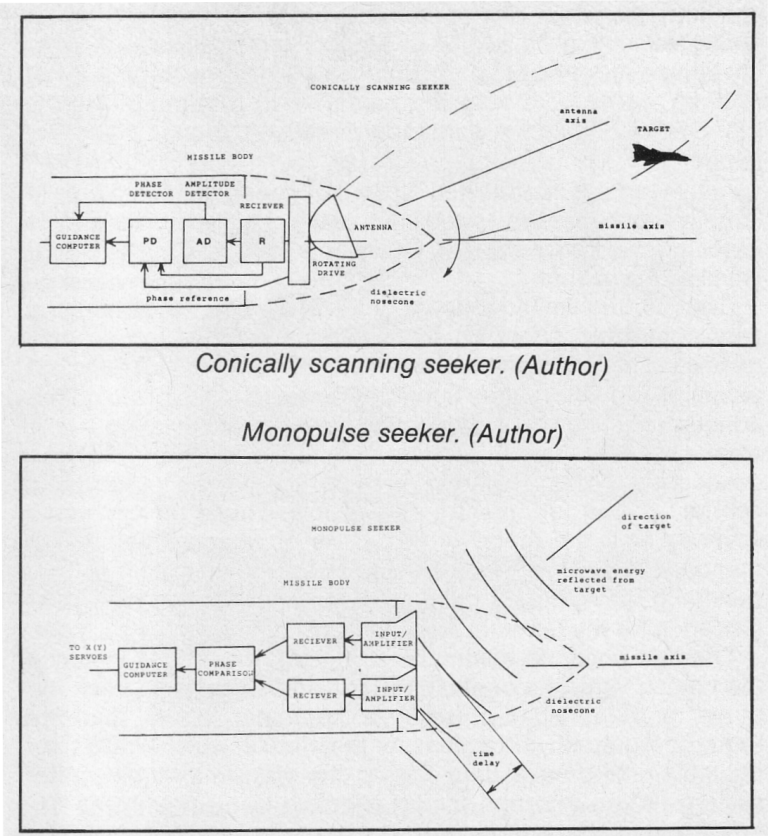
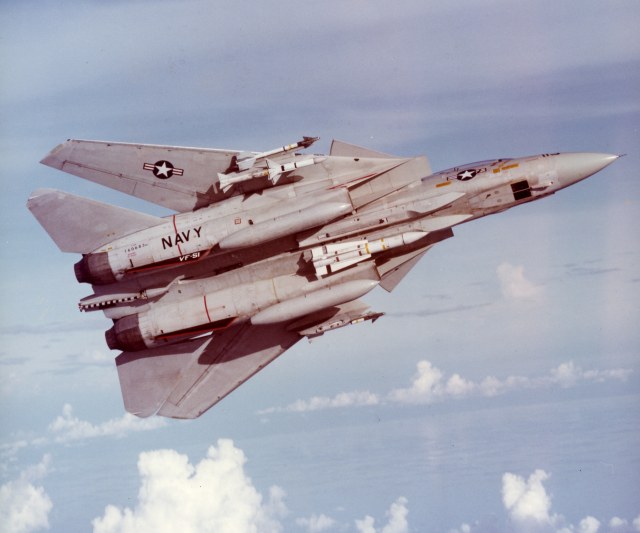 Exposing its belly, this F-14A displays the three classes of missile it is armed with - IR heat seeking, semi-active radar and active radar. The semi-active AIM-7F Sparrow (starboard glove pylon) is a late model of the AIM-7 used during the Vietnam war (at the time plagued by low reliability), the weapon has a maximum range around 100 km, cruising speed Mach 4 and carries a 40 kg continuous rod warhead. This missile will equip the RAAF's F-18A fighters, though it will be later replaced by the smaller and more capable Amraam. The large weapon beneath the fuselage is the AIM-54A Phoenix, with no doubt the world's most lethal air-to-air missile, with a range of 200 km and a big 60 kg warhead. The current A version will be shortly replaced with the newer AIM-54C, equipped with more capable digital signal processors and with a lighter and cheaper airframe. (Lcdr. Dave Erickson, VF-51, USS Kitty Hawk) Electrically conductive materials usually reflect very well, sharp straight edges on an airframe often behave like antennas, in general curved surfaces are worse reflectors than flat surfaces (consider the shape of the B-1, which has 1/10 the radar cross-section of a B-52). A usual measure of an aircraft's ability to reflect microwaves is its radar cross-section (12.566 power reflected per unit solid angle/power incident on target), which varies with the direction of the incident radiation. A fighter, head-on, has a cross section between 0.1 and 1 m2 for the 3 to 10 cm band, whereas a bomber could approach 10 mz (don't try thinking of a B-52's cross section!). The use of composite materials reduces the signature, just as radar absorbing paints help. The reflected microwave energy then travels back to the receiver, which in many instances employs the same antenna as the transmitter. The signal which reaches the receiver is a mixture of a target return, reflected energy from the background (clutter) and electrical noise. Depending on the type of receiver it may or may not be amplified, after which it is mixed with a microwave signal of a higher frequency, a process known as superheterodyning. Mixing creates sum and difference frequencies, the difference frequency being in the high frequency (tens to a hundred MHz) band, this frequency is then amplified (due to a number of reasons, it is difficult to directly amplify microwave signals) and subsequently demodulated. The demodulated signal is then processed by electronics to yield information on the target, typically range and velocity relative to the radar. Modern radars employ complex techniques to reject clutter, employing high speed digital signal processors, these also serve to circumvent jamming or deception. Semi-active Radar Guided AAMs Semi-active radar guided missiles dominate the World's radar guided missile population, basically by virtue of their relative simplicity. The vast majority of currently operational designs originated in the 1950s, aside from a number of Soviet types, recently deployed (they did have some catching up to do). The AIM-7 Sparrow is a development of a 1950s weapon, just as the Skyflash is, in turn, a development of the AIM-7 itself. In the mid-fifties, when it was decided to develop radar guidance for air-air missiles, it was impossible, with state of the art technology, to package a radar transmitter and receiver of the appropriate range into a medium sized missile. Were it possible to fit all the systems in, the abysmally low reliability of vacuum tube electronics would make the operational deployment of such a weapon rather a hindrance than a gain to an air force's combat capability. As things turned out, two different guidance systems were tried, beam riding guidance and semi-active guidance. The former class is generally regarded as extinct (in a beam riding system, the missile travels along a tracking beam transmitted by the launch aircraft's fire control radar). The weapon's accuracy is given only by the fire control's tracking accuracy, which need not be very good, particularly at long ranges. This, and problems associated with the dynamics of the weapons flight, led to the eventual demise of the whole class (AIM-7A, AA-1 Alkali). Currently, beam riding (laser, though) is used by the RBS-70 SAM. The latter class of weapon not only survived two decades, in fact it thrived and currently represents the main medium range AAM in most frontline air forces. In a semi-active guidance system, the launch aircraft acquires the target with its fire control radar, and if the conditions are right, will track it. The Weapons Systems Officer (F-4, typically) will then power up the missile and lock the launch aircraft's illuminator onto the target. The illuminator is usually a small, separate narrow beam radar transmitter which can be selectively pointed at a target by use of the tracking information generated by the fire control radar. If the missile's guidance then succeeds in locking on to the target's radar return, the missile may then be launched. The AIM-7, as carried by the F-4, F-14, F-15, F-18 is ejected from its mount and when clear from the launch aircraft, fires its solid propellant rocket engine. It then accelerates to its cruise velocity, pointing itself at the target. The guidance system will generate an error signal if the weapon points at anything else than the centre of the target's radar cross section. Most weapons employ proportional navigation, due to the nature of the guidance, this allows for all aspect, typically head-on kills. When the target is within the lethal radius of the weapon's warhead, a proximity fuse, usually radar, detonates the warhead, commonly a high explosive/fragmentation type (the timing of the fuse is critical, an Israeli F-4E failed to kill a Syrian Foxbat in a head-on, snapup AIM-7 attack simply because the missile, fused for targets travelling at transonic speeds, detonated after passing the Mach 3 MiG, failing to cause any damage) and destroys the target. Most weapons have miss distances of the order of metres, though the Skyflash has apparently narrowed that down to the order of a metre. The most important factor determining a semi-active guided weapon's lethality is its tracking accuracy and ability to discriminate between the target's return and ground clutter. Earlier weapons employed conical scan seekers, however newer systems rather use monopulse seekers, as these are more accurate and resist jamming better, though at the expense of added complexity. Conical Scan Semi-active Seekers Conically scanning seekers established themselves very early, as the dominant type of seeker in use, this was basically due to their conceptual simplicity and undemanding signal processing electronics, easily implemented with vacuum tubes. The principal element in the system is a rotating antenna. This antenna, usually a dish, rotates about the axis of the missile, however, the axis of the antenna (the axis of its main lobe - an antenna lobe being the pattern in space we would get, if we moved around the antenna with an electromagnetic field strength meter and marked all the points with an equal field strength) is offset by several degrees, when the antenna rotates, its axis draws a cone around the missile axis. (See diagram 1). When the launch aircraft is illuminating the target, it behaves, as far as the seeker is concerned, as a point source of electromagnetic energy. If the target lies within the seeker's cone, rotating the antenna will modulate the output signal leaving the antenna, as the signal is stronger as the target is closer to the axis of the antenna lobe. This results in a sinusoidal variation in the amplitude of the output signal. The direction of the target can be found from the phase of the modulation, with respect to the direction of the antenna relative to the missile's axis. The variation in amplitude contains the information as to the other angular component of the target's direction. Simple phase and amplitude detectors can readily extract error signals, these can then be fed into the missile's guidance computer, which can accordingly determine the correct control surface deflection for optimal guidance to the target. The signal transmitted by the illuminator may be pulsed or continuous-wave (CW), a pulsed signal offers higher peak outputs but may be more readily jammed. In its basic configuration, a conically scanned system may be easily jammed, providing we do know the rate at which it rotates. If we transmit a signal at the same frequency as the illuminator, but amplitude-modulate it with a frequency very close to the frequency of the seeker's antenna rotation, we will succeed in creating a false error signal, which will throw the missile off course. Apparently USN F-4Ss of the USS Midway experienced some problems during joint manouevres with the RAN, as its seems, the AIM-7 seekers could not digest chopped returns reflected by the rotating props on the RAN's S-2s. Conical scanning is not likely to be used in any future designs, as it is being displaced by monopulse seekers.
Monopulse Semiactive Seekers Monopulse seekers derive all target bearing information from a single pulse, i.e. a continuous wave illuminating signal. These seekers are very demanding in the stability of the system's electronics and require compact, high gain receivers, all of these factors making vacuum tube implementation very difficult; on the other hand, they are highly resistant to amplitude modulation jamming - as a result of these factors, it was only in the 1970s that monopulse systems saw operational deployment, typically the British Aerospace Skyflash. A phase comparison monopulse system (see diagram 2) utilizes phase differences (time lags) between incoming signals to generate guidance error signals. If the target lies along the missile's axis, the target return enters each receiver simultaneously. However, if the target lies off axis, the return will enter the receiver on the side closer to it earlier, i.e. it will have a phase lead over the return entering the other receiver. This phase difference is proportional (for small errors) to the error angle between the target and missile axis and may be easily detected by the electronics. On the other hand, though, any drift in the receivers which could alter the signal's phase during processing would generate a false error signal. A practical system would employ four receivers, two for each axis. Each of these two receivers would drive a phase detector, which would generate the given error signals. These would be subsequently fed into computers, to find the required control deflections. Monopulse systems, such as the Skyflash seeker, are very accurate and resist jamming. Good clutter rejection allows snap-down attacks on targets as low as 250 ft, test trials of the Skyflash were very successful, with several direct impact kills. Active Radar Guided AAMs Active radar guided missiles are the Rolls Royce of the air-to-air missile world. Probably the most extreme example of what they are capable of, is the Hughes AIM-54 Phoenix. Launched from the F-14, the weapon is targeted by the large AWG-9 radar and fire control system of the launch aircraft. The missile has a cruise velocity in the region of Mach 5 (note: classified), after covering a distance of up to 100 nm it will destroy its target with a 60 kg warhead; a note of interest - in a number of trials AIM-54s with dummy warheads destroyed drones by direct impact. Active radar guidance has, up to date, been restricted only to large weapons, as the added complexity of a transmitter and its associated systems made it impossible to fit into a medium or small sized weapon. Even so, the limited amount of available space has had one very noticeable effect on the weapon configuration - only relatively small transmitters are used, their limited power output enabling only short range operation. If it were possible to output adequate power, another problem would probably arise - the small diameter of the missile would limit the size of the antenna used, accurate information as to the bearing of the target would call for as long an antenna as possible. These factors would severely limit the range of this class of weapon, however a number of means exist to eliminate this problem - all providing mid-course guidance, leaving the active radar guidance for the terminal homing phase of the weapon's flight. The first option is command link guidance. In this instance the launch vehicle's or site's radar would accurately track the target and launched missile, a computer would find the required flightpath corrections for the missile, which would then be transmitted via a data link to the missile's flight control system. When in range for an effective lock on with the onboard radar, the weapon would initiate its terminal guidance phase using its own radar and computer, no longer requiring guidance commands. This type of system is often used in surface-to-air missile systems. Another option available is the use of inertial mid-course guidance. The weapon is equipped with a radar and an inertial reference system (typically a 3 axis gyroscopic device - the Amraam is to use a strapdown gyro). Just prior to launch, the fire control computer will provide the missile's computer with the target's position and the parameters of its flightpath. Using the inertial system to continuously track its own position, the missile will follow a flightpath which will bring it within radar range of the target. The weapon will then switch on its own radar, locate the target, lock on, home in and destroy it. This system has one great advantage - the target need not know of the approaching missile until it's too late, complemented by the fact that it is not possible to jam a gyro, as compared to a command data link or tracking/illuminating beam. Another advantage offered is the possibility of multiple launches at independent targets, eg. up to six Amraams may be launched close to simultaneously, at individual targets. The third option one may choose is the use of semi-active radar midcourse guidance. Like in all semi-active radar systems, the fire control employs a microwave beam to illuminate the target. The missile receives this energy and uses it to guide in within the range of its own radar, which is then used for the terminal phase. Semi-active midcourse guidance offers the advantage of simplicity, as the missile need only use its own radar in a passive mode, without any datalink receivers or inertial reference systems. On the other hand, though, this form of guidance lends itself to deception and jamming, if appropriate measures are not taken. Active radar guidance is likely to become far more common in the future, as high power microwave solid state devices are perfected, enabling the construction of compact and reliable transmitters. Faster and more capable microprocessor chips (or even faster bit-slice processors) will give the weapon itself a better ability to resist jamming and discriminate between targets and clutter. Powerful signal processors would allow the guidance itself to take over many of the functions currently handled by the launch aircraft's fire control, such as resolving individual targets in a formation. The missile could operate in a captive search mode, prior to launch, circumventing the need to use the launch aircraft's fire control radar - ultimately the weapon could be carried by non-radar equipped aircraft, in the same fashion as current fire-and-forget IR AAMs. With the trend toward smaller and lighter fighter aircraft, this becomes even more attractive, the simpler the fighter's radar/firecontrol, the greater the reliability and hence availability for combat. Radar missile guidance offers both range and adverse weather operation which cannot be matched by IR or optical guidance. One may assume that future designs, rather than utilising a single form of guidance, with its tightly confined launch envelopes, would use a combination of sensors, which could make jamming and/or deception difficult, if not impossible, in practical situations. The ultimate goal may be seen as a small, compact, all aspect, all weather, all altitude, short and long range, fire-and-forget weapon, most likely to materialise in the late 1990s, if the high energy laser doesn't get there first. |
|||
|
|||||||||||||
|
|
|
|
|
|
|
|
|
|
|
|||
|
|
|
|
|
|
|
|
|
|
|
|||
 |
|
|
|||||||||||
| Artwork, graphic design, layout and text © 2004 - 2014 Carlo Kopp; Text © 2004 - 2014 Peter Goon; All rights reserved. Recommended browsers. Contact webmaster. Site navigation hints. Current hot topics. | |||||||||||||
|
Site Update
Status:
$Revision: 1.753 $
Site History: Notices
and
Updates / NLA Pandora Archive
|
|||||||||||||
|
|
Tweet | Follow @APA_Updates | |||||||||||
|
|
|||||||||||||
|
|
|||||||||||||