|
||||||||||||||||||||||
 |
||||||||||||||||||||||
![F-22A Raptor, FB-22, F-22E, F-22N and Variants Index Page [Click for more ...]](APA/f-fb-22.png "F-22A Raptor, FB-22, F-22E, F-22N and Variants Index Page [Click for more ...]") |
 |
![People's Liberation Army Air Power Index Page [Click for more ...]](APA/pla-air-pwr.png "People's Liberation Army Air Power Index Page [Click for more ...]") |
 |
 |
 |
 |
 |
 |
![Military Ethics, Culture, Education and Training Index Page [Click for more ...]](APA/ethx-culture.png "Military Ethics, Culture, Education and Training Index Page [Click for more ...]") |
 |
||||||||||||
 |
![Russian / Soviet Weapon Systems Index Page [Click for more ...]](APA/rus-weps.png "Russian / Soviet Weapon Systems Index Page [Click for more ...]") |
 |
 |
 |

|
 |
 |
 |
 |
 |
||||||||||||
 |
 |
|||||||||||||||||||||
| Last Updated: Mon Jan 27 11:18:09 UTC 2014 | ||||||||||||||||||||||
|
||||||||||||||||||||||
|
||||||||||||||||||||||
|
||||||||||||||||||||||
|
|
|
|
|
|
|
|
|
|
|
||||||||||||
|
|
|
|
|
|
|
|
|
|
|
||||||||||||
|
|
|||||||||||||||||||||
| Last Updated: Mon Jan 27 11:18:09 UTC 2014 | ||||||||||||||||||||||
|
||||||||||||||||||||||
| Advanced
Concepts STEALTH TECHNOLOGY |
|||
|
|||
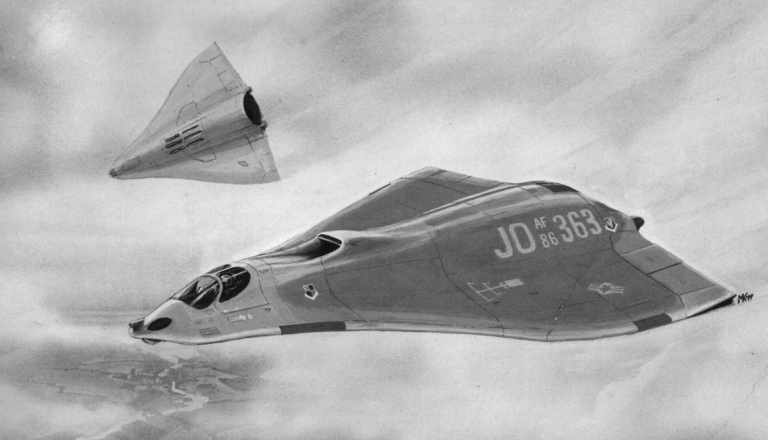 Artist's rendering of what the CSIRS stealth fighter may look like. This aircraft would penetrate Soviet (or other) air defence systems, to carry out reconnaissance or precision strike missions over heavily defended, high value targets. The aircraft would employ carbon composite structure, FLIR/TV passive sensors and an advanced passive detection system, to monitor hostile emissions. Weapons and fuel are carried internally (Illustration by Mark Kopp). Editor's Note 2005: This technical primer and analysis
predates all US DoD public disclosures on the F-117A/Have Blue and
B-2A/ATB programs. Therefore some key techniques used by the US
contractors such as planform and edge alignment were not publicly known
at that time. Many of the techniques covered in this article were and
remain used in US low observable designs.
One may, in fact, reasonably assume that the AWG-9 was copied down to the last transistor, in the same fashion as the Tupolev and Shvetsov bureaux duplicated the state-of-the-art B-29, in 1946. If we set aside the air-superiority role, where the Russians are preparing the MiG-29 Ram-L, a Mach 2.5 twin-engine, twin-fin air combat fighter with a reported thrust to weight ratio of 1.4:1, and focus on penetrating Soviet air-defences, be it battlefield or homeland, Western aircraft will have to penetrate not only swarms of lookdown-shootdown fighters, but also SAM belts, supported by massive phased array radars, and presumably also AAA point defence systems. As one may observe, a rather nasty lot to contend with, as a whole. Up to date, the Western philosophy for penetrating Russia's air defences has been rather simple - fly very fast, down in the weeds and use as much ECM as practicable, a concept evidenced by the F-111 and B-1A, both high performance aircraft with terrain following radar and comprehensive ECM suites. These aircraft were tasked with long range strike and strategic nuclear strike missions. Battlefield strike and inter diction were roles to be covered by fighter bombers, operating in conjunction with ECM and defence suppression aircraft, very much a brute force approach to the problem. Unfortunately, all things eventually come to an end, just as the lack of AEW and lookdown radar did, in this instance. Obviously, there will be some deficiencies in the new system, as the Russians have not had the benefit of incrementally gaining experience through development, this will provide Western air forces with some breathing space, however, this period will not last for long and a solution must be found. In the short term, the B-1 B bomber will fill the gap; though not such a snappy performer as the B-1A, it has a radar signature only a fraction of its predecessor's. It will penetrate at low level to deliver nuclear or conventional bombs or launch the SRAM defence suppression missiles and ALCM cruise missiles. Battlefield strike and interdiction roles will presumably remain the domain of the F-111 and Tornado, until the Russians integrate a high performance lookdown radar with a high performance air-combat fighter, to match the F-15. In the long term, though, more radical solutions are necessary. In the tactical role, the USAF is seeking the Advanced Tactical Fighter (ATF), a twin-engined aircraft with a combat radius better than 1,000 nm, STOL capability, 2-D exhaust nozzles (manoeuvre/STOL), conformal or internal weapons carriage, Mach 2 cruise at 50,000 feet and Mach 1.6 at low level. These aircraft would assume the strike role of the F-111 and air-air role of the F-15, particularly for deep penetration missions (local air superiority missions being covered by lightweight fighters, presumably derivatives of the Rockwell HiMAT or Grumman X-29A FSW fighter). Performance above all, these aircraft are liable to have large radar and infra-red (IF) signatures; considering though the nature of the missions to be flown, day/night/all weather, this is hardly a serious deficiency, as there is little point in minimising one's electromagnetic signature, when the enemy can simply see you flying in. In the strategic penetration role, bombing or reconnaisance, this approach is hardly viable, for obvious reasons. The solution is the use of Stealth technology. Stealth technology is a rather general term applied to the whole spectrum of techniques used to reduce an aircraft's electromagnetic signature. The aircraft's capability to reflect radar energy, over a given spectrum, must be reduced, which is a very involved task, something the reader will later come to appreciate. An even more Herculean task is the reduction of the aircraft's IR signature, as one could hardly imagine a glider in the given role. On the other hand, the benefits to be gained would easily offset these difficulties. The target would have no prior warning of a strike, the bombers could penetrate safely at high altitudes, efficiently cruising at supersonic speeds. Recce/strike aircraft, operating in adverse weather or at night, could penetrate battle field defence systems, aside from fulfilling a strategic role. Given that the performance of all these systems is adequate, these aircraft would be nearly impossible to detect, could not be tracked by fire control systems, and would be vulnerable only to fighters under visual or close range IR acquisition. Due to the mission profile possible, i.e. Hi-Hi-Hi, long range missions, e.g. across the Atlantic (viewing the general attitude of Western Europe toward the USSR, a very likely necessity in any future major conflict), will be commonplace. In this sense, it may lead to a redefining of the meaning of air superiority, rather from the brute force extermination of the opposition's fighters, in order to gain access to any targets available, to a rather more subtle case of being able to hit any target any time, irrespective of the opposition's fighters. This approach is also more viable in terms of losses, particularly in view of the Communist Bloc's numerical superiority. Some insight into the techniques available for the reduction of an aircraft's electromagnetic signature may be gained from the following. Infra-red Signature Infra-red radiation is emitted by all heat sources in the aircraft, whatever they may be. The IR band as a whole comprises all electromagnetic radiation with wavelengths between 800 um and 1000 um, though the region of interest here is the near infrared, i.e. shorter than 10 um. That is because the predominant wavelengths emitted by bodies at temperatures of the order of hundreds of degrees fall into this band. The principal source of IR in any powered aircraft is the propulsion. Jet engines being heat engines with less than 100 per cent efficiency, they radiate waste energy as heat, in two basic ways. The tailpipe of the jet engine is a very intense source of IR energy, the intensity and wavelengths depending very much on the type of engine. Turbojets have EGTs (exhaust gas temperature) of the order of 1000�C, though newer turbo fans have turbine EGTs around 1350�C. This leads to emissions in the 1 to 2.5 um band. The second major source of IR is the exhaust gas plume, formed as the exhaust gases flow out of the tailpipe and expand. The plume, on dry thrust, is cooler than the tailpipe, particularly with turbofans, which mix cool bypass air with the turbine exhaust gases. These emissions cover most of the near IR band. Lighting the afterburner will dramatically increase the temperature of the plume, it will then dominate the aircraft's signature. Further IR is emitted by hot parts of the engine, particularly the afterburner nozzle. Aside from these sources, the aircraft is likely to emit IR from its skin; at higher speeds frictional heating occurs, also reflected and re-emitted sunlight contributes. As one can obviously perceive, the IR signature cannot be eliminated, at the best only reduced. Flying at lower speeds, and using surface paints which have a similar IR reflectance to the background is liable to reduce emissions from the aircraft's skin. Emissions from hot parts of the engine can be screened off by parts of the airframe. The plume temperature may be reduced by mixing in further cool air, thus assisting in reducing the temperature of the tailpipe region. The key to success in suppressing an aircraft's signature lies in shifting its IR emissions into regions (wavelengths) which are more heavily attenuated by the atmosphere (as things are, the near IR is best transmitted in three 'windows', the 2.5, 4 and 10 micron bands), i.e. allowing them to fall outside of transmission windows, where they are more readily absorbed by C02 and water vapours. In this fashion, the heat emitted is far more difficult to detect, at long distances (a factor of growing importance, as the Soviets appear to be showing great interest in passive IR target acquisition systems). Given that all the above factors are considered and dealt with, the aircraft's signature may be substantially reduced. (Further reading, TE March 1982.) Electromagnetic Emissions Modern combat aircraft emit electromagnetic waves over a very wide spectrum. The greatest source is the radar, whether operating in air-air or air-ground modes, emitting pulses of power up to the order of hundreds of kilowatts. Given that an opponent has a warning receiver equally as sensitive as the radar's own receiver, he will detect the radar at least a4 twice the distance necessary for the radar to pick up a return. This means that a radar equipped aircraft does an excellent job advertising both its position and identity, as a spectral analyser of one or another sort, coupled with a computer memory file, will identify the radar quite readily. The obvious solution to this problem is flying with one's radar set shut down, which, of course, creates another set of problems, related to the detection of the enemy. Another source of emissions is the use of radar/radio altimeters and Doppler navigation systems, all of which rely on the transmission of beams from the aircraft to the Earth's surface, in order to make measurements. The solution would appear to be the use of inertial navigation and perhaps lasers or millimetric wave systems for height measurement, as these allow much narrower beams. Radio transmissions, whether voice or digital datalink, will also alert an opponent; depending on the type of transmission, they may also allow the identification of the aircraft. Electronic countermeasures, particularly jammers, will likewise indicate an aircraft's location. Though they may succeed in confusing the radar system to be jammed, other systems, passively listening, may exploit them to locate the incoming aircraft. The issue of whether to use or not to use ECM is very complex. Given that the ECM serves to conceal the aircraft and will not reveal its position to listening posts, then its use is appropriate. As it turns out, the vast majority of current ECM serve rather to confuse or deceive hostile radar, assuming detection is inevitable. Aside from all of these, functional, sources of energy, an aircraft is also likely to radiate lesser quantities of interference, caused by switching transients of various sorts in the aircraft's electrical system. This is less of a problem in all-metal aircraft, as the structure will provide some screening, but may become a problem with composite structures, which behave much like lossy dielectrics, rather than conductors. As one can observe, success in suppressing the whole spectrum of emissions hinges on the use of passive sensors, line-of-sight (laser) communications, inertial or satellite navigation and the ability to identify and eliminate any forms of interference generated by onboard systems. Radar Signature The radar signature of an aircraft is a measure of its detectability by a particular radar system. Electromagnetic waves, as emitted by radar, for instance, propagate through space only until confronted with a different medium. Depending on the particular medium, part of the energy will be reflected back to the source, part will penetrate into the surface. Given that the medium is conductive (e.g. a metal aircraft skin) and the waves are at microwave (typically radar) frequencies, most of the energy will be reflected. However, if the medium has electrical properties close to that of free space, as far as the wave is concerned, there will be little if any reflection and the impinging wave will penetrate, propagating through the material. This may imply the simple solution of building an aircraft of such material, however, internal systems, e.g. engine, would then reflect. Fortunately, these materials can be made lossy (absorbing the energy and re-emitting it as heat) and then a physical phenomenon known as the skin-effect occurs; this confines the electrical and magnetic fields (voltages and currents), generated by the impinging wave, to a thin surface layer, given by the so called skin depth, characteristic of a material at a given frequency. Given that the skin depth is much smaller than the thickness of the material, all of the wave which did penetrate will be absorbed. Radar absorbent materials operate on this principle, incoming waves cannot distinguish them from free space, but are absorbed and dissipated as heat once inside the material (one could consider trying to use a paint with similar properties, however, as it appears, one ends up with unreasonable thick nesses - electrical lossy paints can however assist, as will be seen later). Another effect which can be exploited to reduce the radar signature is specifically shaping the aircraft. Assuming the aircraft is metal, and therefore reflects most of the energy landing on its surface, by shaping it a particular way, one can reduce the amount reflected in the direction the radiation came from. A measure of how much is reflected is the radar cross section, a hypothetical area which radiates the same amount of energy as the aircraft, whatever shape it may be, reflects in that particular direction. All shapes have particular cross-sections, which vary with wavelength and direction, however the size of these cross sections can be radically different. Rounded smooth shapes have low cross-sections, whereas concave or sharp shapes usually focus energy and reflect a lot. Corners, or joins between say tail and fuselage, reflect very well. Engine inlets and tailpipes are exceptionally bad; as it often turns out, the waves will propagate along them, as in a waveguide (see TE, June 1982) until they hit either the compressor or turbine blades, which reflect them out with added modulation, JEM (Jet Engine Modulation), easily identifying the aircraft. Flight decks and radars are also bad, as the canopy perspex is transparent to radar, just as the radome is, as both areas are anything but smooth inside, they have large cross-sections. Weapon bays or hardpoints carried ordnance are a story on their own; suffice to say both cause difficulties. After considering these major factors, one can look at the array of ECM or communication aerials, some of which will in fact be tuned to the incoming radar to increase sensitivity (radar warning receivers - RWR). All of these are likely to re-emit some of the incoming energy. One technique to reduce this part of the signature involves increasing the reflectance of the canopy/radome/cover to incoming radar; like this it will appear to be another part of the aircraft's skin, smoothly shaped, hence possessing a lower signature. This is achieved by coating canopies with thin (transparent) metallic layers, radomes are built as multilayered dielectric interference filters (TE, March 1982), transparent to onboard radar, but tuned to be opaque to hostile radar (typically the B-1B). These techniques work adequately for some systems; however, wide band ECM aerials need to operate at the same wavelength as the hostile radars encountered, therefore, they cannot be concealed this way. Likewise, inlets and exhausts need to be open, for obvious reasons. These cases are dealt by the use of radar absorbent materials and geometry. Typically an inlet will contain an S-bend or (appropriate) baffles, concealing the face of the compressor from direct radiation. As the walls and baffles are absorbent, the travelling wave will disappear long before it could reach the compressor. In summary, one must deal with the cumulative effects of a large number of smaller component cross-sections and the radar cross-section of the airframe. The biggest problem would be the design of a system to counter radars operating at long wavelengths (metres) down to very short wavelengths (centimetre, millimetre band), as the cross-section varies to a great degree, with extremes of frequency. A smooth, flattish shape with a low head-on/side-on physical cross-section should perform well for most wavelengths, head on or side-on, but may reflect a lot, if directly above a shorter wavelength radar. Therefore it would be desirable to employ lossy paints and absorbent materials all over the surface, to reduce further any reflection which occurs. Here is where the snag appears, as lossy paints and absorbers are usually lossy and absorbent, to the right degree, only at some wavelengths, and tend to deviate with wavelength. In that sense, one could build an excellent Stealth aircraft for one particular family of radars, but it wouldn't be quite so excellent for another, in fact it may perform miserably. Another difficulty stems from the skin depths required, as long wave length radar has a much greater skin depth than shorter wavelength systems - i.e. an aircraft invisible to a centimetre band radar may be easily picked up by a WW 11 300 MHz radar. The problem, as a whole, tends to become quite complicated. Composite materials, e.g. carbonfibre reinforced epoxy, may be a way out, as they could be doped with specific dielectric and resistive additives to bring their electrical properties closer to what is desired; if the aircraft's skin and airframe are built from such materials, the overall effective thickness may be increased, allowing for greater skin depth. What one could envision as a design approach would be the choice of shape to provide a minimum cross-section (presumably, all metal models could then be built and tested to verify this), once this would be established, structural and skin materials would be chosen for maximum absorption, over as wide a spectrum as possible. The final stage would be the choice of geometry and materials for inlets, exhausts, canopies and sensor/weapon bays or stations. The United States' current Stealth programme involves the development of a strategic nuclear bomber, the Northrop ATB, a reconnaissance/strike fighter, the Lockheed CSIRS, and an advanced stealthy cruise missile. Northrop Advanced Technology Bomber. The ATB, or Stealth Bomber, is to become the airborne element of the US nuclear strike triad, it will replace the B-1B in the penetration role and carry out long range nuclear strike missions. Northrop is leading the project, presumably for their great experience with both ECM and large flying wing aircraft, Boeing and Vought are co-operating. Total contracts for development are worth $7300 million. The ATB is a heavily classified project, in fact so classified, that nobody really knows anything specific, at this stage. It is assumed the aircraft will be a delta platform flying wing, as this configuration offers both a low radar cross-section and a good lift to drag ratio, allowing for efficient high speed cruise. Initial estimates of the powerplants to be used suggested four high bypass ratio turbofans, chosen for fuel economy and low IR signature. Current estimates favour two variable cycle engines (a variable cycle engine allows for continuous changes of bypass ratio to meet either thrust or fuel consumption require ments, behaving much like a high bypass turbofan at one extreme or a turbojet at the other), the suggested size has also decreased. No specific estimates of crew size seem to be available, though one could assume two to four men. Engine inlets and exhausts would presumably lie on the upper surface of the aircraft, employing inlet S-bends, exhaust baffles and most likely, fairly long inlet and exhaust ducts. Airframe and skin structures would be carbonfibre composite. Weapons would be carried in an internal weapons bay, most likely free fall nuclear bombs, as the small size would preclude the carriage of stand-off missiles or cruise missiles. One could assume a mission profile of the following sort - takeoff with full internal fuel from the continental US or other safe airbases, followed by a very steep climb, on full thrust, to a cruising altitude, likely above 40,000 feet. Once at cruise altitude, the engines would switch to a high bypass mode and the aircraft would begin a high subsonic, or low supersonic cruise to the target area. Longer missions may require in-flight refuelling. Navigation would employ inertial and satellite systems, though some form of TERCOM update could be used, over safe zones. Hostile airspace would be penetrated at medium to high altitudes, exploiting cloud cover wherever possible to confuse IR surveillance systems. An ATB would carry a comprehensive passive ECM system, which could classify and locate all hostile sources of radiation. This data would be passed on to a graphic image generating computer, which would synthesise a picture of the landscape, with lethal zones (volumes of space around SAM/radar/AEW systems) clearly displayed. The pilot would then steer the aircraft between these zones, avoiding detection and/or tracking, simply by following his TV screen or HUD. Targets would be attacked with free fall weapons, though these may be equipped with inertial or TV (smart image recognising systems) terminal guidance, which would also allow stand-off ranges of several miles, useful for nuclear strike. Active, most likely deceptive ECM would be employed for penetrating heavily defended zones, this would be employed if hostile radar were to lock on, at close range, during the terminal strike manoeuvre. The ATB is to enter service in 1992, which leaves us a whole decade for speculation and the US DoD a whole decade to revise their designs. It is very likely the aircraft and mission profile will substantially alter, as the USSR refines its air defence structure, only time will tell. Lockheed Covert Survivable In-weather Reconnaissance/Strike The Lockheed CSIRS is another advanced project employing stealthy technology. Scheduled for service entry in the late eighties, this aircraft is likely to perform a primary role of short to medium range tactical reconnaissance, reflecting the hopeless case conventional fighters, fitted for recce, must contend with in penetrating hostile air-defence zones at low level. A secondary strike role would tend to back up this approach, to minimise losses over heavily defended high value targets. Lockheed are responsible for the project, probably a natural choice for their specific experience with high performance penetration aircraft, as the SR-71 Blackbird. No official releases on details of the project are available, though some journals have reported details, Lockheed are tight lipped(". . . we can neither confirm nor deny these reports. . . "). Reports indicate the aircraft is the F-25, powered by a 29,000 pound F-101 DFE afterburning turbofan. At this point, we can allow ourselves more speculation, as other reports indicate a platform much like the shuttle or some of Lockheed's stealthy drones. With this amount of information we could picture the following - a rather compact, single seat aircraft the size of the F-16E (see illustration), with composite skins and some structural elements, the remainder titanium or aluminium. The aircraft would have to be very agile, with high acceleration, to minimise exposure time over a target. The signature constraints would force fixed inlet geometry, limiting top speed to Mach 1.8. The engine would be buried inside the fuselage, afterburner nozzle inclusive, bleed or bypass air would create a boundary layer between the exhaust plume and duct wall. These would be possibly clad with doped carbon-carbon tiles (space shuttle), to absorb incoming energy, leaving only a narrow cone, aft of the aircraft, where one could directly illuminate the turbine. Due to its shape (it would have a small, if any, tail) the aircraft would be statically unstable in yaw and most likely in pitch also. Pitch/roll control would be provided by trailing edge elevons, yaw control by split wingtip speedbrakes (Kevlar/carbon composite). The aircraft would employ a full authority, redundant digital fly-by-wire system, possibly derived from an off-the-shelf system as the AN/ASW-44. Weapons would be carried in an internal bay, as conformal carriage would be inadequate. A possible configuration could be very much like the rotating bomb bay of the Buccaneer, but employing interchangeable weapon/sensor/fuel pallets on the stores half of the bay. A conformal bomb/ missile pallet has lower drag and signature than an open bay, when exposed. Rotated into a concealed position, it would not differ from a closed bay. The choice of weapons or sensors would depend on missions, one could assume a payload in excess of 1000 lb, for a 500 nm combat radius. Hi-Lo-Hi, all fuel being internal. It is unlikely a gun would be carried, but the AMRAAM could possibly be targeted by passive systems, or used in a captive search mode, carried in a pallet or bay. The aircraft would have to carry a comprehensive array of passive sensors. FLIR would be essential, Low Light TV very useful and a low light sensitive derivative of TISEO would be excellent. Rearward facing sensors could also be employed. A passive detection system, for any radars or emitters, would be essential, with a 360 degree capability. Conformal planar phased array antennae could be employed, these should be available by 1990. Data from all these sensors would be processed by a high speed image processing and generating computer, feeding real images together with synthesised symbology and synthesised terrain profiles (computer memory file in conjunction with inertial nav) onto a wide angle HUD, or helmet projection visor - the Lantirn HUD could represent a suitable off-the-shelf system. Head down colour CRTs or other displays would handle non-critical or status information. One could assume that after being coated with radar absorbents, the aircraft would receive a low IR, low contrast grey camouflage. Stealth technology is in its beginnings, at this stage it isn't even apparent whether the concept will prove itself in operation or become a multimillion dollar flop, though it is fair to assume that whatever the outcome, a lot will be learnt about the reduction of signatures and a lot of that will be incorporated in other projects. It is, in its essence, a massive exercise at seeing without being seen and it does involve a lot of new technology, which must be integrated very thoroughly. Only time will tell how successful the concept actually is. |
|||
|
|||||||||||||
|
|
|
|
|
|
|
|
|
|
|
|||
|
|
|
|
|
|
|
|
|
|
|
|||
 |
|
|
|||||||||||
| Artwork, graphic design, layout and text © 2004 - 2014 Carlo Kopp; Text © 2004 - 2014 Peter Goon; All rights reserved. Recommended browsers. Contact webmaster. Site navigation hints. Current hot topics. | |||||||||||||
|
Site Update
Status:
$Revision: 1.753 $
Site History: Notices
and
Updates / NLA Pandora Archive
|
|||||||||||||
|
|
Tweet | Follow @APA_Updates | |||||||||||
|
|
|||||||||||||
|
|
|||||||||||||