|
||||||||||||||||||||||
 |
||||||||||||||||||||||
![F-22A Raptor, FB-22, F-22E, F-22N and Variants Index Page [Click for more ...]](APA/f-fb-22.png "F-22A Raptor, FB-22, F-22E, F-22N and Variants Index Page [Click for more ...]") |
 |
![People's Liberation Army Air Power Index Page [Click for more ...]](APA/pla-air-pwr.png "People's Liberation Army Air Power Index Page [Click for more ...]") |
 |
 |
 |
 |
 |
 |
![Military Ethics, Culture, Education and Training Index Page [Click for more ...]](APA/ethx-culture.png "Military Ethics, Culture, Education and Training Index Page [Click for more ...]") |
 |
||||||||||||
 |
![Russian / Soviet Weapon Systems Index Page [Click for more ...]](APA/rus-weps.png "Russian / Soviet Weapon Systems Index Page [Click for more ...]") |
 |
 |
 |

|
 |
 |
 |
 |
 |
||||||||||||
 |
 |
|||||||||||||||||||||
| Last Updated: Mon Jan 27 11:18:09 UTC 2014 | ||||||||||||||||||||||
|
||||||||||||||||||||||
|
||||||||||||||||||||||
|
||||||||||||||||||||||
|
|
|
|
|
|
|
|
|
|
|
||||||||||||
|
|
|
|
|
|
|
|
|
|
|
||||||||||||
|
|
|||||||||||||||||||||
| Last Updated: Mon Jan 27 11:18:09 UTC 2014 | ||||||||||||||||||||||
|
||||||||||||||||||||||
| THE
ANATOMY OF THE TACJAMMER |
|||
|
|||
|
EA-6B ICAP II Prowler
at Avalon, carrying a pair of ALQ-99 mid-band pods (© 1995-2010 Dr
Carlo Kopp; M645/1000S / Sekor 80mm f/2.8 using Fujichrome Velvia 50). The practice of using tactical aircraft to carry high power radar jamming equipment originated during WW II, when RAF Defiants fitted with Mandrel jammers first disrupted the operation of the Luftwaffe's Freya A-band acquisition radars. Defiants equipped with Mandrel jammers or Moonshine deception repeaters and rocket firing Typhoons thus laid the foundations of modern tactical support jamming and defence suppression. The use of these types also underscores a trend followed well into the seventies; that of fitting offensive electronic warfare equipment and defence suppression weapons to types which had outlived their usefulness in their originally envisaged roles. It wasn't until the late 1960s that the pivotal role of Electronic Warfare (EW) in tactical defence penetration and suppression was fully accepted and as a result, specialised derivatives of frontline tactical aircraft developed to fill these roles. The first of these to fill the former role were the US Navy's EA-6A and EA-6B derivatives of the A-6 Intruder family, two types which supplemented and supplanted the ungainly and obsolete EF-10s and EKA-3s. These new aircraft were true Support Jamming (SJ) aircraft, capable of flying Escort Jamming (EJ) and Stand-Off Jamming (SCJ) missions. Standoff jammers will orbit outside of the lethal radius of hostile defenses and jam radar and communications from a distance, escort jammers accompany strike aircraft into hostile airspace and jam acquisition radars and communications from close range. The proliferation of radar guided Surface to Air Missiles
(SAM) and radar directed guns (AAA) in the 1960s coupled with the
increasing payload/radius performance of tactical aircraft created a
situation where tactical fighter-bombers were up against air defenses
built to stop strategic bombers fitted with extensive radar and
communications jamming equipment. In this situation tactical aircraft
are at a disadvantage - while the use of their onboard radar warning
receivers (RWR or RHAW) and defensive jammers (ECM) can defeat
individual hostile weapons, the defending side has the advantage of
seeing the big picture and thus concentrating its SAM, AAA and fighter
resources to maximum effect. Firing multiple SAMs at a single aircraft can and often will saturate the crew and jammers' workload thus increasing the likelihood of a kill. This advantage is most easily destroyed by high power jamming of the defending side's acquisition and Ground Control Intercept (GCI) radars and associated communications network. This capability is available in large strategic bombers which can carry a dedicated Electronic Warfare Officer/Defensive Systems Operator and thousands of pounds of powerful jamming equipment in addition to the aircraft's (self) defensive RWR/RHAW and ECM. Fitting high power jammers and associated management systems to every tactical aircraft is however physically impossible given equipment size/ weight alone and thus the only realistic solution is to dedicate some tactical aircraft to the carriage of ordnance and some to the carriage of jamming equipment. A Tactical Jammer (Tacjammer) is thus a high performance tactical aircraft equipped as a Support Jammer and typically tasked with penetrating a tactical air defence system to disrupt it at close range with high power jamming of its surveillance, acquisition and GCI radars and communications network.
Understandably any Support Jammer is a lucrative target fitted with expensive equipment and carrying expensive to train operators, therefore a Tacjammer must have an ability to evade SAMs and fighters at least as good as but preferably better than the regular version of the same aircraft. Furthermore, a Tacjammer is penalised in radius performance as unlike strike aircraft it cannot shed 4,000 to 12,000 Ib of weight (ordnance) over the target if the going gets tough. In practice Tacjammers are implemented as derivatives of tactical strike aircraft with airframe modifications as required to accommodate internal and external elements of a Tactical Jamming System (TJS) and fitted with enhanced derivatives of the defensive ECM carried by the core aircraft. This philosophy is evident in established types such as the EA-6B Prowler and EF-111A Raven and in newer types such as the NATO Tornado ECR (Electronic Combat/Recce) and presumably the Russian Fencer E(ECM) subtype.
The Grumman EA-6B Prowler
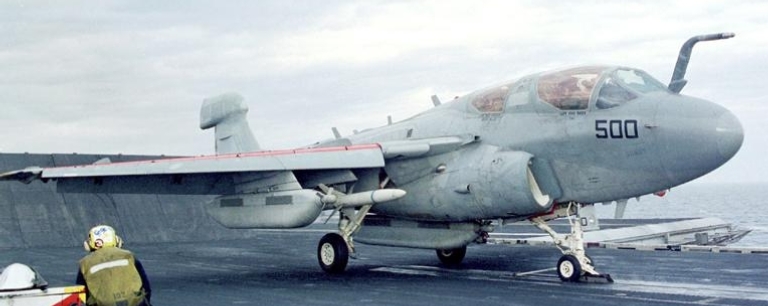
Colloquially known as the Queer, the EA-6 is the USN's principal Electronic Warfare aircraft. The Prowler is essentially a stretched A-6 airframe with additional stations for two more crew members and various detail airframe changes to accommodate the extensive jamming system. First flown in May, 1968, the EA-6B first deployed in 1971 and subsequently played a major role in the Linebacker II campaign disrupting the North Vietnamese air defence system in support of Navy strikes and SAC B-52 raids. The Prowler has retained much of the A-6 airframe with the wing, centre-section, tail and mid fuselage very close to the original. The wing was however strengthened to increase the g-limit at high gross weight and the rear fuselage was stretched to compensate for the most substantial structural change, the 4.5 ft stretch and reshaping of the forward fuselage. The new forward fuselage provided space both for two ECMOs and a substantial volume of mission specific electronic equipment. The other highly visible change to the airframe is the bulbous receiver antenna fairing at the top of the vertical stabiliser. These airframe changes increased gross weight up to nearly 60,000 Ib which forced the strengthening of the undercarriage and the fitting of 11,200lb P&W J52-P-408 powerplants in all but the earliest airframes; the Prowler will reach 520kt at sea level. The EA-6B apparently handles much like an overweight A-6 although the aircraft has had a high accident rate due to reduced stall margins. A programme is under way to improve low speed handling which is particularly critical on final approach prior to trapping on a carrier flight deck (USN flying technique emphasises AoA/power management on final. (The A-6/EA-6 thus lands with airbrakes deployed to maintain the engines in a responsive RPM range). Specific changes will include a vertical stabiliser extension above the tail fairing. recontoured flaps and slats and linking the wingtip air brakes into the flight controls to function as additional ailerons at low airspeeds. As an operational asset the eleven squadrons of USN/USMC
Prowlers have no equivalent; the EA-6Bs provide SOJ and escort jamming
support for strike aircraft while also providing electronic recce and
support jamming for the fleet if threatened by hostile strike aircraft.
EA-6B ICAP II (US Navy image).
EA-6B ICAP II Prowler at Avalon (©
1995-2010 Dr Carlo Kopp; M645/1000S / Sekor 80mm f/2.8 using Fujichrome
Velvia 50).
EA-6B ICAP II Prowler ALQ-99 SIR fairing
on the top of the tail (© 1995-2010 Dr Carlo Kopp; M645/1000S / Sekor
80mm f/2.8 using Fujichrome Velvia 50).
ALQ-99 mid-band pod (© 1995-2010 Dr Carlo
Kopp; M645/1000S / Sekor 80mm f/2.8 using Fujichrome Velvia 50).
The source of the Prowler's potency is the Eaton/AIL AN/ALQ-99 Tactical Jamming System. The Basic/Excap ALQ-99 is comprised of a Frequency Set-on Receiver set. up to five external jamming pods and a central processor tied into an IBM AYQ-6A central computer. The ALQ-99 is integrated with a General Instrument ALR-42 System Integration Receiver set. Functionally the ALR-42 SIR is at the top of the chain - it is a sophisticated radar warning receiver which detects and prioritises threat radars (threats) for power managed jamming by the ALQ-99 or the aircraft's defensive ALQ-41 trackbreaker ECM (also supported by the APR-27 SAM launch warning receiver). Power management is a term which refers to the allocation of available jamming power in such a way that the greatest threats receive the most power and are thus most strongly degraded. Threat parameters are passed by the ALR-42 SIR to the ALQ-99 which locks its set-on receivers on to the designated threats. Unlike conventional RWRs, the set-on receivers can actually remember and analyse the threat signal waveform (employing a Frequency Memory Device and Signal Processor) and provide parameters used by the ALQ-99 central processor to programme the allocated jammer. The ALQ-99's jammers are carried in external 950lb pods each of which carries typically two 2 kW transmitters, a control computer tied to the computer in the parent aircraft and a substantial volume of dedicated electronics (power supplies, exciters, drivers) to support the transmitters. Transmitter power is provided by a ram air generator at the front of the pod with transmitter antennas under the forward ventral pod radome. The ALQ-99 offers several noise/spot-noise jamming modes (refer TE Sept 88) and may have other capabilities such as false target generation - no doubt a well kept secret. In terms of management, the ALQ-99 can be operated in three primary modes. Automatic, where the SIR detects threats, the computer sorts them and the jammers jam them. Semiautomatic, where the operator selects and controls the jammers; and Manual, where the operators also identify and prioritise threats. The ALR-42/ALQ-99 provides the ability to jam high power surveillance, acquisition and tracking radars; this capability is supplemented by a Sanders ALQ-92 Communications Jamming System which disrupts GCI communications links, this device was also earlier carried by EKA-3B standoff jammers. This suite was used in early Basic revision J52-P-8 powered EA-6Bs which provided three band coverage (C,D,E ?), these were after 1973 rapidly supplemented by Excap aircraft with six band (C to H ?) coverage and J52-P-408 powerplants. From 1976 EA-6Bs were delivered to Icap standard fitted with faster computers, new cockpit display sets, upgraded comm/nav/IFF, Automatic Carrier Landing System and the standard USN ALQ-126A trackbreaker defensive ECM. The EA-6B Icap was supplanted by the current Icap 2 version the prototype of which first flew in 1980. The Icap 2 upgrade saw substantial electronic improvements to the jammer hardware with the ALQ-99 providing full eight band (C to J) coverage. The Icap 2 Prowler carries a USN standard CDC AYK-14 Tactical Computer tied into a MIL-STD-1553B databus. and revised operator display sets. Functionally the AYK-14 performs a similar management function to that of the AYK-14s in the F-18, driving the pilot's digital flight instrument displays. In the Prowler however it also ties into the ALQ-99 TJS, an onboard Recorder/ Reproducer and a dedicated ASN-123 Display Computer (front end processor for the technical) which drives the digital displays and keyboards used by ECMO's 2 and 3 in the aft cockpit. The use of the 1553 bus provides tremendous system level flexibility with the AYK-14 also driving a digital display in the front cockpit and in late Icap 2 aircraft tying into a CV3976/AWG HARM control/armament panel. The AGM-88 High-speed Anti Radiation Missile (HARM) was a late addition to the EA-6B having been implemented in a crash 18 month programme with first production deliveries this year. The absence of HARM was long criticised by Prowler crews who are generally considered to be the source of most electronic warfare and defence suppression expertise in carrier airwings, usually planning the HARM strikes flown by the A-7E and F-18A/C squadrons. Integrating the HARM with the ALQ-99 software and the large shipboard TSQ-142 TEAMS (Tactical EA-6B Mission Support) mission planning computer mission parameters into the ALQ-99 before launch via a magnetic tape cassette. In practice this means that Prowler missions can be preprogrammed in detail using the TEAMS to concentrate available intelligence thus significantly speeding up preflight preparations. The addition of HARM provides the Prowler with the teeth it needs to bite particularly problematic threat radars while also demonstrating an emergent trend to merge the tactical jamming and defence suppression roles, of the Tornado ECR. The EA-6B Advcap upgrade is currently in the pipeline and will include new high performance Litton receiver-processors which should enhance the ALQ-99's capability as a deception jammer. Included is a new Eaton/AIL exciter-modulator for the high band transmitters providing more diverse and sophisticated jamming modes. Two additional wing pylons and 12,000 Ib J52-P-409 engines will allow a full complement of jammer pods plus two HARM rounds. A new pod mounted ITT ALQ-149 Communications Jammer will also be carried.
The Grumman/General Dynamics EF-111A Raven
The EF-111A is the USAF's first true tacjammer. The need for such an aircraft became most apparent in South East Asia where the USAF EB-66B/E was constrained to the SOJ role lacking the performance to survive in a MiG and SAM saturated environment. While the USAF recognised the effectiveness of the Navy EA-6B, the EA-6B lacked the performance and endurance required by the USAF to support its fast F-111 and F-4 tactical fighters. The high density European theatre would require an upgraded ALQ-99 and a high performance airframe to carry it. The analogue F-111A was the natural choice with some airframes surplus to the A-model wing. Both prototypes of the EF-111A flew in early 1977 and were rebuilt from existing low time airframes, with 42 production rebuilds being delivered from 1981 onward. The airframe of the EF-111A differs little from the basic F-111 A the only major structural changes being the fitting of a large fairing to the top of the vertical stabiliser and the installation of a jammer pallet in the internal fuselage weapon bay. Internal changes were substantial with a resculptured cockpit, numerous antenna and wiring installations and presumably a major increase in electrical power generation capability to support the thirsty jammer electronics. The aircraft retained the geriatric AJQ-20A nav-attack and APQ-110 Terrain Following Radar (TFR) but acquired a newer APQ-160 attack radar. The EF-111A carries the ALQ-99F which had 70% commonality with the Navy ALQ-99. The ALQ-99E offered much faster threat acquisition and identification while being substantially automated with only one Electronic Warfare Officer required to operate it. Each jammer in the 99E could cover a larger number of threats than the Navy version (spot noise jamming where the jammer dwells on the frequency of each threat radar for a programmed fraction of a second after which it retunes to the next and so on ...) and used multi-mode antennas which allowed omnidirectional and directional transmission. Ten jammers each with a steerable antenna are carried in the weapon bay, the antennas protruding below the fuselage concealed under a distinctive canoe radome. The USAF are understandably secretive about the 99E therefore little has been published on the system level tie-in with the remaining aircraft systems. The aircraft also carries the upgraded ALR-62(V)4 Terminal Threat Warning System (TTWS) which is designed to look through the powerful jamming transmissions of the ALQ-99E. Defensive jamming is provided by the capable ALQ-137 trackbreaker ECM which is common to SAC's FB-111As (refer TE Sept 88) and provides fore and aft coverage. Antenna placement on the EF-111A differs from the F-111 with receiving elements of the ALR-62, ALQ-137 and ALQ-99E situated in the tail fairing with some ALQ-137 transmit antennas and ALR-62 forward antennas on the wing gloves and nose. Given the architecture of the EA-6B/ALQ-99 and the known major modifications to the ALR-62(V)4, it is very likely that the ALR-62 TTWS performs a similar function to the ALR-42 SIR in the EA-6B, detecting, classifying and prioritising threats for the automatic set-on receivers of the ALQ-99E and defensive ALQ-137. Under the control of the ALQ-99E's internal processor jammers would then be directed against selected threats. Cockpit interior layouts released by the USAF indicate a large rectangular CRT display on the right hand side of the EWO's panel beneath which is a control keyboard and above which is a combined TTW/DECM indicator panel. A bar telltale status indicator is provided for the ten jammers which have individual mode controls and automatic and manual steering controls on a right hand side console panel. Available information suggests coverage in six bands in early aircraft, it is likely that subsequent upgrades provide full C to J band coverage as in the Navy Icap Prowler. 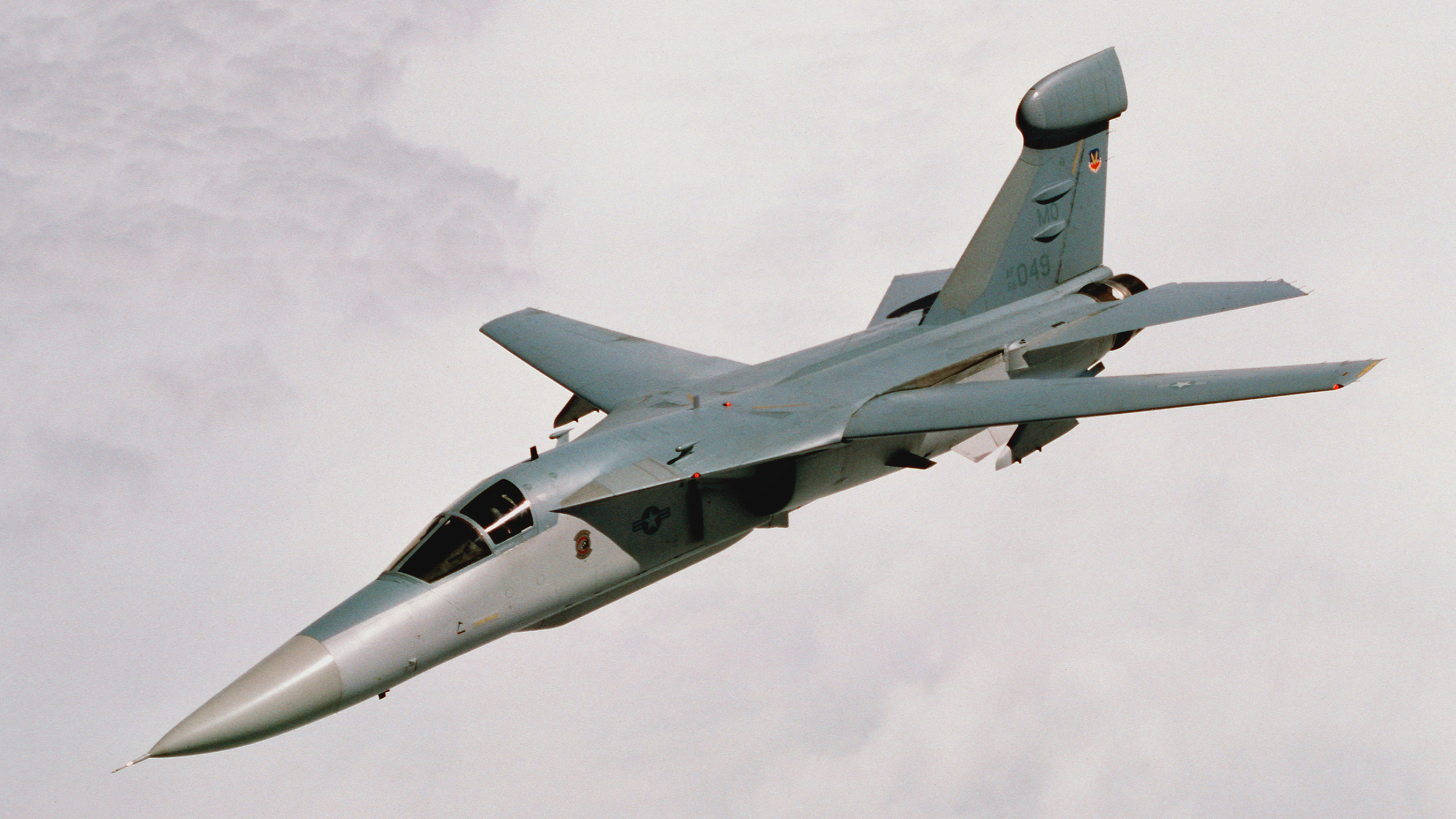 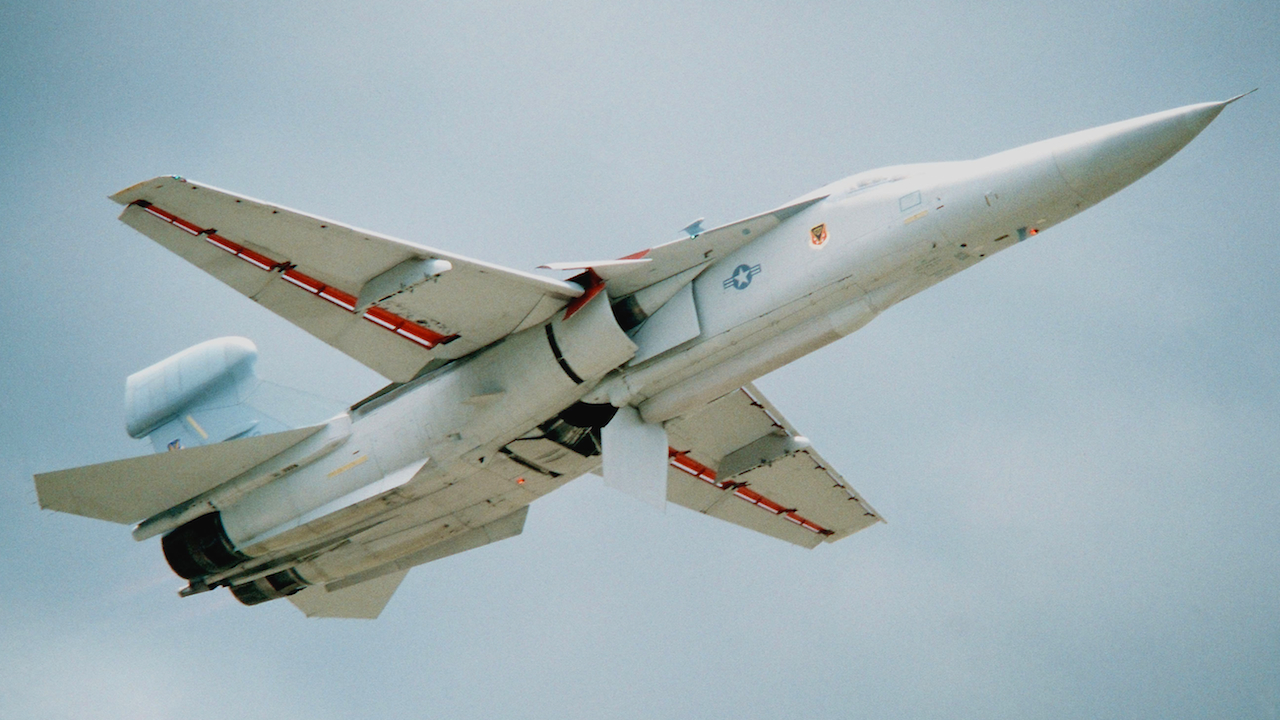 EF-111A ALQ-99 transmitter installation (above, below). Transmitter modules, largely identical to the naval variant, were installed on a pallete mounted in the weapon bay. The canoe radome covered the steerable antennas. Arbitrary module mixes could be fitted on the flightline, for a total of up to ten (US Air Force).   EF-111A ALQ-99 transmitter installation (above, below). These images show the open weapon bay door / radome assembly, permitting access to the array of transmitter modules for reconfiguration or maintenance. The aircraft, 66-0041 of the 429th ECS at Cannon AFB, NM, was photographed at Malmstrom AFB, Montana (© 2012, Phil Peterson). 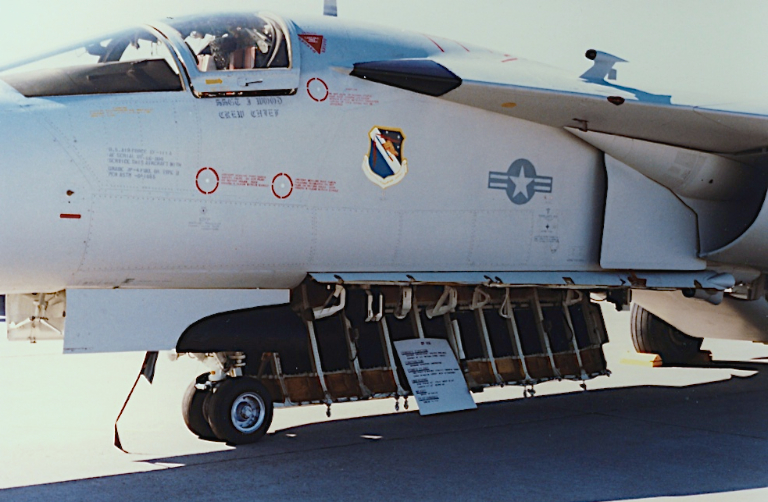 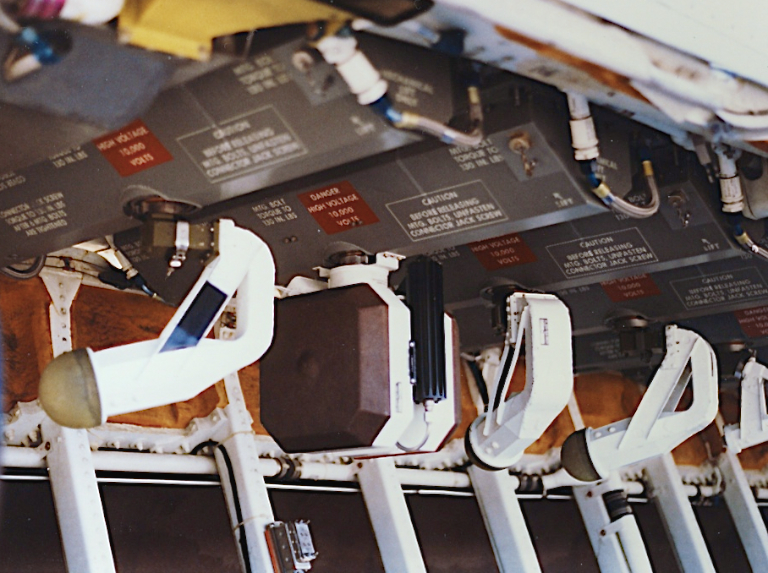 EF-111A ALQ-99 transmitter installation (above, below). These images show a typical mix of transmitter modules, with unique steerable antenna installations for four different bands. The emitter boresight depression angle is a compromise intended to accommodate both standoff and escort jamming. The aircraft, 66-0041 of the 429th ECS at Cannon AFB, NM, was photographed at Malmstrom AFB, Montana (© 2012, Phil Peterson).  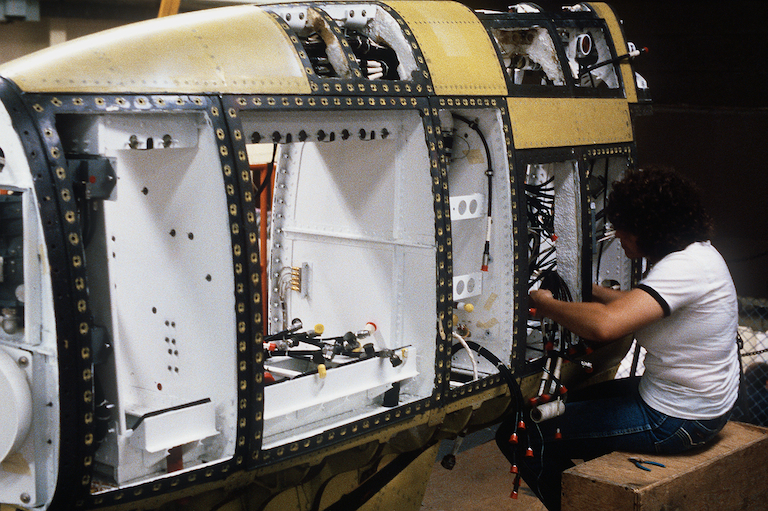 EF-111A ALQ-99 SIR
fairing avionics installation at the Grumman Riverhead Plant in 1981.
Below, antenna configuration
(US Air Force).

At the time of writing the US$81.5m Eaton/AIL/General Dynamics upgrade programme, running since 1984, was cancelled by USAF Systems Command who regarded cost overruns and schedule slippages in the contract as unacceptable. This upgrade involved new high band exciters for the ALQ-99E jammers many of which were originally designed by AIL; of the 49 Line Replaceable Units in the ALQ-99E, a third were designed and built by AIL. The USAF was to decide whether completion of the programme is to be awarded to Grumman who lost out in the 1984 bidding. It is however certain that the cost overruns and delays will postpone the USAF's plan to fit the upgraded Litton receiver set developed for the EA-6B Advcap thus leaving the EF-111A's capabilities well behind those of its Navy counterpart. It is unclear what impact this will have on longer term plans which apparently include phased array antennas (much like the B-1 B/ALQ-161) for the jammer transmitters; these will allow time sharing an antenna between several threats without a penalty in power delivered to the threat. Phased arrays allow nearly instantaneous pointing of very tight beams which concentrate more jamming power on the threat. It is almost certain that the EF-111A will undergo the full USAF F-111 A/E offensive avionics/ flight controls upgrade currently under way and proposed for RAAF F-111 s. The longer term outlook is most likely that of the EA-6B and EF-111A being replaced by a derivative of the A-12 Advanced Tactical Aircraft (ATA) early in the next century. The ATA is currently being designed as a stealthy multi-role replacement for the A-6E and later F/FB-111 aircraft.
Mission Profile
The EA-6B and EF-111A have been optimised for the naval strike and high density air/land battles respectively, therefore a broad spectrum of missions is flown. The EA-6B will spend most of its time in two roles - electronic support of the fleet and support jamming during air strikes. The former role involves a considerable amount of electronic recce (ELINT) in conjunction with dedicated EA-3B, EKA-3B, ES-3A and ASW/ASuW S-3A/B aircraft, sniffing for and investigating the electromagnetic emissions of hostile naval forces and shore based installations. The other aspect of this role is the jamming of radars on hostile surface vessels, recce and strike aircraft in support of antishipping strikes by friendly aircraft or maritime air superiority/ defence missions directed at hostile maritime strike aircraft. In this uniquely naval mission the EA-6B is a potent offensive and defensive tool. The other major aspect of the Prowler's mission is support jamming and defence suppression during strikes on coastal targets. These missions may involve penetration with escort jamming or simply stand-off jamming.  USN/Douglas EKA-3B Skywarrior. The elderly EKA-3Bs and EA-3Bs provided support jamming and electronic recce during the Vietnam conflict. In the latter role the aircraft is still used although it is to be replaced by ES-3A Vikings rebuilt from ASW airframes (US Navy image).
The EF-111A has been by design targeted at the high density central European air/land battle and three classes of mission are envisaged. In Stand-Off Jamming missions, the EF-111As would operate at altitude 200 to 400 nm from the battle front from where they would snow Warpac long-range surveillance radars probing for Allied AWACS, JSTARS, TR-1 surveillance/recce aircraft, EC-130H Compass Call communications jammers and tankers. These valuable but slow moving aircraft are vulnerable to long range SAMs such as the SA-5 (range cca 160 nm) recently deployed in central Europe, while it also appears that the Flanker and new AS-11 ARM firing defence suppression Foxbat F would be employed to dash through the NATO fighter/SAM screen on dedicated AWACS killing sorties. Operating in pairs the EF-111As would blind surveillance radars and attempt to confuse ground based direction finding systems thus preventing the Warpac from locating and destroying some very important assets. In Close-in Jam missions the EF-111A would approach the forward battle area and blind the Long Track, Flat Face, Clam Shell and Land Roll mobile surveillance/acquisition radars to approaching NATO A-10, Jaguar and Harrier Close Air Support (CAS) aircraft. This leaves the CAS aircraft only up against the Warpac's terminal defences and allows ingress well above 500 ft while over friendly airspace thus saving a considerable amount of precious fuel. On Primary Jamming missions, the EF-111As fly as escort jammers with deep penetration strike aircraft such as the F-111 E/F. Typically the aircraft all penetrate using TFR at very low level and hopefully undetected. As the strike aircraft approach the radar horizon of the target's area defences, the EF-111A would pop up to several thousand feet and jam any radars which would be considered a threat, while the strike aircraft pound the target from tree top altitude. These tactics were employed against the Libyans in 1986 quite successfully with no SAM hits reported. High performance tactical jamming aircraft are a necessary part of any major air power and represent the most effective means of disrupting the control of the enemy's defensive system. Once that has occurred the individual SAM and AAA systems have no means of coordinating and concentrating their fire on specific targets. This renders them essentially ineffective when confronted by the onboard defensive jammers of the attacking strike aircraft. While the acquisition of specialised aircraft such as the EA-6B and EF-111A is out of the reach of smaller air forces, multi-role tactical jamming/defence suppression aircraft such as the Tornado ECR are an affordable and reasonable means of performing these roles. It will be interesting to see whether the RAAF responds to this emerging trend. The payoff is considerable. [Editor's Note 2005: Despite
this
early
1989 analysis and a generous offer by the US Air Force
during the late 1990s, the Australian DoD has never displayed any
interest in acquiring any Electronic Combat/Attack capabilities.] |
|||
 |
|||
| The
EA-18G 'Growler' is expected
to replace the EA-6B on CVBG flight decks. It is built around the
ALQ-99 system (Boeing image). |
|||
|
|||||||||||||
|
|
|
|
|
|
|
|
|
|
|
|||
|
|
|
|
|
|
|
|
|
|
|
|||
 |
|
|
|||||||||||
| Artwork, graphic design, layout and text © 2004 - 2014 Carlo Kopp; Text © 2004 - 2014 Peter Goon; All rights reserved. Recommended browsers. Contact webmaster. Site navigation hints. Current hot topics. | |||||||||||||
|
Site Update
Status:
$Revision: 1.753 $
Site History: Notices
and
Updates / NLA Pandora Archive
|
|||||||||||||
|
|
Tweet | Follow @APA_Updates | |||||||||||
|
|
|||||||||||||
|
|
|||||||||||||