|
||||||||||||||||||||||
 |
||||||||||||||||||||||
![F-22A Raptor, FB-22, F-22E, F-22N and Variants Index Page [Click for more ...]](APA/f-fb-22.png "F-22A Raptor, FB-22, F-22E, F-22N and Variants Index Page [Click for more ...]") |
 |
![People's Liberation Army Air Power Index Page [Click for more ...]](APA/pla-air-pwr.png "People's Liberation Army Air Power Index Page [Click for more ...]") |
 |
 |
 |
 |
 |
 |
![Military Ethics, Culture, Education and Training Index Page [Click for more ...]](APA/ethx-culture.png "Military Ethics, Culture, Education and Training Index Page [Click for more ...]") |
 |
||||||||||||
 |
![Russian / Soviet Weapon Systems Index Page [Click for more ...]](APA/rus-weps.png "Russian / Soviet Weapon Systems Index Page [Click for more ...]") |
 |
 |
 |

|
 |
 |
 |
 |
 |
||||||||||||
 |
 |
|||||||||||||||||||||
| Last Updated: Mon Jan 27 11:18:09 UTC 2014 | ||||||||||||||||||||||
|
||||||||||||||||||||||
|
||||||||||||||||||||||
|
||||||||||||||||||||||
|
|
|
|
|
|
|
|
|
|
|
||||||||||||
|
|
|
|
|
|
|
|
|
|
|
||||||||||||
|
|
|||||||||||||||||||||
| Last Updated: Mon Jan 27 11:18:09 UTC 2014 | ||||||||||||||||||||||
|
||||||||||||||||||||||
| Bell/Boeing V-22A Osprey | |||
|
|||
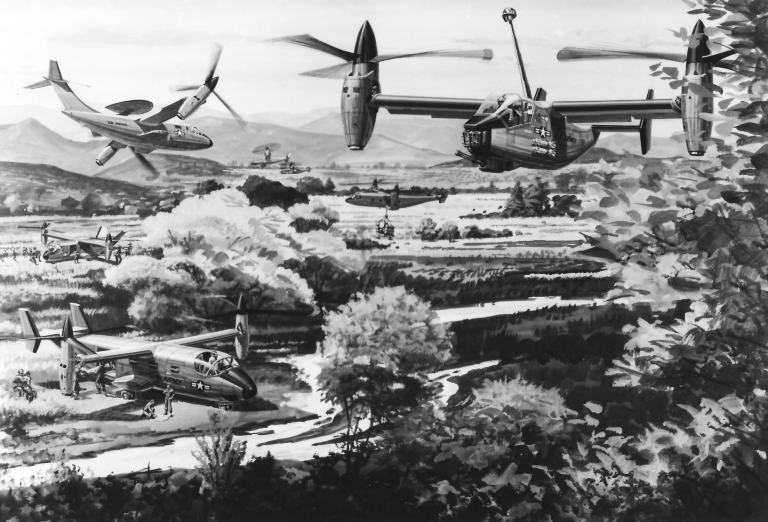
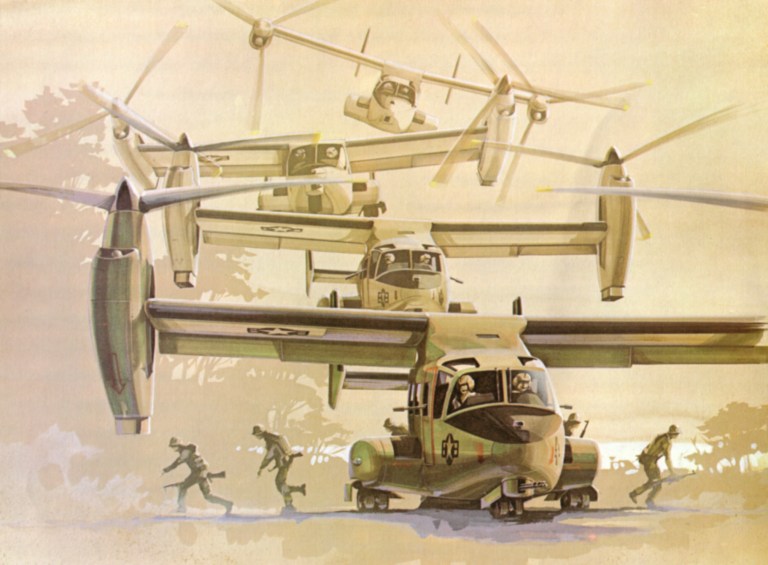
 Editor's Note 2005: written two decades ago, this technical summary and analysis is based on what was expected to happen at that time. Unfortunately the large number of new technologies introduced in the JVX resulted in a long running series of difficulties which effectively stalled service entry of this revolutionary light airlifter. Australian visitors will note that many of the ADF light airlift force structure planning issues described in this paper remain unresolved two decades later. Very much the surprise contender in the current RAAF Utility Helicopter tender, the MV-22A JVX is an aircraft about to substantially alter the style of airborne assault. The US Marine Corps is committed to over 550 aircraft with a projected IOC of 1991, the remaining US services sharing a requirement for a further 500 V-22s in various versions. Not to fall behind the Soviets have announced a projected IOC before the end of this decade for a Tiltrotor assault ship expected to supplant the trusty Mil-8 Hip. The requirement for the JVX or Joint Services Advanced Vertical Lift Aircraft grew out of a series of operational factors, some of which became quite apparent during the Vietnam conflict and some of which surfaced within the following decade. The USMC has been the driving force behind the push for JVX facing block obsolescence of its CH-46 fleet and nearing obsolescence of its CH-53A/D fleet, thus Marine Corps requirements have dominated the design of the aircraft. Vietnam demonstrated the enormous advantages in mobility and response time offered by the use of assault helicopters. Breaking the siege of Khe Sanh, the 'Toan Thang' thrusts into Cambodia, the crushing of the Tet offensive and the 'Lam Son' Laotian campaigns all hinged on the use of airborne assault. The fierce resistance offered by the NVA and VC, equipped with armour and AAA, exposed many of the weaknesses inherent in the technology of the day. The Marines' workhorse was the CH-46 which very quickly demonstrated the clumsiness of tandem rotors with numerous instances of chopped rotor drive shafts, insufficient blade flapping clearance was to blame and this severely restricted landing zone approach and touchdown speeds. Closely clustered powerplants could be disabled with a single AAA hit and armour was required at the expense of payload. The suppressive fire offered by two side mounted .50 cal machine guns was hardly adequate particularly in view of the constrained field of fire. Rotor noise, restricted touchdown speeds and a limited 140 kt dash speed often took the bite out of surprise attacks. The newly introduced CH-53 was a substantial improvement and is a favourite of USMC assault pilots to this day. Even so this aircraft has limitations in payload-range performance and dash speed, this combined with availability limitations. These factors became painfully apparent when the US attempted to penetrate to Tehran to rescue embassy personnel held hostage. The mission was aborted after several helicopters became unserviceable enroute. Other developments during the seventies also influenced the emerging JVX specification. The Yom Kippur war saw numerous heliborne assaults, the Israelis distinguishing themselves particularly with an audacious convoy ambush deep inside hostile territory, but the significant factor was the mass application of the crude but deadly ZSU-23-4P radar directed gun. This weapon used in conjunction with the shoulder launched heat-seeking SA-7 Grail SAM effectively denied assault helicopters their traditional airspace above 1500 ft, where small arms cease to be particularly effective. To compound this situation, the Soviets developed the massive Mi-24 Hind D/E attack helicopter which had the speed and firepower to threaten established assault helicopter types. The turn of the decade also saw the emergence of a Soviet lookdown/shootdown capable radar/AAM system - India's acquisition of the thus equipped Fulcrum fighter heralds a new phase in Third World airpower. Life wasn't meant to be easy for the USMC, to add to this family of threats shore based anti-shipping missiles such as Exocet went on sale to Third World nations. It was very apparent that the CH-46/53 replacement had to provide a significant improvement in payload/range, penetration speed firepower with a substantial reduction in radar, acoustic and infrared signatures. The HXM program was initiated to define the requirements. While this was happening, however, the remaining services were defining their requirements for a similar class of aircraft, the USAF HX Combat Rescue/Special Operations aircraft to supplant the HH-53 Jolly Green Giants and HC-130s, the USN VSX Combat Rescue aircraft and the Army SEMA-X electronic warfare platform. The DoD subsequently collapsed the multiservice programs into
the single Joint Services Advanced Vertical Lift Aircraft (JVX) program
and the Army was nominated lead service. This was the beginning of a
series of interservice political developments which eventually led to
the selection of the Tiltrotor concept in preference to the Advancing
Blade Concept (ABC) helicopter and Tiltfan fixed wing aircraft in
April,
1982.
One of the considerations leading to the choice was the
excellent track record of the Bell 301 XV-15 Tiltrotor demonstrator
aircraft (see Dec 1983 issue), a development program sponsored by the
Army and NASA. Ironically the Army's interest in JVX began to fade as
massive commitments to the AAH, AHIP and LHX development programs bit
into the service's budget. The Navy subsequently had to assume
responsibility for JVX development as the USMC's requirement would
dominate production quantities. In June 1982 the two leading contenders
for the development contract, Bell Helicopter Textron and Boeing
Vertol,
announced a teaming agreement which effectively concentrated all
existing developmental experience in Tiltrotor vehicles within a single
organisation. Though this was greeted by opponents of the Tiltrotor who
generally argue that as a radical development it must fail to perform,
the urgency of the USMC requirement was judged as sufficient to
dispense
with the traditional competitive fly-off. The preliminary design
contract was awarded to Bell/Boeing by the USN in April, 1983.
The Bell/Boeing MV-22A Osprey The Marines' medium assault MV-22A will be the first JVX derivative to enter production and operational service. The USMC requirements are very stringent both in terms of performance and operational characteristics. The MV-22A must carry 24 combat equipped Marines (5,760 lb) over a 200 nm radius at 250 kt/3000 ft/33 deg C. It must be capable of hauling a 10,000 lb slung load over 50 nm, and hovering out of ground effect at 3000 ft with either payload. A typical assault mission profile specified involves vertical takeoff from an LHA at 39.5 deg C, 5 minutes loiter, a 50 nm / 3000 ft cruise to a hover out of ground effect at 3000 ft / 33 deg C, troop landing and return to the LHA for reloading and repeating the mission without refuelling. Common interservice requirements further imposed are a 275 kt dash speed at sea level and 2,100 nm ferry range. Operational requirements are centered upon the USMC shipboard assault environment. Rotor diameter was constrained to 38 ft to provide a set clearance from an LHA bridge during VTOL operation. The folded footprint is slightly larger than that of a CH-46, to allow for for 10 aircraft on LHA launch spots, 15 folded and 6 in the hangar deck (LHA full complement at 31 aircraft). Sensors for all weather / night penetration and terrain following are required together with self defensive AAMs and a gun. Bell/Boeing had succeeded in completing all design tradeoff studies by the beginning of 1985, this also involving a series of configuration changes to improve performance and operational characteristics. It is expected that preliminary design should be complete by June 1985 when the Full Scale Development phase running to and through 1987 commences. By the end of 1984 Bell/Boeing had done 4700 hours of wind tunnel testing on seven models, built full scale mockups of the cockpit, nacelles, wing fuselage interface, rotor / hub fold and tested a 2/3 scale rotor at NASA Ames Research Centre. The rotor tests were apparently very successful, particularly in view of the fact that the original XV-15 rotor had been tested on the same installation. Subsequent contract modifications for tooling, a full scale mockup and avionic system integration studies were awarded by the USN early this year. Bell/Boeing have in turn awarded subcontracts for wing control surface design/production and tail section design to Lockheed-Georgia and Grumman respectively. The contract for the digital flight control system went to GE Aerospace Control Systems. Within the Bell/Boeing team wing/rotor/nacelle/transmission design is the responsibility of Bell Helicopter, whereas Boeing is working on the remainder of the airframe and systems. Upon commencing production Bell and Boeing will competitively bid against each other over the 60%/40% split in production. The first flight of the MV-22A prototype will depend on
powerplant availability and is currently scheduled for early 1988.
Airframe The demanding performance specifications set for the V-22A have resulted in the adoption of an almost completely composite material airframe structure, with only about 1,000 lb of metal used. The weight saving overall is estimated at 25%, but additional gains fall out of the low radar reflectivity of the carbonfibre and its very good tolerance to high energy laser weapon damage. Both factors should improve survivability substantially. The dominant composite material will be the Hercules IM-6 graphite/epoxy composite, though some glass will be incorporated for instance in the wing structure. The Bell designed rotor is fully composite and will employ blades with an advanced airfoil profile. The short 18 ft length 30 in chord blades should not experience flapping clearance problems in either rotary or fixed wing made, particularly as the wing was swept slightly forward and the nacelles pivot at midlength. The absence of metal in the blade structure will substantially reduce the characteristic Doppler signature of the rotors hopefully depriving enemy radar of valuable information. The rotors mount on tilting gearbox/engine nacelles which have absorbed and will absorb considerable design effort. Whereas in earlier Bell JVX studies an essentially gearbox-nacelle configuration with an outboard external engine pod was used, in the current design a far more compact configuration with the engine beneath the gearbox is employed. This presumably serves to minimise the area/volume ratio while shielding the gearboxes with the engine mass against small arms fire from fore/beneath. Boron fibre armoured lower doors may be used in later production examples, with tolerance for splinters and gunfire up to 7.62 mm calibre. The engine inlet design employed computer aided techniques, almost essential in view of the enormous angular range over which the inlet is expected to operate (up to 180 deg AOA!). An additional advantage of the new configuration lies in the greater cross-section of the aft nacelle available for the infrared suppressing exhaust diffuser thus helping reduce the (IR) energy density of the exhaust flow. The suppressor will be driven off the gearbox. The gearboxes have a 30 minute dry run capability and are linked by drive shafts coupled into a centre-section gear box box common also to the APU. All ancilliaries are also coupled into this box; with alternators and hydraulic pumps nacelle box driven this provides virtual triple redundancy. The tilt actuators are also mechanically coupled and have position locks. Preflights and tests can be done under APU power. If power is lost completely in fixed wing (FW) mode, the actuators can be unlocked upon reaching a landing site and the torque load will swing the rotors up into rotary wing (RW) configuration in about 10 seconds. The extreme separation of the powerplants minimises the probability of both being disabled by a single hit, fixing the engines in line with the rotor axis results in residual engine thrust augmenting rotor lift. The 22 in thick wing has a chord of 8 ft 4 in and is fully composite for maximum stiffness at given weight. The slight dihedral improves nacelle/fuselage clearance when the wing is folded while adding some further blade flapping clearance in helicopter mode. The 40 ft span wing torque box is fully graphite/epoxy. The wing trailing edge is split into inboard and outboard flaperons which are separated from the torque box by additional (fixed trailing edge) structure. Considerable effort has been expended on using the flaperons as large deflection flaps to help reduce rotor downloads on the wing while in rotary wing mode and thus improve lifting capability. Fences may also be used though it is expected that the configuration will have to be fine tuned during flight tests. Significantly the wing is 'blown' by the rotor slipstream in fixed wing mode which allows far higher wing loading in turn reducing gust sensitivity at low altitudes. The wing/fuselage junction serves as a swivel point for folding the wing. To fold the aircraft the rotor blades are first folded over the wing after which the nacelles are tilted down to fixed wing position and the wing is swivelled over the fuselage. Folding is fully powered and takes about 1.5 minutes. The swivel joint itself is a metal reinforced graphite epoxy ring, apparently a difficult item to design as hydraulic, electrical, fuel and control lines had to be brought through it. The APU gearbox assembly will be situated in this area. While Bell engineers did modify the wing and nacelle configuration, the changes pale against the efforts of the Boeing designers. The Boeing engineers completely revised the fuselage tail against the earlier Bell configuration very much at the expense of aesthetics. The clean fuselage with small sponsons and an elegant T-tail yielded to practicality and. performance. The fuselage has a very squarish cross section, it is built around a 24 ft long, 7.38 ft wide and 6.9 ft high loadspace and was stretched by a full 7 ft against the earlier design. The afterbody configuration was patterned on that of the C-130 both to reduce drag and assist in load handling. As a result the H style tailplane was raised to improve rear clearance by 20", the top of the aft hatch is now 91.5" above the ground. The tailgate is a C-130 style two piece arrangement with a main door/ramp and upper door which tucks away into the roof of the hold. This allows level loading which should be appreciated by the loadmasters. A small hatch was included in the main door to allow parachuting of small loads or troops one at a time. Rollers are used. The H-tail was selected as the best tradeoff of aerodynamic stability against structural weight with the added gain of compactness. The Grumman designed structure is expected to incorporate both graphite and Kevlar epoxy composites. A conventional stabiliser/elevator and stabiliser/rudder arrangment will be used. The centre fuselage section including wing, undercarriage and sponson attach, ments is also a fully composite structure. The new sponsons were patterned on the CH-47 style sponson and apparently do reduce fuselage drag. Bell/Boeing quote a 23% reduction in drag achieved by the combined use of the new sponsons and afterbody. The sponsons serve primarily as fuel tanks. Bag self seal fuel tanks are fitted fore and aft with the main undercarriage stowed between. Provision is made for attaching 375 gal (1,7001) drop tanks on both sides. The fuel system employs a single point standard NATO pressure refuel/inflight refuel arrangement with emergency gravity fill for one sponson tank and transfer to remaining with an electrical APU (or cart) driven pump. An A-6 style fixed inflight refuelling probe is mounted on the nose supplanting a telescopic probe under the nose. Apparently work was done on an integral wing box tank but this was rejected on grounds of vulnerability (through greater area/volume) and weight, crashworthy self sealing bags are employed instead. The forward fuselage also experienced changes with the gun turret under the nose yielding to a cleaner nose mounted gun, with a FLIR night vision turret under the nose and radar relocated upward and left of centreline. The standard gun is the new General Electric three barrel 4,000 rd/min .50 cal Gecal 50, weighing only 66 lb, excluding ammunition. The crew seats are armoured and together with the troopseats deform downward to absorb crash loads. The undercarriage is designed for a maximum 12 fps sink rate (much like Caribou STOL aircraft) and will collapse at 16 fps through a 22.5 in travel. The fuselage has also been designed to absorb crash loads, the base will crush through 10.5 in at 30fps,/20 G. The combined impact sink rate limit is 34 fps. Structural battle damage tolerance is expected to exceed MIL-STD-1290. The aircraft is also fitted with two cargo hooks for slung
loads and can carry a Hummer (HMMWV) vehicle. Hardpoints are available
on the forward fuselage for the fitting of AAM launch rails or light
gunpods.
BELL/BOEING MV-22A OSPREY. The MV-22A has
experienced
several changes in configuration through its evolution. The current and
almost certainly final configuration employs large sponsons and C-130
style loading ramp. The aircraft will attain 325 kt in level flight at
an altitude, and cruise at 250 kt at sea level outclassing conventional
heloes by a significant margin. Cruising at 300 kt and 20,000 ft with a
full load of 24 armed troops it can cover 1,200 nm on internal fuel. 
Powerplants Initial plans called for the flight testing and early production of the MV-22A equipped with a General Electric T64-GE-717 axial flow turboshaft. This engine was a 4,725/4,155 SHP development of the widely used T64 family with modifications to allow for sustained vertical operation, as such it was a very mature design with well established support facilities throughout the US services. Once the V-22 would enter production redesign for a new 6,000 SHP derivative of the MTDE (Modern Technology Demonstrator Engine) would occur with the newer engine becoming available for the higher gross weight USAF and USN versions of the aircraft. Two engines were competing for the role, the GE-27 with 6,000/5,350 SHP and the PW-3005 very much in the same class. Both engines could be expected to weigh 700-800 lb, much like the T64, however newer technology will allow for higher turbine temperatures which should provide a 41 lb/SHP.hr SFC; better than the 0.45 class T64. It was subsequently decided upon assurances of both engine suppliers to commence flight tests with the MTDE derivative engine, rather than the T-64. Although this will delay flight tests by 6 months, it is expected to save US$66 million in redesign and testing costs. Though one could question the wisdom of marrying an immature powerplant to a new airframe, Bell/Boeing have expressed confidence that time schedules will be met. Systems & Cockpit The MV-22A will be fully digital, much like the F-18A which pioneered this approach. The flight control system will be a digital triplex fly-by-wire system employing MIL-STD-1553B serial busses for communication. Three MIL-STD-1750A architecture microprocessors will be used per channel with two for primary flight control and the third for automatic flight control. The use of MIL-STD-1750A processors will cut support costs in comparison wth proprietary processor types. Mechanical backup will be provided. Significantly the FBW control system may rapidly modified with software updates, easily implemented in the field by swapping PROM memory chips. The flight controls will provide hands-off attitude, heading and altitude hold. Virtually all avionic equipment will be tied into dual redundant 1553B busses. The system will employ two mission computers, possibly late models of the USN standard Control Data AYK-14 as used in the F-18. The bussing architecture could be expected to follow the USN standard as used in the F-18 and F-14D with each computer controlling its own bus, with a dedicated interprocessor bus. It is worth noting that the recent release of several chip sets for 1553 bus interfacing will cut costs and complexity, dispensing with the need for a dedicated bit-slice-processor for bus protocol handling. The aircraft will have a fully 'glass' cockpit with multiple Cathode Ray Tube (CRT) displays, these are expected to be semi-intelligent with embedded microprocessors. A HUD will be employed as will an integrated nav/comm system. The radar set is optional, though in the USAF version very likely to be the TI LANTIRN (or derivative) as used on the HH-60, F-15E and F-16. A FLIR turret will be fitted and may also be integrated as a PNVS system for helmet visor projection. A radar warning receiver will also be fitted, a later APR-39 (the latest version has added voice threat annunciation), the tactical versions of the V-22A will require a full warning suite with IR, laser, UV warning receivers. IR jammers, chaff and flare dispensers would also be used, eg ALE-39. All cockpit systems and sensors will 'hang' off the 1553B busses. Unlike designs such as the F-18 the V-22 is expected to follow a distributed processing philosophy in which most 1553 bus devices (eg sensors, displays) will have sufficiently powerful microprocessors to handle most of their computing load locally. This frees the mission computers from intensive but secondary tasks such as display graphics while cutting down on bus traffic (thus freeing further mission computer time). The aircraft will also carry active defensive systems. The Gecal 50 gun though primarily for landing zone suppression will provide some air-air capability, and AAMs will be carried. Options at this stage appear to be 4 X FIM-92 Stinger or 2 X AIM-9 Sidewinder both fire and forget weapons. It is expected that sidestick controllers will be used in the cockpit though the prototypes will have provision for conventional cyclic/collective controls. The final result will depend on flight testing. Flight Characteristics & Performance In the absence of a flying MV-22A one can really comment only
upon the XV-15 bearing in mind that the bigger and heavier JVX will
have
an advanced flight control system and roughly 30% better power to
weight
ratio. Most pilots find the XV-15 nice to fly with good response in
both modes. The large mass at the wingtips does result in a lot of roll
inertia, though this may to a degree reflect upon the analogue SCAS
used in the XV-15. The aircraft is reasonably well damped in pitch, the
mass distribution precludes any rapid oscillation in roll.
It will however sustain oscillation in yaw once induced which is hardly surprising in view of the mass distribution and airframe geometry, this can be easily checked with rudder. Pilots very quickly acquire a habit of using tilt as an additional flight control, particularly as a means of 'viffing' while manoeuvring. Fixed wing low level ride is smooth due to the high wing loading, the MV-22A will have a fighter class 90 lb/ft2 at full load and 50% fuel. It will be rated at +3.OG and -0.5G for fixed and rotary wing manoeuvring. Dash speed is 285 kt at low level rising to 325 at altitude, cruise speed drops to 240-250 kt on the deck with a respectable 300 kt at 20 kft. At 300 kt/20 kft with 5,760 lb (24 troops) payload the V-22A has a VTOL still air range of 1,200 nm, rising to 1,500 nm under STOL conditions. In rotary wing mode forward speed falls to 110 kt, rearward/sideways speed to 35 kt. Disc loading is a large 18.5 lb/ft2 which provides good gust response at the expense of hover efficiency. Empty weight for the MV-22A is 27,840 lb, maximum gross weight is 42,385 lb. The aircraft has a ceiling of about 29 kft in fixed wing mode, though its climb rate will have degraded to 100 fpm at 23.8 kft. In rotary wing mode the hover ceiling (OGE) is at 7,100 ft. With a roughly 1000 sqft planform (F-15 class) the aircraft should be quite difficult to spot at low level, compared to a conventional helo (2000 ft2+) disc area). The XV-15 is very quiet due to low rotor speeds (about 333 RPM FW rising to cca 400 RPM RW) and this trait will follow on to the JVX, interestingly the XV-15 is reputed to give observers only several seconds of warning on a high speed low level pass. Aircrew and troops can look forward to far more comfortable rides than with current heloes, the reduction in vibration should improve the life of both mechanical components and particularly electrical connectors. The XV-15 has been flown through numerous trials. As a tanker
and receiver it has flown with an A-6, as a tanker with a CH-53, wake
effects have been described as minimal. The aircraft has been flown
against an A-4, OV-1 and CH-46 in every instance 'viffing' with tilt
was
found to be very useful. All aspect missiles such as the AIM-9L need
only be pointed at a target to guide successfully (the secret behind
the
Harrier's dogfighting successes) and can provide a manoeuvrable
platform with a good defensive capability.    MV-22A transition and touchdown. Unlike conventional helicopters the MV-22A penetrates enemy territory as a fast terrain following turboprop aircraft with low radar, infrared and acoustic signatures. Approaching the landing zone it transitions to helicopter mode for touchdown. Suppressive fire is provided by a 3 bbl .50 cal Gecal 50 gatling gun with a 4,000 rd/min firing rate. A Flir night vision turret is under the nose providing adverse weather/night capability. Note the in-flight refuelling probe. This capability will almost certainly be needed by the two other major variants of the V-22A. Though the US Army has orders for 365 aircraft to be used for medevac and theatre transport, these aircraft will be the USMC MV-22A version. The US Navy HV-22 is a dedicated combat search and rescue platform with the very dangerous mission of penetrating hostile airspace to pick up downed aircrew. The basic mission requirement is to rescue four persons at a radius of up to 460 nm at 7000 ft/28 deg C. The typical mission profile specified involves a VTO from a CV at 39.5 deg C, climb to 500 ft and cruise out 180 nm, climb to 7000 ft for search and cruise a further 280 nm, hover at 3000 ft/33 deg C (OGE) then hover at sea level. At this point the 880 lb rescue load is picked up and a return to the CV at 2000 ft takes place, with a 500 ft approach for the last 180 nm followed by a vertical recovery. The full internal and external fuel tankage capability of 11,850 lb common to this and the USMC version is to be used. Maximum gross weight is at 42,835 lb, the USN has a requirement for 50 aircraft. With a similar but longer ranged mission profile, the USAF CV-22 is the heaviest of the family. The CV-22 is a long range special operations aircraft with the overlapping roles of combat rescue and insertion of up to 12 strong commando teams. The basic mission profile specified involves carrying 12 troops (2880 lb) to a 700 nm radius at < 500 ft/39.5 deg C. With a total fuel capacity of 19,000 lb this version weighs in at 50,600 lb at take off (short strip STO). The CV-22 will be a much needed improvement upon the cumbersome CH-53 and HC-130 teams currently employed in this role. It is worth noting that Bell/Boeing have projected a gunship derivative of the V-22 airframe. This aircraft would have tandem seating crewmembers with an aft gunner/WSO, both on zero-zero seats and provided with armour. A multimode radar would be nose mounted together with a 25 mm gun turret, AAMs would be carried on the forward fuselage sides (F-8 style), with a large fuselage weapon bay provided for the carriage of air-ground (typically PGMs) weapons. Though no formal requirement yet exists it will only be a question of time as there is no rotary wing close air support platform which could escort the 250 kt+ V-22. JVX - An Australian Perspective The emergence of the USMC's MV-22A as an assault vehicle characterises the growing divergence between the Marines' and US Army's respective requirements and strategies in airborne assault. The Army given its role as a land combat force is developing an inventory and tactical approach optimised for a close-in high density air-land battle. Based on European and Southeast Asian experience the Army assumes well coordinated and mobile enemy defences typified by the Soviet armoured/mechanised division operating in the central European theatre. To deal with this opponent the Army relies to a large degree upon its AH-64 and AH-1 ATGW firing helicopters, supported by USAF (TAC) Close Air Support (CAS) and defence suppression aircraft. In this environment the Army will employ support/refuelling zones as nodes from which scout, attack and assault helicopters will fan out to deal with targets. In both offensive and defensive scenarios high technology sensor equipped scout helicopters would reconnoitre the battle zone employing terrain masking to avoid detection and hostile fire. Assault and/or attack helicopters would then be directed against their targets, in most instances approaching in Nap Of the Earth (NOE) flight. Once a Landing Zone (LZ) is assaulted an aerial bridge to support/refuelling zones (eg LZ 'Stud' at Khe Sanh) is established to ferry in troops, equipment and supplies and evacuate casualties. The high technology LHX scout helo and projected CH-47 replacement, the 120,000 lb class Advanced Cargo Rotorcraft (ACR) are both crucial to this strategy and this also reflects in the Army's reluctance to commit funds to JVX development. JVX cannot offer the 30,000 lb / 300 nm payload/range capability of the near C-130 class ACR (possibly Tiltrotor) while it is also hardly suited to an essentially short range hover dominated NOE mission profile as flown by the scout/utility LHX and UH-60 UTTAS. Significantly the primary threat in this situation is a numerically superior ground force supported by mobile AAA and some SAMs. Concealed approaches and surprise are critical elements. This approach does assume that TAC will sweep all look-down/shoot-down capable hostiles from the skies - a helo creeping along in NOE flight is as good as a stationary target. The Marines' philosophy revolves about the primary need to get as many troops off an offshore platform (LPH, LPA, LHA) onto a beachhead LZ as quickly as possible often over a long distance. Though Navy and USMC fighters would provide MiGCAP it cannot be assumed that hostile air defence fighters will be absent - CV based aircraft are a finite resource which is heavily committed with air-ground and other air-air missions. Ground based defences are assumed localised, but over a full spectrum, this is consistent with most of the remote (Third World) theatres of operation which the Marine Corps must deal with. Under these conditions assault aircraft must have both high performance/manoeuvrability at low level to avoid air defences and good payload/range performance. The latter is essential as a fleet has a finite number of aircraft and reinforcements / replacements are impossible to get at short notice. The JVX is the product of this philosophy and will be supported in the assault role by CH-53E heavy lift heloes and LCAC surface effect vehicles. In the context of the RAAF tender the MV-22A meets or exceeds most of the requirements. Some such as fitting into a C-130 hold become superfluous in view of the aircraft's 2,000 nm ferry range and in-flight refuelling capability. On the other hand requirements such as performing a utility gunship role will be difficult to meet with a specialised assault aircraft. The issue of suitability hinges basically upon what is perceived as our future force structure and respective service roles. If the RAAF selects a conventional utility helicopter as the UTTAS or W30-400 it acquires a vehicle optimised for a high density close range land battle, with NOE agility and efficient hover performance at the expense of speed and range (these factors led to the rejection of a Tiltrotor configuration for LHX). Will a regional conflict then resemble the high density Eurotheatre? It is fair assumption that any low or medium level regional confrontations will resemble a Third World contingency. Given this holds, JVX could offer some quite useful capabilities. Other than performing utility chores for the RAAF, one of the primary roles of the utility helicopter will lie in assault lifting the Operational Deployment Force (ODF). The RAAF's ability to airlift the ODF across the continent and its ability to provide assault lift into battle are both considered to be woefully inadequate [1;6.95] and it is unlikely that resources will be found for a major expansion of RAAF tactical airlift squadrons. One option under consideration was the replacement of the aged Caribou with further C-130s which is reasonable in view of the RAAF's own need to support its deployed forces outside of commitment to the ODF. However acquiring a conventional helicopter to replace the UH-1 will have little impact upon the theatre airlift capability of the RAAF, an area where JVX could offer some gains. With the ability to cruise at 300 kt/20kft over 1,500 nm legs with a payload of 24 armed troops JVX could be employed directly to deploy ODF forces to their theatres of operation. Subject to STO gross weight limits the JVX operating from Townsville, could cover the NT, PNG and parts of the NW in a single leg without refuelling. With its inflight refuelling capability the MV-22A may then access any part of the continent in a single non-stop flight at comfortable altitudes. As the JVX has comparable loadspace and superior payload/range to the Caribou it could fill the gap after the Caribou's retirement with added VTOL and slung load flexibility, and higher agility. The MV-22A's penetration capabilities could be very useful for the insertion and recovery of SAS units deep inside hostile or unsanitised territory, just as the possibility of flying combat rescue or long range SAR missions would not go astray. In summary the acquisition of the MV-22A to replace the UH-1 and later the Caribou would provide the RAAF with a considerable growth in its short range transport and assault lift capability while to some degree relieving the growing pressure on available C-130 resources. As most of the technologies used in the design of the MV-22A are quite mature it is very reasonable to assume that the aircraft will meet the set specifications. The penalty in acquiring the JVX rather than a conventional helicopter lies in higher unit acquisition costs and support facility costs, combined with the need to restructure role allocations. To introduce the aircraft and integrate it into the force structure could require more than superficial changes. JVX offers a range of new capabilities unavailable in conventional assault helicopters. It remains for the RAAF to choose which generation of assault vehicle will serve Australia's forces into the next century. REFERENCES:
|
|||
|
|||||||||||||
|
|
|
|
|
|
|
|
|
|
|
|||
|
|
|
|
|
|
|
|
|
|
|
|||
 |
|
|
|||||||||||
| Artwork, graphic design, layout and text © 2004 - 2014 Carlo Kopp; Text © 2004 - 2014 Peter Goon; All rights reserved. Recommended browsers. Contact webmaster. Site navigation hints. Current hot topics. | |||||||||||||
|
Site Update
Status:
$Revision: 1.753 $
Site History: Notices
and
Updates / NLA Pandora Archive
|
|||||||||||||
|
|
Tweet | Follow @APA_Updates | |||||||||||
|
|
|||||||||||||
|
|
|||||||||||||