|
||||||||||||||||||||||
 |
||||||||||||||||||||||
![F-22A Raptor, FB-22, F-22E, F-22N and Variants Index Page [Click for more ...]](APA/f-fb-22.png "F-22A Raptor, FB-22, F-22E, F-22N and Variants Index Page [Click for more ...]") |
 |
![People's Liberation Army Air Power Index Page [Click for more ...]](APA/pla-air-pwr.png "People's Liberation Army Air Power Index Page [Click for more ...]") |
 |
 |
 |
 |
 |
 |
![Military Ethics, Culture, Education and Training Index Page [Click for more ...]](APA/ethx-culture.png "Military Ethics, Culture, Education and Training Index Page [Click for more ...]") |
 |
||||||||||||
 |
![Russian / Soviet Weapon Systems Index Page [Click for more ...]](APA/rus-weps.png "Russian / Soviet Weapon Systems Index Page [Click for more ...]") |
 |
 |
 |

|
 |
 |
 |
 |
 |
||||||||||||
 |
 |
|||||||||||||||||||||
| Last Updated: Mon Jan 27 11:18:09 UTC 2014 | ||||||||||||||||||||||
|
||||||||||||||||||||||
|
||||||||||||||||||||||
|
||||||||||||||||||||||
|
|
|
|
|
|
|
|
|
|
|
||||||||||||
|
|
|
|
|
|
|
|
|
|
|
||||||||||||
|
|
|||||||||||||||||||||
| Last Updated: Mon Jan 27 11:18:09 UTC 2014 | ||||||||||||||||||||||
|
||||||||||||||||||||||
| Maritime Deterrence, Submarines and Air Power |
First published in Australian Aviation July 2000 by Dr Carlo Kopp |
|
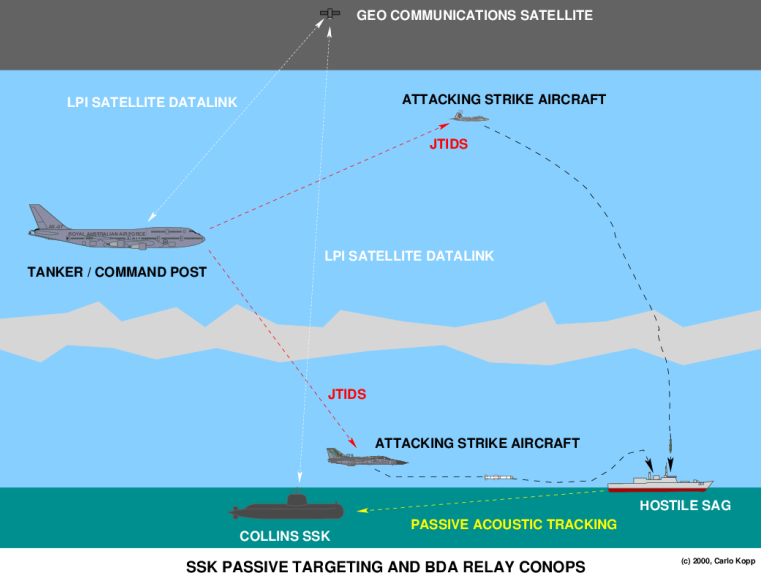
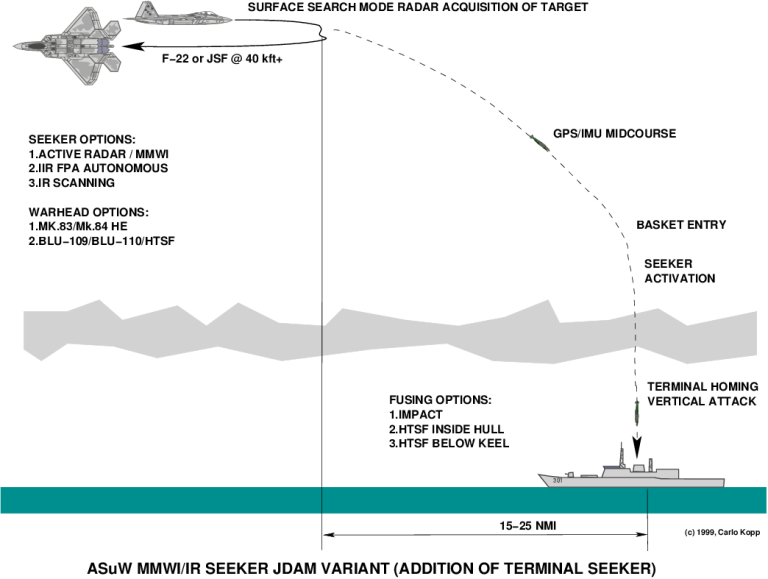
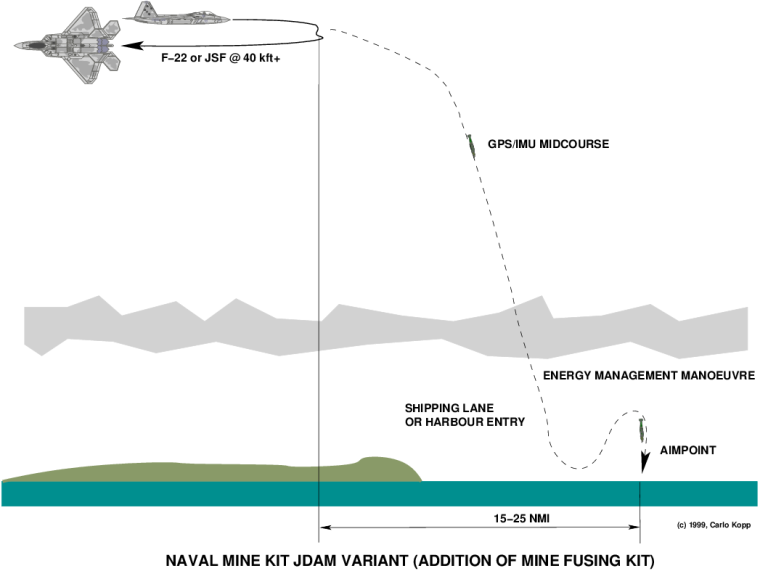
With force structure changes more than likely in the near future, in response to a changing regional environment, and the nearing decisions on the replacement of core assets such as the F/A-18 and F-111, it is well worth exploring the basic issues in sea control and looking at future options in strategy and technology. The ADF's extant basic strategy for sea control was independently developed, but in its fundamentals is basically the same model which was developed originally by the Kriegsmarine and Luftwaffe, and later shamelessly appropriated by the Soviet Voenno-Morskii Flot and Aviatsiya Voenno-Morskovo Flota. This model envisages the coordinated use of land based air power and submarines to engage and destroy hostile surface vessels and any supporting assets, frequently at extended ranges. In its fundamentals this is a very sound strategic model, and was proven to be highly effective during the Battle of the Atlantic. A disproportionate response in effort was required by the Allies to win this battle against the Germans. The Soviet variant of this model, based upon the use of the Tu-95/142 Bear, Tu-16 Badger and Tu-22M Backfire (recently acquired by India), in conjunction with a wide range of nuclear powered attack submarines, presented a formidable challenge for NATO and would have tied down much of the USN carrier fleet in times of war. Fortuitously this battle never occurred outside wargaming tables and simulations. If the Soviet model had any weaknesses, these were the same weaknesses the German model had - a failure to properly coordinate operations between air assets and submarines. The current ADF force structure model for sea control operations is also not without it warts. While we possess over a hundred Harpoon capable aircraft, the F/A-18As are limited, without tankers and well loaded with Harpoons, to a combat radius of about 250-300 NMI, thereby leaving the outer operational radius to the F-111, AP-3C and Collins SSKs. Only the F/RF-111C AUP is currently Harpoon capable due to delays in the F-111G upgrades, and the Collins SSKs are still in the process of being made genuinely battleworthy. Moreover, the Collins is limited in dash speed and dash endurance due to the primarily political choice of classical diesel electric, over nuclear propulsion. The absence of a genuine AAR fleet limits the reach of the F-111C/G to about 800-1,000 NMI, and the F/A-18A with B-707-338C to about 800 NMI in useful numbers, leaving only the AP-3C and Collins with the capability to cover the extremities of the outer envelope. The very improbable scenario of a an invasion fleet 300 NMI off the coast could be dealt with decisively by the ADF - it is arguable how well even the USN could cope with a massive deluge of ASMs with concurrent harassment by submarines. A single carrier CVBG could find itself in much difficulty. The bigger issue for the ADF in the coming decades will be the far more probable scenarios of India and the PRC interfering with sea lanes to our north, and also potentially interfering with UN operations in South East Asia. With no certainty on the issue of runway access on the territory of our northern neighbours, we could find ourselves in the situation where the only assets with the required combat radius are the AP-3C and the Collins SSKs. In terms of firepower both would be capable of effective harassment attacks, however the AP-3C is not survivable in the presence of fighters, and the Collins has a transit speed which requires many days to position, and many days to get into safe airspace for reloading with torps from a tender. Clearly this in not a credible deterrent to hostile maritime operations by serious players in the wider region. In established ADF-speak, the term "deterrence" is almost exclusively reserved for precision land strike by the F-111 against strategic fixed targets. The lame proposal to use the Collins as a cruise missile shooter in this role was also centred on this model. If current trends in Asia persist, it is likely that the primary problem in deterrence will not revolve around turning fixed ground targets into rubble, but rather keeping hostile naval and air assets from operating in the region, and precluding the insertion of military supplies via sealift and airlift. Therefore the deterrence model we use needs to be broadened in its scope to encompass deterrence against naval power and long range air power, as well as the traditional strategic target set. For this expanded deterrence to be credible, the ADF will need to further evolve its force structure and its doctrine. The most important capability required for such a model is a decently sized fleet of strategic tanker aircraft, as this allows the RAAF to extend the reach of the TFG and SRG to credible distances in credible numbers (see AA Dec 99 - April 00). Having the tanker fleet to deliver the firepower we need to the distances we need is however only part of the solution. It will be necessary to acquire targeting information in contested airspace, and also perform Bomb Damage Assessment (BDA). Ideally a combat SAR capability would also exist, since very long range operations always run the risk of fighters in the drink. The currently envisaged role for the Collins SSK seems to vary, depending upon whom you approach, but generally it is seen as being best used to attack high value assets with torpedoes and provide a surveillance capability against hostile naval forces. With a sensitive passive sonar, it has the ability to identify and track surface contacts without being detected from below the radar horizon of the contacts. The traditional view is that the submarine goes in for a torpedo attack while the RAAF rains Harpoons, AGM-142s and GBU-10s on the opposing naval force. ASW ops using helicopters are not viable with a sky full of hungry fighter pilots, and the combination of subsurface and air attack is any convoy or SAG commander's worst nightmare. Can this model be improved upon ? The limitation of the Collins is its modest torpedo load, and once the acoustics are fixed, its transit speed and endurance, especially when running quiet. If it exposes itself, like any SSK, the opponent will most likely try to hunt it down with ASW helicopters and surface vessels. While we can debate the effectiveness of potential opposing ASW capabilities against the stealthiness of the Collins, the reality is that once it starts launching torpedoes its presence in the near vicinity is known. If we budget two torps per target for a guaranteed kill, and assume the odd torp goes astray in combat, we are up against the problem of how many targets the SSK can concurrently engage and destroy in a surprise attack, and how many times it can repeat such an attack. This raises the question of whether the Collins is best used as a "shooter", or whether this portion of the engagement is best left to air power. An alternative model is to use the Collins as a targeting and BDA platform which supports air attacks by strategic tanker supported F-111 and F/A-18, retaining its torpedo armament for defence against ASW forces if it is cornered or otherwise exposed, or for high value targets of opportunity. While such a use of the submarine may not be gratifying to many of our naval enthusiasts, it is a model in which the Collins exploits its strengths, which are stealth and towed passive sonar, and avoids its weaknesses of limited firepower and submerged endurance / dash speed. The other side of this model is that the strengths of air power, rapid transit, massive firepower and flexibility, are best exploited, without incurring the large overheads of tanker supported and fighter escorted targeting recce and BDA sorties. While it may be argued that an AP-3C or even an RQ-4A Global Hawk can perform the targeting recce and BDA roles better, an opponent using good emission control practices, running electromagnetically silent, must be hunted down using radar. Any radar transmission by the AP-3C or Global Hawk betrays its position, identity and possibly intent. Only passive sonar can provide genuinely undetectable maritime target detection, tracking and identification which denies the opponent any warning. In practice, this doctrinal model would see the submarine detecting and shadowing a hostile SAG, CVBG or convoy, carefully developing a situational picture using its passive sonar system to identify and count the types of targets and their positions in the area. Budgeting 4-8 hours for a strike force to arrive, the submarine raises a communications mast and uses a covert LPI (Low Probability of Intercept) satellite link to transmit the situational picture to a maritime operations HQ. From there the strike mission is tasked and a tanker supported fighter package is sortied to engage the target set. The submarine then uses its covert satcom link to get the estimated arrival time of the strike force. Once the fighters arrive, the submarine could datalink the current tactical picture to the fighter package, thereby allowing them to approach without using radar to alert the targets. Once the package knows the exact position and types of target, the fighters can light up their radars, pick targets and start shooting missiles. Once the missiles hit their targets and the package departs for home, the submarine can move in closer to assess the number of kills, and if conditions permit, finish off damaged vessels using torpedoes. This is an economical use of the submarine's warload, and its use under conditions where the opponent is unlikely to be in the position to mount an effective ASW response. Once this phase of the strike is completed, the submarine can move to a safe distance and use its covert satcom link to send the BDA results to maritime HQ. If another air attack is warranted, then the profile is repeated. This "combined force" use of the SSK and air power also has the advantage of allowing the submarine to remain in the patrol area longer, rather than departing after one or two engagements, due to having expended its warload. Fuel and supplies permitting, the less torpedoes are expended, the longer the sub can remain active in the area and therefore the greater its effectiveness given the slow transit speed to an operating area. Surprise is always a decisive advantage in combat, and this model is designed precisely for that, since the opponent's first warning is the activation of targeting radars and the launch of Harpoons. Depending upon the launch geometries the warning time before missile impact could be as short as several minutes. If a weapon like the AGM-142 is used and launched against the primary AAW asset off targeting coordinates provided by the submarine, this asset may have a warning time of seconds. Much depends upon the quality and currency of targeting coordinates which the submarine can datalink to the strike aircraft. If the information is of sufficient accuracy and recency, then the Harpoons could be targeted silently and launched from below the radar horizon of the target shipping. Therefore the first warning is when the Harpoon seekers light up, seconds from impact. Unless the primary AAW radar of the defending vessel is good enough for early detection of the Harpoons, the first warning will be the ESM alarm identifying the Harpoon seekers. Adapting the Collins SSK The minimal adaptation to the Collins SSK to support this regime of operations is the installation of a covert LPI digital datalink capable of relaying targeting coordinates, and other messages, over a satellite link. The big difference between a covert link, and a conventional link, is that the covert link must not betray the submarine to hostile ESM or active radar searches of the patrol area. The best strategy for defeating ESM is to use a centimetric band highly directional pencil beam, a very low sidelobe antenna, and a spread spectrum waveform for the datalink signal. To defeat radar searches, the antenna mast and antenna must have a very low radar cross section. In essence the same caveats which apply to the design of an LPI radar on a stealth aircraft apply to the antenna installation on the sub. However, since the antenna mast will be grazing the surface, and weight is a much lesser issue, the demands are much lesser than for a combat aircraft. The most practical choice is the adaptation of an existing active phased array antenna designed for a fighter aircraft, installed in a faceted fairing on top of a mast. The antenna boresight would point vertically upward. An issue will be the choice of antenna design, or its adaptation, to match a centimetric band satellite repeater. This type of installation, if done properly, can have a negligible radar cross section, especially for the shallow grazing angles typical of search radars. Since the operating areas are mainly equatorial, geostationary satellites will be directly overhead or at very modest deflection angles. A typical fighter radar has a beamwidth of about 3 degrees, which is well suited for this application. The motion of the submarine is easily compensated if a phased array is used, and the appropriate pointing angle is easily calculated in software, since the submarine has an accurate navigation system and the position of the satellite is fixed. The absence of moving parts means the design can be very reliable. It is worth noting that other choices also exist for doing this, such as a tethered floating antenna with optical fibre cable embedded in the tether. Direct relay of coordinates between the submarine and aircraft is cumbersome, and a very simple alternative is to exploit yet again the satellite, to relay the signal to a tanker aircraft equipped with a suitable satellite transceiver and JTIDS datalink master station. It is expected that JTIDS will be a standard fit on all RAAF combat aircraft by the end of the decade, so no additional expenses are incurred in this respect. What could present a problem is submerged endurance and speed vs noise, especially when shadowing target shipping. SSKs excel in the stealthy ambush, but do not perform well in sustained dashes due to the need to snorkel and recharge batteries. Therefore appropriate tactics would need to be developed, especially when dealing with fast SAGs or CVBGs. In the longer term, air independent propulsion must be a serious consideration. There have been promising developments in a number of areas, such as hydrogen-oxygen fuel cell technology, which could be applied eventually. While near term choices are centred on schemes such as air independent diesels or Stirling engines, both are potential noise sources due to moving parts. Fuel cells are fed on a flow of hydrogen and oxygen, and produce electricity and water when these are combined, with no moving parts. Of course, it is not practical to fuel an SSK (or a car) using tanks of LOX and LH2 ! Current trials in the automotive area involve the use of compressed air, and hydrogen produced by breaking down a liquid fuel such as gasoline, methanol or diesel in a chemical reactor, termed a "reformer", which performs catalytic cracking. Therefore the propulsion package is fed on a liquid fuel and air, produces electricity with no moving parts other than compressors for the air, and is virtually silent. For a non-nuclear submarine, the attraction of this approach is that the size of the batteries can be significantly reduced and the freed volume used for the storage of compressed air or oxygen and possibly, more fuel. Since compressed air or oxygen are used, compressors for the air feed to the cell may not even be required. Current PEM (Proton Exchange Membrane) technology fuel cells being trialled for automotive use have demonstrated power densities of around 1 kiloWatt per litre of cell volume, and are regarded to be scalable up to 10 MegaWatt power levels, which is in the required class to drive an SSK (see IEEE Spectrum Nov 98). For comparison the Collins is driven by a Jeaumont Schneider 5.4 MW DC motor. In an SSK application, the PEM cell directly drives the main shaft motor, and charges if required the backup batteries. Instead of snorkelling to expel diesel exhaust and draw air, the sub would snorkel only to replenish its compressed air supply. An interesting benefit of using a hydrogen / oxygen fuel cell is that hydrogen can be tapped off to drive a Sabatier reactor carbon dioxide scrubber (technology being developed by NASA for Mars missions). This would allow the sub to rid itself of carbon dioxide without consuming oxygen candles or electricity, as long as it has supplies of compressed air and fuel it can remain submerged. How soon PEM technology will be mature enough for an operational SSK application remains to be seen. HDW are currently testing a large Siemens PEM fuel cell for the Bundesmarine, specifically for use in the 212 class SSK. This PEM module is claimed to have a conversion efficiency of about 70%. The big issue will remain the design of the reformer modules for efficiently converting hydrocarbon fuels to hydrogen and waste products. If current trends continue the technology may be available for use by 2010, around the time the Collins boats become due for midlife refits. Air Power Issues To support such a regime of submarine based targeting and BDA, the principal requirements are sufficient numbers of big tankers and the appropriate satcom datalink and JTIDS capability on some of these, which would become defacto airborne command posts for the strike packages. While the F-111 and the F/A-18 remain our primary combat aircraft, existing weapons and delivery techniques would suffice. The interesting question which arises is that of adapting the future AIR 6000 replacements to the maritime strike role. Should the RAAF opt for evolved teen series generation aircraft, such as the F-16/Block 60, the F/A-18E, the F-15E/K, the Typhoon or the Rafale, then the existing weapons technology, ie the Harpoon and AGM-142 for standoff attack, and the laser guided bomb for close-in attack, would be retained or replaced with future equivalents and the established tactics adapted as required. Established weapons, established tactics and established cost structures. What about the stealthy F-22 and the planned F-32/35 JSF, should it reach production ? These types are built to exploit stealth and clearly outclass teen series generation aircraft in the counter-air and land strike roles. For strike missions they are intended to penetrate high and fast, indeed the F-22 does so at 45 kft+ and Mach 1.4, delivering GPS guided GBU-31/32 JDAMs. Stealth requires internally carried weapons, and modestly sized bays designed around 1,000 lb JDAMs will not fit the Harpoon or similar ASMs. Penetrating at stratospheric altitudes and supersonic speeds is not a viable launch environment for Harpoon class ASMs. Even should a supersonically rated ASM be built, it is unlikely to fit into an internal bay, and carried on a pylon compromises stealth and incurs costly drag. The solution to this problem, for direct antishipping strike and for naval mining, turns out to be simpler than one might expect - derivatives of the GPS guided JDAM bomb. For antishipping attack a radar terminal seeker for the JDAM, derived from established millimetric wave or IR seekers designed for anti-tank munitions, is neither a costly nor a complex adaptation. The fighter would use its radar to track the intended target vessel, the bomb would be programmed with the "no escape" footprint for the ship, and released. Using its conventional JDAM GPS/inertial guidance, it would fly itself to a point above the acquisition footprint, point itself vertically down and activate the radar seeker. Once it has located the ship, it would home in and vertically punch through the superstructure or upper decks at supersonic speed. It is worth commenting here that the major air-sea battles of WW2 in the Pacific were won primarily by the humble SBD Dauntless dive bomber, delivering 1,000 lb bombs in steep diving attacks. The targets were typically very well armoured by today's standards. The lethality of a radar seeker equipped antishipping JDAM variant could be significantly enhanced by using the smart fuse technology devised for bunker busting bombs. These fuses have an internal accelerometer to allow them to pick which cavity to explode in. For an antishipping application, the bombs would be programmed to explode once they have punched through beneath the keel of the ship, in the same place modern torps are designed to explode. If a pair of JDAMs is dropped and the fusing programmed for a fraction of a second of delay between the bombs, they could achieve a similar effect to a dual pulse torpedo warhead, and break the back of the ship. Attacking in a vertical dive, the bomb arrives in what is a traditional blind spot for ESM and defensive radar coverage. Even if the ship's superstructure is faceted to beat an ASM seeker or search radar, decks are always nicely flat so the radar cross section is enormous. The millimetric wave seekers developed for killing tanks could thus be easily adapted for this purpose. An Infrared (IR) seeker may be cheaper, but is weather limited. For mining operations, the JDAM can also be adapted. Several existing USN air delivered naval mines simply use Mk.80 series bombs with appropriate fusing kits. The issue for mining is to achieve an accurate low speed delivery. For a JDAM derivative naval mine dropped at supersonic speed and 40 kft+, this is a first glance a problem issue. However, the JDAM is designed to fly shaped trajectories, and adaptation of the autopilot software would allow the bomb to be programmed to fly a pull-up before impact, to bleed off most of its energy, and arrive at the intended aimpoint at a very low speed. From a force structuring perspective, the nice aspect of these proposed weapons is their inherently low cost, yet high lethality. Even if the anti-shipping seeker adds USD 50k, a reasonable estimate, to the cost of a USD 15K JDAM kit, the weapon is still a fraction of the cost of a Harpoon or a guided torpedo, yet delivers a 1,000 lb warhead at supersonic speed. Such economics are difficult to argue against. The economic advantage in turn means that larger stocks can be kept, still at a total cost advantage, and this improves sustainability. Since such derivative weapons are based upon extant technology, developing them incurs little risk or cost, against a new generation ASM design. Maritime JDAM variants delivered by stealthy fighters offer the very same economic advantages offered by the stealth delivered standard JDAM against standoff missiles or cruise missiles. Moreover, tactical conditions permitting, such weapons could also be delivered by conventional fighters. Since they are cheap, they are a viable choice for killing low value targets such as Fast Patrol Boats, missile boats, and barges. Clearly the technology base now exists which would allow the use of the F-22 and the JSF in the maritime strike roles currently occupied by the Harpoon firing F-111 and F/A-18A. Given the timelines for AIR 6000, these aircraft become viable candidates across the whole role spectrum currently performed by the RAAF's SRG and TFG. In summary, it is clear that viable alternative choices exist in doctrine and technology to support the sea control and maritime deterrence missions over coming decades. Our defence planners should consider this carefully in the upcoming force structure and acquisition debates. 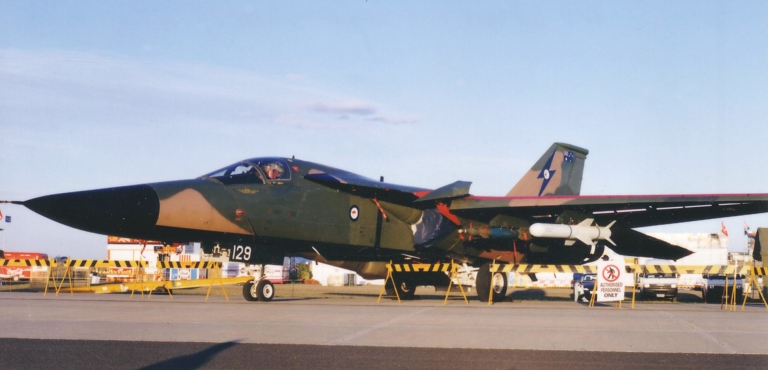 The limitation of the RAAF's current force structure in maritime strike scenarios is poor operating radius. While the R/RF-111C and F/A-18 are Harpoon capable, the latter requires tanker support for anything beyond trivial radii, while the former is limited to about 1,000 NMI. The AP-3C is not survivable in the presence of hostile fighters and modern SAMs. To produce a credible maritime deterrent, a robust number of strategic tanker aircraft will be required. The Collin SSKs can provide an effective recce and BDA capability to support the RAAF in such operations thereby significantly reducing the operational overheads incurred in the targeting cycle (RAAF PR).
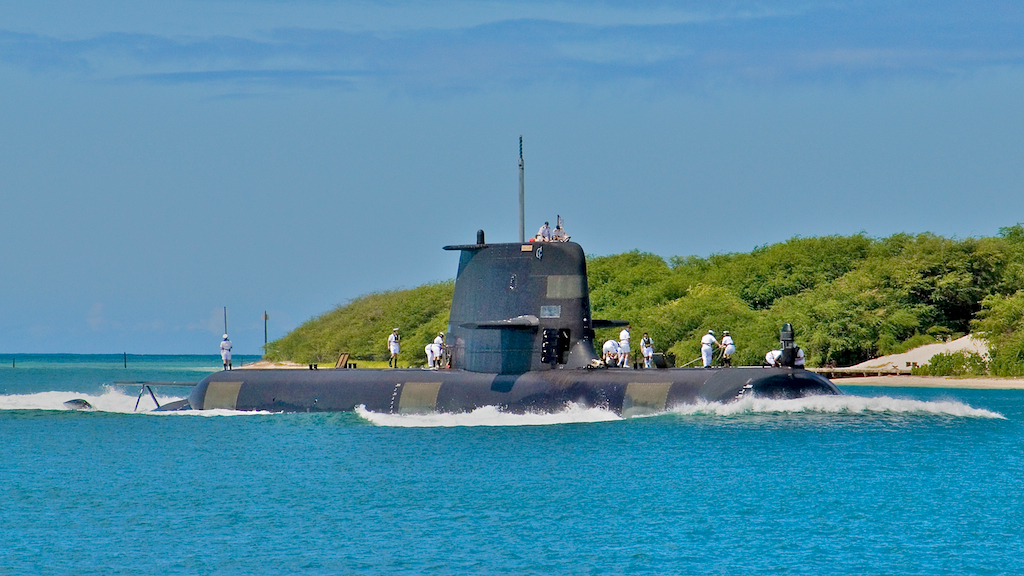
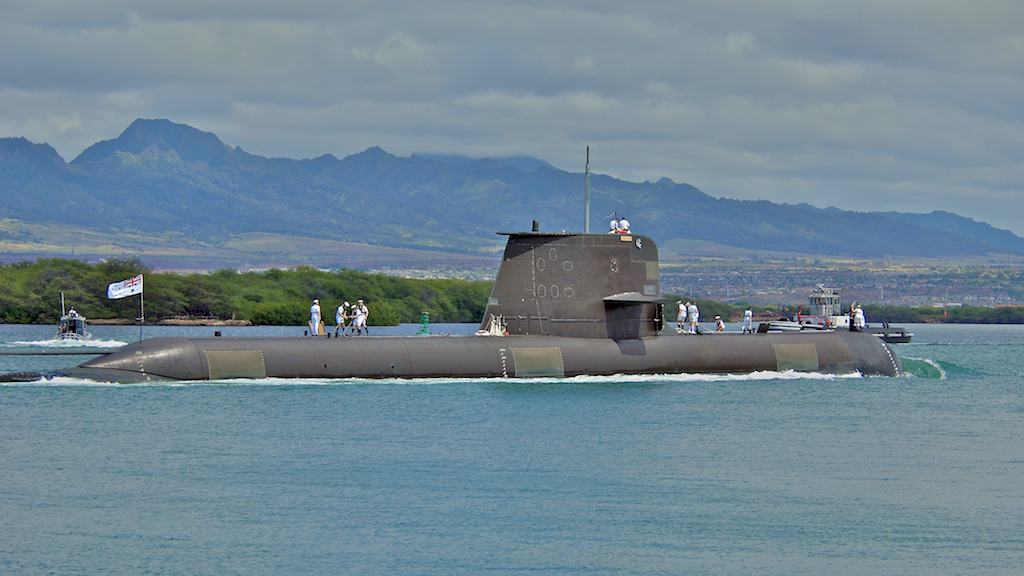
SSG-75 HMAS Waller. The Collins SSK, once fully operational, has much potential for use as a targeting reconnaissance and Bomb Damage Assessment platform, supporting long range anti-shipping strikes by strategic tanker refuelled fighters. Its use in this role requires that a covert LPI satellite communications link be added, to relay targeting and BDA information to the aircraft. Using it for targeting and BDA exploits its stealth, on station endurance and capable sonar and systems, while exploiting the short response time of air power, and its massive and sustained firepower (DoD).
|
 |
 |
 |
|
This hapless destroyer was hit by a Mk.48 torpedo launched from a Collins SSK. The torpedo exploded under the keel and broke the back of the ship. A similar effect can be achieved by a GBU-31/32 JDAM if the HTSF smart fuse is employed, and the bomb set to explode once it punches through the bottom of the target vessel. At a fraction of the cost of a Harpoon or a torpedo, a seeker equipped JDAM would deliver unprecedented bang for buck (DoD). |
|
|||||||||||||
|
|
|
|
|
|
|
|
|
|
|
|||
|
|
|
|
|
|
|
|
|
|
|
|||
 |
|
|
|||||||||||
| Artwork, graphic design, layout and text © 2004 - 2014 Carlo Kopp; Text © 2004 - 2014 Peter Goon; All rights reserved. Recommended browsers. Contact webmaster. Site navigation hints. Current hot topics. | |||||||||||||
|
Site Update
Status:
$Revision: 1.753 $
Site History: Notices
and
Updates / NLA Pandora Archive
|
|||||||||||||
|
|
Tweet | Follow @APA_Updates | |||||||||||
|
|
|||||||||||||
|
|
|||||||||||||