|
||||||||||||||||||||||
 |
||||||||||||||||||||||
![F-22A Raptor, FB-22, F-22E, F-22N and Variants Index Page [Click for more ...]](APA/f-fb-22.png "F-22A Raptor, FB-22, F-22E, F-22N and Variants Index Page [Click for more ...]") |
 |
![People's Liberation Army Air Power Index Page [Click for more ...]](APA/pla-air-pwr.png "People's Liberation Army Air Power Index Page [Click for more ...]") |
 |
 |
 |
 |
 |
 |
![Military Ethics, Culture, Education and Training Index Page [Click for more ...]](APA/ethx-culture.png "Military Ethics, Culture, Education and Training Index Page [Click for more ...]") |
 |
||||||||||||
 |
![Russian / Soviet Weapon Systems Index Page [Click for more ...]](APA/rus-weps.png "Russian / Soviet Weapon Systems Index Page [Click for more ...]") |
 |
 |
 |

|
 |
 |
 |
 |
 |
||||||||||||
 |
 |
|||||||||||||||||||||
| Last Updated: Mon Jan 27 11:18:09 UTC 2014 | ||||||||||||||||||||||
|
||||||||||||||||||||||
|
||||||||||||||||||||||
|
||||||||||||||||||||||
|
|
|
|
|
|
|
|
|
|
|
||||||||||||
|
|
|
|
|
|
|
|
|
|
|
||||||||||||
|
|
|||||||||||||||||||||
| Last Updated: Mon Jan 27 11:18:09 UTC 2014 | ||||||||||||||||||||||
|
||||||||||||||||||||||
The RAAF Tanker Program Boeing 707-338C Tanker |
 |
by Carlo Kopp First published Australian Aviation, May, 1990
One of the most significant yet least publicised capabilities to be acquired by the RAAF in this decade is that of inflight refuelling. The inflight refuelling tanker is a potent force multiplier in nearly all defensive and offensive scenarios, providing fighter and strike aircraft with substantial gains in effective payload radius performance. In practical terms this translates into greater time on station for air superiority aircraft and larger weapon loads at greater radii for strike aircraft. The first major application of inflight refuelling in a real conflict took place during the Vietnam conflict, where USAF SAC tankers supported not only strategic aircraft, but also tactical fighters which were based in Thailand and South Vietnam. It was here that the tanker proved its worth in tactical air warfare, allowing fighters and strike aircraft to enter and exit hostile airspace along tactically favourable routes with substantial weapon loads. SAC KC-135s saved many tactical fighters from an unenviable fate when their pilots ran their tanks dry in afterburning dogfights deep inside hostile territory. In purely defensive scenarios the tanker has acquitted itself equally well, allowing extended combat air patrol at substantial distances. Both the RAF's North Sea and North Atlantic air defences and the USAF TAC's Alaskan air defences are largely dependent upon inflight refuelling, given the wide areas to be defended. In both of these situations the tankers fly out with the fighter aircraft which will top up their tanks as required throughout the mission. This is particularly relevant when investigating poor quality target tracks, as the fighters may spend a lot of time searching for their quarry. The alternative of using unrefuelled fighters is simply not viable, as their time on station and radius of action would be constrained, thus forcing the use of many more aircraft to maintain a continuous presence in a given area. The Australian requirement for inflight refuelling stems largely from this scenario. Defending the air and sea space of the North and North West imposes constraints not unlike those faced by the RAF and the USAF in the Northern hemisphere. The RAAF will defend Northern Australia from a chain of airfields stretching from Western Australia to Cape York. Learmonth, Curtin, Tindal, Gove and a planned bare bones base on Cape York would provide basing for F/A-18 aircraft, with Tindal serving as a base for squadrons deployed from Williamtown. Forward deployed F/A-18s would then refuel inflight as required by the mission and tactical/strategic situation in place at the time. The RAAF's specific requirement for an Air-Air-Refuelling (AAR) capability has existed for at least two decades, but has been repeatedly preempted in the acquisitions queue by other programs which were deemed to have a higher immediate priority. By the mid eighties the requirement had firmed up and approval was granted for the RAAF to proceed with a specific program to modify four Boeing 707 transports to a dual role tanker/transport configuration. The RAAF had sought a very modest capability with the principal objective, in common with many other RAAF capabilities, to provide a core force for operational training which would provide a limited operational capability if required. This core capability with four airframes and several qualified crews could then be expanded to a full operational capability, were the requirement to ever arise. The RAAF tanker force will support the F/A-18 force in training, on long range deployments, during exercises with Allied air forces and when the opportunity arises, also refuel Allied aircraft during exercises. The latter would hopefully help repay those of our Allies who have in the past generously provided the RAAF with opportunities to practice AAR. At this time the RAAF program will involve only a hose/drogue capability to support the F/A-18, there are no immediate plans to install a refuelling boom to support the F-111, or to refuel other tanker/transports. The RFT for the RAAF tanker program was issued in June, 1986, with source selection taking place in late 1987 after a detailed evaluation. The contract was subsequently awarded on the 23rd June, 1988, to Israel Aircraft Industries (IAI), who nominated Hawker de Havilland as subcontractors. The proposal involved a close derivative of an existing system design which IAI had successfully supplied in the past. HdH would, as subcontractors, carry out the installation of upgrade kits supplied by IAI. To that effect, HdH made a major financial commitment in constructing a new hangar at Tullamarine airport, adjacent to the existing Ansett facility.
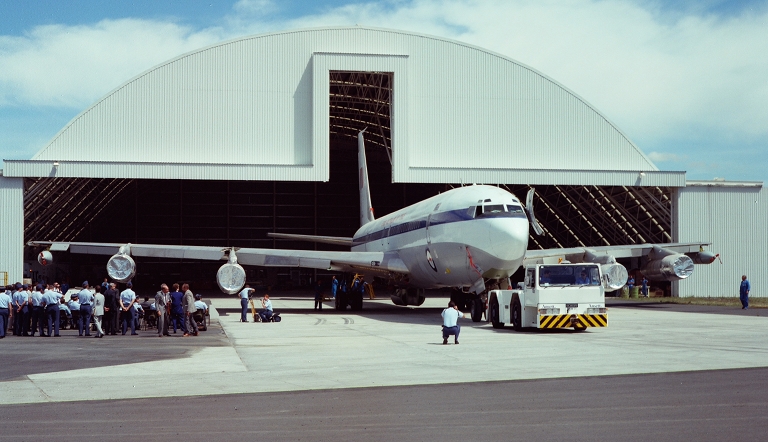
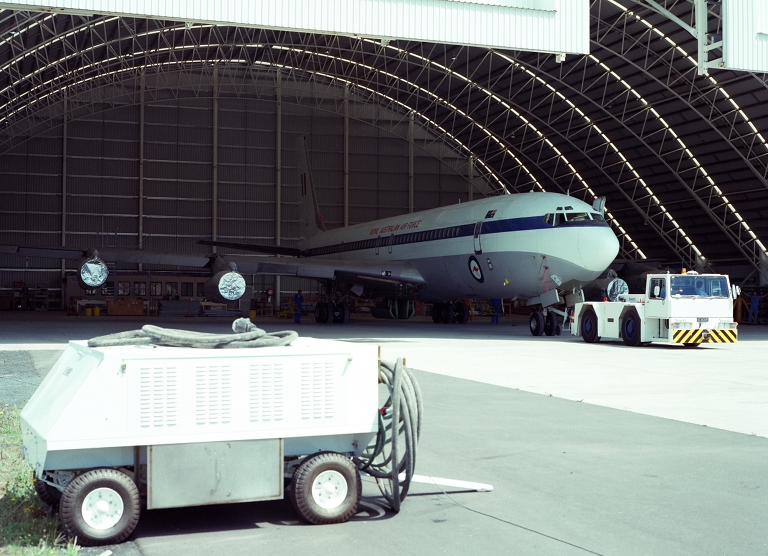
Cameras clicking, A20-629
rolls
out of the new HdH Tullamarine hangar to an audience of dignitaries,
journalists and senior RAAF officers. This is the first aircraft to be
modified and was at the time being prepared for ground testing of the
fuel system installation. Following ground tests and further avionic
installation work, the aircraft entered its flight test program.
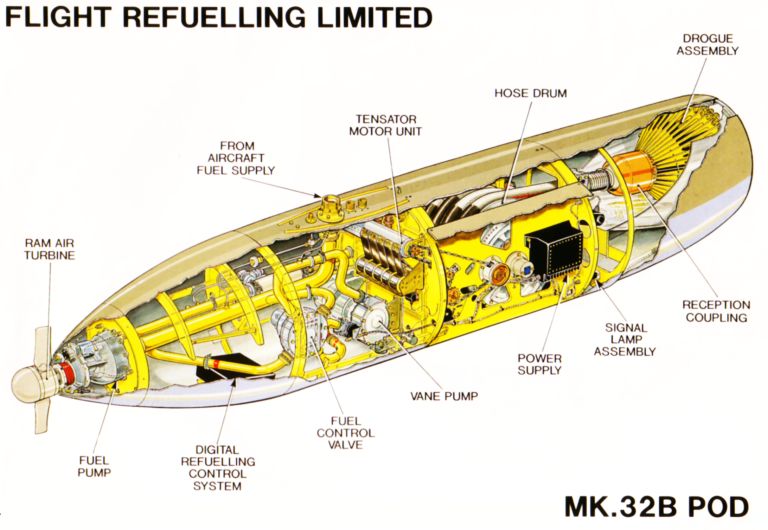
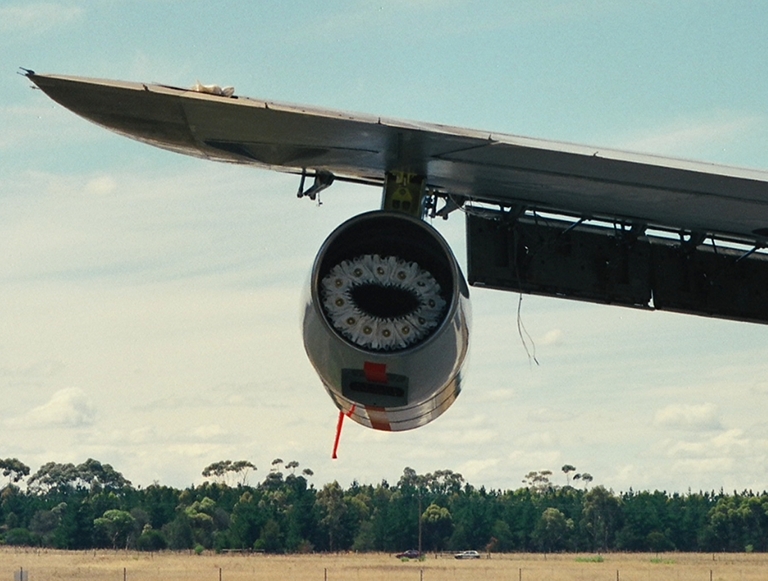
Cutaway of Mk.32B pod.
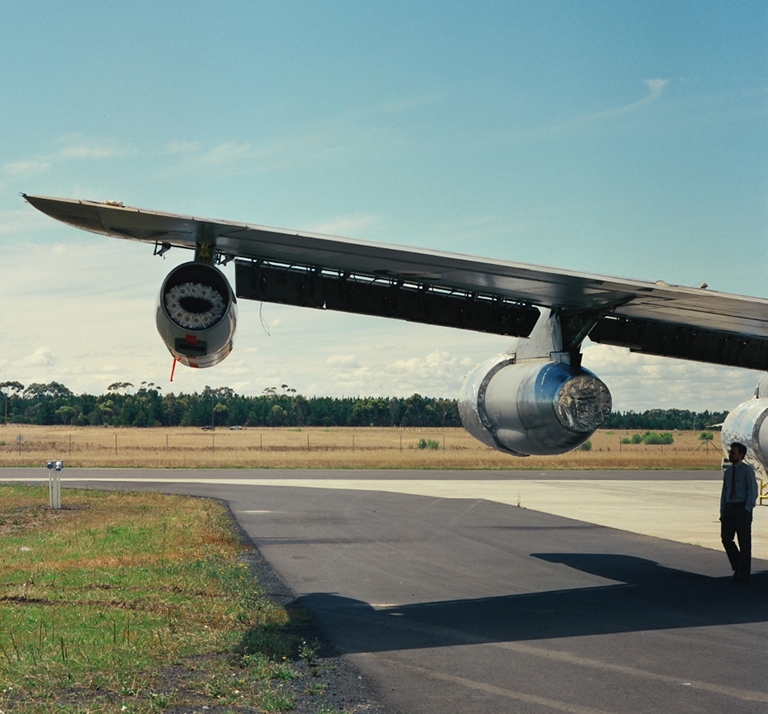
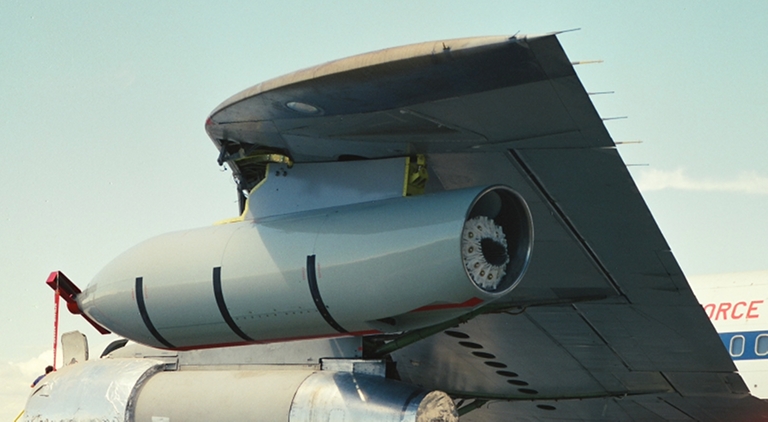
Detail view of the port
wingtip
Mk.32B pod installation. Note that at this time many panels were
removed from the aircraft to provide access to systems for initial
ground testing. The recess in the aft lower part of the pod conceals
the pod status indicator lights. Below further images.
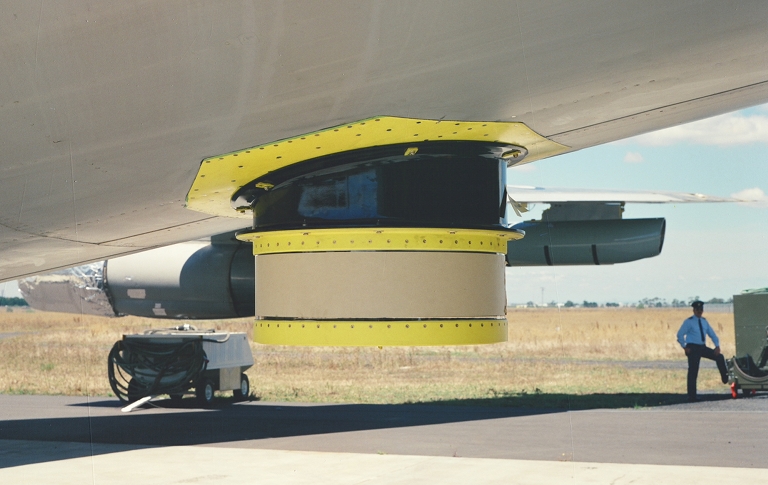
Detail view of the ventral TV camera turret. Note the 360 degree field of view enjoyed by the camera, which is used by the Flight engineer to view the progress of the refuelling operation.
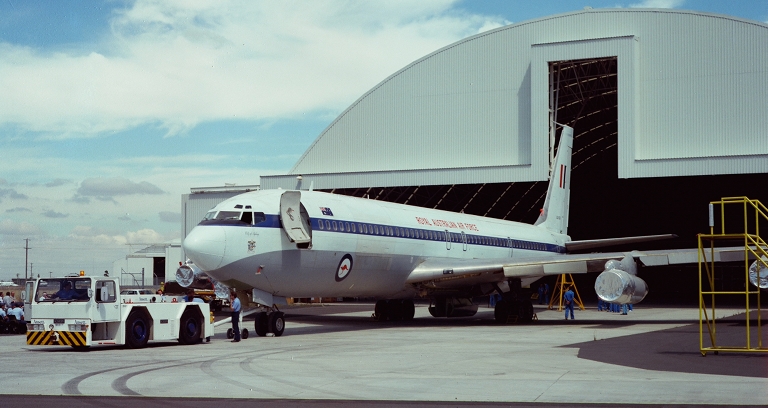
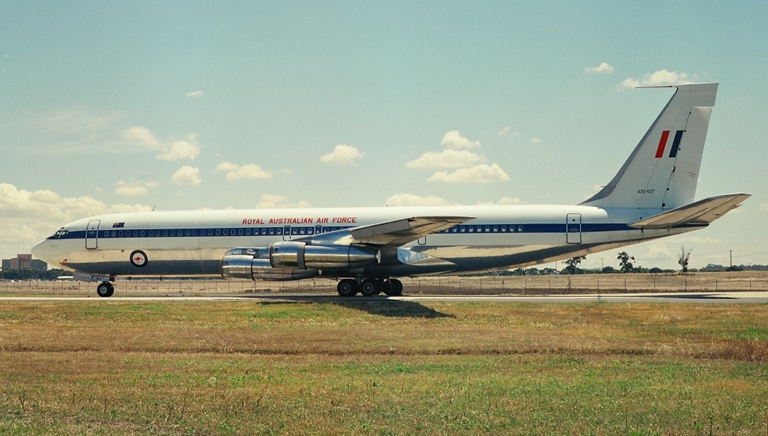
A20-627 awaiting its conversion. The RAAF will be converting four of its six B-707-338C aircraft to dual role tanker/transport configuration. The RAAF Tanker/Transport Upgrade The upgrading of the four B-707-338C aircraft to a dual role tanker/transport configuration involves the installation of AAR hardware and a substantial exercise in installing and integrating AAR mission avionics. The AAR hardware installation includes pumps, plumbing, hydraulics, pods and associated instrumentation and control hardware, while the avionic upgrade involves the fitting and system integration of Tacan beacons, IFF equipment and some additional systems. All hardware fitted is fully Milspec qualified and therefore has a full operational capability. The stated limitation in force operational capability results from the tanker/transports' MTOW limit given the runway lengths available, ie the internal fuel capacity of up to 158,000 lb held in the B-707's wing and centre section fuel tanks is comparable to the typical load of dedicated KC-135 tankers. The aircraft are powered by four 18,000 lb class two spool JT3D-3B (civilian derivative TF-33) low bypass ratio turbofans. Higher takeoff weights could be achieved with CFM-56 high bypass ratio fans as fitted to current build E-3C/E-6A/KE-3A and reengined KC-135R airframes, but this would be rather expensive and is not currently under consideration. While the fitting of fuselage fuel cells and/or bladders is possible, it would offer little in return given the performance limited MTOW constraint. Furthermore, it would restrict the role of the aircraft to AAR alone thus limiting the utility of the otherwise dual role aircraft. Fitting fuselage fuel tankage would bring the fuel capacity up to about 180,000 lb were it ultimately required. To place the matter of force capability in to context, an F/A-18A with 4,000 lb of bombload (ie 4xMk.83 low drag) and three 315 gal tanks (ie 6,000 lb fuel) and full internal fuel (ie 11,000 lb) has a combat radius of about 550 NM. Refuelling inflight at 450 NM on the outbound leg and receiving about 8,000 lb of fuel, its strike radius is increased to over 800 NM. With about 50,000 lb of fuel to offload at this radius, a single B-707 tanker can refuel a strike force of six F/A-18A aircraft. Assuming three tankers available for operations at any given time, one of which is being used as a backup, the RAAF ought to be capable of flying a 12 aircraft F/A-18A strike force against a target at 800 NM. To place this in to further context, an F-111A/C with 4,000 lb of bombload has an unrefuelled combat radius of about 1,100 NM. At about 800 NM combat radius an unrefuelled F-111A/C can deliver up to 8,000 lb of bombload. In an operational situation, assuming the RAAF were to have 12 F-111A/C aircraft available for strike operations, the use of the tankers and F/A-18A aircraft would increase the RAAF's medium range strike capability by about 50 %. That is excellent value for taxpayers' money. The AAR hardware installation is based upon a design produced by the Bedek Division of Israel Aircraft Industries for the Israeli Defence Force, which has several tanker aircraft in service. The system design has had some detail changes to meet the RAAF's engineering requirements, with installation work being carried out by HdH under the supervision, where appropriate, of IAI staff. Most of the hardware is sourced in the US and UK, with remaining components supplied as upgrade kits by IAI. The refuelling pods are manufactured and supplied by Flight Refuelling Ltd in the UK. Internal modifications to the B-707 systems are necessary. The AAR system uses hydraulically powered fuel pumps to drive fuel to the pods, which in turn feed the fuel via hose to the receiver aircraft. Four submerged J.C.Carter fuel pumps are situated in the centresection fuel tank and these feed fuel into 3" pipes via a crossfeed valve arrangement which allows either pod to be fed by any pump. This functional redundancy was adopted to minimise the likelihood of fuel pump failure interrupting an AAR hookup. Under operational conditions one pod will be supplied by a selected pump. The 3" pipes are installed through the wing main spar box using attachments designed to decouple mechanical loads from the wing structure. The pipes then attach to mounting flanges within the wingtip pylons, the pylons are structurally attached to the forward and aft main spars. The fuel management strategy used during AAR operations differs from that adopted for regular B-707 operation, as fuel from the inboard and outboard wing tanks is pumped into the centresection tank from where it is offloaded to receiver aircraft. Hydraulic fluid for the pumps is supplied via 1 1/4" pipes and hoses from two redundant utility hydraulic systems, designated UT1 and UT2. UT1 is the basic B-707 hydraulic system which is powered by two Abex engine accessory drive hydraulic pumps fitted to inboard engines #2 and #3. Typically one fuel pump will be driven by UT1, together with remaining aircraft systems such as flight controls. UT2 is a new installation carried out as part of the upgrade and involves, other than the necessary plumbing, the installation of another two Abex hydraulic pumps on outboard engines #1 and #4. Again, under operational conditions, UT2 will in turn supply the second pod. This highly redundant strategy is designed to allow system operation with full or partial capability in the event of hydraulic or fuel pump failures. The installation employs the latest Flight Refuelling Ltd Mk.32B pods. The RAAF will be the first operational user of the Mk.32B, which is currently under evaluation on USAF KC-10A tanker/transports and is planned for testing on USAF KC-135 tankers. The Mk.32B pod is the latest in a long line of refuelling pods built by FRL. It is a direct descendant of the Mk.32/2800 pod in use with the RAF since the 1980s. Unlike other pod designs which rely upon parent aircraft high pressure hydraulic fluid to drive pumps and drums, the Mk.32B uses a clever combination of fueldraulic and mechanical hardware to achieve the same capability with substantially greater reliability and robustness. In addition, pod control is carried out by a microprocessor based digital controller, which allows pod performance characteristics to be tailored to a particular customer's requirements. The pod is fully self contained and derives its power (ie fuel working pressure) from a variable pitch ram air turbine which is controlled by the pod computer. Fuel fed from the parent aircraft at pressures as low as 6 psi is charged to a working pressure of about 50 psi by a centrifugal pump, which feeds the fuel into a multiport rotary valve, which directs the fuel either back into the parent aircraft fuel system or into a vane pump/motor. The valve position and fuel flow are determined by pod operating mode. Three modes are employed, trail, transfer and rewind. In trail mode, when the pod deploys the hose/drogue assembly, the vane motor acts a pump and thus brakes the drogue as it is dragged out of the pod by the slipstream. Once the drogue is in its proper trailing position, receiver aircraft may connect. Receivers must insert their probes into the drogue reception coupling to connect their fuel line in and then must push the drogue forward to automatically initiate fuel transfer. Proper hose mechanical loading is ensured by a set of tensator springs in the pod, these store mechanical energy as the drogue unwinds the hose off the drum and once in transfer mode, remove hose slack. When refuelling is complete, the energy in the springs is used to wind the hose back on to the drum. While fuel transfer is under way, the high pressure fuel flow produced by the centrifugal pump is fed into the hose and hence receiver fuel system, with flow rates of nominally 2800 lb/min (FRL have quoted better figures achieved in testing). Once refuelling is complete, the receiver falls behind the tanker and disengages its probe when the hose reaches full trail position. In the event of the receiver damaging the drogue such that it becomes a flailing hazard to the tanker, the hose/drogue assembly can be jettisoned. Pod status is signalled to the receiver aircraft with a set of shrouded yellow, red and green lights on the rear of the pod. These together with other pod functions are controlled by the pod computer. The self contained Digital Refuelling Control Unit monitors pressure, temperature, flow rate, position and speed sensors and controls in turn the various valves and actuators required to control the pod. The software continuously monitors pod health and signals its status to a flight deck monitor panel via an ARINC 429 serial databus. The bus also carries commands down to the pod. The pod design had to meet both Milspec and more stringent US FAA requirements for reliability and design integrity, this in turn will translate into very favourable life cycle costs. The software based control system allows rapid adaptation to various types of tanker and receiver airframes, over a wide range of airspeeds (ie 160-325 kt IAS). The pod may be operated at altitudes up to 35,000 ft, it weighs in at 1190 lb. Additional mission support hardware has also been installed to support AAR operation. Floodlights will illuminate the aircraft's tail surfaces to provide receiver aircraft with a clear view of the tanker's tail during night operations. In addition, infrared floodlights illuminate the receiver aircraft so that the tanker Flight Engineer can view the operation, day and night, with a remote television camera. The TV camera, fitted with a servo driven zoom lense, is mounted on a vibration damped turntable assembly inside a ventral rear fuselage turret. This installation allows the Flight Engineer to view the aft lower hemisphere about the aircraft. The camera installation is fully qualified for B-707 operating conditions and also feeds a video tape recorder which is used for postflight debriefing. Flight deck modifications specific to the AAR function include an additional column at the flight engineer's station, mounting control and indication panels for the pods, pumps and lights and a small TV monitor and joystick controller for use with the TV camera system. The navigator's station is transformed into a Mission Coordinator station, with panels mounting a CRT display and controls for the mission avionics. The mission avionics fit is comprehensive. The aircraft will be fitted with new dual redundant inertial navigation equipment (INS), Tacan, IFF and upgraded communications. The INS will be Litton LN-92 ring laser gyro equipment. All aircraft will be equipped with dual redundant Collins SIT-421 IFF transponders, and a forward facing Hazeltine AN/APX-76B(V) IFF interrogator with dipoles mounted on the existing weather radar antenna. A Collins 150 Tacan system will be installed, this consists of AN/ARN-118 and APN-139 subsystems which allow receiver aircraft to locate and rendezvous with the tanker. Additional communications equipment includes a Magnavox AN/ARC-164 UHF transceiver and a Collins DF-301E/F UHF DF set. The Mission Coordinator's console is equipped with a Bendix MultiFunction Display (MFD), which is used for displaying mission control information and weather radar imagery. The aircraft's existing weather radar installation was substantially revised by HdH, who added in facilities for timesharing the radar between the pilots and Mission Coordinator. This was a non-trivial engineering exercise which involved hardware changes to route radar video to the alternate displays. In timeshare mode the refresh rate of the respective displays is halved. Functionally, the MFD will be employed to display radar images overlaid with navigational and IFF symbology, this allows the Mission Coordinator to evaluate weather conditions in a given area and reposition waypoints, tracks and rendezvous positions accordingly. Raw data for this function is provided by the INS, Tacan and IFF interrogator subsystems. In summary the RAAF's tanker hardware upgrade is a lean yet effective combination of state-of-art hardware and existing systems, with sufficient system redundancy to provide a fully operational capability. Project Management The project management structure is divided into the management teams of the RAAF, the prime contractor and the principal subcontractor. The leader of the RAAF group is the part time project director, Group Captain P.J. Rusbridge, to whom the full time project manager, Wing Commander Trevor Couch, reports. The project manager is supported by three RAAF engineers on a full time basis, and by other RAAF personnel from Logistics Command and Air Headquarters as required. These include the Life Cycle Support group, Airworthiness, 486 Sqdn (B-707 maintenance) and 33 Sqdn (B-707 aircrew). During the flight testing phase, flying operations will be under the control of Wing Commander J. Foley, the program flight test director. The prime contractor, IAI, have a small team of senior personnel on site who perform an essentially supervisory role, overseeing the work carried out by HdH personnel. This is particularly important with work being carried out on the first airframe to be upgraded and it is expected that HdH will assume greater responsibility for supervision on subsequent airframes. Interface with IAI's design office and corporate management in Israel takes place via the local team. The HdH organisation is more comprehensive, with various groups from manufacturing, design, assembly and installation making their respective contributions. Installation work takes place at the Tullamarine facility, with manufacturing and design work carried out at the Fisherman's Bend site. At the time of writing installation work was close to completion on the first airframe, A20-629, the roll-out for development and acceptance flight testing taking place on the 12th February. The project has proceeded very smoothly for a systems integration exercise of such complexity involving three major parties. Conventional management wisdom suggests the potential for problems increases with the increasing number of organisations involved in a given task, it was therefore most refreshing to see a program successfully defy the odds. Needless to say, this is no accident, and results from a sustained effort by the management teams of all three organisations. Group Captain Rusbridge indicated that 'The project is characterised by a strong sense of cooperation between all parties involved and a clear commitment to achieving program objectives. This results largely from a firm project management policy based upon harmonious work relationships - being able to openly state your point of view while accepting the other party's point of view...' This strategy has clearly paid off and contrasts sharply with the adversarial contractor/customer relationships which often accompany complex defence programs. The large commitment of HdH upon entering the program is clearly appreciated by the RAAF, the program director stating ' It is a particularly welcome event that HdH showed confidence in the program by making a major capital investment which should ultimately be useful in other applications'. The next major phase of the project is the acceptance testing which will take place from February to April, and as with all projects is the phase which will determine how well the systems integration exercise turned out. Significantly, there is agreement between all parties on testing procedures, a traditional area of disagreement in many projects. Upon completion of acceptance testing the aircraft will be handed over to the RAAF and subsequently returned to operation. No doubt it is eagerly awaited by 33 Squadron. The tanker/transport upgrade program is an interesting case study in project definition and management, an instance where a system has been carefully defined and tightly matched to its role, and where its implementation has been carried out in a relatively painless fashion, largely as a result of solid management practice and good engineering. The final comment is left to the program director, Group Captain Rusbridge: “The RAAF hopes that at the end of the project people will find lots of good things to emulate. This will ultimately be for the overall good of the ADF and Australian industry.” Notes: Imagery produced with Mamiya M645/1000S and Sekor C 80 mm f2.8, using Kodak Vericolor III Pro Type S, and Fujicolor Pro 100 ASA media.
|
| |
|
|||||||||||||
|
|
|
|
|
|
|
|
|
|
|
|||
|
|
|
|
|
|
|
|
|
|
|
|||
 |
|
|
|||||||||||
| Artwork, graphic design, layout and text © 2004 - 2014 Carlo Kopp; Text © 2004 - 2014 Peter Goon; All rights reserved. Recommended browsers. Contact webmaster. Site navigation hints. Current hot topics. | |||||||||||||
|
Site Update
Status:
$Revision: 1.753 $
Site History: Notices
and
Updates / NLA Pandora Archive
|
|||||||||||||
|
|
Tweet | Follow @APA_Updates | |||||||||||
|
|
|||||||||||||
|
|
|||||||||||||