|
||||||||||||||||||||||
 |
||||||||||||||||||||||
![F-22A Raptor, FB-22, F-22E, F-22N and Variants Index Page [Click for more ...]](APA/f-fb-22.png "F-22A Raptor, FB-22, F-22E, F-22N and Variants Index Page [Click for more ...]") |
 |
![People's Liberation Army Air Power Index Page [Click for more ...]](APA/pla-air-pwr.png "People's Liberation Army Air Power Index Page [Click for more ...]") |
 |
 |
 |
 |
 |
 |
![Military Ethics, Culture, Education and Training Index Page [Click for more ...]](APA/ethx-culture.png "Military Ethics, Culture, Education and Training Index Page [Click for more ...]") |
 |
||||||||||||
 |
![Russian / Soviet Weapon Systems Index Page [Click for more ...]](APA/rus-weps.png "Russian / Soviet Weapon Systems Index Page [Click for more ...]") |
 |
 |
 |

|
 |
 |
 |
 |
 |
||||||||||||
 |
 |
|||||||||||||||||||||
| Last Updated: Mon Jan 27 11:18:09 UTC 2014 | ||||||||||||||||||||||
|
||||||||||||||||||||||
|
||||||||||||||||||||||
|
||||||||||||||||||||||
|
|
|
|
|
|
|
|
|
|
|
||||||||||||
|
|
|
|
|
|
|
|
|
|
|
||||||||||||
|
|
|||||||||||||||||||||
| Last Updated: Mon Jan 27 11:18:09 UTC 2014 | ||||||||||||||||||||||
|
||||||||||||||||||||||
| BAe Active Skyflash and AIM-120 AMRAAM | |||
|
|||
|
The
Air-Air Missile is the principal weapon of the modern air
superiority fighter and as such its performance and capabilities can be
one of the determining factors in individual engagements and force
effectiveness as a whole. Advances in modern defence penetration
technology have further diminished the questionable effectiveness of
surface based air defences, increasing the pressure on air defence
aircraft to fill the ever increasing gap.
No more clearly was this evident than during 1991 Gulf war, when the numerically immense and quite modern Integrated Air Defence System (IADS) of Iraq was rendered ineffective in a matter of hours, never to recover from the initial coup. Iraq's interceptor force became the only air defence left to the nation, and due sheer ineptitude on the part of its operators and command, made no useful contribution to the defence of Iraq's airspace. The peculiar nature of this conflict, and the unprecedented incompetence of the Iraqis, have conspired to produce a situation whereby the effectiveness of many current Western weapon systems appears far better than it actually was. An instance of this is the AIM-7 Sparrow SARH AAM, at this time still very much the mainstay of Western radar guided AAMs. The current monopulse AIM-7M/P is the descendent of a line of missile designs dating back to the 1950s, using evolutionary developments of the basic airframe configuration, equipped with increasingly more sophisticated seekers and better rocket powerplants. The fundamental limitation of the established AIM-7 family is its basic guidance principle - Semi Active Radar Homing (SARH) - which requires that the launch aircraft continue to illuminate its target until missile impact. This requirement is a severe limitation when operating in contested airspace, as the launch aircraft's manoeuvre options are constrained, rendering it vulnerable to attack due predictable flightpath geometry. This limitation is equally painful in the air intercept role, as the interceptor is locked into engaging targets one at a time. A clever opponent can easily exploit this by saturating a CAP with more targets than can be handled at that time, getting aircraft through the CAP barrier. An additional handicap for the user of such weapons is the unambiguous launch warning provided to the target by the illuminator, even a rudimentary warning receiver can recognise the signature of an illuminator, allowing the target ample time to react with evasive manoeuvring. Earlier conflicts saw the majority of kills go to heatseeking AAMs which are fire and forget weapons, therefore it was expected that the AIM-7 would fare poorly in Iraqi airspace, contested by fighters such as the MiG-29 Fulcrum and Mirage F.1EQ, both equipped with look-down capable radar, modern all aspect heatseeking and SARH AAMs and modern warning receivers. Reality proved to be very different. The Iraqis lacked the airmanship to even attempt effective evasive manoeuvring, and lacked the operational sense to engage with a numbers advantage, easily achievable due the geography of the conflict. Always flying as singles or pairs, no less than 28 of their aircraft were engaged and destroyed, in excess of 80% of these kills were achieved with AIM-7 Sparrows. A Turkey Shoot in the tradition of the 1944 Phillipine Sea battle, the Iraqi air defence campaign did not offer the environment which would put Allied fighters and AAMs to the test. Reports indicate that the USAF had rushed some AIM-120 AMRAAM rounds into the theatre, but too late to see any action. It is questionable whether any engagement with this weapon would have proven to be anywhere as demanding as test program target engagements, conducted under intense jamming conditions. As it has transpired, the Gulf campaign has severely damaged the cause for newer radar guided AAMs, by creating an unrealistic perception of the effectiveness of the established SARH weapons. Positive AWACS target identification at extended radii, and totally inept tactical and operational practices by the Iraqis allowed Allied pilots to engage from extended radii, with a positional advantage, using the AIM-7. If the Iraqis turned their radar warning receivers on, they certainly didn't take heed of them. The collapse of the USSR has removed the most sophisticated opponent the West has faced since the Third Reich. While the Soviets may not have been as competent technically or as well equipped as Western air forces, they certainly were not stupid, and paid much attention to areas such as operational art and manoeuvre warfare. While we can have no doubt that a conventional Western air campaign against the Communist Empire would have eventually swung in our favour pushing the Communists to all out nuclear war, the Communists would have certainly applied their numbers advantage against every weakness detectable in the Western air order of battle. The reliance upon SARH missiles as air defence weapons would have been exploited mercilessly through saturation attacks, an favourite Communist tactic. The new world order, for want of a better description, will see at least a decade of political turbulence in the Third World, as allegiances change and the balance of power shifts. This instability was first displayed by Iraq, but it is hardly realistic to expect this to be the last perturbation of the next decade. As the major powers reduce the size of their defence forces, the stabilising deterrent effect of these will also diminish. The perception that Western powers are unable to intervene in numbers at some remote part of the globe will prove to be an irresistable temptation for local tinpot dictators. The case of Argentina moving against the Falklands mere weeks after the decision to sell the STOVL carrier to Australia is a classical case study. History has this fascinating property of repeating itself, one may surmise due to the failure of many to study the mistakes of others. This political effect will be exacerbated by sales of former Soviet weapons to any party with cash on hand. It is not realistic to assume that the governments of the former Soviet republics will not sell off the assets of the former Red Army. Faced with total economic and political collapse, with a black market driven economy, they may not be able to stop such sales even if they had intended to. Recent reports of the Russian government encouraging the export of weapons reinforce this argument. The scenario which emerges for the last decade of this century is not necessarily comfortable, if one lives in the neighbourhood of any of the less stable Third World regimes. An abundance of cheap, modern weapons and a knowledge that Western powers are substantially outnumbered on site, will encourage adventurous military behaviour. With most Western economies suffering arms race withdrawal symptoms, Western governments will become increasingly preoccupied with domestic economic problems, which will place further pressure on Western military budgets. An effect we are seeing even at this time is the shrinkage of force sizes, with major reductions in combat capable unit sizes. The pressure this places upon the Western military will not be unlike that presented by Soviet tactical forces during the period of the Cold War, the enemy will be somewhat less sophisticated in terms of skills and technology, but will have a substantial numbers advantage in the theatre of operations. The standard of training may be far greater than that of the Iraqis, as the advisors and instructors are likely to be privately paid mercenary Eastern Europeans. The possibility of former Communist Bloc aircrew being employed as mercenaries similarly cannot be discounted out of hand. There are a great many former MiG and Sukhoi drivers now seeking alternate employment overseas. Under these conditions, many of the arguments raised
originally for the acquisition of new generation weapons to counter the
Soviets still hold, albeit on a numerically smaller scale. Being
outnumbered by a slightly less able opponent still equates being
outnumbered!
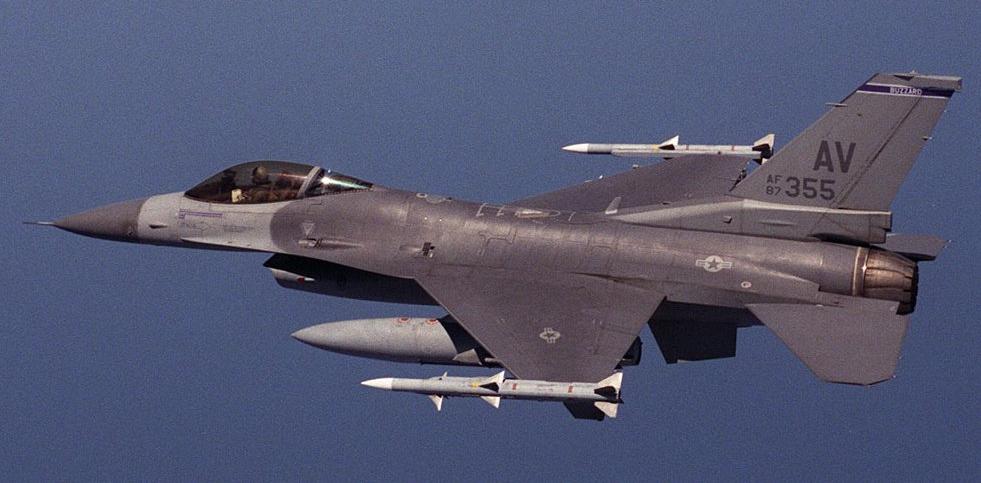
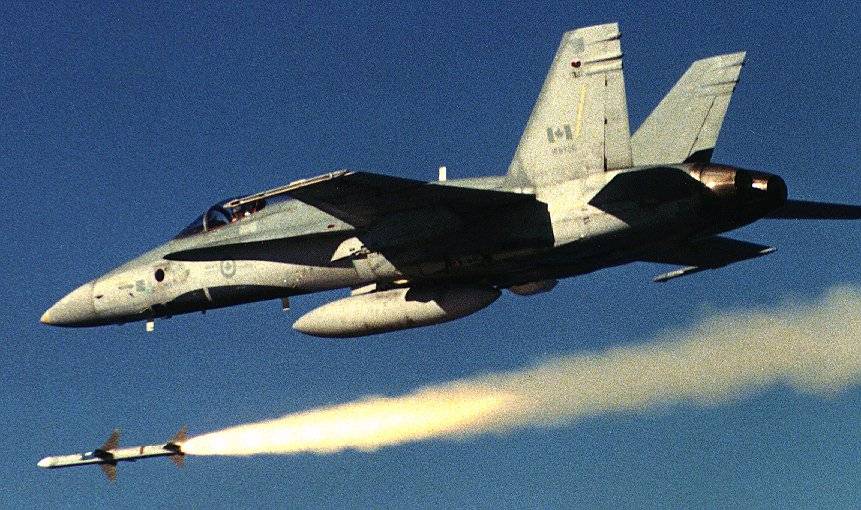
The sophisticated AIM-120A
AMRAAM
is the most advanced radar guided missile in the Western world, with a
lightweight airframe, long range, low smoke powerplant and high
performance active radar seeker. Capable of concurrent launches against
up to 8 targets, the AMRAAM is small enough to be carried by smaller
fighters such as the F-16 and F/A-18 without penalising payload radius
performance. AMRAAM is however itself penalised by high unit costs and
to date only moderate numbers have been purchased and deployed (US Air
Force). The ubiquitous AIM-7
Sparrow
is the mainstay of Western radar guided missiles, and was responsible
for more than 80% of air-air kills in last year's Gulf war. The most
recent versions are the AIM-7P with AMRAAM compatible midcourse
datalink
guidance, and the AIM-7R, which uses a dual mode IR/SARH monopulse
seeker similar to the older Skyflash, providing good performance
against low level targets, while also having a heatseeking capability
for terminal homing. The AIM-7 is the only radar guided weapon used by
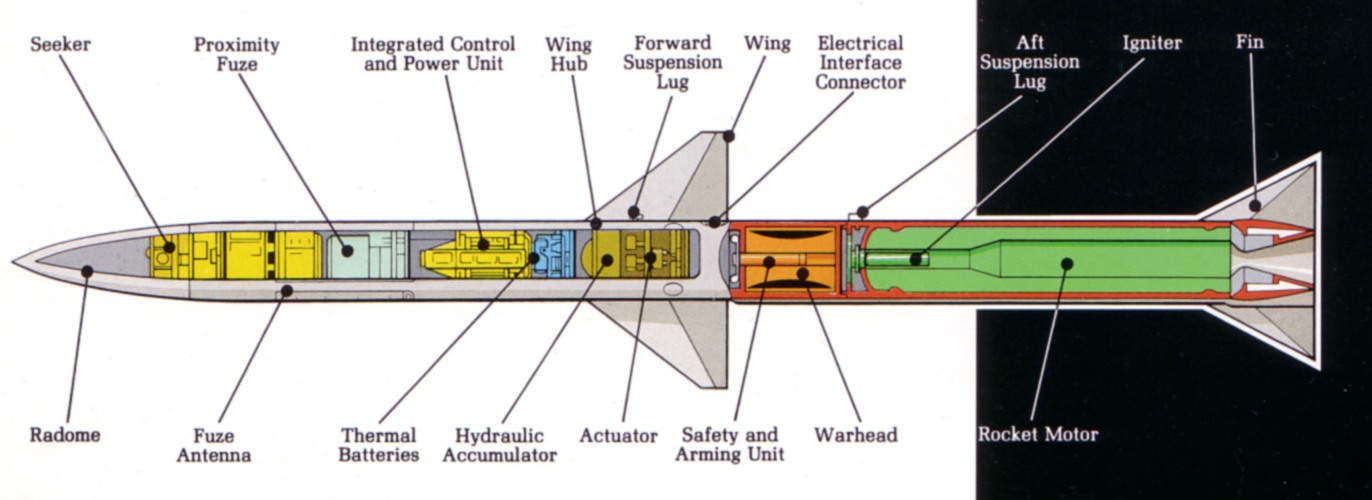
the RAAF's F/A-18A force. AIM-120 AMRAAM - Successor to Sparrow ? The Hughes AIM-120A Advanced Medium Range AAM (AMRAAM) is the designated successor to the Sparrow in US service. The AMRAAM is without doubt the most sophisticated radar guided AAM in service today, with an active radar seeker, midcourse datalink guidance, sophisticated ECCM, low smoke engine, fire-and-forget capability and multishot capability. A lightweight 350 lb class weapon, with range and speed similar to the 500 lb Sparrow, the AMRAAM is a potent weapon (see TE Sept, 1986 for a profile of this weapon). This sophistication and tight packaging came at a cost, both in terms of protracted pain in development and high unit acquisition costs. The stated cost of the missile, as many other US programs, is further exaggerated by the idiosyncrasies of program accounting practised in the US, whereby R&D overheads on projects are amortised across existing production runs, rather than ultimate potential runs, further bloating the figures. The objective in designing the AMRAAM was to provide a fire and forget all weather beyond visual range (BVR) missile sufficiently light to allow even smaller fighters such as the F-16 and F/A-18 to fly air defence missions against a numerically stronger opponent, with tactically useful weapon loads. Utilising a timeshared datalink for midcourse guidance, the track-while-scan fire control radar of the launch aircraft can guide up to eight AMRAAMs against multiple independent targets concurrently, each missile engaging its target once within terminal homing range of the active radar seeker. Alternately, AMRAAMs may be launched fire-and-forget directly in active homing mode at closer range targets to provide a wider dogfight engagement envelope than that provided by the heatseeking AIM-9. Receding supersonic targets at several miles range will usually outrun a small heatseeker simply due propellant exhaustion, the missile's rate of closure under these conditions may be as low as several hundred knots and will decline rapidly once the propellant has burned out. A high performance fighter therefore traditionally stood a good chance of defeating such weapons at range simply due aerodynamic performance. A fire-and-forget missile in the medium range class will however greatly expanding the weapons envelope of a fighter in such engagements, and deny its opponent the option of disengaging from the turning dogfight and making a break for it. AMRAAM therefore represents a major advance in the state of the art, providing an aircraft such as the F/A-18 with an effective air defence capability against multiple closing targets at lower altitudes. Whereas in a conventional scenario the fighter would have to be paired with a target one-on-one, equipped with four or six AMRAAMs it can alone break up a multiple aircraft raid, possibly destroying several aircraft in a single multiple round launch. This provides an appreciable force multiplication effect which, until an opponent acquires comparable weapons, would probably be decisive in a conventional air war. Similarly, the absence of launch warning is powerful tactical advantage, as it is impossible to divine the intentions of an opponent whose radar is operating in track-while-scan mode. Much of the design effort expended upon the ATF (YF-23/F-22) program would be of limited use without the AMRAAM, as the stealthiness of the ATF serves to reduce the useful range of an air intercept radar against the aircraft in a closing engagement. Using its frequency agile radar and infra-red search and track sensor it may not be detected by a less sophisticated opponent, who would then be up against an effectively silent, invisible adversary firing missiles which announce their presence only in the terminal homing phase. The initial intention was for the production cost of an AMRAAM to be comparable to that of an AIM-7, how this was expected to occur eludes the author, as the AMRAAM is at least a factor of ten more complex than the AIM-7. With a frightening cost overhead of developing and maintaining of the order of 100,000 lines of software in the AMRAAM's internal network of microprocessors, an active seeker including a travelling wave tube transmitter, custom integrated circuits and a modern high energy low smoke propellant engine, it is difficult to understand how a machine of such complexity could be built at a comparable cost to a mature development of a fifties airframe, with lower density packaging and far simpler electronics. At this point in time AMRAAM is in low volume production, to equip the USAF and the USN. The USAF had until last year placed a high priority on fitting USAFE F-16s with the weapon, to offset the radar/missile advantage of the Fulcrum A/C deployed by the USSR in Europe. Where the USAF intends to deploy the weapon at this time is unclear. The unit cost figures are also unclear, with various sources indicating costs between US$250,000 and US$1M. In any event, AMRAAM is an expensive weapon and this will limit the rate of its deployment significantly, moreso with cuts in the US defence budget. This of course raises the question of less capable alternatives, as the AIM-7 will be phased out as AMRAAM stocks grow. The US services have large stocks of the AIM-7 and the missile will therefore remain in US service for some time. A possible alternative for other air forces seeking an active missile but unable to pay for the AIM-120 is the new BAe Active Skyflash. British Aerospace Active Skyflash The BAe Skyflash is without doubt the most potent non-US derivative of the AIM-7 family, and was designed specifically to engage low flying targets in closing engagements. It is the principal weapon carried by the Tornado ADV F.2/F.3. The Skyflash traces its ancestry to the AIM-7E2 and early models employed the airframe, powerplant and warhead of the E2, as the longer range of the AIM-7F was not considered necessary for the close-in interception role. The most notable difference against its contemporary, the AIM-7F, is in its ability to engage low radar cross-section (RCS) targets at low altitudes, some sources indicating a capability against targets as low as 250 ft AGL. The follow-on to the Skyflash is the Improved Skyflash, the principal design changes were a series of upgrades to the SARH seeker and a Kinematic Upgrade program, which saw aerodynamic changes to reduce airframe drag and changes to the control system. While the AMRAAM will by used by the Royal Navy on the Sea Harrier FRS.2, the cost of the AMRAAM was seen by BAe as providing a place for a less capable active radar homing weapon, and the Active Skyflash was thus conceived. The seeker employed by the Active Skyflash is a Thompson-CSF
design, a pulse Doppler high PRF (Pulse Repetition Frequency) active
radar seeker with a slotted flat plate planar array antenna. The
antenna
is gimballed to provide a 55 degree off boresight limit, and is rate
stabilised and directly driven by geared motors. In this respect it is
similar to the AMRAAM seeker.
The Active Skyflash
seeker
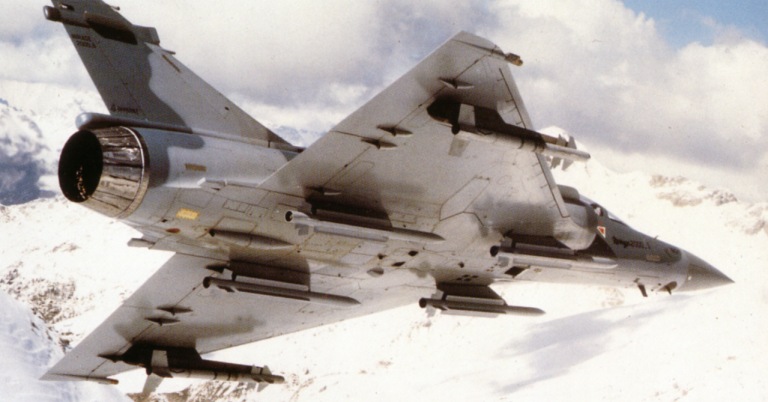
is a derivative of the Matra MICA active radar seeker. This weapon has
been widely exported on on the Mirage 2000 series (Matra images). Where the seeker differs fundamentally from AMRAAM is in the use of an injection locked solid state transmitter, this approach was initially sought by AMRAAM designers but had to be rejected due reliability problems in the then immature high power microwave transistors. The state of the art has progressed since, and the Skyflash seeker exploits the newer and more power efficient technology, which avoids the need for a high voltage power supply, with its associated penalty in weight, volume and power drain. The transmitter is fed from a high purity microwave source, the reference signal from which is amplified by the transmitter chain. In comparison with AMRAAM, the Active Skyflash is likely to exhibit lower peak power output, BAe believe however that the seeker offers comparable acquisition range performance to the AMRAAM which suggests a more sensitive receiver and possibly the use of pulse compression techniques. The receiver is a multiple channel monopulse design, with a single radar frequency which is heterodyned down twice to two intermediate frequencies, before detection and digitising for consumption by the missile's digital signal processor (DSP). The DSP performs target search and identification, and then tracking in azimuth, elevation, range and velocity to provide inputs for the guidance section. The DSP software is resident in EPROM memory devices (firmware) and BAe stress the comprehensive ECCM (counter-countermeasures) features in the code. Again the sensitive nature of such features precludes open discussion. The seeker has a variable PRF capability which allows it to adapt PRF to target engagement geometry, much like AMRAAM. This design strategy allows optimisation for closing or receding targets. Similarly it is unclear how much frequency agility the seeker possesses. The intolerance of solid state microwave power transistors to high standing wave ratio (SWR) in antenna assemblies (ie this is the tendency for microwave energy to bounce off the antenna/radome assembly while inside the missile and feed back into the transmitter, overheating the transistors) suggests less scope for clever manipulation of transmitter parameters, whether this has constrained frequency agility performance is not clear from published material. Due to the sensitive nature of seeker performance, a closer comparison of the AMRAAM and Active Skyflash seekers is not possible in the open literature. As discussed above, AMRAAM's thermionic transmitter and antenna-embedded receiver are likely to provide for somewhat longer acquisition range and a larger acquisition basket, which are probably necessary in any event to match the greater range performance of the newer airframe/powerplant combination. Low altitude performance is highly sensitive to the DSP algorithms used and is similarly difficult to estimate in the absence of real numbers. The active seeker is complemented by a pulse Doppler active proximity fuse, powered by an independent thermal battery. The fuse employs a pair of receive and a pair of transmit antennas, using a slotted waveguide design, this would create a radiation pattern resembling a flattened dumbbell, the plane of which is normal to the missile's longitudinal axis. The antennas are flush with the missile skin, aligned lengthwise. The fuse electronics are largely built with thick film hybrids on ceramic. The proximity fuse is complemented by a contact fuse, the latter using a piezoelectric accelerometer to sense missile impact. BAe claim the the proximity fuse has good resistance to countermeasures and can operate successfully in low altitude clutter. The Active Skyflash seeker feeds the missile's Integrated Power and Control Unit (ICPU) with serial signals proportional to target line-of-sight difference from the missile's boresight in yaw and pitch, and with a signal proportional to target range. The missile is steered by cruciform wings, a pair each generating yaw and pitch inputs, with one pair differentially controlled to provide roll stabilisation. The wings are actuated by solenoid controlled hydraulics, the solenoids driven by DC amplifiers fed from digital to analogue converters (D/A). The heart of the ICPU is an intelligent digital autopilot. Motion sensing, ie accelerations and angular rates, is via analogue/digital converters tied to a group of accelerometers and rate gyros. The digital autopilot reads inputs from the gyro/accelerometer group and the seeker, and uses this information to continuously compute the appropriate control surface positions, to achieve the desired flightpath. The use of a digital autopilot provides for great flexibility in optimising the control algorithms to the geometry and altitude of the engagement. Parameters such as loop gains are selected in response to prelaunch commands from the carrying aircraft, which can interface to the missile autopilot either via an analogue adaptor or a digital Mil-Std-1553B Remote Terminal or Mil-Std-1760A interface. In a typical launch sequence, the launch aircraft initially provides the autopilot with parameters to set gains, and then feeds in a set of bias signals which are proportional to the angular corrections in pitch and yaw required to bring the missile from the aircraft's flightpath to a direction appropriate for collision with the target. During the first half second after launch, the full autopilot function is inhibited with only pitch, roll and yaw stabilisation loops active to keep the missile attitude under control. At one half second after launch until powerplant boost phase burnout, the autopilot reacts to the preprogrammed bias signals. Thereafter, during sustainer burn, the autopilot flies the missile to a point which was preprogrammed before launch, where the active seeker is engaged and terminal homing commences. Alternately, in short range mode, the missile seeker activates immediately after launch and once the target is acquired, bias signals are discarded by the autopilot which commences terminal homing. BAe have stated that the seeker employs modified proportional navigation for terminal homing, utilising information derived from Doppler and body acceleration. The ICPU electronics are powered by a thermal battery embedded in the ICPU section, although prior to the launch command power is drawn from a 200V/400Hz triple phase feed from the launch aircraft. The missile is physically interfaced via a 32-way umbilical cable which carries all power and communications between the missile and launch aircraft, with powerplant firing initiated by a two way motor fire cable. Both interfaces are joined by connectors, which separate at launch time, the interfaces are designed to be physically and electrically compatible (when analogue interfaces are fitted) with the SARH AIM-7E/F/M and Skyflash, although some additional signals must be fed to the seeker before launch to program the autopilot for the midcourse phase. The wing actuators are embedded in the missile centresection, in the wing hub assembly. The wings are actuated hydraulically, with double linear actuators, controlled by valves, which are in turn electrically actuated. Hydraulic pressure is generated by a precharged gas bottle, which is contained in a rubberised bladder, in turn embedded in the hydraulic fluid reservoir. The gas bottle is punctured at launch pressurising the bladder and in turn the reservoir. The hydraulic fluid then enters the actuators through the valves and is vented from the missile once used. The missile warhead assembly follows, a cylindrical structural shell containing a either a continuous rod or blast fragmentation warhead. Typical AAM fragmentation warheads rely upon the warhead shell to break up, usually producing a spherical pattern of high velocity fragments which accompany the blast wave. BAe indicate that the existing warhead is a continuous rod type, although a new blast fragmentation type may be fitted. A tube running through the centre of the warhead contains the explosive booster and safety and arming unit. While carried the detonator is shorted, and the explosive chain is interrupted, with the proximity fuse output shorted by the umbilical connector. The contact fuse is inactive until full arming of the safety and arming unit occurs. The safety and arming unit requires a sustained longitudinal acceleration in excess of 4G, and is energised by the autopilot. The missile will not become fully armed until it is 750 to 1,200 ft away from the launch aircraft. The booster is fired on a signal from either the proximity fuse or the contact fuse. The final structural assembly is the rocket motor casing, which contains a solid propellant rocket bonded to the outer wall of the casing. The boattail section of the tail encases the exhaust nozzle, and is designed specifically to minimise aft section drag. The electrically operated igniter is conventionally situated at the front of the casing, firing down the central cavity. The propellant is layered to provide a two stage boost-sustain profile, initially accelerating the weapon to cruise speed which is then maintained until propellant burnout. The igniter is fired by the launch aircraft through a dedicated (above) signal, just prior to separation. The tailfins are fitted into slots in the boattail. The powerplant, developed in the HOOPOE upgrade to the SARH
Skyflash, provides a similar boost-sustain profile and performance to
that in the AIM-7F/M.
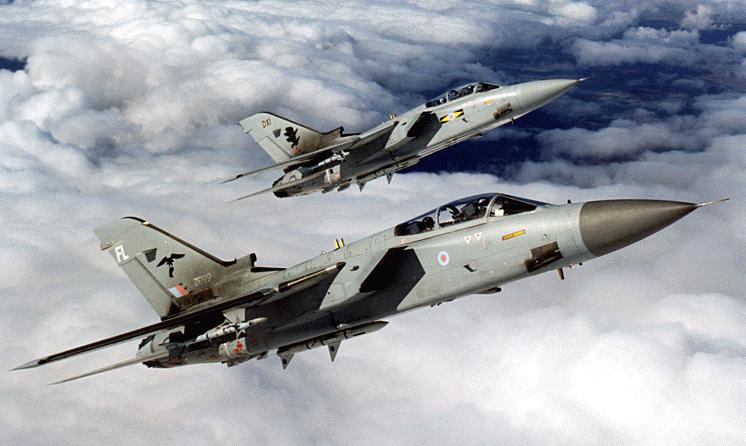
Active Skyflash firing its engine upon release from an RAF Tornado F.3 ADV. An evolutionary development of the Skyflash, itself derived from the AIM-7E2, the Active Skyflash combines an active radar seeker, pulse Doppler fuse and intelligent digital autopilot with the airframe of the late model Improved Skyflash. The Active Skyflash offers many of the functional advantages of the AMRAAM, at a lower cost, but has lower aerodynamic performance than AMRAAM primarily due to older airframe and powerplant design, and is a heavier weapon due basic design (BAe via FAS).
The Active Skyflash retains the airframe of the basic Skyflash/Improved Skyflash, but is fitted with a Thomson CSF active radar seeker. This allows fire and forget launches against multiple targets, which will not become aware of the inbound missile until it is either sighted or its active seeker commences terminal homing. The active seeker has an inherent capability to burn through hostile jamming as the power on target increases as the missile closes with the target.
Weapon Performance Aerodynamically the Active Skyflash is an improved Sparrow and as such suffers the basic limitations of its parent's airframe. With a 500 lb launch weight, the missile offers no payload advantage over its predecessor, unlike the 350 lb AMRAAM, and will exhibit a similar albeit somewhat better manoeuvre envelope to the Sparrow. Against the Sparrow however, the active seeker confers many of the tactical advantages of the newer AMRAAM, allowing the Skyflash to be fired against multiple targets in fire and forget mode, again at shorter ranges than the AMRAAM. As there is no communication between the launch aircraft and missile after launch, unlike the AMRAAM which receives midcourse updates from the launch aircraft, the Skyflash can only be detected in its terminal homing phase, either by a missile approach warning system (infrared or radar), or by radar warning receiver once the active seeker has acquired the target. Theoretically, interception of AMRAAM datalink commands could provide some warning, although not specific to the target under attack, whereas the silent Skyflash offers no warning until it is too late for most targets. The Active Skyflash can be fired in three modes. Normal Mode involves the tracking of the target by the launch aircraft, silent launch of the missile, followed by silent midcourse cruise on precomputed parameters to the acquisition basket, where the seeker is activated for terminal homing. While cruising the seeker is aligned so the target is centred in its field of view, to maximise the probability of engaging the intended target. The launch aircraft may engage a single target at a time with a single target track AI radar mode, or if track-while-scan capable, multiple targets simultaneously. Short Range Mode involves seeker activation shortly after launch, with delay to activation set in accordance with intercept geometry and altitude. Similar to short range mode, the Visual/Reversionary Mode is in effect a casualty mode, allowing the launch of the missile against a target within a cone aligned with the aircraft boresight. The only range figures released to the knowledge of AA indicate that the missile is effective to a range between 17 and 25 NM against a M0.9 closing target, assuming subsonic launch at 20,000 ft, which is typical for an air intercept scenario. The missile can snap up or down by 30,000 ft, although no indications are available as to the range penalty in a snap up launch. Similarly low altitude range will be lesser simply due higher air density and hence lower groundspeed. Against the Sparrow, the Active Skyflash will exhibit better seeker performance at extended radii as the active seeker power on target will rapidly improve as the range to target closes, this allowing attacks on small RCS targets at low altitudes, in a severe countermeasures environment. Because the radar power on target increases with decreasing range to target, the seeker will be able to burn through jamming. Unless a jammer can defeat the missile very early in the terminal phase, the target is doomed. In comparison with SARH Sparrow, if the missile has enough energy to manoeuvre effectively at this range, the active seeker will vastly improve kill probability. In a 'high-noon' engagement against a target firing either a SARH missile or third generation heatseeker the Active Skyflash will confer a substantial advantage in allowing the first shot and providing freedom of manoeuvre after launch. In summary the Active Skyflash offers many of the generic advantages of active missiles such as the AMRAAM, with lesser aerodynamic performance due older airframe design. As such it is a serious contender for those air forces with requirements less demanding than those which dictate the use of AMRAAM, ie adversaries with high power AI radar/missile combinations or forces equipped with lightweight launch platforms unable to carry serious weapons loads (eg Sea Harrier). Whether the RAAF takes an interest in the Active Skyflash remains to be seen, the current budgetary climate is not conducive to the acquisition of another missile type over the established AIM-7 stocks, or derivatives thereof. Certainly were the requirement for an active missile to develop, say as the result of regional acquisition of the Fulcrum or Flanker, the AMRAAM and Active Skyflash would have to come under consideration. It could prove to be an interesting contest. |
|||
|
|||||||||||||
|
|
|
|
|
|
|
|
|
|
|
|||
|
|
|
|
|
|
|
|
|
|
|
|||
 |
|
|
|||||||||||
| Artwork, graphic design, layout and text © 2004 - 2014 Carlo Kopp; Text © 2004 - 2014 Peter Goon; All rights reserved. Recommended browsers. Contact webmaster. Site navigation hints. Current hot topics. | |||||||||||||
|
Site Update
Status:
$Revision: 1.753 $
Site History: Notices
and
Updates / NLA Pandora Archive
|
|||||||||||||
|
|
Tweet | Follow @APA_Updates | |||||||||||
|
|
|||||||||||||
|
|
|||||||||||||