|
||||||||||||||||||||||
 |
||||||||||||||||||||||
![F-22A Raptor, FB-22, F-22E, F-22N and Variants Index Page [Click for more ...]](APA/f-fb-22.png "F-22A Raptor, FB-22, F-22E, F-22N and Variants Index Page [Click for more ...]") |
 |
![People's Liberation Army Air Power Index Page [Click for more ...]](APA/pla-air-pwr.png "People's Liberation Army Air Power Index Page [Click for more ...]") |
 |
 |
 |
 |
 |
 |
![Military Ethics, Culture, Education and Training Index Page [Click for more ...]](APA/ethx-culture.png "Military Ethics, Culture, Education and Training Index Page [Click for more ...]") |
 |
||||||||||||
 |
![Russian / Soviet Weapon Systems Index Page [Click for more ...]](APA/rus-weps.png "Russian / Soviet Weapon Systems Index Page [Click for more ...]") |
 |
 |
 |

|
 |
 |
 |
 |
 |
||||||||||||
 |
 |
|||||||||||||||||||||
| Last Updated: Mon Jan 27 11:18:09 UTC 2014 | ||||||||||||||||||||||
|
||||||||||||||||||||||







|
Sukhoi
Su-34
Fullback
Russia's New Heavy Strike Fighter Technical Report APA-TR-2007-0108 |
| by
Dr
Carlo
Kopp, AFAIAA, SMIEEE, PEng January, 2007 Updated October, 2008 Updated January, 2011 Updated April, 2012 Text, Line Art © 2004 - 2012 Carlo Kopp  |
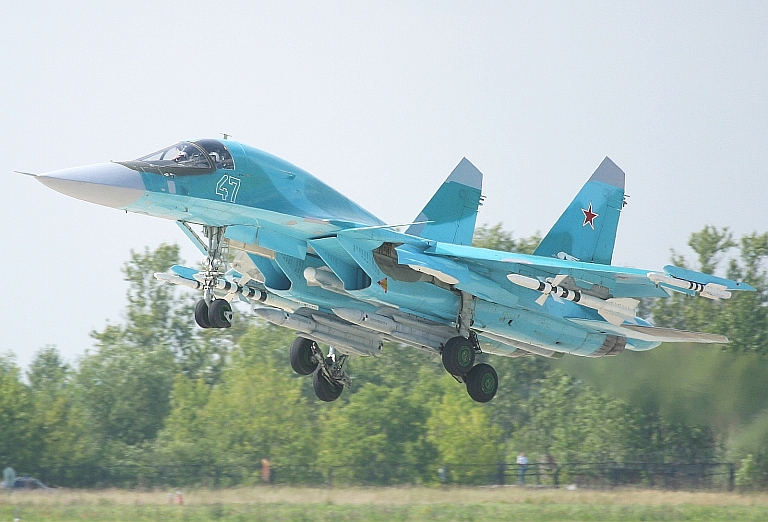 BackgroundWhile the region was seen the deployment and manufacture of hundreds of Flankers since the early 1990s, all of these have been incremental developments of the baseline Su-27S and Su-27UB tandem seat airframes. Since the late 1980s the Sukhoi bureau has been developing a family of derivative airframes, which utilise side by side seating. With the now increasing likelihood of regional buys of these aircraft, this analysis will explore the features, capabilities and growth potential of these Flanker derivatives.This analysis is an updated and expanded version of the original 2004 analysis. |
Resources
 |
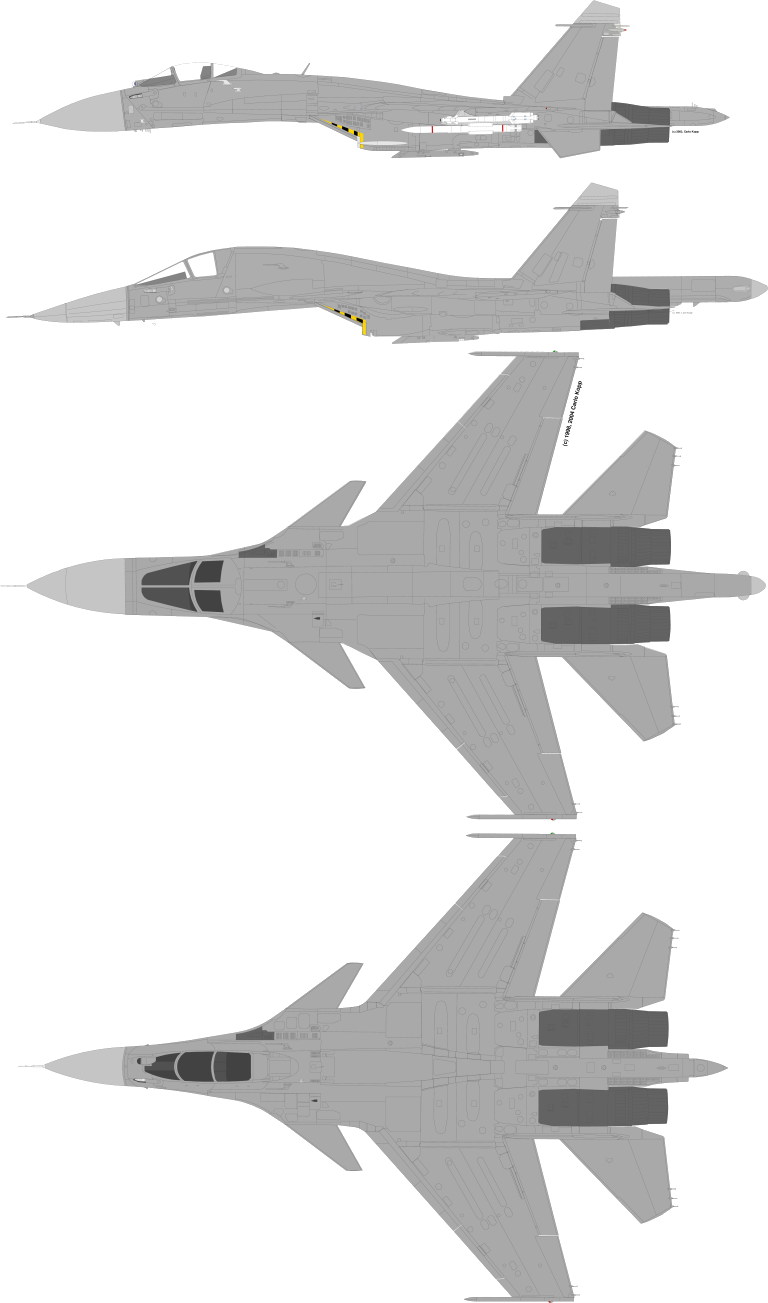 Comparison of
Su-34
and Su-30MK. The
Su-32/34
series
is
a new design, despite its reuse of a large
number of existing Flanker components. The fuselage is largely new
sharing only the aft engine nacelles with the Su-27/30 (Author)
 |
The Su-27IB and Early Fullback DevelopmentDuring the latter years of the Cold War Soviet Frontal Aviation units employed a mixed fleet of battlefield interdiction and theatre strike aircraft. The most potent of these was the Sukhoi Su-24 Fencer, conceptually similar to a smaller F-111, supplemented by the even smaller Su-17 Fitter, a variable geometry derivative of the Su-7 Fitters, and the MiG-23BM and MiG-27, both derivatives of the variable geometry MiG-23 interceptor. Soviet doctrine during that period was being seriously challenged by large numbers of US and NATO teen series fighters, especially the F-15 and F-16. While Frontal Aviation MiG-29 and Su-27S fighters were to win the air battle, allowing the less agile Su-24, Su-17, MiG-23BM and MiG-27 to survive and attack their targets, it was evident to Soviet planners that replacements for these strike aircraft would need to be capable of surviving close contact with the F-16 and especially the F-15. The Sukhoi bureau was intimately familiar with the problem to be solved, as designers of the earlier Su-7, and later Su-17/22 and Su-24, they had first hand exposure to the often conflicting design requirements of these roles. Early Sukhoi thinking concentrated on adaptations of the
baseline
Su-27UB tandem seat trainer, a model since then implemented in the
F-15E-like Su-30MK series exported to China and India. Frontal Aviation
thinking was however that the crew station approach used in the Su-24
worked better for the high workload and potentially long endurance
strike roles. Conceptual design of the Su-27IB as an Su-24 replacement
began in 1983.
Sukhoi Su-24 Fencer A (© 2011, Jeroen Oude Wolbers).
The Su-27IB (Istrebityel Bombardirovshchik - Fighter Bomber) concept solidified during this period, with a much enlarged side-by-side cockpit area more akin to a flight deck in a larger bomber, in a substantially enlarged and reshaped forward fuselage. Specific aims of the new design were to provide better ergonomics for long range / long endurance / high workload profiles, better sanitary conditions for the crew, facilities for the crew to eat meals on long duration profiles, and saving the cost of duplicated cockpit displays and instrumentation. The flight deck was to be fully pressurised, obviating the need for the crew to wear masks through the whole flight. The whole flight deck was surrounded by a welded titanium tub to protect the crew from ground fire. Crew access was via a ladder in the nosewheel well, the dual nosewheel being relocated forward and retracting aft, opposite to production Su-27s. The crew sat on K-36DM zero-zero seats. The much enlarged chined and blended forward fuselage was attached to what was essentially a modified Su-27UB dual trainer airframe, with the production main undercarriage, wing and aft fuselage sting. The ventral stabiliser surfaces were removed. Designed as a deep strike fighter the T-10V-1 prototype included Su-35 canards for low altitude ride improvement and load alleviation, the Su-35 wing and revised fixed inlets devoid of the FOD suppression hardware used on the Su-27S and UB, and limiting supersonic dash speed to around Mach 1.6. The Su-27 stabilators and tails were retained. Internally the centre-section was strengthened to accommodate a 45 tonne maximum gross weight, increased over the baseline 28 tonne Su-27S. Internal volume was increased by about 30% over the Su-27. Other design features were to include a phased array multimode attack radar, internal forward looking IRST/TV/laser targeting system, external podded FLIR/laser targeting system, aft fire control and tail warning radar, and internal defensive jammers. Development was authorised in 1986 with the baseline configuration set in 1987. Leninetz, designers of the Backfire's Down Beat and Bear's Clam Pipe attack radars, and the Foxhound's Zaslon phased array, were contracted to develop the radar, with Ural and Geofyzika contracted to develop the electro-optical systems. The Su-27IB was to be fitted with a heavily integrated digital weapon system, using glass cockpit components, thus emulating the first seen in the US with the digital F-111D two decades earlier. Weapons planned included the Kh-29 and S-25LD Maverick analogues, the KAB-500Kr electro-optically precision guided bomb, the KAB-500L laser guided bomb, and the electro-optical/datalink guided KAB-1500TK GBU-15 analogue. Three of the Kh-59 stand-off weapons, analogous to the AGM-142, were to be carried, or up to six Kh-31 and Kh-35 Kharpunski anti-shipping missiles. For defence suppression, up to six Kh-31R anti-radiation missiles were to be carried. Defensive weapons were to include the GSh-301 30 mm gun, up to eight R-73 Archer WVR AAMs and up to six R-27 BVR AAMs. A total payload of up to 8 tonnes of dumb bombs were to be lifted, including payload of 36 x FAB-250 500 lb bombs. Six B-8M1 rocket pods for up to 120 S-8 rockets, or six B-13L pods for up to 30 S-13 rockets could be carried for close air support tasks. The first prototype T-10V-1 flew in April, 1990, and within months flew aerial refuelling trials and simulated carrier landing approaches on the Tbilisi, in the Black Sea. The aircraft was first publicly exhibited in 1992. The second prototype, the T-10V-2 was built in 1993, adopting the Su-35 wing with additional stations, enlarged internal fuel tanks, enlarged spine and lengthened tail stinger, the production reinforced centre section design, and the representative production configuration of the tandem dual wheel main undercarriage. The first Low Rate Initial Production airframe, the T-10V5 was flown in early 1994 and renamed the Su-34, clearly a play on the aircraft's Frontal Aviation predecessor, the Su-24 Fencer. This prototype was painted in an unusual blue/green camouflage, labelled the 'Su-32FN' and presented at the 1995 Paris airshow as a maritime patrol and strike fighter. Two more SU-34s were built in 1996 and 1997, and presented at the Paris airshow in 1997, again as the 'Su-32FN'. Russian sources claim this nomenclature was further changed with a new designation of 'Su-32MF', presumably standing for Mnogofunktsioniy Frontoviy (Multirole Tactical). While the Su-32FN and Su-32MF/34 are essentially identical T-10V-5 derivative airframes, there are important differences in their intended roles and avionics, and both will be discussed separately. In comparing the basic Su-32/34 airframe against Western
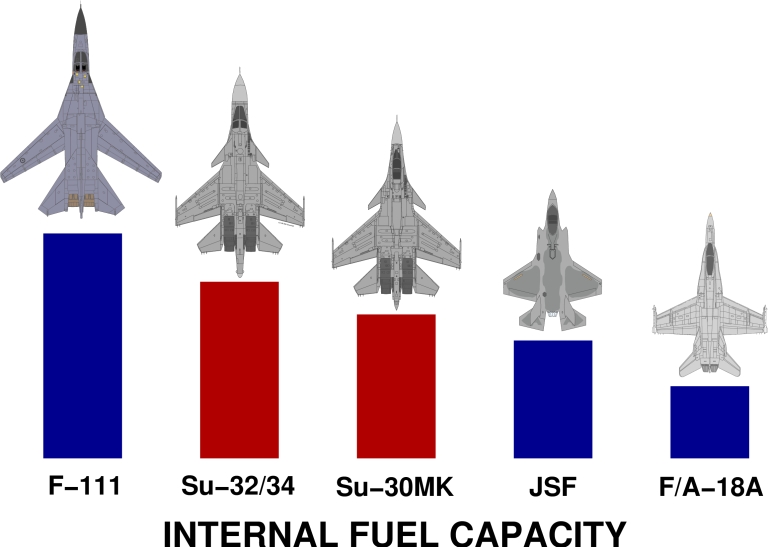
types,
the design with 12.1 tonnes (26.7 klb) of internal fuel sits in between
the Boeing F-15E and F-111 in combat radius and weapon payload
capabilities. It will provide at lower gross weights lower agility than
the F-15E, but higher agility than the F-111. Its top end supersonic
performance is inferior to both US types. Like both US types, the
aircraft is intended to perform low altitude penetration using terrain
following radar (TFR) functions. Unlike the F-15E with a podded LANTIRN
TFR and the F-111 with a dedicated redundant APQ-171 TFR, the Su-32/34
uses a phased array which interleaves TFR and other modes, a concept
used previously only the in B-1B's APQ-164 phased array. |
 |
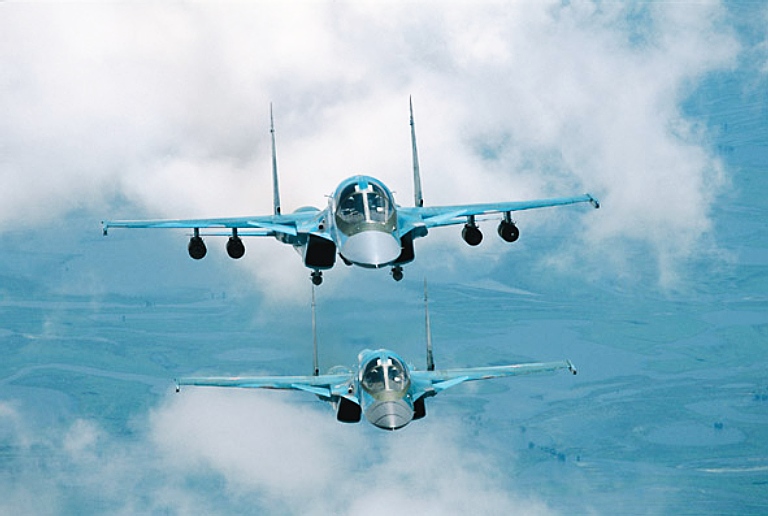 |
 |
 |
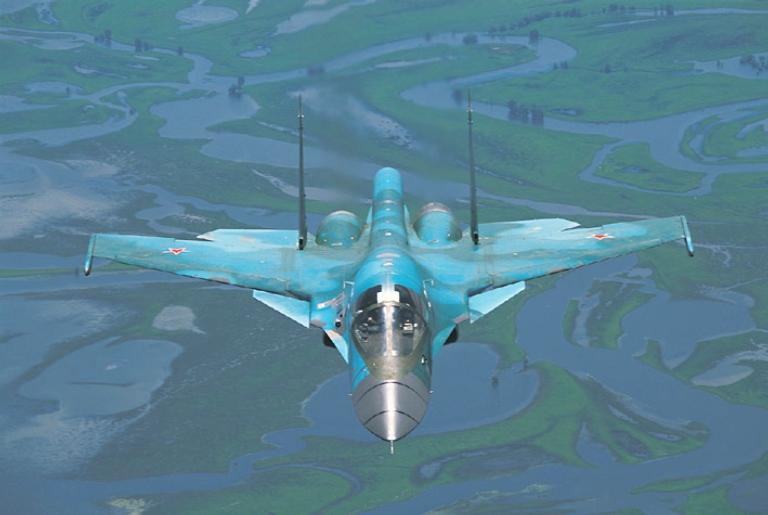
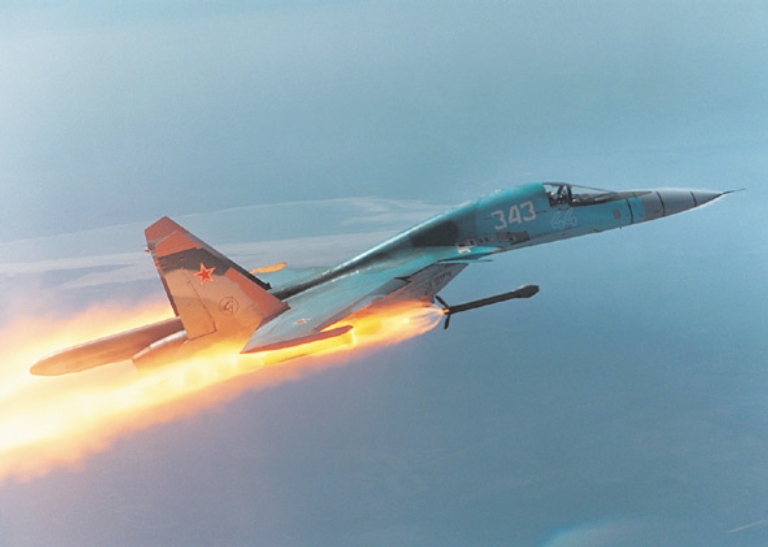 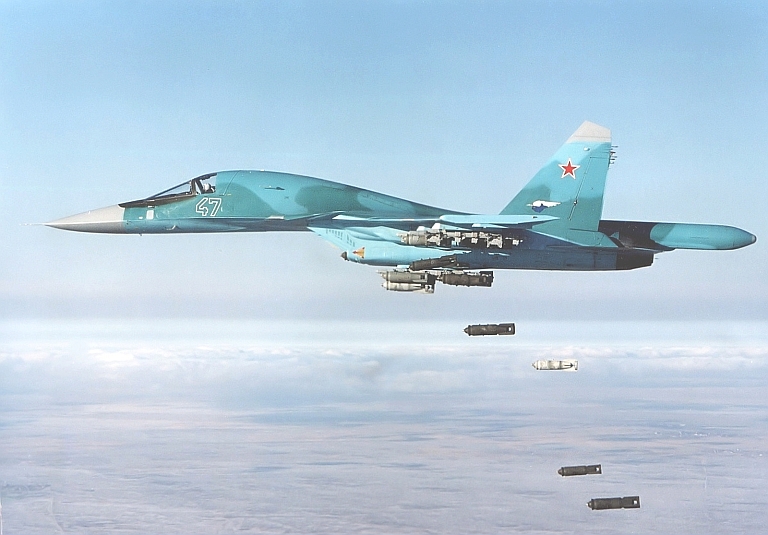 Su-34 Fullback (NAPO images) |
The Su-32MF/Su-34 Fullback Strike Fighter
The basic configuration of the intended production
Su-32MF/Su-34
aircraft is a multirole deep strike fighter, intended to perform the
battlefield interdiction, close air support and deep strike roles now
performed by the Su-24 in Russia, the F-15E in the US and the F-111 in
Australia. In addition the Russians envisage a long endurance / range
air combat role for the aircraft, with the intent to use it to attack
ISR platforms with stand off missiles; in this respect its tasking
reflects early US Air Force thinking on the F-111 series. The manufacturer's website states that the Su-34 is designed
to defeat the F-15, F/A-18 and Eurofighter Typhoon in air combat
engagements. EU reports claim that production Su-32MF/34 will be fitted with the newer AL-41F engines, rated at 35 klb wet/SL/static thrust, rather than the AL-35F used in the demonstrators. However, Low Rate Initial Production (LRIP) aircraft are being delivered with late models of the Al-31F engine, the Al-21MF. The aircraft has an aerial refuelling probe, plumbing for three drop tanks, and can carry the Sakhalin UPAZ-1A aerial refuelling pod performing as a buddy tanker. The primary aircraft sensor is the large Leninets B-004 multimode phased array radar, which uses like all current Russian designs passive phase shifter technology with a Travelling Wave Tube (TWT) transmitter. The radar is claimed to be highly modular with redundant components, reflecting the APQ-164 model to achieve very high mission reliability on long endurance sorties. The X-band design is claimed to achieve a 15 kW peak power rating, although production radars could see the use of higher rating TWT transmitters since developed for the NIIP BARS series. The radar is claimed to provide a range of 200 to 250 km (108
to 135
NMI) against large surface targets, ground mapping capability to 150 km
(81 NMI), Doppler beam sharpened ground mapping to 75 km (40 NMI) and
GMTI target tracking to 30 km (16 NMI), the latter similar to
contemporary Western attack radars like the APG-76. Detection
performance against fighter sized aerial targets is claimed to be 90 km
(48.6 NMI), comparable to the N-001 series. A Synthetic Aperture Radar
high resolution groundmapping mode was planned, and given its existence
in the evolved N-001/N-011M series, does not present difficulties. The
radar provides a low altitude terrain avoidance mode, and automatic
terrain following capability. An inertial navigation system supplemented by a GNSS receiver
(Glonass and likely GPS C/A) is employed. The planned internal electro-optical suite appears to have vanished in more recent reports, with claims that the Sapsan-E thermal imaging and laser targeting pod will be carried externally, probably on the No 9 ventral inlet station. Development Su-32/34 are fitted with a large circular dielectric panel on the upper fuselage, which can only be a satellite communications antenna given its size and placement. No equipment type has not been disclosed. A didgital datalink is fitted but no disclosures have been
made on the type as yet - for situational awareness and air-air combat
the latest TKS-2
standard on the Su-30/35 is the most likely type fitted. The cockpit uses a single dual combiner Head Up Display, and
AMLCD displays. The widely photographed prototype cockpits are unlikely
to represent a production configuration, given the layout of the more
recent Su-30MK and Su-27SKM/SKU glass cockpits. The crew sit on K36DM
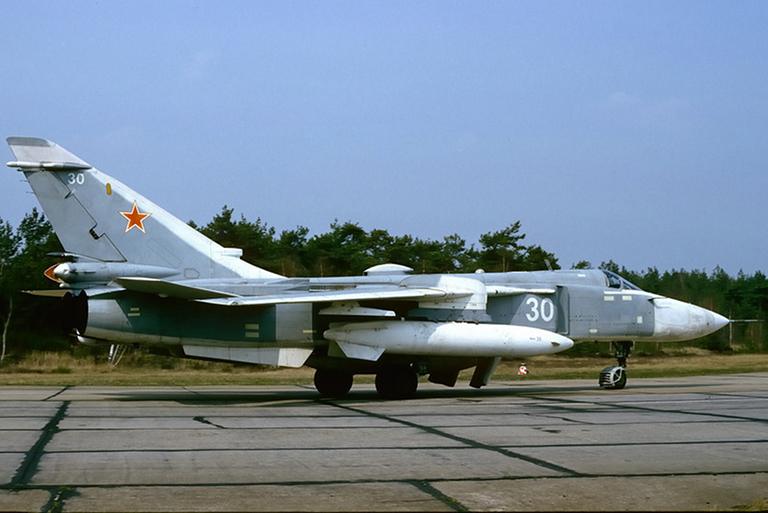
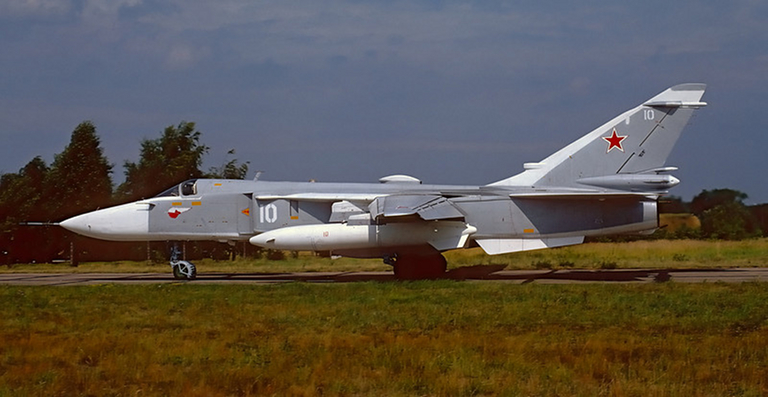
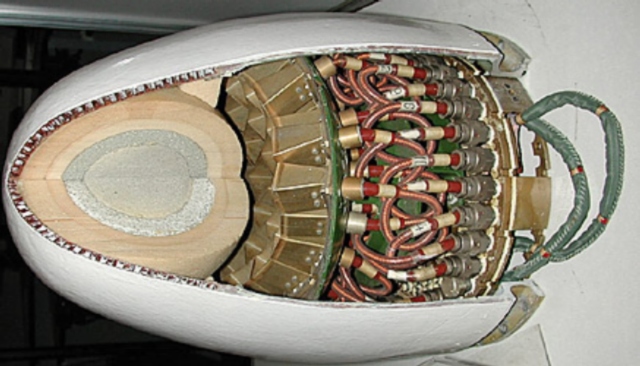
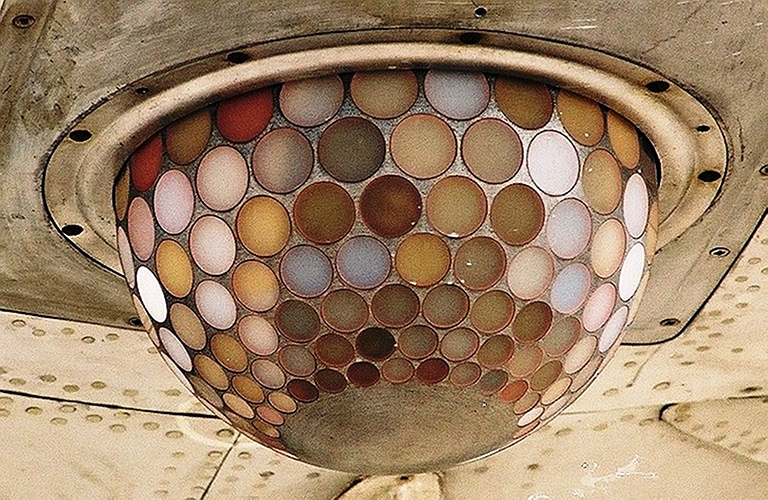
ejection seats. Defensive systems include a Radar Warning Receiver, most likely the current variant of the SPO-32 / L150 Pastel digital receiver carried by the Su-27/30. The podded wingtip mounted KNIRTI SPS-171 / L005S Sorbtsiya-S H/I band defensive jammer has been reported, this system being an evolution of a jammer developed for the Backfire C. The Sorbtsiya-S, unlike most Western jamming pods, is designed to operate in pairs and uses forward and aft looking steerable wideband phased arrays to maximise jamming effect. It is worth observing that the Sorbtsiya is clearly built to provide cross-eye jamming modes against monopulse threats, and the wideband mainlobe steering capability provided by the phased array permits best possible utilisation of available jamming power. A graded dielectric lens is employed (refer image below).
The
KNIRTI
SPS-171 /
L005S Sorbtsiya-S H/I band ECM pods are paired on the aircraft wingtips.
Azovskiy
L-082
MAK-UL
(above)
and L-136 MAK-F (below) infrared threat warning
sensors (images © Miroslav Gyűrösi). 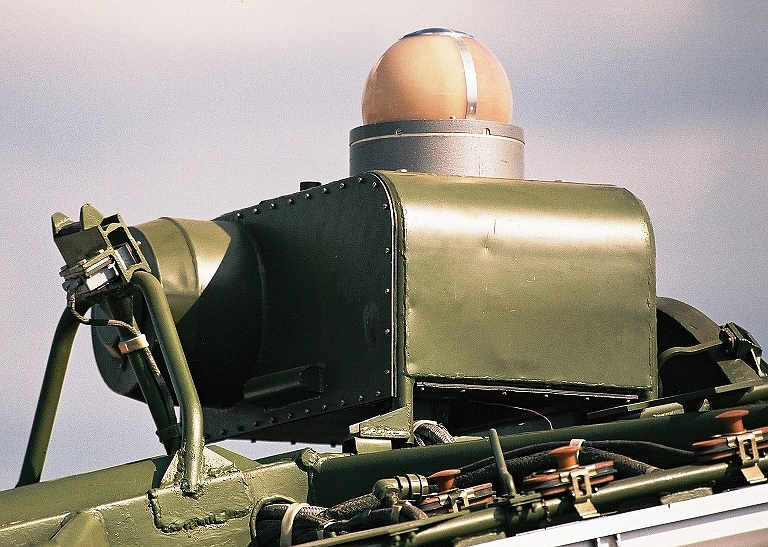
It is likely that a later generation variant of the Azovsky MAK series IR/UV Missile Approach Warning System will be used, such as the L-136 MAK-UFM - the L-082 MAK-UL was carried by the Su-24M in the same role. The APP-50 countermeasures dispenser common to the Su-27/30 is likely to be used. Like some Su-30/35 configurations, the aircraft is to carry the Phazotron/Rassvet N012 tail warning radar, in the after 'stinger'. For air combat the aircraft will be equipped to carry the same R-27 (AA-10 Alamo), R-73 (AA-11 Archer), and R-77 (AA-12 Adder) AAMs now carried by the Su-27/30. This will provide a credible BVR capability against closing fighters, and allows the Su-32MF/34 to be retasked as an air defence interceptor. The radar's GMTI capability is likely to be exploited for cruise missile defence tasks. Like the Su-24 Fencer, the Su-32MF/34 is expected to be used
for derivative roles. For tactical reconnaissance, the likely candidate
pod is the recently revealed M400 centreline pod. It is equipped with a
Raduga multi-band) IR imaging system, AP-403 and AP-404 panoramic
cameras, and optional modules with the M402 Pika SLAR radar and
AK-108FM oblique camera.
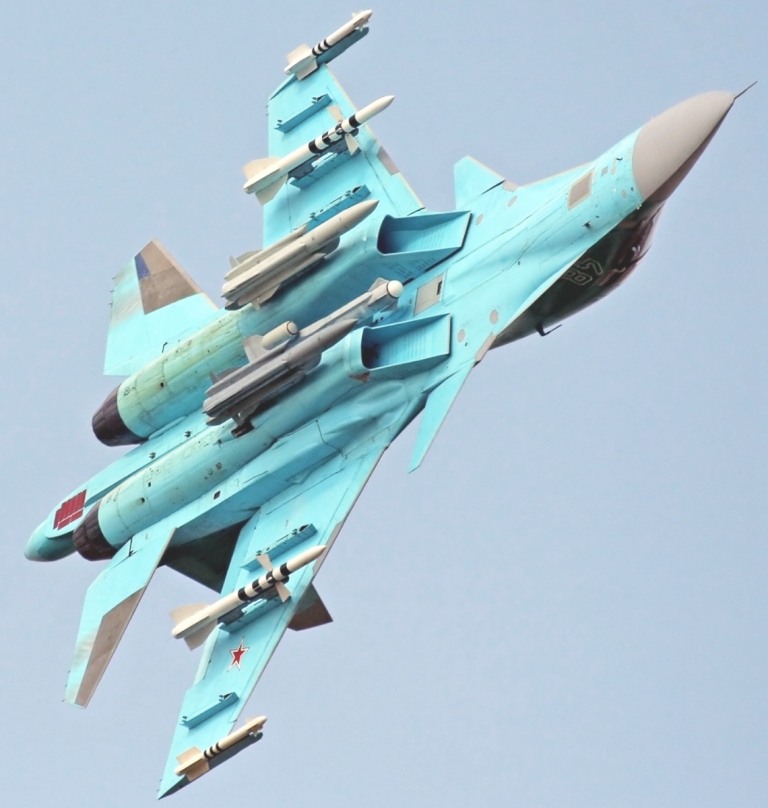
Of more interest in the longer term is the proposed support jamming variant, discussed in the Indian and Russian trade press. This aircraft is a Russian analogue to the EF-111A or EF-18G Growler, designed as a fast support jammer for escort and standoff jamming. The podded L175V / KS418 high power jammer is being developed for this purpose, it being an analogue to the US ALQ-99 jamming pods on the EA-6B and EF-18G. The KS418 is believed to be related closely to the TsNIRTI MSP-418K support jamming pod, claimed to be designed around a DRFM (Digital RF Memory) jamming techniques generator. Air to ground weapon payloads for the Su-32MF/34 will include all of the stores currently cleared on the Su-35, Su-30MK and Su-27SKM. Beyond the weapons envisaged during the early development of the aircraft, the Kh-65 cruise missile has been discussed in EU reports - three could be carried. It is likely the satellite aided inertially guided KAB-500/1500S-E will be included in any production configuration. Russian reports claim the aircraft was trialled in Chechnya. In perspective, the Su-32MF/34 will provide an incrementally
better penetration and strike capability over the top tier production
Su-30MKI and Su-30MKK/MK2 configurations, by virtue of more internal
fuel, higher gross weights, strike optimised avionics, terrain
following capability, better crew
comfort and larger weapons payloads. The Su-32MF/34 will with three
3,000 litre external drop tanks match the radius performance of the
F-111, but with less disposable weapon payload. In the long term the
Su-32MF/34 is important since it provides for a non-US sourced
persistent battlefield strike fighter with the large weapon payload and
sensor package to be effective. Datalinking to remote ISR platforms
with SAR/GMTI is only a matter of time, in technology terms. The Su-34 Fullback entered LRIP last year and the first two
production aircraft were delivered to the Russian Air Force on the 15th
December, 2006. Russian sources claim a requirement for 58 aircraft by
2015, primarily to replace older Su-24 Fencers. |
 Leninets B005 Multimode Attack Radar
phased array. The B004 multimode phased array attack radar is the most
advanced
strike radar ever designed for a Russian combat aircraft. Unlike the
N011M/BARS, the B004 is an optimised bomber radar, similar in many
capabilities to the APQ-164 in the B-1B, and sharing the same
generation of antenna technology. This image shows a prototype radar,
and also exposes the fixed geometry intakes unique to the Su-32/34
series (Sukhoi).
|
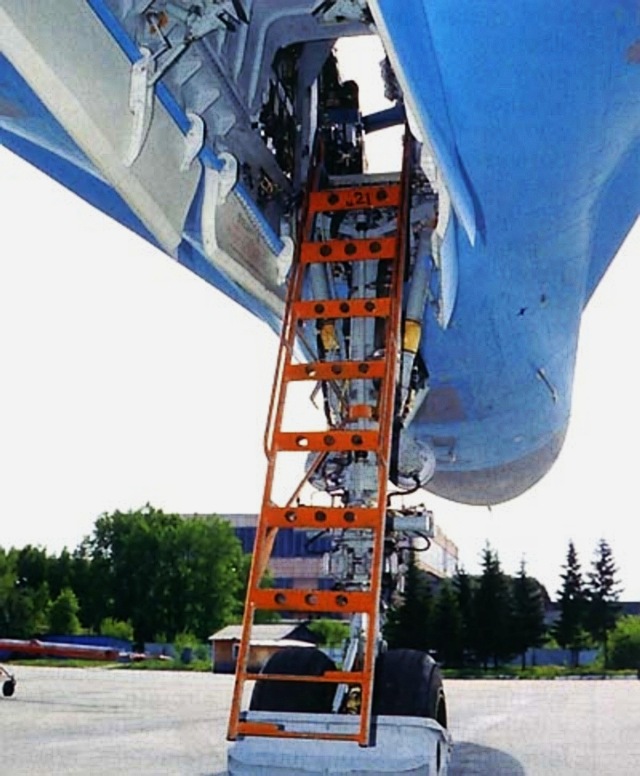 Access
to
the
cockpit
(below) is via the nosewheel well (above). The
demonstrator cockpit shows the spacious flight deck, pressured to
permit flight up to 30,000 ft without masks. A production cockpit is
likely to see the conventional instruments replaced with AMLCDs. Crew
access in the Su-27KUB, Su-32MF/FN and Su-34 is via a ladder in
the nosewheel well, a feature unique to these fighters. This
facilitates forward deployment of these aircraft (Sukhoi)
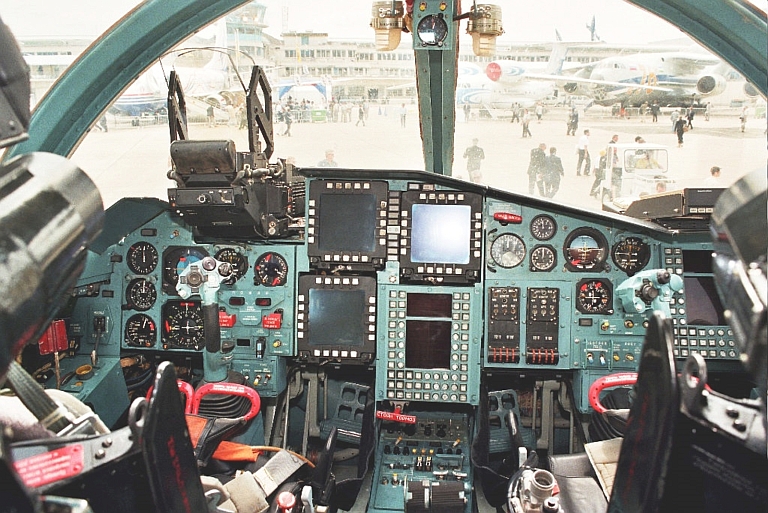 |
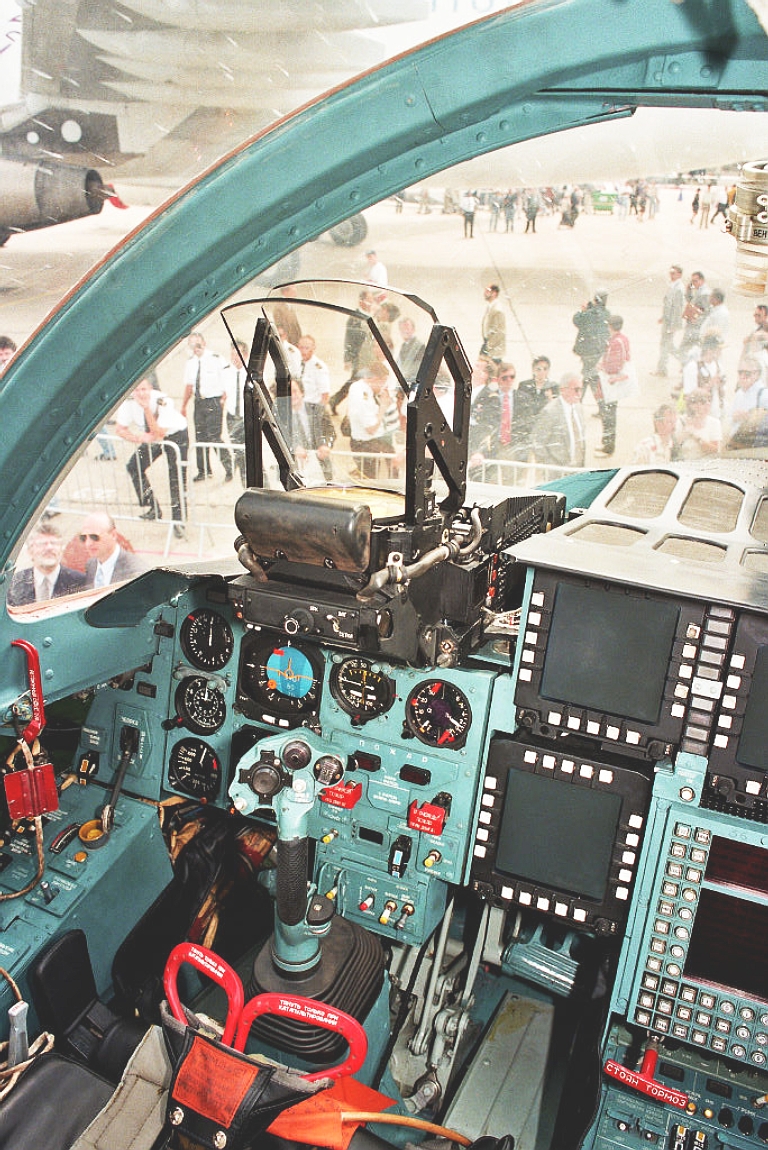 Development
configuration
- pilot station (Russian internet image).
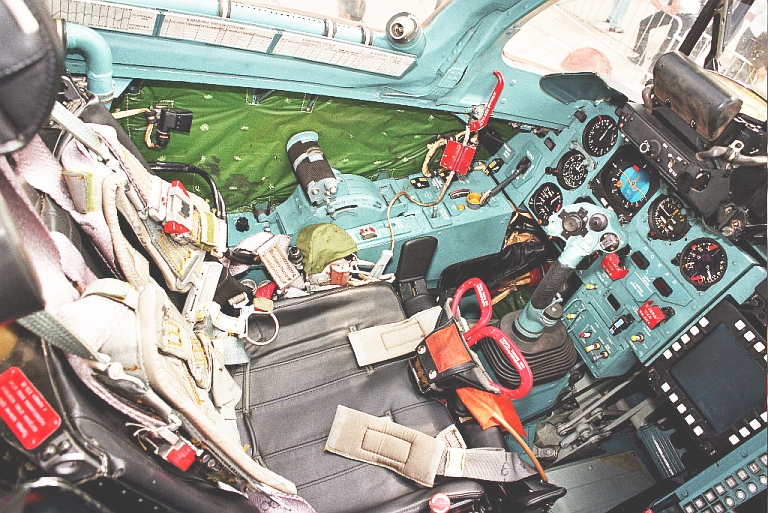 Development
configuration
-
pilot station
(Russian internet image).
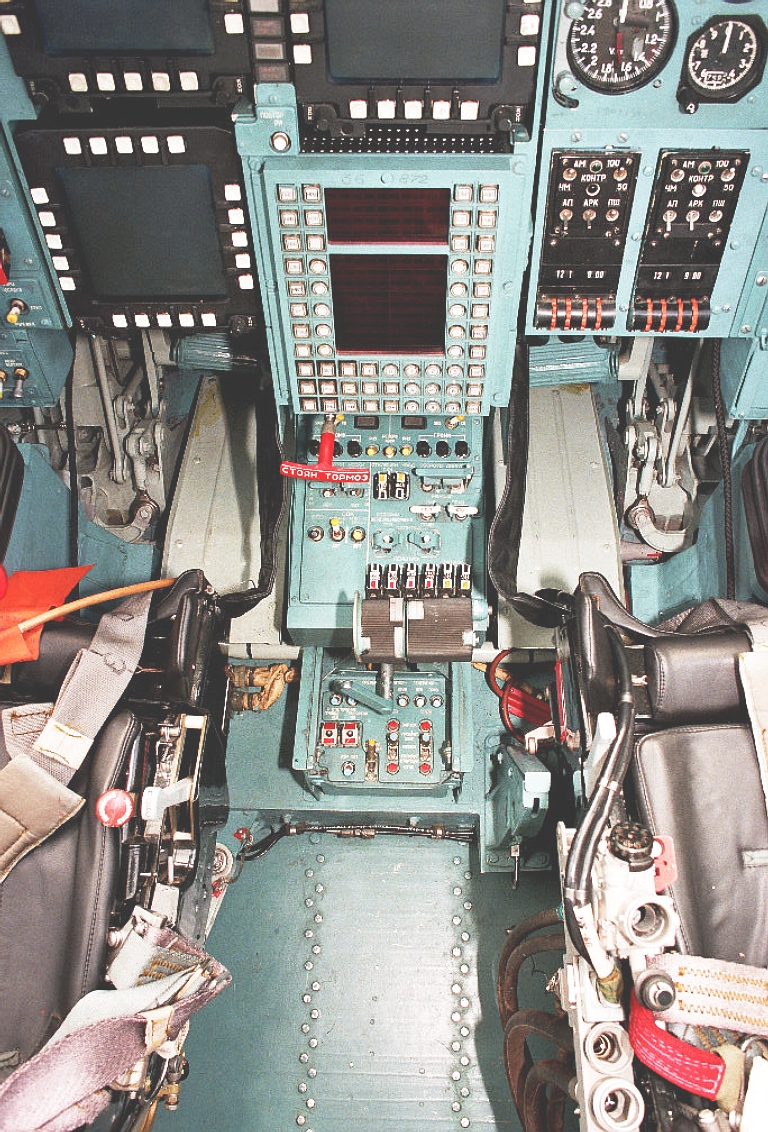 Development configuration - centre console (Russian internet image).  Development configuration - Weapons System Officer station (Russian internet image). |
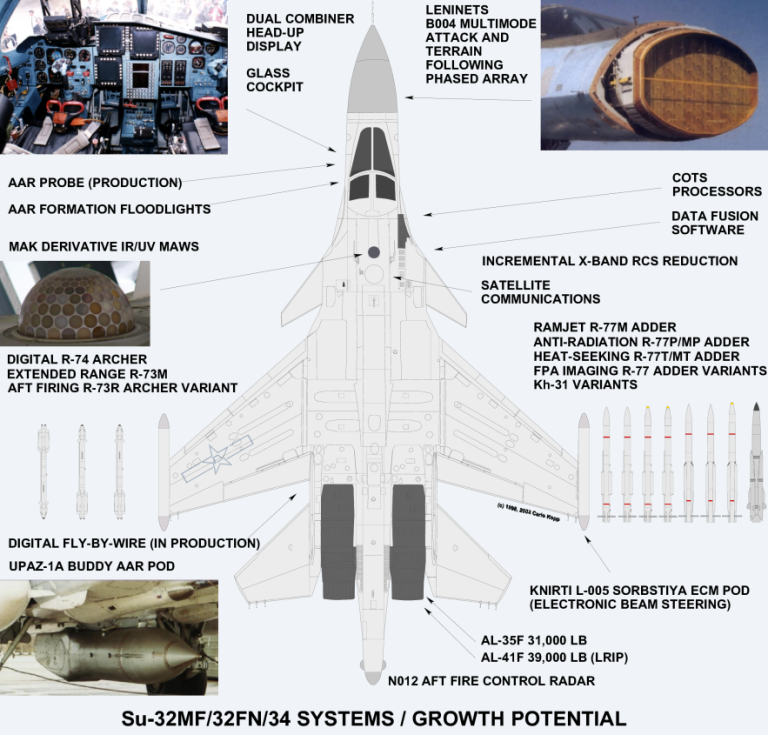 (Author)
|
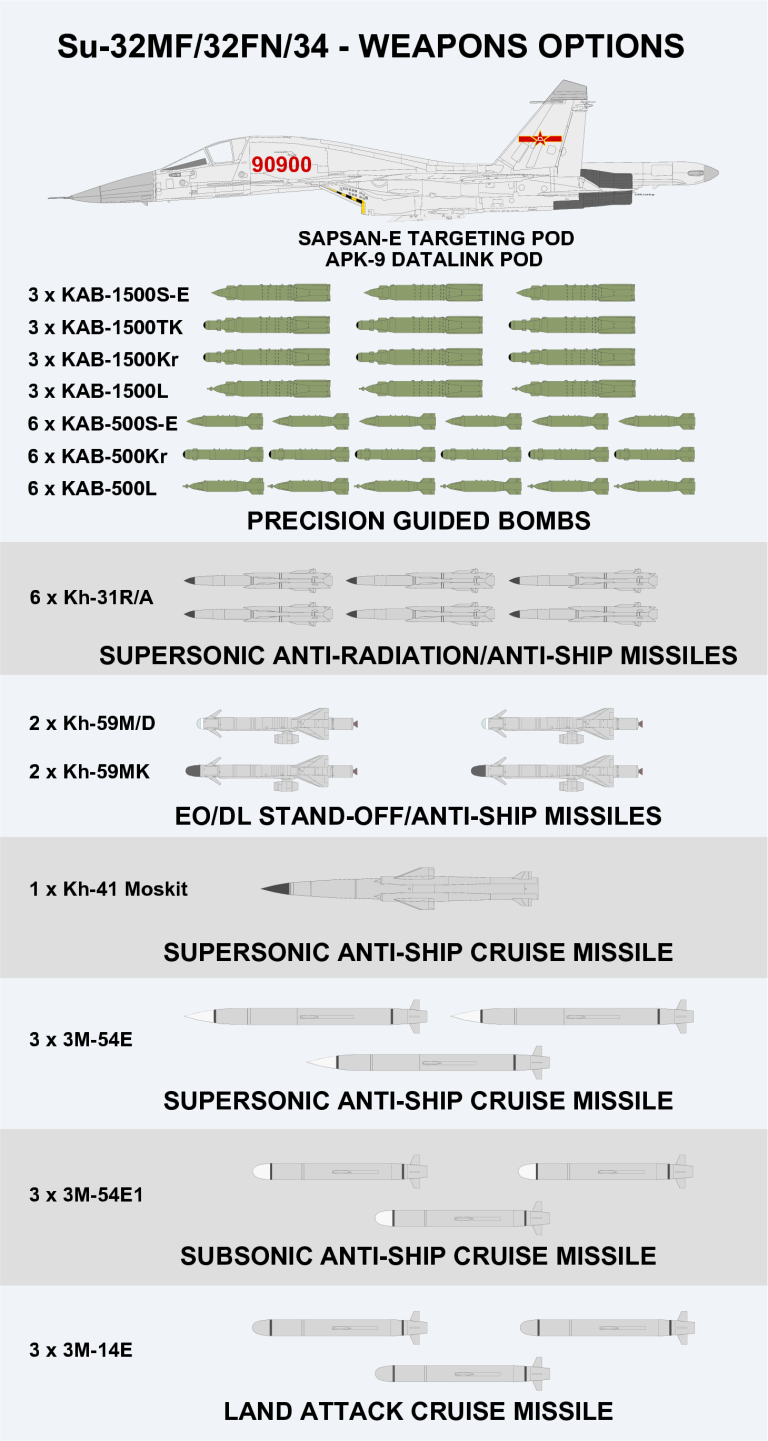 Development Su-32/34 aircraft have been
displayed with the full suite
of current Russian precision guided munitions. The maritime Su-32FN
also also been displayed with the Kh-41 Sunburn, and early mockups of
the 3M-54 family (Author).
|
|
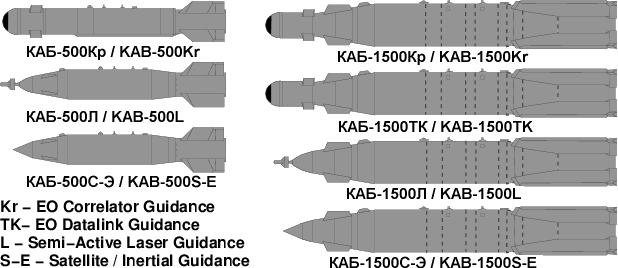
GNPP
KAB-500 and KAB-1500 guided bombs (Author)
|
The Su-32FN Fullback Maritime Patrol/Strike Fighter
The Su-32FN is a unique maritime patrol, Anti-Submarine Warfare and maritime strike derivative of the T-10V design, designed to perform littoral and coastal maritime roles. The inclusion of an ASW capability in this aircraft created much debate during the 1990s, as this role in the West has traditionally fallen on specialised airliner derived airframes. The Soviet LRMP fleet comprised variants of the Tu-142M Bear F and Il-38 May, derived from the Il-18 Coot airliner. To understand the reasoning behind an ASW equipped strike fighter it is necessary to explore latter Cold War Soviet maritime doctrine, and the concurrent US Navy maritime strategy. During this period the Soviets envisaged their ballistic missile armed SSBN fleet operating in bastions near to Murmansk/Polyarnyy and Vladivostok, and other fleet elements defending the Baltic and Black Sea ports. In the event of a full scale war with the West, the bastions, Baltic and Black Sea would be the hunting ground for US Navy and Royal Navy SSNs, while the airspace would be actively contested by F-14s from US CVBGs and land based US Air Force F-15 sweeps. This is an environment which is not conducive to the longevity of LRMP turboprops like the Bear and May. This presented the Soviets with genuine issues in performing maritime patrol and ASW tasks and a highly survivable airframe was a must. As the bastions and approaches to Baltic and Black Sea ports were close to existing land bases, a large strike fighter could provide credible on station endurance, where the station was perhaps 30 minutes of flying time from a runway. While a four hour on station endurance may be modest compared to a turboprop LRMP airframe, proximity to relief aircraft waiting to launch still makes this a viable concept. The result of these pressures was the Su-32FN, devised for the AV-MF to absorb the roles of the AV-MF Su-24 Fencer regiments, and include the 'new' ASW role. It is essentially a supersonic, highly survivable land based equivalent to the Lockheed S-3 Viking. The principal deviation from the baseline Su-32MF/34 was to be the addition of the 'Morskaya Zmyeya' (Sea Snake) maritime patrol avionic suite, since then to be fitted in the reported to be collapsed Indian Navy Bear F avionic upgrade, and a suite of maritime strike and ASW weapons. The suite is claimed to include an Electronic Support Measures receiver and Magnetic Anomaly Detector. For 'classical' maritime strike roles, the Su-32FN is to be armed with up to six Kh-31A or Kh-31R ASMs, six Kh-35U ASMs, up to three Kh-59M/D stand-off missiles, the potent supersonic Kh-41 Moskit (Sunburn) and 3M-54 Alfa supersonic ASMs. Photographs indicate that the centreline adaptor for the Kh-41, developed for the Su-33, would be reused, although one mid 1990s report claimed carriage of two rounds on wing stations. Original Alfa missile mockups were also photographed on the inboard wing stations, this missile has since evolved into the 3M-54/3M-14E (SS-N-27) Club series. The more interesting stores are lightweight ASW torpedoes, carried in pairs on stations 8 and 9, for a total of 4 rounds, and a conformal centreline pod which can be loaded with up to 72 sonobuoys of various types. An ASW patrol weapons mix would probably involve a mix of these stores, drop tanks and depth charges. Unlike the conventional Su-34 strike variants, the Su-32FN has
yet to enter production. |
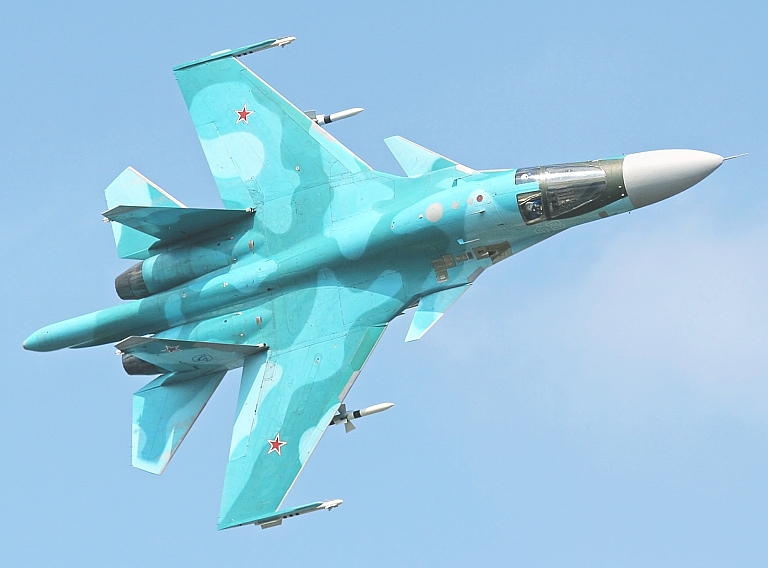 |
 |
 |
 Su-34 Fullback (NAPO images) |
  Rollout
of
LRIP
Su-34
Fullback Airframe No.2 at NAPO Plant (MilitaryPhotos.net)
|
Su-32MF/34 and Su-32FN vs the RegionThe funding shortfalls suffered by the Russian Air Force and Naval Air Arm have seen the plan to replace the 400+ Su-24 Fencer inventory, and remaining examples of the Su-17/22 and MiG-27 postponed repeatedly. Sukhoi and Rosoboronexport have understandably been actively marketing the aircraft for export - a export production run would see the non-recurring expenses in tooling up and completing avionics integration absorbed by an export client, reducing the cost to the Russian Air Force and other export clients. While there has been some speculation about the Indian Air Force signing up, it has a big enough challenge in fielding its 180 aircraft run of Su-30MKIs, an aircraft which provides a large fraction of the Su-32MF/34's capabilities. The more probable client in the forseeable future is China. Russian media reports indicate that a cabinet level PRC delegation visited the NAPO plant in Novosibirsk to inspect the Fullback production line. Unlike PLA-AF Badgers which have the option of launching long range land attack cruise missiles from outside the footprint of interceptor and SAM defences, the same is not true for PLA-AF and PLA-N maritime strike operations against surface warships, especially in the Taiwan Straits and South China Sea. In a time of confrontation, this would be airspace contested by RoCAF fighters and likely US Navy F/A-18s, yet the Badgers must close to a radar line of sight with their targets before they can launch their missiles. Anti-submarine patrol sorties also present a genuine challenge, with a real strategic need for the PLA-N due to Taiwan's SSK fleet planning and the prospect of US Navy SSNs blockading Chinese ports. The PRC faces a strategic problem not unlike the AV-MF did in defending its maritime bastions - turboprop LRMP aircraft stand little chance of surviving to perform their role. We should not be surprised if the PLA-N air arm does order the
Su-34, the Su-32FN, or some mix or hybrid of these types. The
aircraft is a much better fit for the role than the current batch of
several dozen Su-30MK2, and can absorb the littoral maritime patrol/ASW
role. This would permit remaining PLA-N H-6D Badgers to be converted
into tankers to support the Sukhois. The regional deployment of production Su-32/34 derivatives
will present yet another incremental step in regional capability growth
-
again at the expense of Australia's strategic position in the region.
|
Production vs Development Fullback ConfigurationsSince the Fullback entered Low Rate Initial Production some further details have emerged on the configuration of the production aircraft. Polish analyst Piotr Butowski publishing in the German FlugRevue journal, detailed the following configuration for the Sch-141 Kishchnik avionic suite:
Long term planning is to see higher thrust engines, evolution of the mission avionics, an AESA radar and future munitions integrated. The cockpit shows the most prominent changes against the developmental design, and now includes a full 'glass' configuration with an array of multifunction displays for the pilot and WSO.  Production
Su-34
pilot
station (Russian internet images).
 Production Su-34 WSO station (Russian internet images).   Production Su-34 centre panel with standby AH and other instruments (Russian internet images). 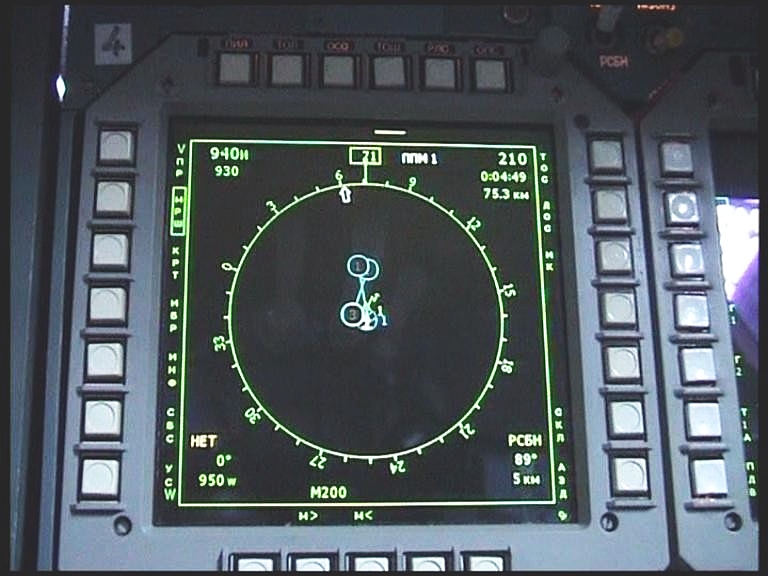 Production MFD in navigation mode (Russian internet images).  Production MFD in moving map display mode (Russian internet images). The ventral electro-optical
targeting system provides a limited capability and is only suitable for
medium/high level deliveries, due to its limited field of regard. It is
likely to be soon supplemented by a licence built Thales Damocles
thermal imaging and laser targeting pod. Russian sources claim that the
Russian MoD licenced the pod design, expected to be built by the Ural
Optical Mechanical Plant (UOMZ), after exposure to the design during
the integration of the pod on the Malaysian Su-30MKM Flanker H. Future
candidates for the pod, other than the Su-34, are the Su-35-1/35BM
Flanker F, the Su-27SM/SMK Flanker B+ and upgraded Su-24M2 Fencer. The
pylon installation, given hardware commonality between the SU-30MK and
Su-34, is likely to be identical for both types. It
is not known whether the Su-34 will use the Shchel series helmet
mounted display, or the Thales
Topsight which has been integrated on
the MiG-29K Fulcrum. 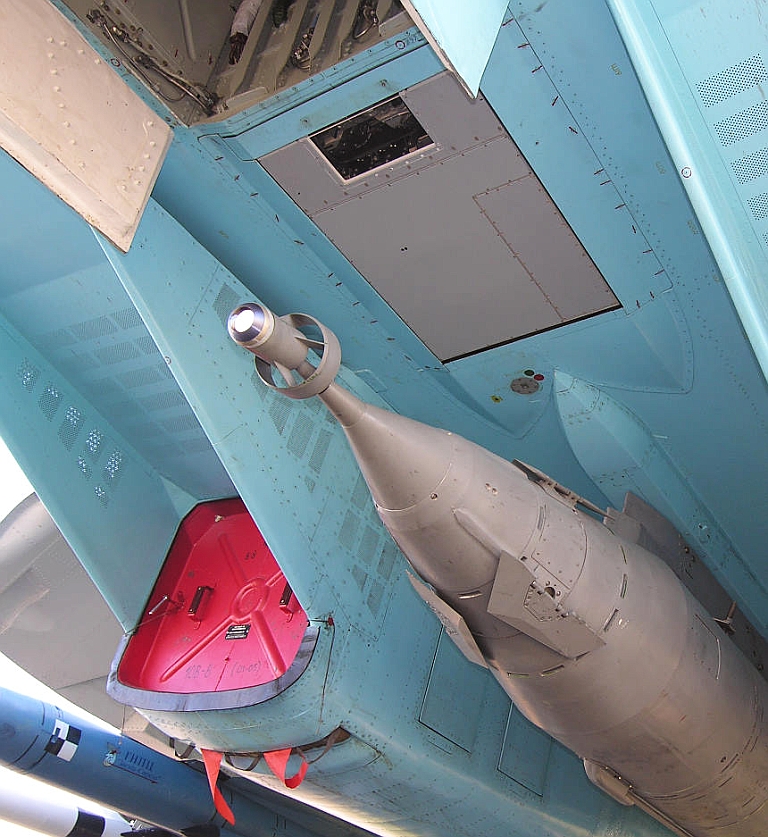 Electro-optical system
ventral
aperture. Note the GNPP KAB-1500L 3,000 lb laser guided bomb on the
centreline station (Russian internet images).
  Thales Damocles electro-optical targeting pod (Wikipedia image). 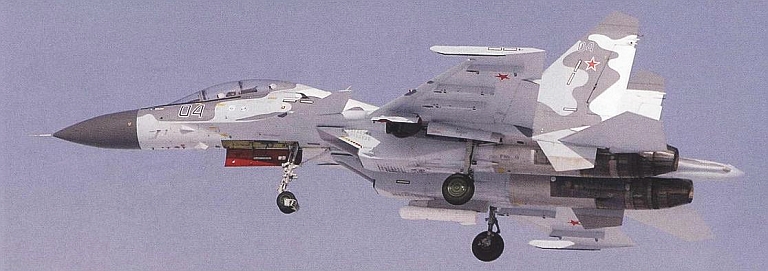 Thales Damocles pod during integration trials on Su-30MK.  Thales Damocles pod pylon on Su-30MKM right inlet station. 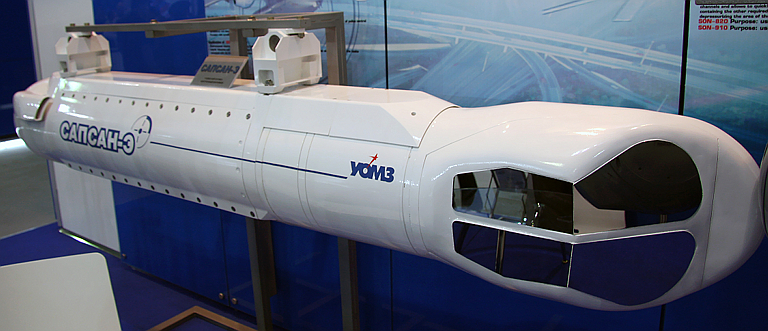 The UOMZ Sapsan E Electro-Optical Targeting System pod is
likely to be offered as an alternative to the licenced French Thales
Damocles targeting pod (©
2009 Vitaliy V. Kuzmin).
|
 |
 Su-34
Fullback
(NAPO
image)
 |
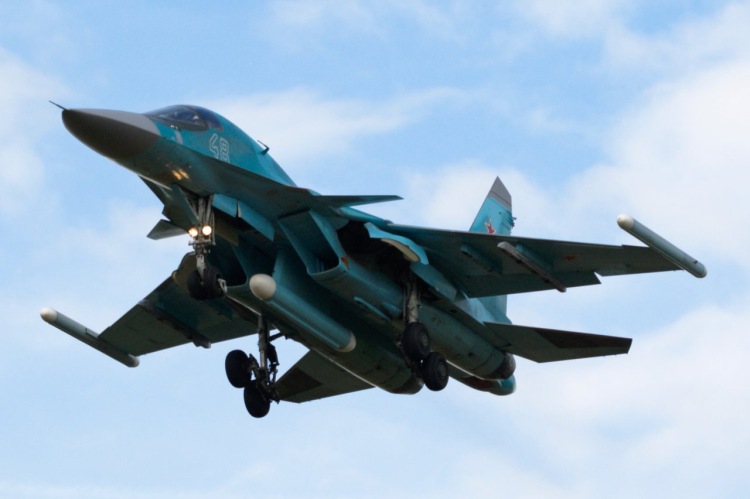 An Su-34 Fullback demonstrator
photographed at Kubinka in September, 2009, equipped with new wingtip
mounted KNIRTI SAP-518 self-protection ECM pods, and a large centreline
KNIRTI SAP-14 “Escort Jammer” support jamming pod. The new SAP-14 is
analogous to the US ALQ-99E series pods, but employs a fundamentally
different antenna arrangement optimised to suppress emitters in the
forward and aft hemispheres of the escort jamming aircraft. The pod has
been cleared for carriage on the Su-30MK Flanker G/H airframes and the
Su-34 Fullback (T5 Studio image - click to download hi res copy).
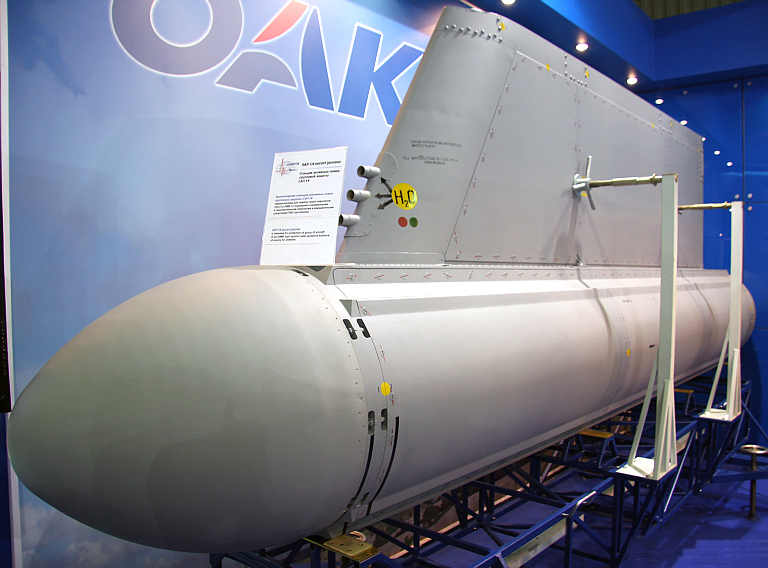 The heavyweight high power KNIRTI SAP-14 Support Jammer ECM pod is a Russian analogue to the US ALQ-99E pod carried on the EA-6B Prowler and EA-18G Growler. It was developed for Flanker family aircraft and is carried on a large centreline pylon. To date little has been disclosed about this design, but it has been observed on the Su-30MK Flanker G/H and Su-34 Fullback. It operates between 1 GHz and 4 GHz (© 2009 Vitaliy V. Kuzmin). 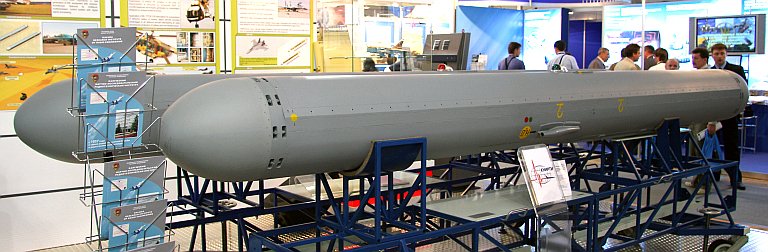 The KNIRTI SAP-518 ECM pod is a new technology replacement for the established L005 Sorbstiya series wingtip ECM pods. It operates between 5 GHz and 18 GHz (© 2009 Vitaliy V. Kuzmin). 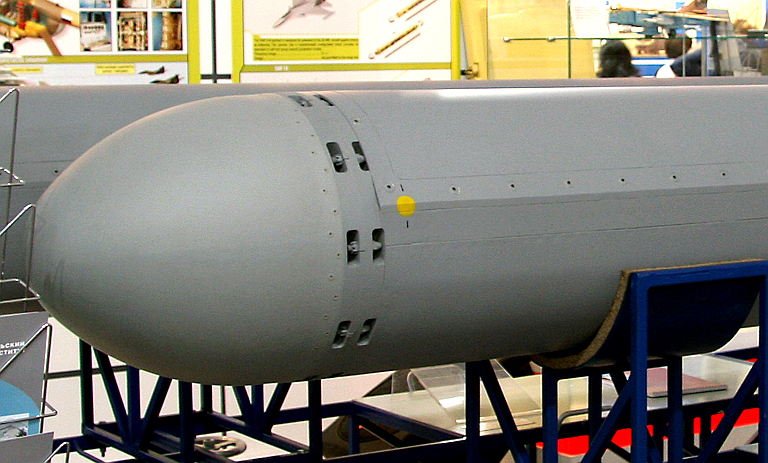 |
Imagery
Sources: MAKS,
NAPO, Sukhoi, Rosoboronexport; Russkaya Sila; Vestnik PVO;
MilitaryPhotos.net
Line Artwork: © 2003, 2007
Carlo KoppTechnical Report APA-TR-2007-0108 |

|
|||||||||||||
|
|
|
|
|
|
|
|
|
|
|
|||
|
|
|
|
|
|
|
|
|
|
|
|||
 |
|
|
|||||||||||
| Artwork, graphic design, layout and text © 2004 - 2014 Carlo Kopp; Text © 2004 - 2014 Peter Goon; All rights reserved. Recommended browsers. Contact webmaster. Site navigation hints. Current hot topics. | |||||||||||||
|
Site Update
Status:
$Revision: 1.753 $
Site History: Notices
and
Updates / NLA Pandora Archive
|
|||||||||||||
|
|
Tweet | Follow @APA_Updates | |||||||||||
|
|
|||||||||||||
|
|
|||||||||||||