|
||||||||||||||||||||||
 |
||||||||||||||||||||||
![F-22A Raptor, FB-22, F-22E, F-22N and Variants Index Page [Click for more ...]](APA/f-fb-22.png "F-22A Raptor, FB-22, F-22E, F-22N and Variants Index Page [Click for more ...]") |
 |
![People's Liberation Army Air Power Index Page [Click for more ...]](APA/pla-air-pwr.png "People's Liberation Army Air Power Index Page [Click for more ...]") |
 |
 |
 |
 |
 |
 |
![Military Ethics, Culture, Education and Training Index Page [Click for more ...]](APA/ethx-culture.png "Military Ethics, Culture, Education and Training Index Page [Click for more ...]") |
 |
||||||||||||
 |
![Russian / Soviet Weapon Systems Index Page [Click for more ...]](APA/rus-weps.png "Russian / Soviet Weapon Systems Index Page [Click for more ...]") |
 |
 |
 |

|
 |
 |
 |
 |
 |
||||||||||||
 |
 |
 |
||||||||||||||||||||
| Last Updated: Mon Jan 27 11:18:09 UTC 2014 | ||||||||||||||||||||||
|
||||||||||||||||||||||
|
||||||||||||||||||||||
|
||||||||||||||||||||||
|
|
|
|
|
|
|
|
|
|
|
||||||||||||
|
|
|
|
|
|
|
|
|
|
|
||||||||||||
| |
|
|
||||||||||||||||||||
| Last Updated: Mon Jan 27 11:18:09 UTC 2014 | ||||||||||||||||||||||
|
||||||||||||||||||||||
Coffin Corners for the Joint Strike Fighter |
||||||||
|
Air Power
Australia - Australia's Independent Defence Think Tank
|
||||||||
| Air Power Australia NOTAM 7th January, 2009 |
||||||||
|
||||||||
|
||||||||
| You have
all seen the movie. Our top-gun heroes fly their F-35 Lightning
II’s on an Offensive Counter-Air mission. They have four
AIM-120Ds aboard and the mission is Air Dominance. Today, the enemy is being cooperative, and they have old Su-27s on combat air patrol. The F-35’s sensors detect the Su-27’s radar, and to clear the air, the Lightning IIs head towards these targets. The 100% reliable, 100% kill probability AIM-120Ds quickly down each Sukhoi with a single shot, so each F-35 kills up to four Su-27s until all are gone from the sky. Our heroes fly back to base, where they enjoy the adoring applause from the troops in the same way as Top Gun’s Maverick and Iceman returning from their air combat defence of their Aircraft Carrier. This scenario draws on the thesis that the F-35 Joint Strike Fighter’s ‘invisibility equals invincibility’, such that the invisible Lightning II always wins, no matter what the odds. While stealth comes at a high cost, it's value is eminently ‘marketable’. The recent fighter competition in Norway has produced a rubbery, but pre-world economic crisis price-point for the F-35 Joint Strike Fighter somewhere between $US160-230M per copy. That price is substantially more that the price of aircraft that provide the same, or superior fighter characteristics like greater speed, range, payload, flexibility and agility, but without ‘stealthiness’. Every thesis has its antithesis. Stealth technology has played an important part of modern battles, and complicates an enemy’s air control strategies and tactics, but the advantages of partial or ‘CAIV-driven’ low observability are fading as ‘counter-stealth’ systems and tactics penetrate its cover. So this is a reasonable question: ‘would a rational Nation purchase the F-35 Joint Strike Fighter at an inflated price if it were not stealthy, when lower cost, more effective air combat aircraft are available?’ The answer is self-evident. There is a deadly corollary to this antithesis. If a Nation purchases the F-35 Joint Strike Fighter without testing its actual stealthiness, it runs the risk of buying an aircraft that is stealthy from some aspects, but observable and hence vulnerable from others. Any competent enemy would know these weaknesses, and exploit them on the first day of battle in a way that a substantial portion of the air combat fleet would be lost. The consequences are dire: probable defeat in battle and loss of sovereignty. It is this ‘sovereign risk’ that makes it imperative to know the real limitations of the Joint Strike Fighter’s stealthiness. The signature of stealth aircraft is a closely guarded State secret, and for most people is ‘unknowable’. Until now that is. A State can classify its secrets like radar signatures, but it cannot classify the Laws of Physics. A colleague, Dr Carlo Kopp, has used open-source radar signature analysis software verified against known shapes and empirical results, to generate radar signature estimations for two key components of the F-35 Joint Strike Fighter: the section of the lower fuselage around the weapons bays, and the axi-symmetric nozzle of the F135 engine. This ‘radar cross section simulator’ can cope with a range of radar operating frequencies used in modern air combat, and plot reflections from complex shapes from any angle. Many people will find it incredible that a private individual can generate radar signatures of a supposedly stealth aircraft, notwithstanding that Dr Kopp is an internationally recognised expert in the field, and an experienced design engineer and university research scientist. I am as sceptical as the next scientist, and demand proof that an open-source academic radar signature tool can produce reliable results. What convinced me was the calibration of the software output. In this case, the radar signature of a cylinder of known size was used, with the simulation output being compared with actual measurements of a physical object. The results can be seen in these images: |
||||||||
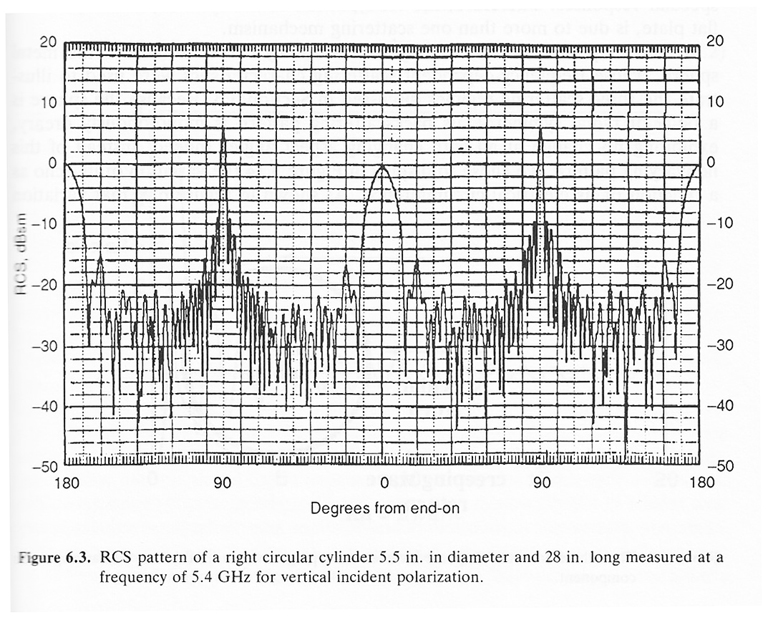 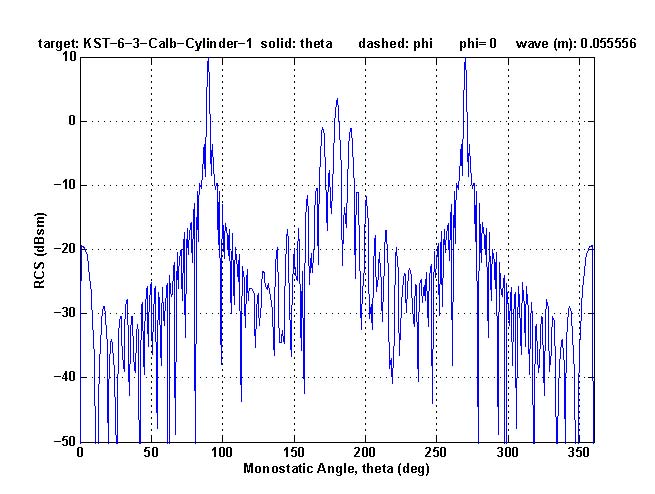 Simulator
calibration plots for a cylindrical shape at 5.8 GHz V-pol (Knott et al
and Kopp).
|
||||||||
|
Even a non-expert eye can see
the high degree of similarity between the actual and simulated
measurements. Experts in the field advise that the correlation is
remarkable and highly significant. This result is an
important part of the validation and verification of the radar
signature simulator.
What are the results using components of the F-35 Joint Strike Fighter’s shape? Here is a link to the results from Dr Kopp’s work, entitled “Assessing Joint Strike Fighter Defence Penetration Capabilities”. Looking towards the nose, the
F-35 Joint Strike Fighter ’s radar signature is quite good at higher
frequencies, with ‘stealth’ shaping, a tuned radome and radar bay
faceting to deflect searching radar beams. From the sides and
below, the radar cross section blooms, especially for the 180 degrees
around the bottom of the fuselage. Using standard computations
for the refraction of radar beams in the atmosphere, and typical
intercept profiles designed to search for the Joint Strike Fighter
where it presents significant radar returns from the fuselage, it can
be shown an air-to-air radar will impinge on the Joint Strike Fighter
’s fuselage between about 0.5° and 3° of arc below the horizontal,
depending on the interceptor’s range and altitude. When the F-35
Joint Strike Fighter exposes its belly to hostile radar, its radar
signature will increase by up to tenfold.
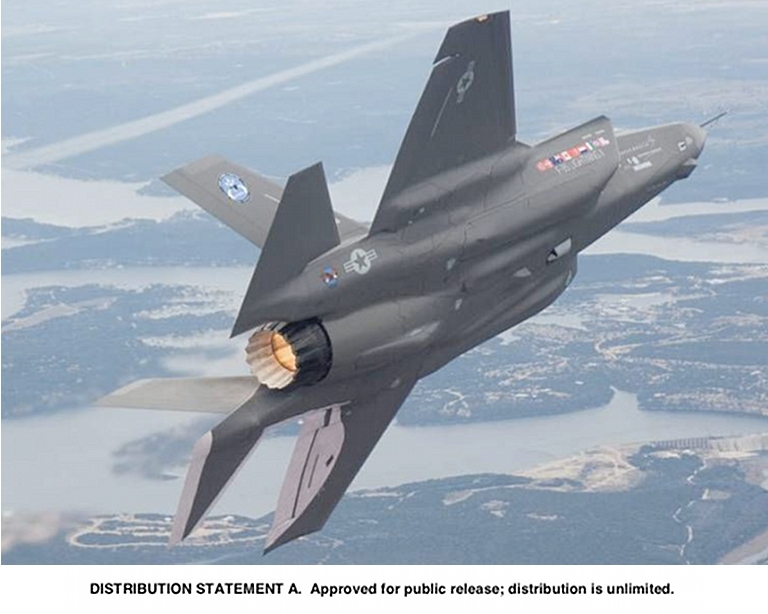
Radar cross sections are large enough, and persistent enough, to allow the F-35 Joint Strike Fighter to be ‘locked-up’ by an interceptor’s radar, and for a Beyond-Visual-Range (BVR) missile to intercept and destroy the aircraft. Turning to the rear quadrant of the aircraft, the jet nozzle is a genuine radar reflector. Unlike the F-22A’s nozzles which are shaped and shielded for stealth, the F-35 Joint Strike Fighter sports a “classic” jet nozzle shape, and its facets and articulated parts provide splendid radar returns – basically a doughnut shape around the rear end. These reflections add to the strength and persistence of the lower fuselage returns, making the intercepts simpler and more reliable. |
||||||||
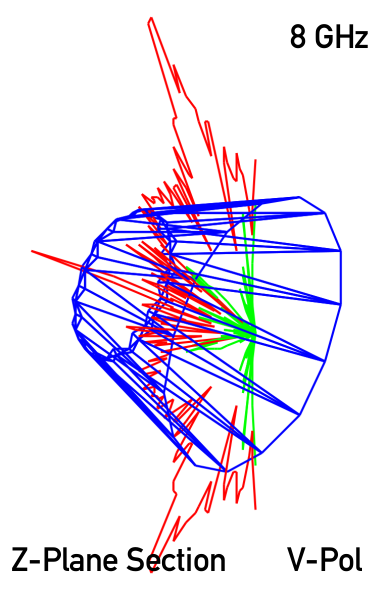 Z-plane section through the doughnut
shaped radar signature lobes of the Joint Strike Fighter axisymmetric
nozzle, at 8 GHz i.e. X-band favoured for fighter radars and missile
engagement radars. Results plotted with Matlab (Kopp).
|
||||||||
|
‘Top
Gun’ was released in 1986. Three
decades later quite a different air combat environment is evident as a
‘Red
Force’ analysis of F-35 Joint Strike Fighter ’s operations in the
2015-2020
time-frame shows. This world is
much more technically complex, but with one enduring simplification for
air
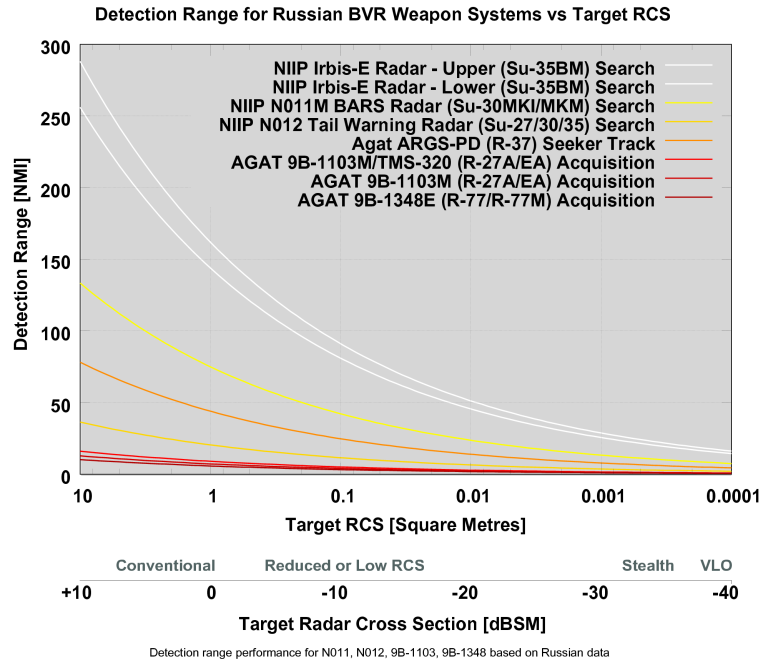
combat: the ‘Military Two-Step’ - sensors find the target, missiles
make the
kill.
The first task is to find the
target. At lower frequencies, radar systems
like Australia’s JORN or Russia’s Podsolnukh E
yield long-range
detection of
potential targets, providing advance warning but lacking the precision
for
accurate targeting. At a slightly
higher frequency, VHF radars like the Russian Nebo-UE,
SV and
SVU or Vostok E use wavelengths comparable to the size to the
F-35’s
shaping features, generating all-aspect radar returns, according to the
Russians equivalent to a beach-ball in size. These radar
capabilities are implemented using modern
techniques such as reliable
solid-state electronics, AESA or electronic
beam-steering management of radar beams, and intelligent digital
signal
processing of the returns, using technology no different from that in
contemporary US or EU radars.
An Integrated Air Defence
system can also be
effectively cued by Human Intelligence (HUMINT), as simple as an agent
making
an international mobile phone call when departures of fighters and
supporting
tankers and early warning aircraft are observed. Network Centric
Warfare is no longer the province of the USA
and Australia, so what sensors find, shooters can exploit.
|
||||||||
 |
||||||||
| With the
Integrated Air Defence System cueing the interceptors, tactics to find
and kill enemy aircraft are devised. The ‘Siberian Wolf Pack’
hunting technique of encircling prey with hunting packs is appropriate,
as the F-35 Joint Strike Fighter ’s radar returns are greatest from the
rear and lower hemispheres. Encirclement presents a grave danger
to the F-35 – if it points its stealthy nose at one threat, it exposes
its reflective lower sides and (also infra-red radiating) rear-end to
other predators. This broad and strong extent of reflection
provides adequate time for these predators to lock and guide missiles
to within killing range. Aircraft like the later Sukhoi Su-30MK and Su-35BM series have substantial speed, range and payload capabilities, so are ideal predators for an F-35 Joint Strike Fighter hunt. With adequate warning, they can launch and position to geo-locations where they can use to advantage the shortcomings in the F-35 Joint Strike Fighter stealth and poor aerodynamic/kinematic performance. Typically, air combat tactics will involve pincer attacks and flying the interceptors well above and below the operating altitude of the F-35 Joint Strike Fighter to enhance the radar returns from the fuselage and the jet nozzle. |
||||||||
 |
||||||||
While the forgoing has concentrated on
radar
signatures, future air combat tactics must consider the infra-red
spectrum. The infra-red world is becoming
more active, sensitive and effective, with scanning, all hemisphere
systems
like the F-35’s DAS and the MiG-35 and Su-35 OLS-35 Infra-Red Search
and Track
(IRST) systems. These systems are
designed to detect the unmaskable launch signature of missiles and
track them
as they close. Russia equips its Beyond-Visual-Range
(BVR) air-to-air missiles like the obsolete R-27
‘Alamo’
and the capable R-77 ‘Adder’ series with a mix of seeker heads – Radar,
Scanning Infra-Red and Passive Anti-Radar. By
2015, the longer range, Meteor equivalent RVV-AE-PD will,
in all probability, provide a significant missile range advantage over
the
latest AIM-120D. The F-35 Joint
Strike Fighter makes no attempt to mask its jet exhaust as was done for
the
F-117, the B-2 and the F-22A, so with its large, hot, unmasked F135
engine, it
will be as visible to infra-red detectors as other jet aircraft with
large,
hot, unmasked exhaust nozzles.
The F-35 Joint Strike Fighter proponents’ riposte has been that the AIM-120 is a 100% reliable and 100% kill probability missile, so each F-35 carrying four AIM-120’s will account for four Sukhois or MiGs. This is a dangerously naive assumption. Operationally, the AIM-120 has achieved 10 BVR kills from 17 shots – a Pk or “kill probability” of 0.59 (59 percent) against benign or “dumb” targets. The AIM-120 has been tested in over 200 test firings, with a reliability of about 85 percent, so statistically speaking, about one of those four AIM-120s will be a dud. Aircraft like the Su-35BM are equipped with a range of defensive measures – Digital Radio Frequency Memory (DRFM) jammers, Missile Approach Warning Systems, towed decoys, chaff, Helmet Mounted Sights to cue agile missiles like the R-74 Archer against less agile BVR missiles, and if all these defenses fail, extraordinary agility that can out-turn an incoming high-Mach BVR missile. No AIM-120 has been tested let alone operationally employed against a target with this panoply of defensive measures, so the kill ratio of the AIM-120 in modern air combat may well be much less than the operational 0.59 Pk experienced to date. By contrast, the Su-35 can carry wingtip DFRM jammers and still have hard-points for 12 missiles. These missiles can be a complement of WVR and BVR types, with the long-range missiles having a mix of seeker types - e.g. radar, infra-red and passive anti-radar seekers. So, if the AIM-120 shots fail to kill all of the enemy’s aircraft, a lot of missiles will be incoming as return fire. The statistics of having only two to four air-to-air missiles can, as MGen Richard Koch, chief of USAF Air Combat Command’s advanced air dominance branch, recently observed, give rise to a “cold sweat” when contemplating air combat with an adversary with far more shots[i]. As an example, if the AIM-120 launch reliability of the F-35 yields three shots, and each shot has a post-launch Pk of 0.3, then the aggregate kill probability of launching at three adversaries is 0.9 kills, or at a single aircraft is 0.66 kills. If the enemy is present in superior numbers, such yields will be insufficient to dominate the battlespace. When the Lightning is out of ammunition, what next? Retreat, exposing a radar reflective, infrared radiating, rear end to a rapidly closing Mach 2 enemy aircraft? Will the Lightning have the fuel to run fast enough, for long enough to escape from a Sukhoi with larger fuel reserves? Or will it stand and fight an old-fashioned turning dogfight with its gun as its sole remaining weapon? Each of these egress tactics will have a bloody end for the F-35 Joint Strike Fighter ’s pilot. Now look at the other side. If the launch reliability of the Russian missiles is about the same as the AIM-120, the Sukhoi’s 12 missiles become 9. If we denigrate the Russian missiles and say their post-launch kill probability is a half that of the AIM-120 at 0.15, notwithstanding the value of a variety of seeker head options employed by the Russians, then those 9 missiles fired at 9 targets yield 1.35 kills. If fired at a single aircraft, the yield is 0.77 kills. In an air-to-air missile barrage, the aircraft with the most shots wins, all else being equal. Even if the missiles are not equally effective, the aircraft with the most shots may still win. The mathematics cannot be denied. Even if the Russian strategy and tactic of mixing missile seeker head types only gives them parity in Pk, the results still give cause for grave concern: 9 shots at a Pk of 0.3 kills 2.7 aircraft, while if they are all fired at a single target, that aircraft has only a 4 percent chance of surviving. Operationally and commercially, the F-35 Joint Strike Fighter will live or die on its ‘observability’ status. This aircraft was designed as a battlefield interdictor operating in lightly contested airspace. It is now being marketed as an air dominance fighter where it must operate in hotly contested airspace, with the enemy’s Integrated Air Defence Systems employing sensors covering frequencies where the F-35 Joint Strike Fighter reflects or radiates, attracting surface-to-air and air-to-air missiles with a high probability of a kill. The F-35 Joint Strike Fighter ’s ‘Invisible equals Invincible’ thesis looks increasingly fragile, and the antithesis that the F-35 Joint Strike Fighter ‘low observability’ has been penetrated looks increasingly credible. Technical developments over time will accentuate this trend. ‘Caveat Emptor’ is thus sound advice for all potential F-35 Joint Strike Fighter customers, including the US Armed Services. Before paying a high price for the Emperor’s new stealth cloak, it seems wise to have a test parade down the street and see if ordinary, sensible people can see what lies beneath the cover. |
||||||||
Endnotes:[i] MajGen Richard Koch, chief of USAF Air Combat Command’s advanced air dominance branch, stated last week: “I wake up in a cold sweat at the thought of the F-35 going in with only two air-dominance weapons.” Cited from Sweetman W., “JSF Leaders Back In The Fight”, URL: http://www.aviationweek.com/aw/blogs/defense/ |
||||||||
Related ReadingSukhoi Flanker Analysis [Click for more ...] Nebo SVU VHF AESA Analysis [Click for more ...] S-300 SAM System Analysis [Click for more ...] F-22A Raptor Analysis [Click for more ...] Joint Strike Fighter Analysis [Click for more ...] |
||||||||
|
|
||||||||
| Air
Power Australia Website - http://www.ausairpower.net/ Air Power Australia Research and Analysis - http://www.ausairpower.net/research.html |
||||||||
 |
||||||||
| |
||||||||
|
|||||||||||||
|
|
|
|
|
|
|
|
|
|
|
|||
|
|
|
|
|
|
|
|
|
|
|
|||
| |
|
|
|||||||||||
| Artwork, graphic design, layout and text © 2004 - 2014 Carlo Kopp; Text © 2004 - 2014 Peter Goon; All rights reserved. Recommended browsers. Contact webmaster. Site navigation hints. Current hot topics. | |||||||||||||
|
Site Update
Status:
$Revision: 1.753 $
Site History: Notices
and
Updates / NLA Pandora Archive
|
|||||||||||||
|
|
Tweet | Follow @APA_Updates | |||||||||||
|
|
|||||||||||||
|
|
|||||||||||||