|
||||||||||||||||||||||
 |
||||||||||||||||||||||
![F-22A Raptor, FB-22, F-22E, F-22N and Variants Index Page [Click for more ...]](APA/f-fb-22.png "F-22A Raptor, FB-22, F-22E, F-22N and Variants Index Page [Click for more ...]") |
 |
![People's Liberation Army Air Power Index Page [Click for more ...]](APA/pla-air-pwr.png "People's Liberation Army Air Power Index Page [Click for more ...]") |
 |
 |
 |
 |
 |
 |
![Military Ethics, Culture, Education and Training Index Page [Click for more ...]](APA/ethx-culture.png "Military Ethics, Culture, Education and Training Index Page [Click for more ...]") |
 |
||||||||||||
 |
![Russian / Soviet Weapon Systems Index Page [Click for more ...]](APA/rus-weps.png "Russian / Soviet Weapon Systems Index Page [Click for more ...]") |
 |
 |
 |

|
 |
 |
 |
 |
 |
||||||||||||
 |
 |
 |
||||||||||||||||||||
| Last Updated: Mon Jan 27 11:18:09 UTC 2014 | ||||||||||||||||||||||
|
||||||||||||||||||||||
|
||||||||||||||||||||||
|
||||||||||||||||||||||
|
|
|
|
|
|
|
|
|
|
|
||||||||||||
|
|
|
|
|
|
|
|
|
|
|
||||||||||||
| |
|
|
||||||||||||||||||||
| Last Updated: Mon Jan 27 11:18:09 UTC 2014 | ||||||||||||||||||||||
|
||||||||||||||||||||||
|
JSF Alternate Realities: …and from whence they come |
||||||||
|
Air Power
Australia - Australia's Independent Defence Think Tank
|
||||||||
| Air Power Australia NOTAM 13th February, 2009 Updated July, 2010 |
||||||||
Peter Goon, BEng (Mech), FTE (USNTPS), Head of Test and Evaluation, Air Power Australia |
||||||||
|
||||||||
| The following is a citation from the Wikipedia entry on Emeritus Professor Harry G Frankfurt at Princeton University:…….. | ||||||||
|
In the essay, Frankfurt
sketches a theory of bullshit,
defining the concept and analyzing its applications. In particular,
Frankfurt distinguishes
bullshitting from lying; while the liar
deliberately makes false claims, the bullshitter is simply uninterested
in the truth.
Bullshitters
aim primarily to impress and persuade their audiences. While liars need
to know
the truth, the better to conceal it, the bullshitter, interested solely
in
advancing his own agenda, has no use for
the truth.
Following from this, Frankfurt claims that
"bullshit
is a greater enemy of the truth than lies are." |
||||||||
| Where have
we all seen what is
described here so incisively? In essence, ‘the B-word’ is a total (or partial) indifference to the truth and the underpinning data and facts, with ‘partial indifference’ being the source of the too-often-times observed fallacious argument into which a fine thread of truth has been woven. Basically, at the very core of ‘the B-word’ is an indifference to how things really are; that is, an indifference to reality which, appropriately, should be viewed as 'understanding the perceptions plus a full knowledge of the facts'; rather than its half baked sibling. It is what legal practitioners less steeped in the nobler ethics and standards of their profession, such as honesty and integrity, mean when they say, “Tell me what you want and I will construct the argument. I am a lawyer and can argue anything!” Independent, detailed analyses of the Joint Strike Fighter (JSF) Program have raised very serious concerns. The total lack of substantive responses to resulting questions put to the various proponents of the Joint Strike Fighter around the world have led to these queries (examples of which are attached) being distilled down to the following very simple questions. Is the behaviour defined by Professor Frankfurt, and the attitudes/agendas that drive it, at the root of why the JSF Program has achieved such traction in the marketplace? This while the JSF commodity product is so disconnected from reality that repealing some Laws of Physics and Laws of Commerce, as well as Common Sense, would be the only way the jet could possibly meet many of its proponents’ claims? Could this be the reason why standard risk assessments show there is quite a high probability this program will go down in history as the biggest aerospace and techno-strategic defence acquisition FUBAR, ever? |
||||||||
 |
||||||||
|
Could the highly developed marketing strategies and new age management doctrines such as the Pentagon’s much vaunted but mathematically unsupportable concept of CAIV (Cost As an Independent Variable) and its logic flawed implementation within the JSF Program actually have been a way of generating the alternate realities and comfortable fictions that are the tools of trade of ‘the B-word’ artisans? Would it be possible the Goldilocks Pricing Strategy with its apples versus lemons comparison with the F-22A Raptor and the creation of a Prisoner’s Dilemma as a follow on to the JSF Program’s early capture of the political leaderships within the partner nations be additional means for reinforcing the easy going perceptions of these alternate realities? Independent costing and risks analyses based on data compiled well before the Global Financial Crisis (GFC) and its much larger, more rapacious offspring, the World Economic Crisis (WEC), strongly support answers in the affirmative to all such questions. Will the WEC now be used to explain away cost increases and delays in schedule which were already inherent in the program or even to justify more outlandish calls for additional funding and even more time to complete? Surely not, for a quite alarming and frightening reason. If the new US Administration is coerced by such behaviour, as ’the B-word’ is designed to do, and ends up endorsing the JSF Program in its present form with its current and ongoing agendas like white anting all competition, including the F-22A Raptor, this program will likely make the WEC, itself another product of ‘the B-word’, look like a mere stumble [1]. The WEC has brought into focus the serious consequences of sovereign financial risks materialising whereas 'the B-word' that is the JSF Program will put at risk the very sovereignty of all the participant Nations, especially the US of A.However, the big difference with the WEC is that the resulting damages and effects will be very long term but limited to only one half of the globe; the now most practiced proliferators of ‘the B-word’ itself - namely, the Western world. If this is the legacy left to our children, they will damn us all, not just those responsible, into and beyond our graves. The current Y-generation will be doomed to become the "Why?" generation when, in a decade or three, they enquire as to why the great and mighty Western democracies were made to stumble then collapse from within, like most of history's fallen empires, and, in this case, how it transpired that truth and integrity equated to "Samson's hair". |
||||||||
Endnotes:[1] The term 'likely' is used since the consequences or outcomes are still in the future - though the final driving decisions are nigh. However, standard risk assessment, in accordance with Australian Standard AS/NZS 4360:2004 under the international standard guidance of ISO31000, puts the consequences if this risk materialises as CATASTROPHIC and the probability of this risk arising as ALMOST CERTAIN, leading to an overall priority assessment of this risk as EXTREME. Even if the probability of this risk arising were to be down rated 2 levels to MODERATE (one level below LIKELY), the priority assessment of this risk would still be EXTREME. |
||||||||
Annex - Examples of Some of the Questions put to the JSF Community in the Interests of a Strong DebateFor the convenience of all and to establish a common frame of reference, these questions are listed under each of the four elements of the JSF Program mantra, being “Affordability”, “Lethality”, “Survivability” and “Supportability”. Affordability Background: Independent analyses on JSF affordability have been done. A summary of earlier analyses (circa 2002-06) may be found here. The attached file (PDF-A/USMC_DoN_2008.pdf) provides a summary of costs for the DoN JSF for the projected FYDP (pre-WEC). Australia terminated evaluations under the Air6000 New Air Combat Capability Project and entered the JSF SDD Program back in 2002. The Chief of the Air Force advised the unit price for the JSF aircraft was going to be “…about forty million dollars”. Current Australian Defence and JSF Program Office Plans have initial procurements of Block 3 F-35A JSF aircraft in the 2012-2014 period. The results of risk based analyses of JSF costing data from the pre-World Economic Crisis (WEC) era have been provided to Defence. These show the JSF unit price would likely be around US$168 million (-10%/+30% variance range) in the 2012-14 timeframe. Using the same methods of analysis, the price estimated for the F-22A Raptor is around US$136 million. Recent articles published by the IEEE put the unit price figure for the F-22A Raptor at US$137 million. In summary, in 2014 on a per unit procurement cost basis, the Block 3 F-35A JSF would likely cost as much, if not more, than the F-22A Raptor would cost. Opening Questions:
Lethality Background: Lethality is measure of how much physical damage a combat aircraft can inflict upon the enemy. It can be measured, in the tactical context, by the number and size of munitions carried, and in the strategic context by the same plus the range to which such weapons can be delivered and the resulting effectiveness. With survivability dictating internal carriage, the JSF is constrained to a pair of weapon bays, each sized around a single MK.84 size bomb, and a single AMRAAM. Since the start of the SDD, a progressive reduction in the range of weapon types intended to be integrated and cleared has been observed, with only a small fraction of the initially stated weapon types now planned for SDD. The world has moved on since the JSF was first specified, but somehow those defining capability requirements have failed to keep pace, if not gone backwards due to CAIV. This is a new world where the aphorism ‘the quick and the dead’ applies. Opening Questions:
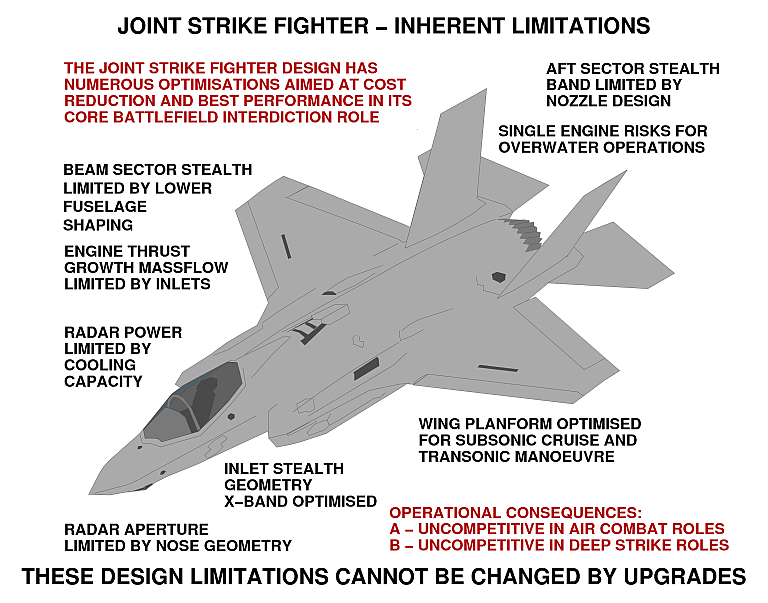
Survivability Background: Survivability is a measure of what fraction of a combat fleet remains alive in a given threat environment, flying repeated sorties over a sustained period of time. The survivability paradigm for the JSF was defined around the ability to survive in a battlefield interdiction environment where the aircraft would be confronted by medium range and short range SAMs, and AAA systems, assuming that hostile fighters, long range SAMs and supporting radars will have been already destroyed by the F-22 fleet. The JSF’s stealth performance, reflected in shaping, was optimised around this model, with independent technical analyses showing that the aircraft will have viable stealth in the front sector, but much weaker stealth performance in the beam and aft sectors. The evolving market for radars and surface to air missiles has, however, taken a different turn to that anticipated when the JSF program was launched. Highly mobile long range SAMs, supported by high power-aperture radars, have been far more popular in the market than the short and medium range weapons which the JSF was defined to and built to defeat. Opening Questions:
Supportability Background: Over the past 30 years, there have been various attempts to reduce the life cycle costs of operating military aircraft. Options strongly supported by Industry have encouraged the transfer of risk and responsibilities to Industry. Such options have included Total System Performance Responsibility (TSPR) contracting models, Public Private Partnership (PPP) contracting models and various other outsourcing contract models. With noted exceptions, the military customers’ satisfaction with such arrangements and their outcomes has been less than optimal. One recurring series of complaint has been the consequential deskilling of the military while cost overall have not reduced and, from those of the pre-deskilling era, observations and concerns about increasing loss of control of assets leading to truly sovereign risks for the clients – loss of the most basic of sovereign controls of air combat assets – the aircraft’s configuration. The latest forms of addressing life cycle costs are the performance based agreement (PBA) models and such things as the Autonomic Logistics Model of the JSF Program – elements of both having been proposed to the P-3 Orion Maritime Patrol Aircraft community and, more recently, the C-130J Hercules Strategic Air Lift Aircraft community. Opening Questions:
Finally and more generally, the results of analyses undertaken by a number of domain experts around the world do not support the notion that the JSF will not be able to meet its original specification. What they do indicate is, due to the effects of management decisions under paradigms like Cost as An Independent Variable (CAIV); the transfer of risks from the SDD Phase to the Operational Phase; and, the extensive deskilling that has occurred in Departments and Ministries of Defence around the Western World, due to the end of the Cold War ‘peace dividend’, this specification will most likely not be met till around Block 6/7, circa 2020 or later. However, where these independent analyses converge is full agreement that the original JSF JORD specification and the specification to which the aircraft has been designed and is being built are based on threat assessments from an era past. This combined with the constraining nature of the original air vehicle specification and the on going effects of expeditious management decisions made under CAIV, mean the overall capabilities of the JSF will have been surpassed by the middle of the next decade, if not earlier. In summary, all the indicators point to a penultimate question - Will the F-35 JSF be obsolete before its time? If not, then why not, given where the JSF Program is in its schedule and overall life cycle compared with where the developing threats are in theirs? That being said, there is much reason for a robust and strong debate. We look forward to your answers, along with the supporting data, information and knowledge, at your earliest, in the spirit of working with you to get the best we can for those who fly as our aim, and confidently demonstrating this thesis (or its antithesis) with hard data and facts as the paramount measures of effectiveness of a strong debate. |
||||||||
| Air
Power
Australia Website - http://www.ausairpower.net/ Air Power Australia Research and Analysis - http://www.ausairpower.net/research.html |
||||||||
 |
||||||||
| |
||||||||
|
|||||||||||||
|
|
|
|
|
|
|
|
|
|
|
|||
|
|
|
|
|
|
|
|
|
|
|
|||
| |
|
|
|||||||||||
| Artwork, graphic design, layout and text © 2004 - 2014 Carlo Kopp; Text © 2004 - 2014 Peter Goon; All rights reserved. Recommended browsers. Contact webmaster. Site navigation hints. Current hot topics. | |||||||||||||
|
Site Update
Status:
$Revision: 1.753 $
Site History: Notices
and
Updates / NLA Pandora Archive
|
|||||||||||||
|
|
Tweet | Follow @APA_Updates | |||||||||||
|
|
|||||||||||||
|
|
|||||||||||||