|
||||||||||||||||||||||
 |
||||||||||||||||||||||
![F-22A Raptor, FB-22, F-22E, F-22N and Variants Index Page [Click for more ...]](APA/f-fb-22.png "F-22A Raptor, FB-22, F-22E, F-22N and Variants Index Page [Click for more ...]") |
 |
![People's Liberation Army Air Power Index Page [Click for more ...]](APA/pla-air-pwr.png "People's Liberation Army Air Power Index Page [Click for more ...]") |
 |
 |
 |
 |
 |
 |
![Military Ethics, Culture, Education and Training Index Page [Click for more ...]](APA/ethx-culture.png "Military Ethics, Culture, Education and Training Index Page [Click for more ...]") |
 |
||||||||||||
 |
![Russian / Soviet Weapon Systems Index Page [Click for more ...]](APA/rus-weps.png "Russian / Soviet Weapon Systems Index Page [Click for more ...]") |
 |
 |
 |

|
 |
 |
 |
 |
 |
||||||||||||
 |
 |
|||||||||||||||||||||
| Last Updated: Mon Jan 27 11:18:09 UTC 2014 | ||||||||||||||||||||||
|
||||||||||||||||||||||







|
The PLA-AF's Aerial Refuelling Programs
Technical Report APA-TR-2007-0703 |
| by
Dr Carlo Kopp, AFAIAA, SMIEEE, PEng July, 2007 Updated August 2009 Updated April 2012 Text, Line Artwork © 2007 Carlo Kopp |
 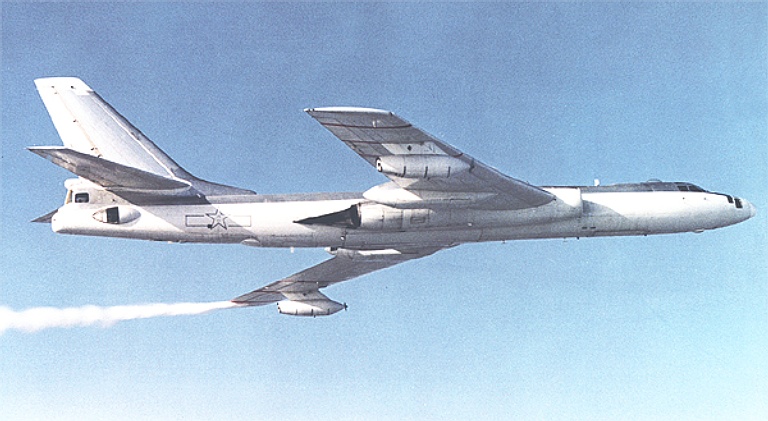 Xian H-6U Badger aerial refuelling tanker dumping fuel. Note the revised nose geometry, believed to be used on the new H-6K cruise missile carrier. The pod installation is derived from a 1986 joint program with FRL in the United Kingdom. |
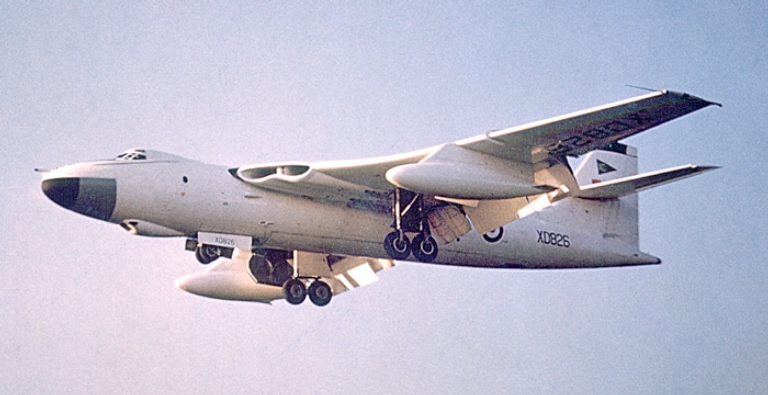
BackgroundBy the end of this decade China will be operating a mixed tanker fleet, comprising at least two tanker variants of the indigenous H-6 Badger, and imported Russian Ilyushin Il-78MK Midas tankers, based on the Il-76 Candid airframe. China, like Australia, was a late entrant in the aerial refuelling game. At this time the PLA operates two distinct tanker variants of the Badger. It should come as no surprise that the Badger was the basis of China's first operational tanker aircraft. China initiated production of cloned Tupolev Tu-16K Badgers during the late 1960s, and conducted an extended series production build until the late 1980s, to supply Badgers to the PLA-AF, the PLA-N and export clients. XAC (Xian) built around 120 airframes for the PLA, initially direct clones of the Tu-16K with the Soviet search radar, armed with dumb bombs or nuclear bombs, later anti-shipping strike H-6D/B-6D with a larger Chinese Type 245 radar, adapted from the Soviet 'Square Tie' missile boat engagement radar, and armed with a pair of large YJ-6/C-601 Kraken ASMs, cloned from the Soviet P-15 Styx ASCM (the Styx weapon system was basically transplanted from a Soviet fast missile boat into the Badger design). Four B-6Ds were exported to Saddam's Iraq, and XAC spare parts sustained the Eqyptian Tu-16K fleet until its recent retirement. 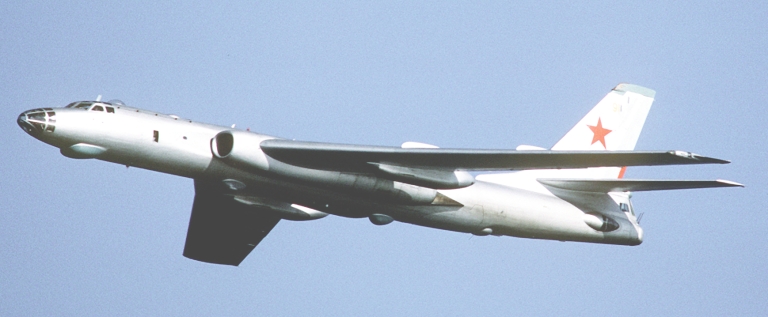 In terms of performance and history the Badger is a contemporary of the British V-bombers and compares best to the Vickers Valiant B.1 in size, weight, installed thrust and basic performance. Until recently, all Badgers were powered by variants of the Mikulin RD-3M, cloned in China as the Wopen WP-8, rated in the 20,000 lb class. 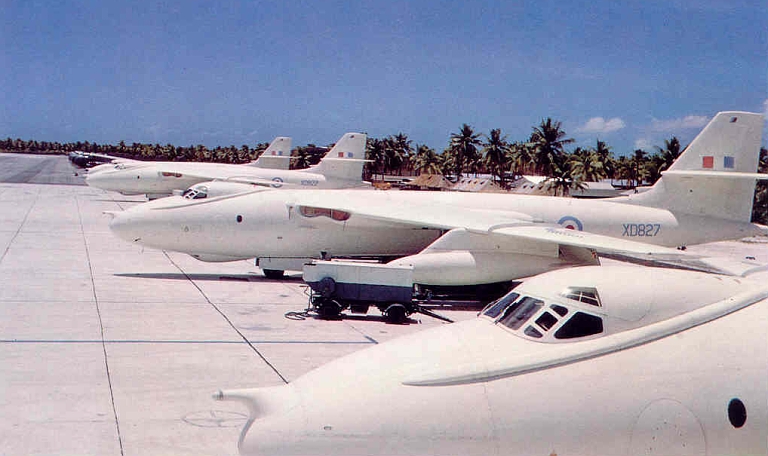 The Tu-16K/H-6 Badger is a
very close equivalent to the long retired RAF Vickers Valiant B(K).1.
Upper image Christmas Island during the Grapple A-bomb trials.
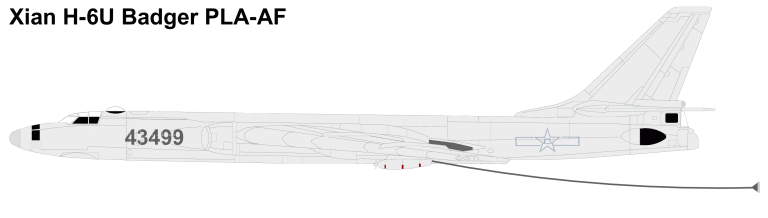
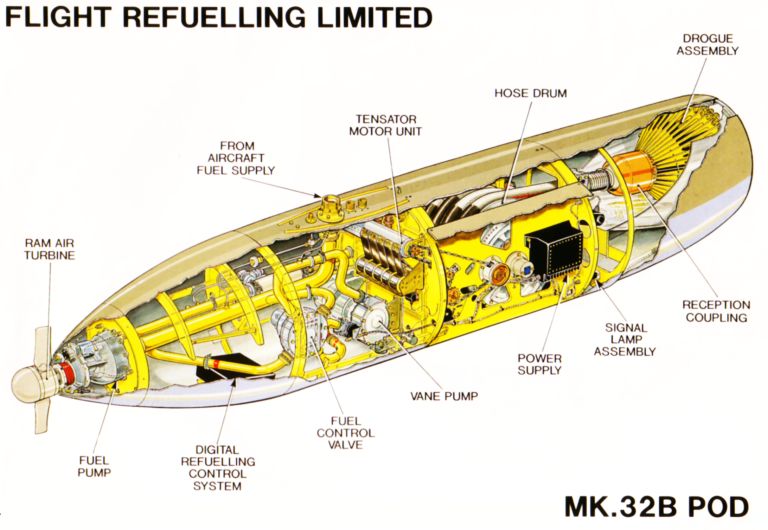
 H-6U/DU Badger Aerial Refuelling TankerThe PLA Badger saga continues, with a tanker conversion engineered during the late 1980s, and production restarted post 2001. The first new production Badgers were the H-6H, armed with a Styx derivative KD-63 TV/datalink guided cruise missile. The H-6H was soon followed by the H-6M, with four outboard wing pylons and built to carry four YJ-83/YJ-62 class anti-ship cruise missiles, and possibly land attack derivatives. This year photos emerged of a third new build variant in test, the H-6K cruise missile carrier with six wing pylons and a new technology turbofan engine. China's tanker conversion was the result of an MoU signed with FRL Ltd in the UK, in 1986. The result of this effort was an adaptation of the H-6 design with two indigenous pylon mounted RDC-1 hose/drogue pods resembling older FRL Mk.32 pods, these pods were designed by the China Research Institute of Aero Accessories. 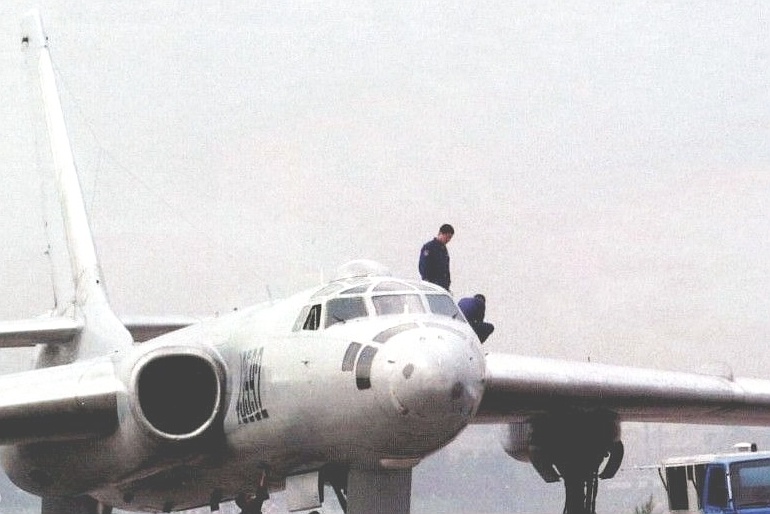 PLA-AF H-6U Badger, note the revised nose.
 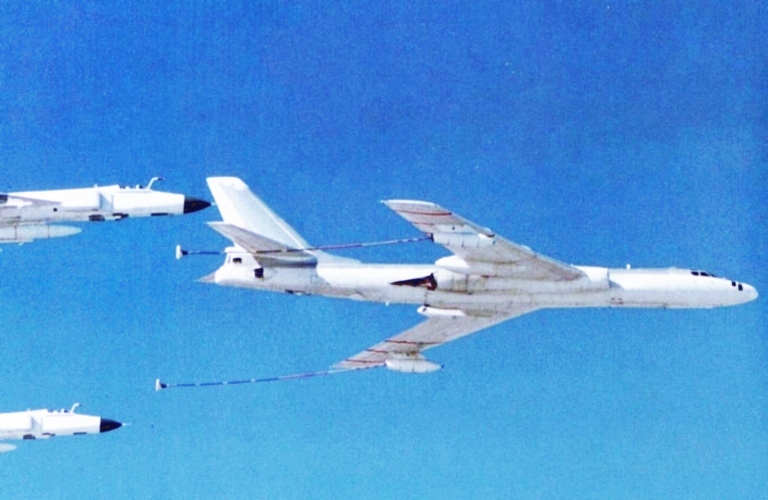 An
Air Force H-6U
gassing a pair of J-8-II Finbacks.
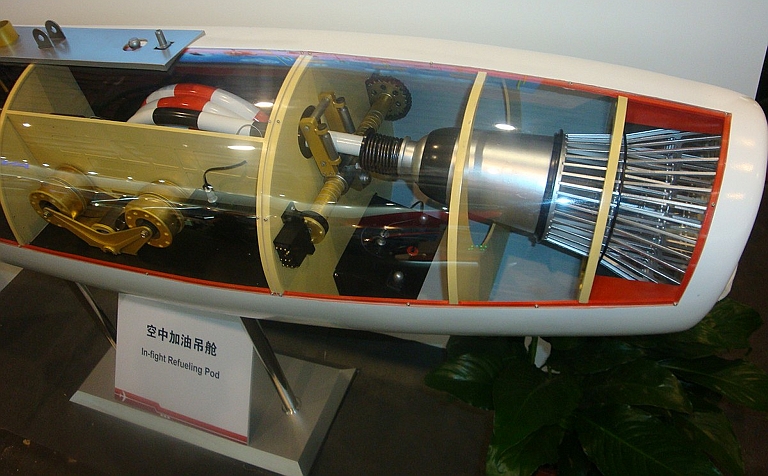 RDC-1 aerial refuelling model cutaway (images © 2009, Zhenguan Studio). 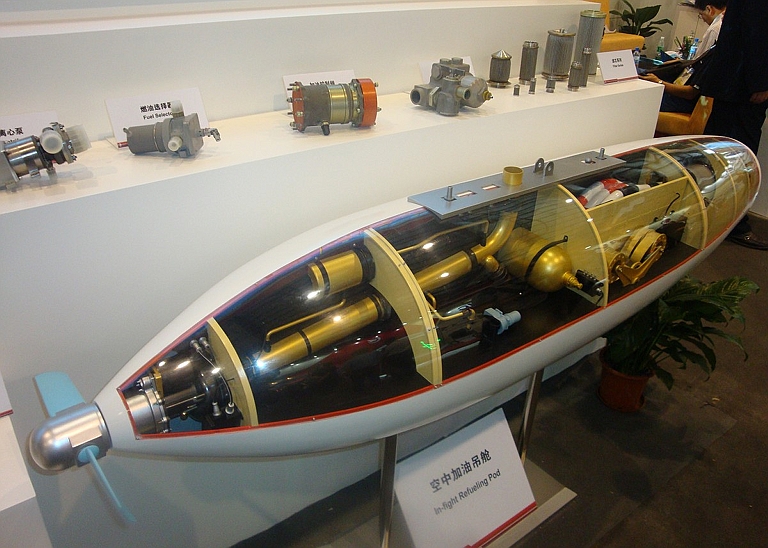 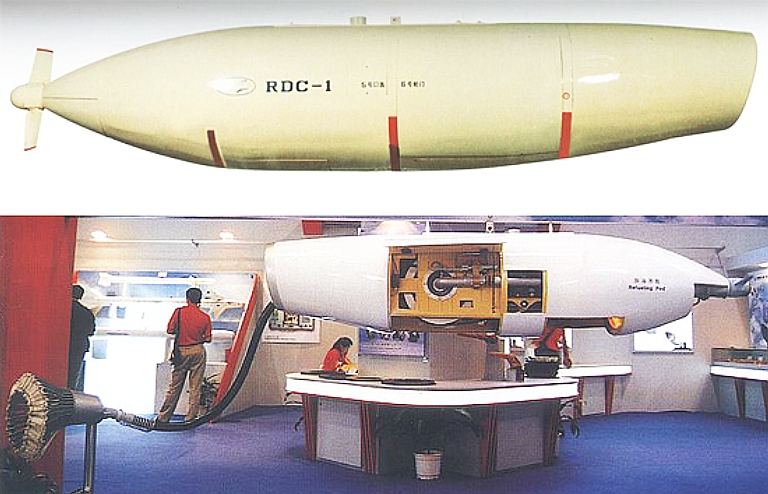 The H-6U
and H-6DU are equipped with a pair of Chinese built China Institute of
Aero
Accessories RDC-1 pods, which appear to be based on the FRL Mk.32
series.
 With around 167,300 lb (75,800 kg) MTOW, 82,000 lb (37,150 kg) BEW, and an internal fuel payload of about 85,000 lb (38600 kg) using a bomb bay tank to supplant a 20,000 lb (9,000 kg) internal bomb payload, the Badger makes for a reasonable tanker in the size and offload class of the British V-bomber tanker conversions. With a total fuel uplift at MTOW about one half of a KC-135E/R, each Badger in practical terms can adequately support only two fighters. The PLA has never disclosed the exact number of H-6 Badgers converted to tankers , nor proper technical detail on the configuration of the tanker. The aircraft is claimed to have dual INS and dual RSBN TACAN beacons. 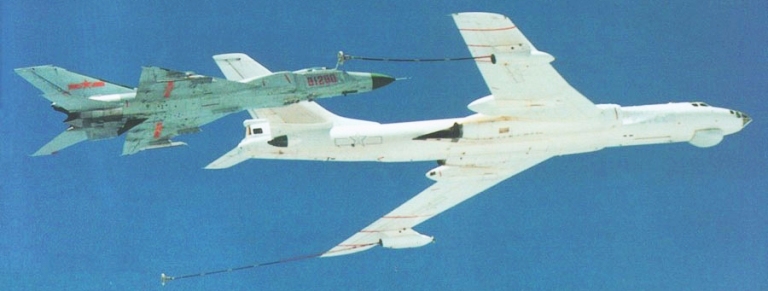 Navy
H-6DU
gassing a J-8-II Finback.
At least
two variants exist, the PLA-AF H-6U and PLA-N H-6DU (HU-6D). Both
appear to be conversions of existing variants, using a pair of wing
mounted RDC-1 hose/drogue pods. 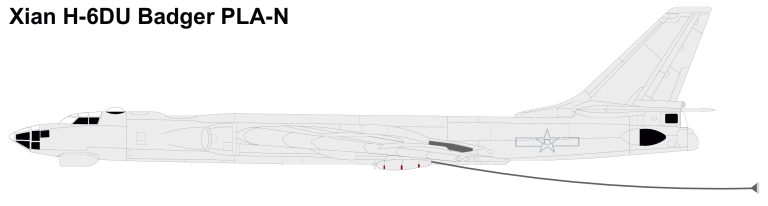
Available photographs indicate the PLA-N H-6DU retaining the ventral Type 245 search radar radome, and the PLA-AF H-6U where the glazed navigator's station in the nose has been painted over or reskinned with sheetmetal, and a weather radar fitted. The remote control gun barbettes and tail turret are deleted to save weight. The Badger refuellers have been used extensively to support the PLA-AF and PLA-N indigenous J-8-II/J-8C/D Finback fighter fleet, and have also been filmed refuelling the new J-10 canard fighter. There is no evidence to date of strike variant Badgers being fitted with refuelling probes – the new turbofan powered H-6K is apt to have a striking radius in excess of 2,000 nautical miles which covers the needs arising from the recently adopted 'second island chain' strategy. The natural candidate for a refuelling probe retrofit is the Tu-95/142 Bear probe, fitted either to the H-6 lower starboard gun port, or above the nose. With a single refuelling an ALCM armed Badger could reach northern Australia from mainland China comfortably. As the PLA does not openly disclose planning decisions, other than as propaganda stunts where this is seen to be useful, there are no indications of how many Badgers will eventually be converted into tankers. The age of most of the 'first generation' H-6/B-6 fleet varies roughly between 12 and 30 years, and the design is a very sturdy Russian derivative of 1940s Boeing technology. Publicly available data suggests that Badger crews often average less than 100 hours annual flying time, which if true indicates that the fatigue life in the Badgers could last for decades yet, corrosion permitting. It is known that some of the oldest Badgers have been scrapped in recent years. 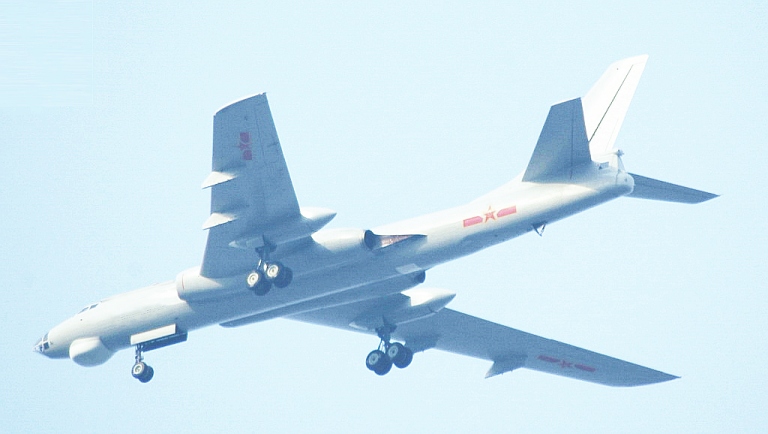 New production PLA-AF H-6M
cruise missile carrier. The
follow-on H-6K has a turbofan engine.
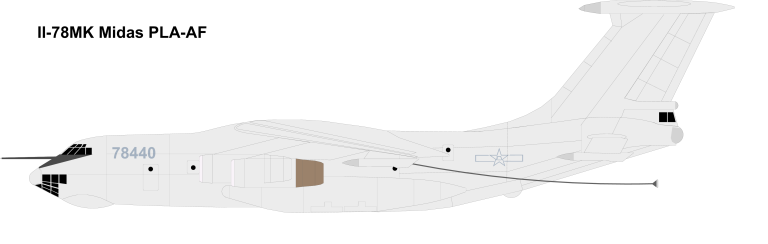
The bigger issue for the Badger are the fifties technology Wopen WP-8 (Mikulin AM/RD-3M-500) 21,000 lb class turbojet powerplants which are thirsty and maintenance intensive by current standards, and the antiquated avionics. Earlier attempts to re-engine the Badgers were abandoned. The appearance of the new build turbofan powered H-6K changes everything. A newer technology 21+ klb class turbofan would have a major impact on the achievable fuel offload performance and the operational economics of the H-6U/DU Badger fleet. Re-engining existing H-6U/H-6DU tankers, or building new production tankers derivatives of the H-6K are now both feasible options for the PLA. The current inventory is operated by the PLAAF 8th Air Division, Leiyang AB, in Guangzhou MR, and the PLA-N air arm 9th Division, from Lingshui AB on Hainan Do. Ilyushin Il-78M Midas Aerial Refuelling TankerChina had an ongoing interest since the 1990s in acquiring four engine Ilyushin Il-78 Midas tankers. In 2003 reports of negotiations with Rosoboronexport and Tashkent based TAPO to acquire six Il-78MKKs and thirty Il-76MDs emerged in the Russian media. India took delivery of Il-78MKI tankers in 2004, and this resulted in a tit-for-tat order for 8 Il-78MK tankers for the PLA-AF. The Il-78 Midas was the second generation of dedicated tanker to be introduced by the Soviets, replacing the very old Myasishchev M-4 tanker conversions operationally in 1987. 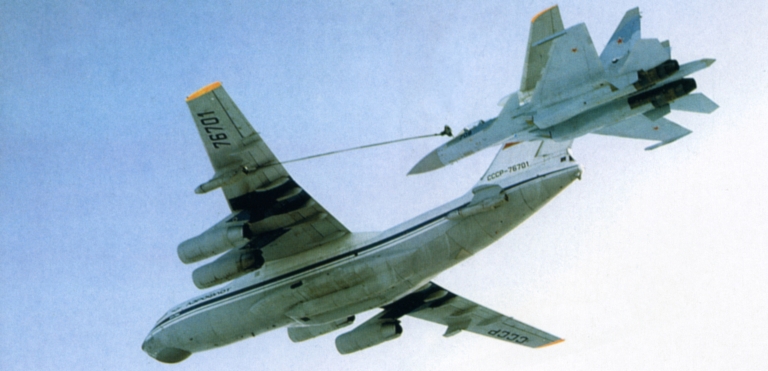 Russian Il-78 Midas
gassing an Su-35.
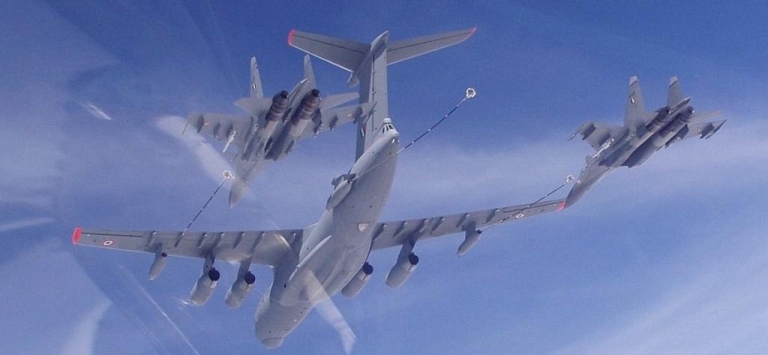 Indian Il-78MKI gassing two
Su-30MKIs (IAF)
The Il-78 is a conversion of the Il-76 Candid airlifter airframe, conceptually not unlike the USMC KC-130 tankers. Around 80,000 lb of auxiliary fuel is carried in two large fuselage tanks, mounted on fixed pallets which are carried on the main freight deck. While the earliest Midas tankers were reported to be dual role 'convertibles', indications are that more recently built aircraft are dedicated tankers, with a single large fuselage tank for auxiliary fuel. 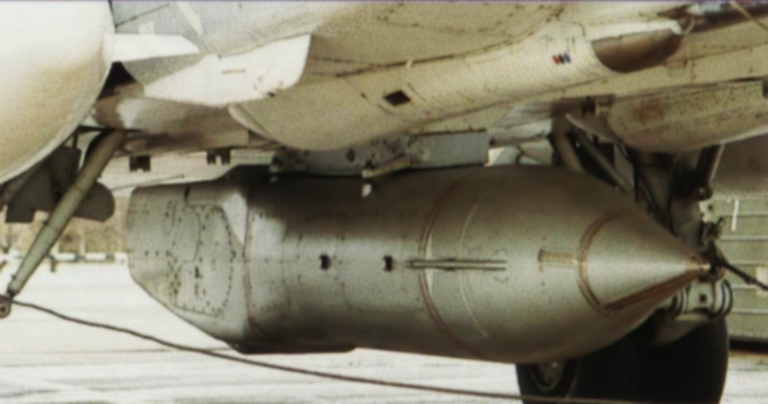 Sakhalin UPAZ-1A refuelling pod installations, upper Su-24 Fencer buddy refuelling store, lower Il-78 Midas. 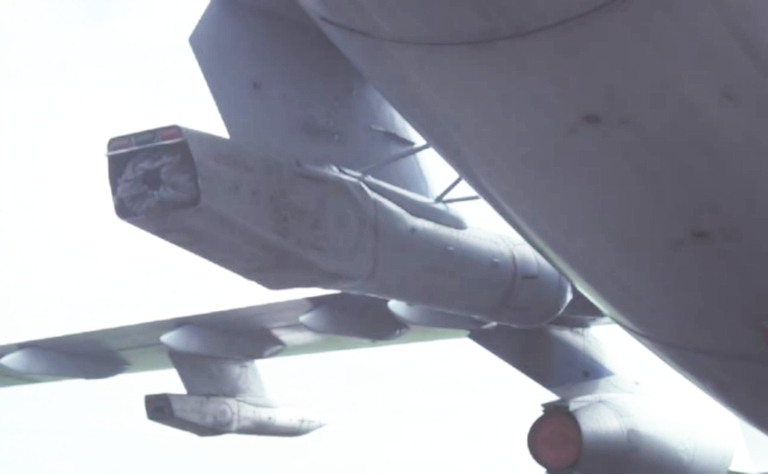 The Il-78 uses the Sakhalin/Severin UPAZ-1/1A aerial refuelling pod which is compatible with standard Russian probes used on the Tu-95 Bear, Su-24 Fencer, and Su-27SKM/Su-33/Su-30/Su-35 Flankers. It is credited with a fuel transfer rate of up to 3,900 lb/minute. The Midas is equipped with three pylons to carry UPAZ-1 series pods, one under each outboard wing, and one on the port aft fuselage. The Russians are known to fly the aircraft with one, two or three pods fitted. The Midas is a tanker in the class of the KC-135 series, with a takeoff fuel payload of around 220,000 lb. Older variants of the Il-76 and Il-78 are powered by four Aviadvigatel' D-30KP turbofans, newer aircraft are now being built with a much more fuel efficient turbofan, with Russia planning to re-engine older aircraft with the PS-90 over time. The recency of the PLA-AF order indicates that the aircraft will be delivered in the Il-78MK configuration, likely powered by PS-90A76 fans. In the long term we can expect significant expansion of the PLA tanker fleet, as all of the late build Su-27SMK/J-11 Flankers and Su-30MKK/MK2 Flankers have refuelling probes, as does the new J-10 canard fighter. The PLA's options will be conversion of existing Badgers, production of a turbofan powered H-6K derivative tanker, or the purchase of further Midas tankers from Russia. |
  |
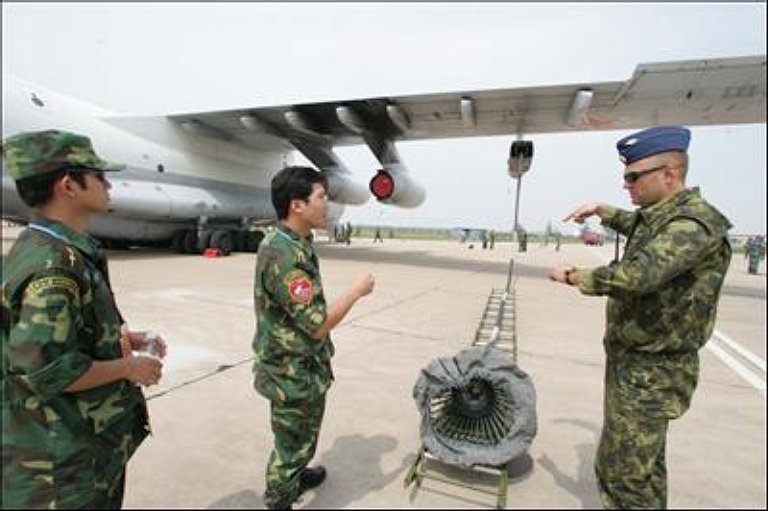 Sino-Russian Peace Mission 2005 exercise images showing deployed Russian Midas tankers (Xinhua). 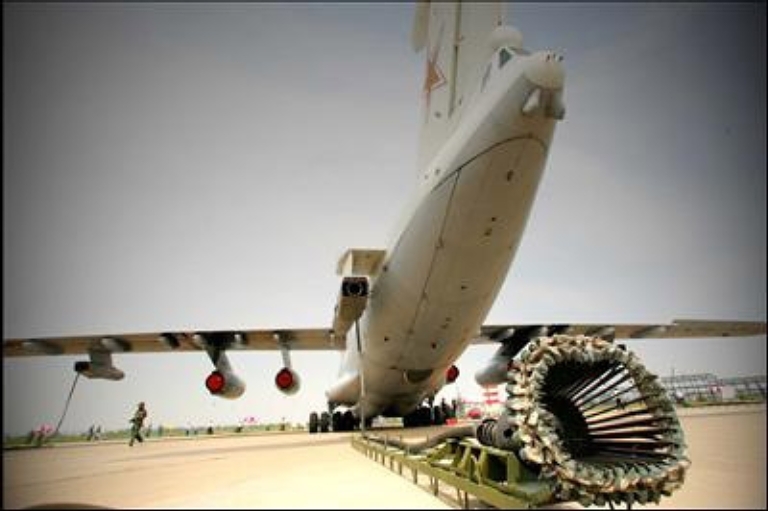 |
PLAAF Tanker Operations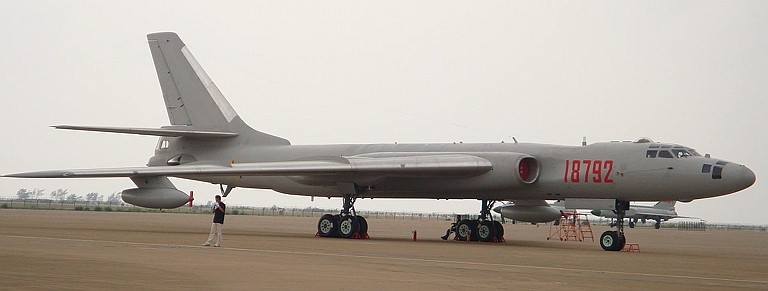 A H-6U tanker of the PLA-AF (image © 2009, Zhenguan Studio). 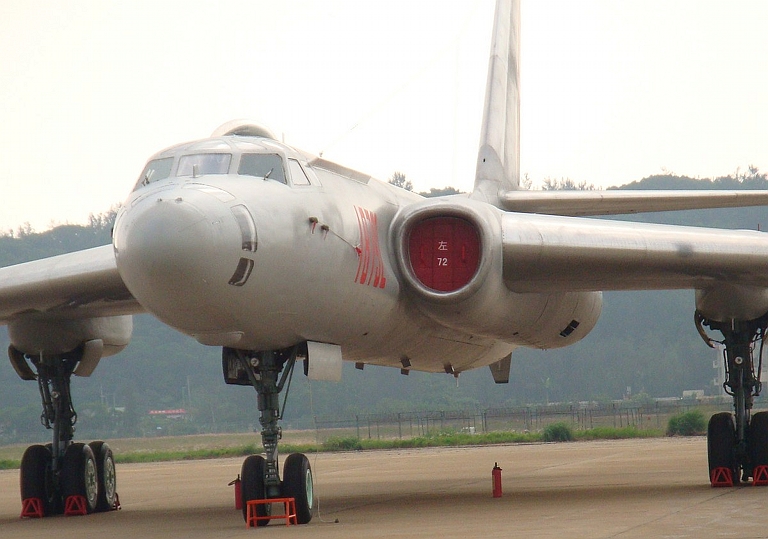 A H-6U tanker of the PLA-AF (image © 2009, Zhenguan Studio). 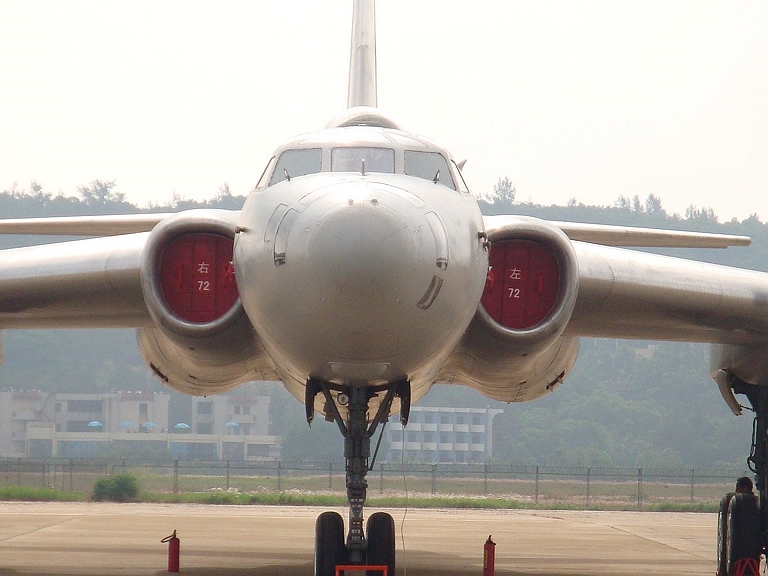 A H-6U tanker of the PLA-AF (image © 2009, Zhenguan Studio). 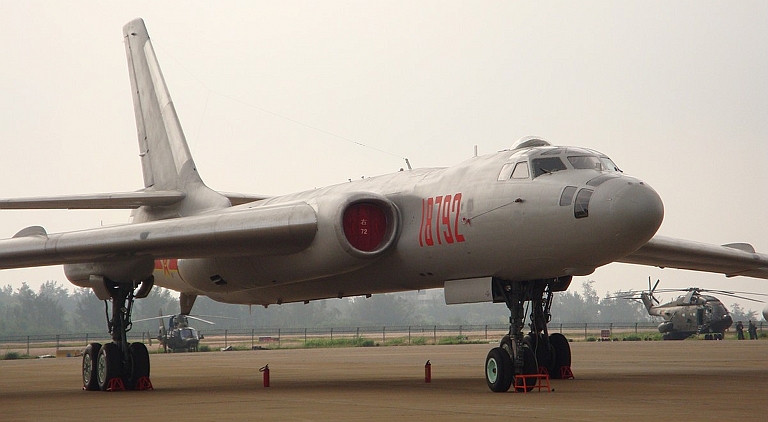 A H-6U tanker of the PLA-AF (image © 2009, Zhenguan Studio). 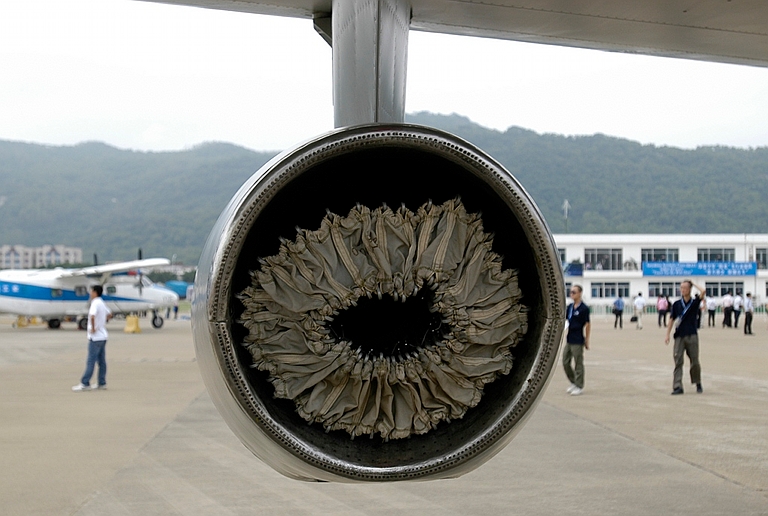 Detail
of the RDC-1 pod stowed on a H-6U
tanker of the PLA-AF (image © 2009, Zhenguan Studio).
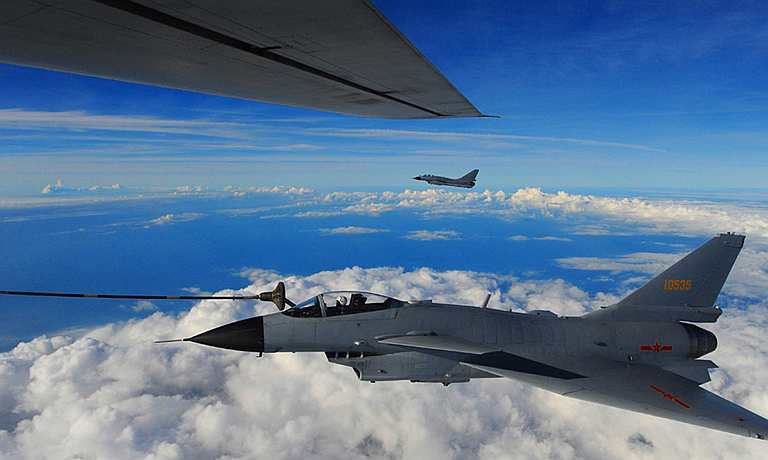 A H-6U tanker of the PLA-AF refuels a
J-10A of the 5th Fighter Regiment, 2nd Air Division, Guangzhou (image
PLA-AF).
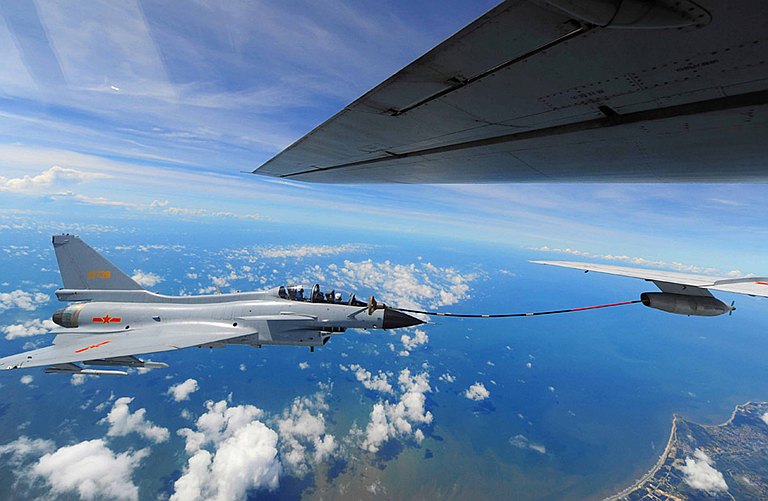 A H-6U tanker of the PLA-AF refuels a
J-10S combat capable trainer over the Guangzhou MR Coast (image PLA-AF).
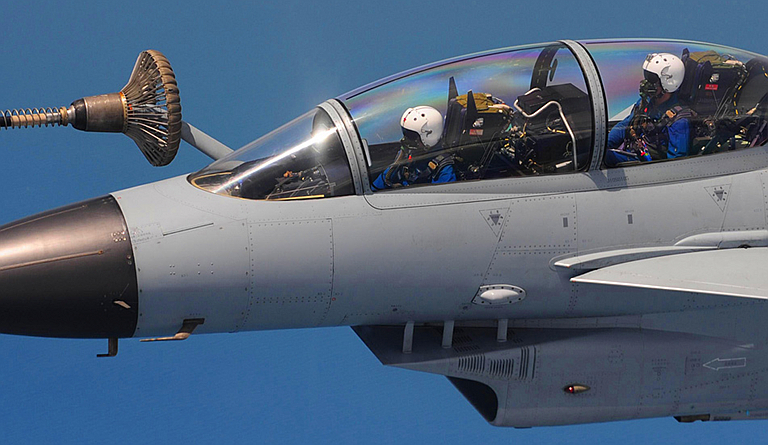 A H-6U tanker of the PLA-AF refuels a
J-10S combat capable trainer over the Guangzhou MR Coast (image PLA-AF).
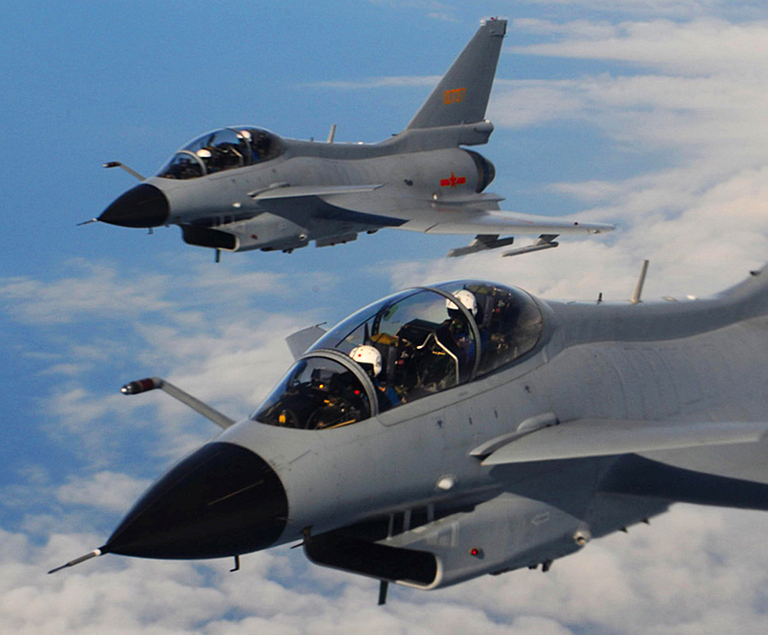 Above, below, a pair of J-10S combat capable trainers line up on a H-6U tanker of the
PLA-AF
over the Guangzhou MR Coast (image PLA-AF).
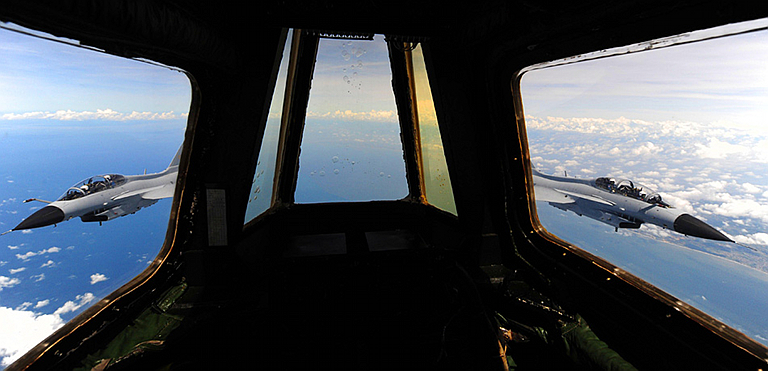 |
|
|
Resources
|
|
Imagery
Sources: Xinhua;
MilitaryPhotos.net;
other Internet sources.
|
|
Technical Report APA-TR-2007-0703 |
|
|||||||||||||
|
|
|
|
|
|
|
|
|
|
|
|||
|
|
|
|
|
|
|
|
|
|
|
|||
 |
|
|
|||||||||||
| Artwork, graphic design, layout and text © 2004 - 2014 Carlo Kopp; Text © 2004 - 2014 Peter Goon; All rights reserved. Recommended browsers. Contact webmaster. Site navigation hints. Current hot topics. | |||||||||||||
|
Site Update
Status:
$Revision: 1.753 $
Site History: Notices
and
Updates / NLA Pandora Archive
|
|||||||||||||
|
|
Tweet | Follow @APA_Updates | |||||||||||
|
|
|||||||||||||
|
|
|||||||||||||