|
||||||||||||||||||||||
 |
||||||||||||||||||||||
![F-22A Raptor, FB-22, F-22E, F-22N and Variants Index Page [Click for more ...]](APA/f-fb-22.png "F-22A Raptor, FB-22, F-22E, F-22N and Variants Index Page [Click for more ...]") |
 |
![People's Liberation Army Air Power Index Page [Click for more ...]](APA/pla-air-pwr.png "People's Liberation Army Air Power Index Page [Click for more ...]") |
 |
 |
 |
 |
 |
 |
![Military Ethics, Culture, Education and Training Index Page [Click for more ...]](APA/ethx-culture.png "Military Ethics, Culture, Education and Training Index Page [Click for more ...]") |
 |
||||||||||||
 |
![Russian / Soviet Weapon Systems Index Page [Click for more ...]](APA/rus-weps.png "Russian / Soviet Weapon Systems Index Page [Click for more ...]") |
 |
 |
 |

|
 |
 |
 |
 |
 |
||||||||||||
 |
 |
|||||||||||||||||||||
| Last Updated: Mon Jan 27 11:18:09 UTC 2014 | ||||||||||||||||||||||
|
||||||||||||||||||||||







|
Defeating
Cruise
Missiles
Technical Report APA-TR-2007-0402 |
||||
| by
Dr
Carlo
Kopp, AFAIAA, SMIEEE, PEng First published in Australian Aviation, October 2004 Expanded, revised, updated April, 2007 Updated October, 2011 Updated April, 2012 Text, Line Art © 2004-2012 Carlo Kopp |
||||
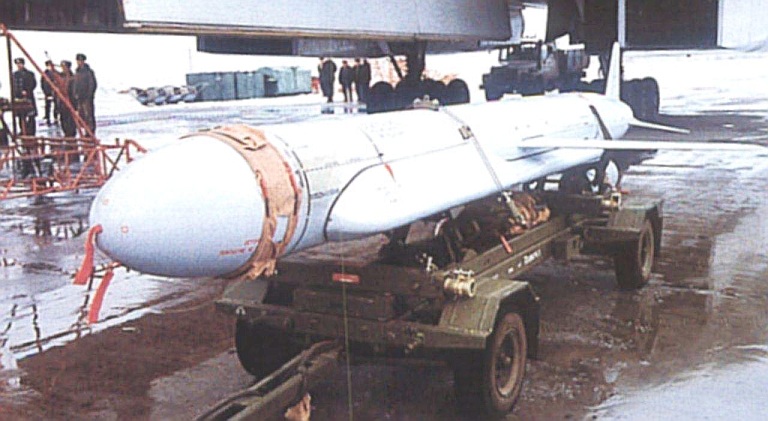 Raduga
Kh-55SM Kent with conformal fuel tanks. China illegally acquired
samples from
the Ukraine to permit the development of a cloned variant for the
PLA. The current production DH-10/CJ-10 is likely a result of this
effort. This weapon is also a candidate for new production PLA Badgers
(RuMOD).
When Fieseler's engineers perfected the FZG-76/Fi-103 V-1 doodlebug in 1944, little could they have imagined the long term impact of their creativity. The V-1 became the forerunner of a family of weapons which has decisively influenced many aspects of modern air warfare since then, and will continue to do so for the foreseeable future. The best starting point is the definition of what a cruise missile is. The media definition of a cruise missile is any weapon similar to the US Navy UGM/RGM-109 Tomahawk/TLAM or US Air Force AGM-86 ALCM/CALCM. The technical definition is any weapon which automatically flies an essentially horizontal cruise flight profile for most of the duration of its flight between launch and its terminal trajectory to impact. In the framework of technical cruise missile definition, weapons are further divided into tactical / sub-strategic / theatre weapons, and strategic weapons, and then divided by warhead into nuclear and conventional. A further division, somewhat arbitrary with the arrival of the SLAM/Block II Harpoon and Russian analogues, is the split between Anti-Ship Cruise Missiles (ASCM) and Land Attack Cruise Missiles (LACM). The most widely deployed are ASCMs, which typically start with
ranges of tens of nautical miles, warhead sizes around 100 kg, and
subsonic cruise profiles. The Exocet, Harpoon, Kh-35U and YJ-8 families
are the most widely used examples. At the opposite end of this spectrum
are the Russian heavyweights, like the rocket propelled subsonic 2.5
tonne class Styx family (Chinese C-601/611 Kraken), the Mach 3+ 6 tonne
class Kh-22M Burya (AS-4), the ramjet Mach 2+ 4.5 tonne class Kh-41
Sunburn and 3 tonne class Kh-61 Yakhont/Brahmos. 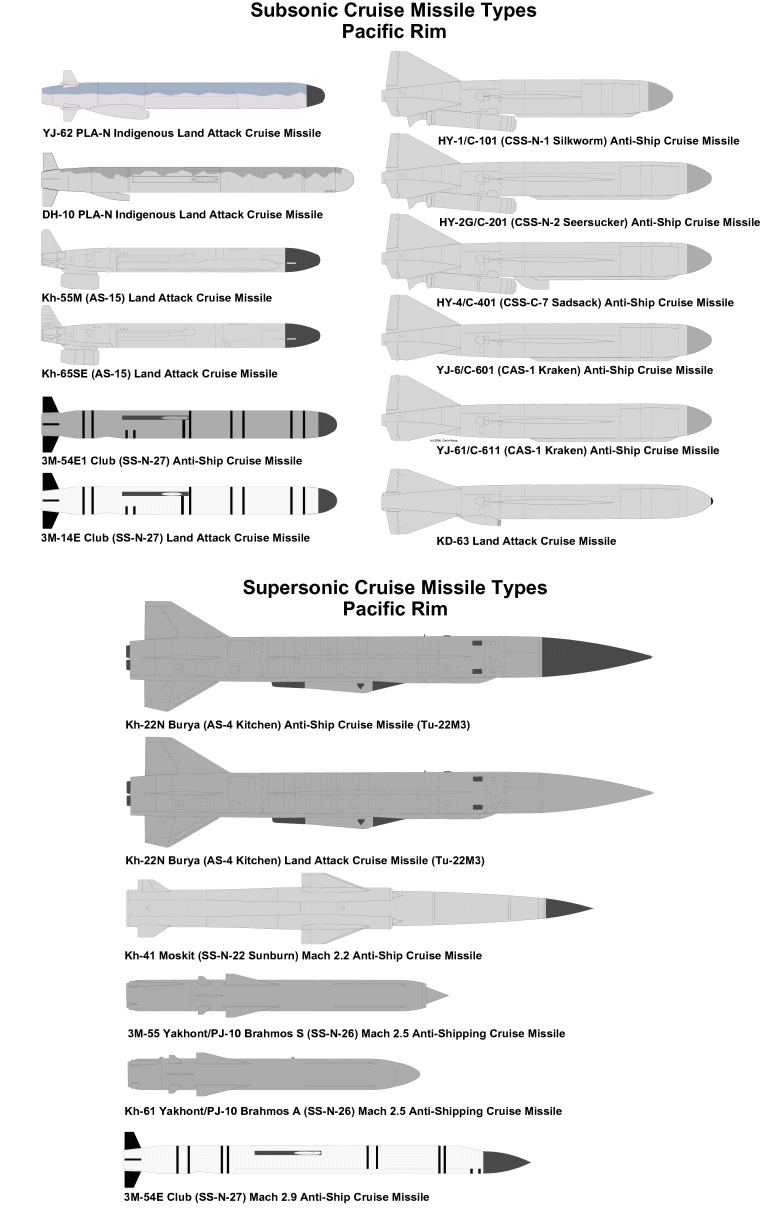
Less widely deployed but increasingly available are LACMs in various categories, including derivatives of ASCMs. The most widely used weapons in this class to date are the UGM/RGM-109 TLAM family and AGM-86C CALCM, with the EADS Apache / Storm Shadow, KEPD-350, AGM-158 JASSM, Kh-55/65 (AS-15), 3M-54 / 3M-14 (SS-N-27) and Chinese clones now appearing in service inventories. From a technology perspective, the commodification of GPS, Ring Laser Gyro, 3rd Generation microprocessor, and Monolithic Microwave IC technologies will have a major long term impact in the market, reducing guidance package costs, but also resulting in the breakdown of the historical technology barriers which limited large scale inventories to the US and USSR. Modern guidance technology has already seen the absorption and reuse of Cold War era cruise missile warstocks, with the remanufacture of US Navy UGM/RGM-109 Tomahawk Anti-Ship Missile (TASM) and US Air Force AGM-86B (nuclear ALCM) airframes into conventional LACMs. The large remaining warstock of Russian weapons may also see reuse, the recent guidance upgrade package for the Kh-22M being a good example, as well as the ever evolving Chinese C-601/611. Strategically, precision guided cruise missiles can have significant military effect, but even inaccurate guidance permits their use as terror weapons against civilians, as the Scud has been used. Historically, the main attraction in cruise missiles has always been in the often very significant stand-off range provided, keeping the delivery platform out of the reach of most if not all air defence weapons. An equal attraction has been the difficulty in detecting, tracking and killing a small, and often very low flying cruise missile. The drawback in all cruise missiles has always been economic - the fraction of warhead weight to total weapon weight has typically been less than 50%, while the cost of these weapons has been of the order of 50 times or greater than guided bombs. Complex guidance and propulsion systems have been the main cost drivers. While the US have repeatedly performed large scale bombardments using up to several hundred weapons per bombing campaign, the cost proved unsustainable even for the US budget. The current effort to field the low cost US$500k class JASSM and Tactical Tomahawk weapons reflects this reality - even at half of the cost of legacy cruise missiles these weapons will be used primarily to kill heavily defended high value targets. For the ADF cruise missiles will become the principal missile defence and air defence issue in coming decades, reflecting not only the wide proliferation of shorter ranging ASCMs and land attack missile derivatives, but also the strategic impact of China's introduction of TLAM/CALCM class weapons as these mature, and extended range turbofan H-6K Badger delivery systems. The fact that cruise missile defence did not rate a mention in
the RAAF force structure rationale presented to parliament on the 4th
June, 2004, is remarkable - more so since this issue has been
repeatedly
raised in parliamentary submissions since November, 2000, and is also
appearing in US defence publications.
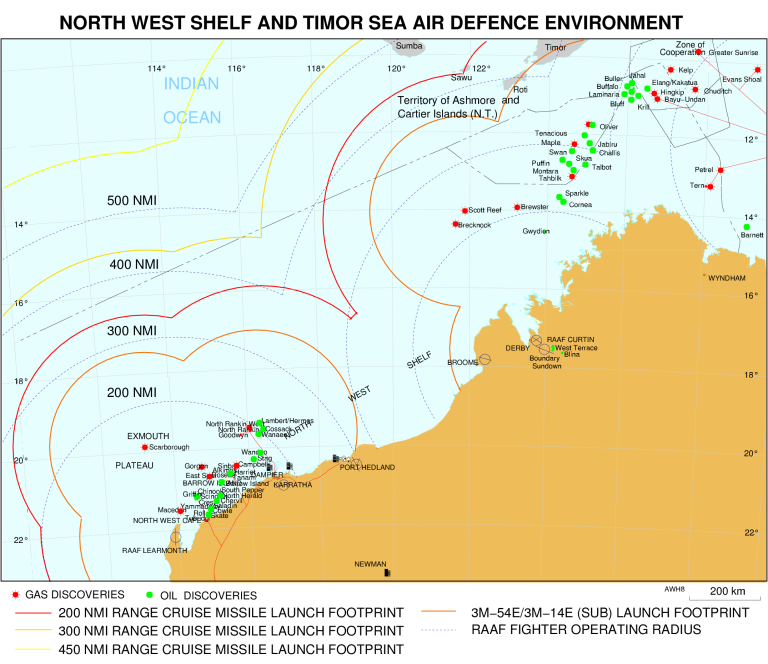
The arrival of cruise missiles in the region presents genuine long term issues for Australia's air defences. The north hosts a large oil/gas industry, and key runways for air defence. Both are high value strategic targets, be it in economic terms or in stripping away air defence capability across the north. This map compares launch footprints for cruise missile of various ranges against fighter intercept radii (Author). Delivery Techniques for Cruise Missiles Since the 1940s cruise missiles have been launched by aircraft and surface launchers, the latter at first fixed and mobile ground launchers, and by the 1950s ships and surfaced submarines. The Tomahawk extended the latter domain to include submerged submarines. Today, a cruise missile could be fired by a large aircraft, a fighter, a surface ship, a submerged submarine and a ground based Transporter Erector Launcher (TEL). An alternative repeatedly canvassed in the US debate of recent has been the covert maritime tramp freighter, or its equivalent, the pretend charter air transport - the latter reflecting US proposals for 747 ALCM carriers, and UK proposals for A340 ALCM carriers. Each of these delivery techniques presents its own unique challenges to a defender, and none can be ignored when planning a cruise missile defence strategy. Large aircraft such as strategic bombers, theatre bombers, and modified transports present the capability to move a respectable number of cruise missiles over regional or global distances in hours or tens of hours, at cruise speeds of the order of 450 KTAS. Range and speed afford flexibility in timing attacks, and in choosing launch points to best disadvantage the defender. On a typical profile the aircraft would fly to a preplanned launch point, spend several minutes releasing the weapons, upon which the bomber can depart. Support jamming to confuse defences is an option. This is the concept pioneered by the B-52/ALCM system, and since adopted by the Russians with the Bear/Blackjack/Kh-55/55M/555 system. It is expected to be used by the PLA-AF once its H-6K/ALCM system matures. There are many variations on this theme possible, the performance of the delivering aircraft and weapon. The Russian operated Tu-22M3 Backfire / Kh-22M series penetrating to the launch point supersonic and high is one extremity, whereas the B-52 going in low armed with AGM-86C is the other. The nearer the bomber can get to an opponent's defensive perimeter, the deeper the weapons can penetrate and the more flexibility the weapon has in routing its flightpath around known defences. The use of tanker supported fighters presents another variation on the same theme. While fighters are inherently more survivable than lumbering heavy bombers, their supporting tankers are not and present similar opportunities to a defender. The operational economics of this game continue to favour heavy bombers. Surface warships have been used extensively by the US Navy to deliver TLAMs, and regional weapons like the 3M-54/14 series will eventually become a feature of regional surface warship inventories. The key issue for the attacker is the range of the weapon, as the warship must remain outside opposing defences. Submarines are the most viable naval delivery system as they permit surprise not available to a surface warship. This was central to Soviet AV-MF sea control operations, with weapons suitable for submerged launches developed. Depth and subsurface topology permitting, a submarine can get quite close to an opponent's coastline before launch, thus reducing warning time and presenting only low signature cruise missiles in flight to opposing air defences. This tactical advantage comes at a the price of the high acoustic signature of multiple launches. This is easy to detect and the missiles in flight also betray the area in which the submarine is operating. While weapons like the TLAM and 3M-54/14 are compatible with attack submarine torpedo tubes, this style of launch is at the expense of torpedo payloads. The favoured approach are vertical or slant launch tubes. Last December the US Navy contracted to have the Ohio class SSBNs USS Ohio, Michigan and Georgia converted into SSGN 726, 727 and 729 respectively, each armed with 154 TLAMs in vertical tube packs, replacing the SLBM launch tubes. The third technique for launching cruise missiles is the mobile ground based TEL, typically using a large all wheel drive truck or semi-trailer. This is yet another a variation of the theme of Wernher von Braun's truck mobile A-4/V-2 launchers used in 1944. The most widely deployed modern ground based cruise missile system was the BGM-109G Gryphon four round TEL deployed in 1983 to counter Soviet SS-20 IRBMs. The Intermediate Range Nuclear Forces (INF) Treaty saw the 500 or so BGM-109Ls scrapped by 1991. India's BrahMos TELs, China's Seersucker TELs and the plethora of coastal defence missile TELs present other examples. Ground mobile TELs present the same advantages and disadvantages as ballistic missile TELs. If dispersed and well camouflaged before the onset of hostilities, they provide surprise as SLCMs do, but also expose their TELs in a similar fashion. Their slow transit speeds present similar problems to submarines and warships in sustaining a high rate of fire, and in successfully egressing launch areas after firing. There is a clear split in capabilities between air launched and surface/subsurface launched weapons. While the latter offer surprise, they lack the mobility and transit speeds for rapid escape and to sustain a high rate of fire. Air launched weapons offer less surprise, but easily offset this limitation by the tenfold or greater speeds of the launch aircraft and the distances over which the weapons can be quickly delivered, and repeat strikes launched. In the Australian/regional context air and submarine launched delivery matter most, as these permit strikes across the sea-air gap. Surface warship and ground launched cruise missiles are of less concern, although the latter are an issue for RAN surface fleet operations and especially amphibious operations in the region. Cruise Missile Defence Strategies
Since 1944 cruise missile defence has remained a persistent headache. As defensive systems have evolved, so has the cruise missile threat. Stealth techniques have complicated the issue, with the cancelled 1990s US AGM-137 TSSAM and its replacement, the current AGM-158 JASSM designed from the outset for true very low observable performance. As cruise missiles are easier to design for low radar signature than a full sized aircraft is, it is inevitable now that second generation EU, Russian and indigenous regional weapons will follow the US lead. A key contributor to Soviet bankruptcy was the deployment of the AGM-86B on the B-52 and its contemporary, the BGM-109L GLCM. The Soviet response was to field large numbers of expensive MiG-31P Foxhounds, Su-27 Flankers, S-300P semi-mobile SAM batteries, S-300V mobile SAM batteries, and supporting assets. With hundreds of each of these systems deployed to counter a modest inventory of US cruise missiles, Soviet PVOS and V-PVO budgets bloated out of control during the 1980s. This remains the classical case study of the assymetric use of technology to effect massive strategic damage on an opposing economy. With regional ALCM/SLCM proliferation, including weapons with hundreds of nautical miles of range, Australia is presented with similar geo-strategic / technological problems to those faced by the Soviets two decades ago, albeit not on that scale. Siberia and Australia's deep north share the common topographical problem of widely separated population centres, military bases and industrial facilities, and the dilemma of an enormous coastline to cover with a finite pool of assets. They also share the advantages of a sea-air gap to the north. While Australia does not face at this time the threat of nuclear armed cruise missiles, the damage effect produced by even conventional cruise missiles against the gas/oil infrastructure would be similar in effect due to the combustible nature of the targets involved. With the Burrup Peninsula and Gorgon/Barrow LNG tank farms each storing when full energy equivalent to a 1 Megatonne TNT class weapon, the warhead issue is truly moot for these economic targets. Defensive strategies for dealing with cruise missile threats fall broadly into two categories, the first being the denial or deterrence of launch and counterforce strategies, the second being the interception of launched weapons. Deterrence strategies amount to threatening credible retaliation, regardless of weapons used. If Australia pursues current force structure plans then this approach will not be credible, given the limitations of the JSF supported by a small number of tankers. Retaliatory pinprick strikes maketh not for deterrence. Counterforce strategies amount to pre-emptive destruction of the opponent's cruise missile capability before it can be deployed or launched. This approach requires similar capabilities to deterrence, but involves much more specific targeting. With a lightweight JSF-centric future strike force, this too is not a credible future option for Australia. Denial of launch strategies amount to shooting the archer, not the arrow paraphrasing the 1980s US Maritime Strategy. This involves killing cruise missile carrying aircraft, sinking cruise missile armed ships/subs, or destroying ground mobile TELs before they have the opportunity to fire. This approach also requires a robust force structure, including good maritime and land strike capabilities, good air defence capabilities, and good ASW capabilities. Interception of launched cruise missiles presents its own challenges, especially in terms of fighter persistence, speed, missile payload, radar performance, tanker and AEW&C numbers. However, in strategic terms it is often the only option left, especially during the period preceding an outbreak of full scale hostilities. As cruise missiles present an attractive first strike weapon to disrupt air defence infrastructure, their use is most likely in the opening round of a conflict.
|
||||
|
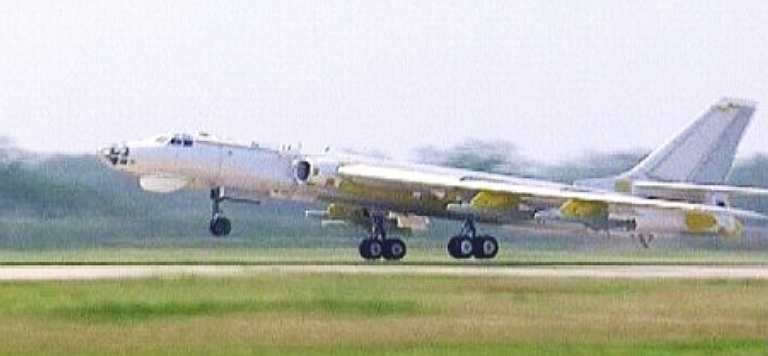
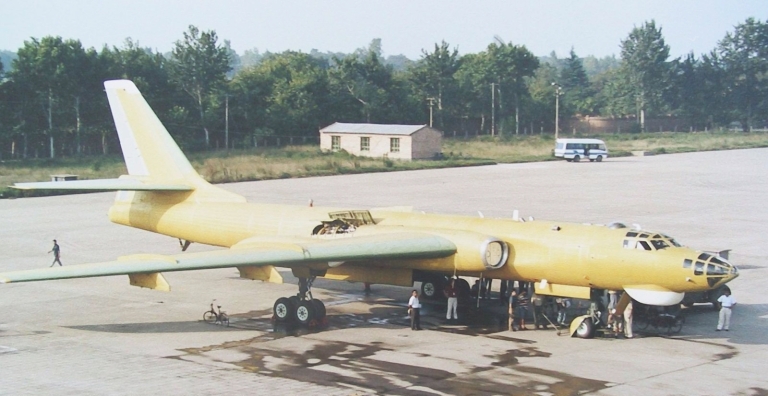
The two most important regional strategic developments
over
the last
two years have been the PLA-AF's January 2010 disclosure of the
stealthy F-111 sized J-20, and the 2002+ development of the cruise
missile carrier H-6K turbofan powered Badger derivative. At this stage
it is not known whether the 20,000 lb
bomb bay fuel tank used with the H-6U tanker has been incorporated, or
whether a refuelling probe will be fitted. The photograph is part of
the Zhuhai 2002 AVIC I promotional video, depicting the earlier H-6H
prototype on
takeoff, carrying four Kh-55/65 class missile bodies (AVIC). [Click for more ...]. 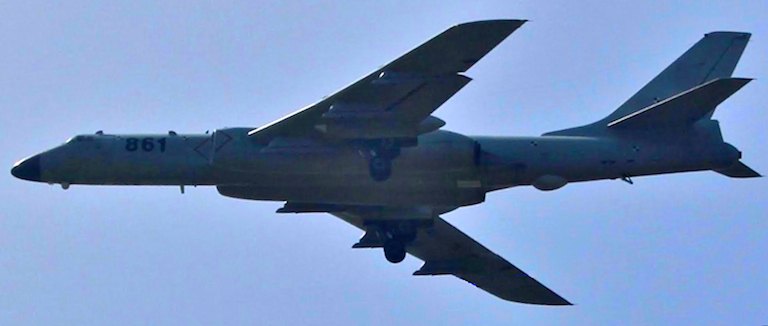
Prototype
Xian
H-6K Turbofan Badger cruise missile
carrier (Xian).
The US Air Force model for cruise missile defence
envisages
inner and outer zones, patrolled by E-3 AWACS and E-8 JSTARS
respectively, with F-22A providing outer zone intercepts, and AESA
equipped legacy fighters inner zone intercepts. Current RAAF planning
leaves gaps in inner zone X-band surveillance capability, and totally
inadequate fighter capability in terms of radar performance, supersonic
persistence and missile payloads. This chart depicts an alternative
model for the RAAF (Author).
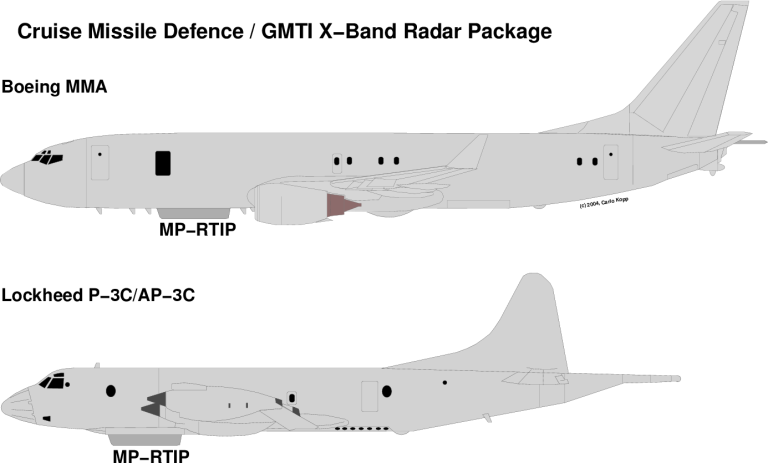
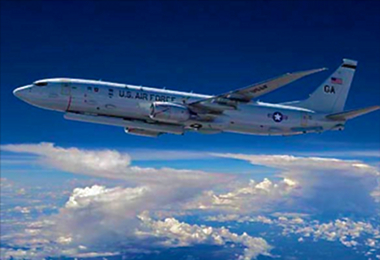
The gap in RAAF inner zone cruise missile defence
surveillance
capabilities could be plugged by fitting an X-band AESA such as the
MP-RTIP to an LRMP aircraft. This provides a dual role cruise missile
defence and littoral/battlefield GMTI capability. The 2004 AFTS/RLM
MMSS
proposal for the AP-3C would provide a low cost/risk means of
introducing this capability (Author).
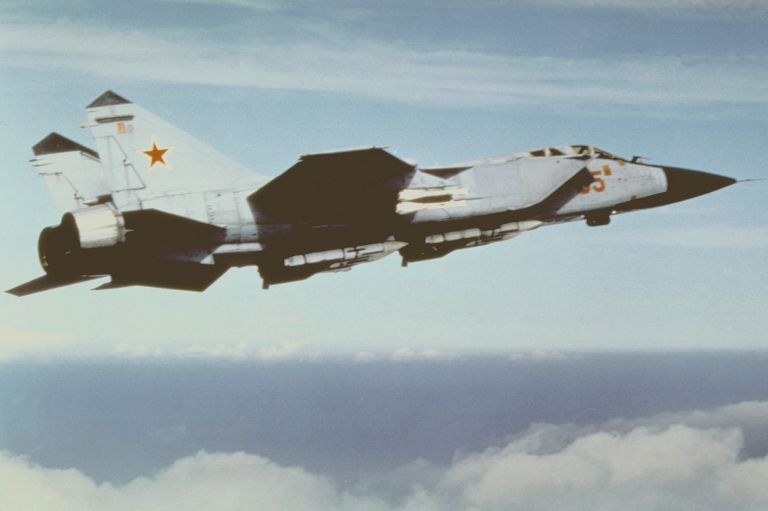
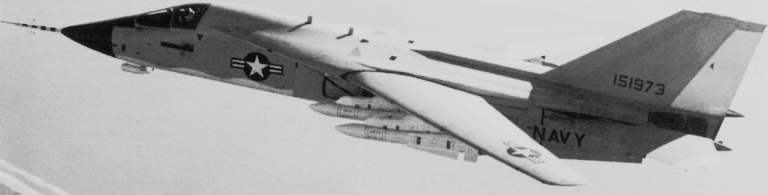
The only two fighters ever specifically built for cruise missile / bomber defence were the Russian MiG-31 Foxhound and US Navy F-111B. The MiG-31P was built to kill B-52/B-1 and the F-111B the Backfire and Badger. These airframes are nearly identical in cardinal weight/size parameters, built to carry large look-down/shoot-down radars, IRST systems and similar R-33/AA-9 and AIM-54 missiles (US DoD). |
||||
|
Implementing Cruise Missile Defence To implement either deterrent or direct counterforce strategies to defeat an opposing cruise missile force requires significant targeting and strike capability. This strategy requires that a opposing force armed with cruise missiles be attacked and destroyed in situ, for instance by demolishing airfields, launch aircraft and missile stocks on the ground, or by analogous strikes against naval bases hosting cruise missile armed warships or submarines. Targeting, with the exception of ground mobile TELs, is less challenging as airfields and naval bases are large fixed infrastructure which can be effectively surveilled using satellites or human intelligence assets, although timeliness can be an issue if signs of strike preparation are the trigger for a pre-emptive attack. Cruise missile warfare like ballistic missile warfare to a large extent obeys the use them or lose them rule, and there are strong incentives to fire off as much of the warstock as early as possible in a campaign. Interdicting cruise missile armed submarines, or intercepting cruise missile carrying aircraft, also present interesting challenges. However, while a riskier strategy than counterforce strikes in situ, interdiction/interception achieves a similar effect by inflicting cumulative attrition on the opponent's delivery force. Rather than destroying the force in a small number of concurrent or closely timed strikes, the attrition occurs overs days or weeks as the opponent's assets are ground down to impotence. In political terms counterforce strikes, especially if pre-emptive, are problematic, but interdiction/interception of delivery platforms presents a clear cut case of defensive action with clear hostile intent by an opponent. The risk is that not every opposing platform is stopped before it launches, and that many will escape to attack yet again. When interdiction of a submarine or interception of a strike aircraft fails, and cruise missiles are launched, the default strategy is then to engage and destroy these before they reach their targets. In practice any model for defeating a cruise missile armed opponent must be multi-layered, even if the counterforce strike option is not implementable due to inadequate strike capabilities. Launch platforms must be detected, tracked and engaged, and if this fails, the cruise missiles must be detected, tracked and engaged. The air-sea gap is valuable in this respect, as it provides a defacto free-fire zone for fighters tasked with cruise missile intercepts, and the distances involved provide for repeat engagement opportunities, fighter fuel and weapon payloads permitting. Reliance on land based SAM systems for terminal defence of
target areas
is a popular but relatively ineffective strategy, as high performance
SAMs with expensive high power-aperture radars are required, and even
with mast mounted antennas to improve coverage the footprint is bounded
by ranges of miles to at most tens of miles. Placing SAM batteries on
warships increases this expense for some gain in mobility. 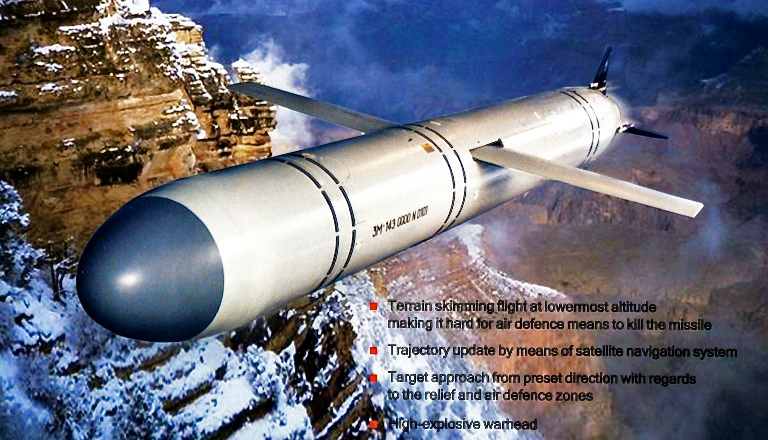
3M14E
Sizzler SLCM
(Novator).
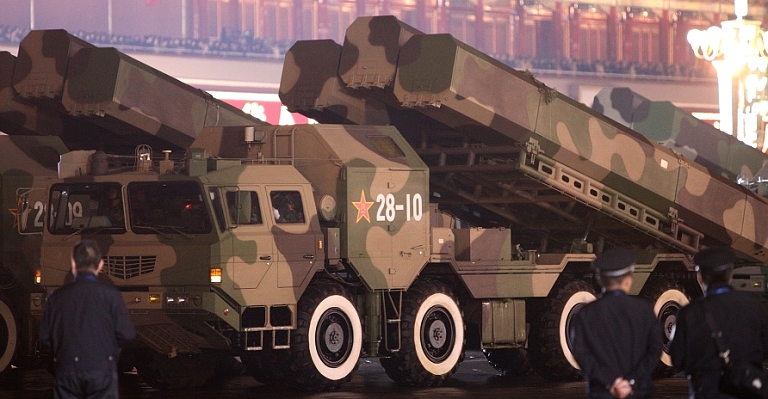 The
ground
launched CJ-10 Long Sword is a strategic cruise missile modelled on the
United States BGM-109G GLCM and Soviet RK-55 Relief, the latter both
scrapped under treaty obligations. Chinese sources credit this missile
with a range of up to 1,100 nautical miles. It carries a range of
different 770 lb or 1,100 lb warheads. The PLA Second Artillery Force
has currently up to 30 deployed TELs (Chinese internet).
Defeating Submarine Launched Cruise Missiles
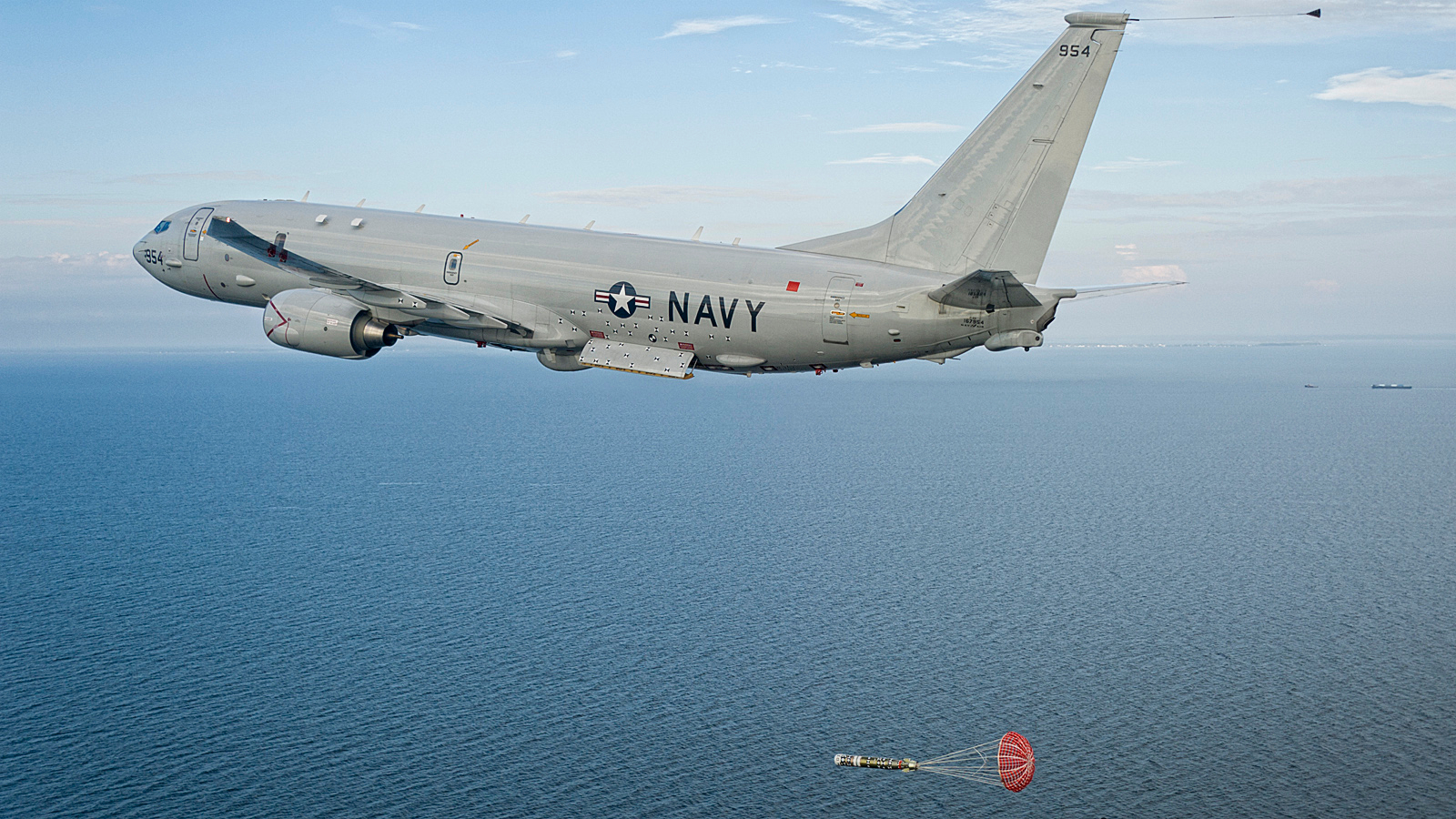
SLCM defence is inherently dual pronged, and involves using LRMP (Long Range Maritime Patrol) aircraft, warships and submarines to engage the launch platform, and AEW&C, tankers and fighters to destroy any missiles which are launched. The range of the opposing SLCM type will critically determine the effectiveness of either prong in this model. A shorter ranging 160 NMI missile like the regional 3M-54/14 series forces the submarine into a relatively small zone surrounding the target, increasing opportunities for ASW forces to find and kill it, especially once it has fired its SLCMs off. Conversely, with a 450 KTAS SLCM cruise speed, aerial interception opportunities are compressed into a 20 minute time window, making the odds of successful missile strikes greater. A 400 to 650 NMI range class SLCM frustrates ASW operations as the footprint to be patrolled increases with the square of missile range, but it also much increases opportunities for aerial interception by tripling if not quadrupling SLCM flight duration over water. The conventional force structure model used for defeating SLCMs is inherently expensive - 24/7 ASW patrols using aircraft and naval assets must be combined with 24/7 AEW&C, tanker and fighter patrols. While ground alert interceptors are an option, the ten minutes required to get them airborne on station reduces available time to effect engagements against the inbound SLCMs. Supersonic climb-out and sustained dash would minimise the time to station, but this is not an option for F/A-18A and JSF. The biggest cost burden in defending against SLCMs lies in the need for concurrent airborne patrols using LRMP aircraft and AEW&C aircraft, effectively doubling up on the required airborne ISR component of the defending force. This is a byproduct of the niche specialisation of these systems. LRMP aircraft on station searching for submarines being positioned for launches present an opportunity to free up AEW&C aircraft for other tasks - if the LRMP aircraft is equipped with radar/datalink capability to cue interceptors to SLCMs in flight. Existing search radars on LRMP aircraft have neither the power-aperture performance nor azimuthal coverage to be credible in this role. A viable radar for this role is an X-band active phased array in the class of the MT-RTIP family of radars planned for the E-8 JSTARS upgrade, the E-10 MC2A and growth Global Hawk variants. These radars will be used by the US Air Force for cruise missile defence, mobile ground target tracking, and likely by the US Navy for the BAMS maritime search role on UAVs - the Global Hawk being a leading candidate. An LRMP aircraft equipped with such a radar acquires an inherent capability to detect and track SLCMs, in addition to gaining improved ASW and ASuW surface search capabilities, and JSTARS-like littoral GMTI search capabilities. This is an important synergy in functions which should not be ignored. Supplementary AEW&C capability for naval surface action groups, and over the horizon midcourse guidance and illumination for shipboard SAMs are also feasible. While SLCMs lack the sustainable rate of fire, and achievable
weight of fire of air launched cruise missiles, they do present a
complex equation for a defender.
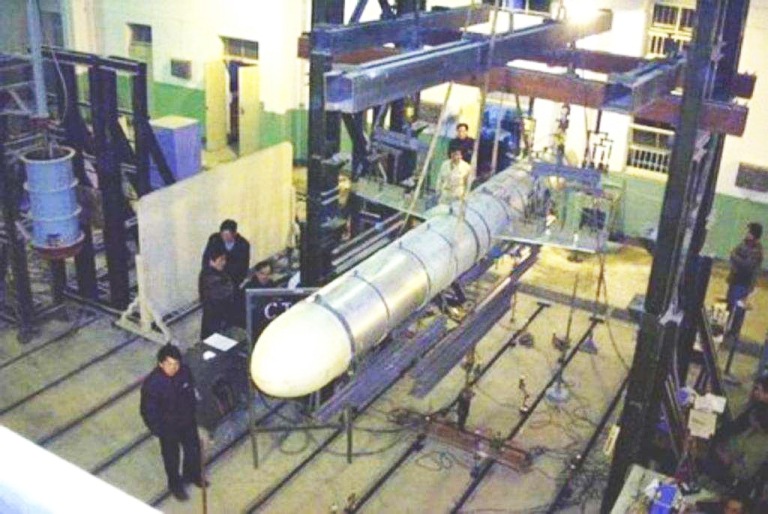
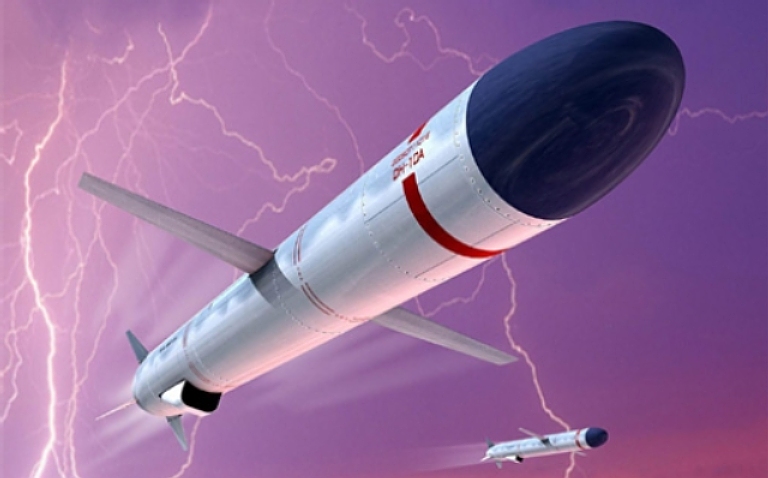
DH-10
Cruise Missile illustration.
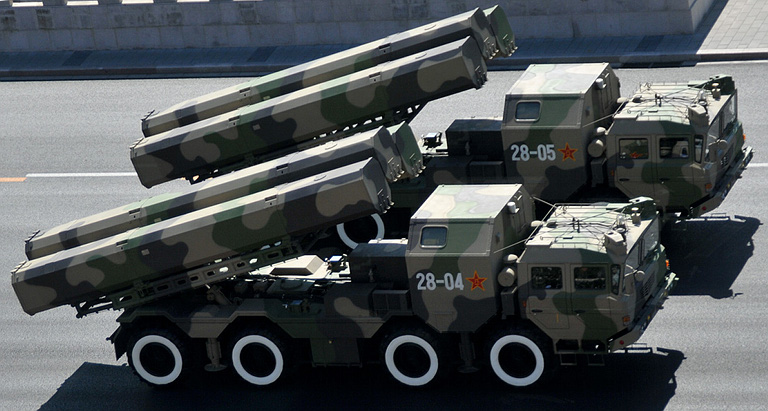 Chinese
sources
report the ground launched CJ-10 to be the GLCM variant of the
DH-10 design, carried on a three round TEL (Chinese Internet).
Launch
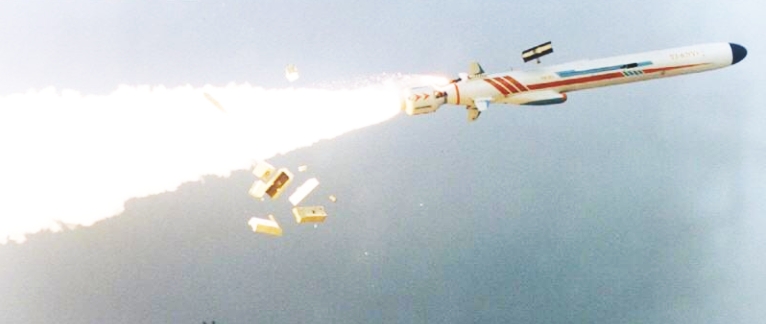
of a 'Tomahawk-like' PLA-N YJ-62 cruise missile.
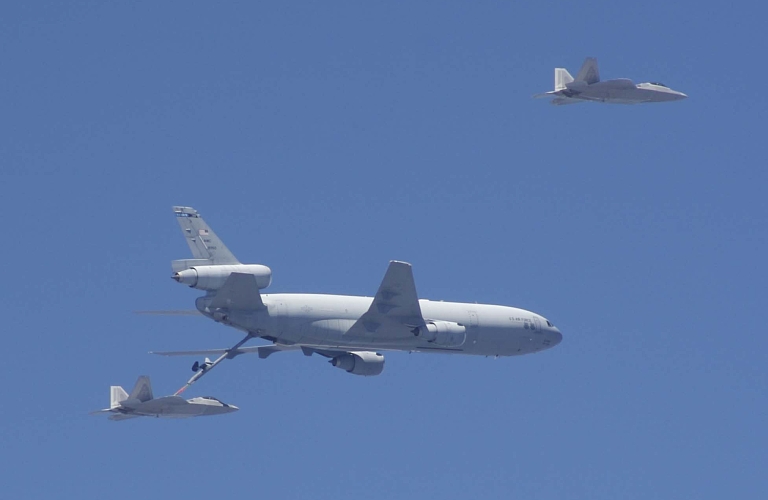
Defeating Air Launched Cruise Missiles The force structure demands required to defeat cruise missile armed aircraft, and cruise missiles once launched are similar, but the latter presenting greater demands both in fighter missile payloads and air intercept radar performance. Supersonic cruise missiles impose further demands on fighter dash speed and supersonic persistence. The conceptual model for cruise missile defence is the combined use of AEW&C, fighters, tankers and in many instances, airborne X-band surveillance radars to detect, track and engage both launch aircraft and cruise missiles. A key issue in killing launch aircraft is the range of cruise missile being carried. A weapon which has 160 NMI of range offers good opportunities for the defender, especially if the AEW&C aircraft and CAPs can be positioned between the intended targets and known threat axis from which the opponent appears. Australia's JORN and the geography of the sea air gap are especially useful, providing the opponent does not exploit JORN blind periods to get a head start before detection. These advantages decline with increasing ALCM range. A weapon in the 400 to 650 NMI range class presents opportunities to launch against a coastal target even if the AEW&C/CAP packages are orbiting well over the sea air gap. The upside for the defender is that a 60 to 90 minute ALCM flight duration presents excellent detection and repeat engagement opportunities. Historically only two fighters were custom designed for cruise missile / bomber defence. The first was the US Navy F-111B, the second the MiG-31P Foxhound. It is no accident that both designs have similar empty weight, internal fuel load, high supersonic performance, huge radar bays, and carried similar payloads of similar sized AIM-54 and R-33/AA-9 Amos missiles. Current US Air Force thinking on cruise missile defence envisages a two zone scheme. The outer zone comprises the E-3 AWACS, E-8 JSTARS / E-10 MC2A and the F-22A, and is intended to detect, track and kill launch aircraft and cruise missiles which might be launched. This outer zone is supplemented by an inner zone, comprising E-8 JSTARS / E-10 MC2A equipped with MP-RTIP X-band radars to track cruise missiles, and a mix of F-22A, JSF and AESA equipped F-15C/APG-82 or F/A-18E/F to destroy leakers which might penetrate the outer zone of F-22A defence. The US some years ago introduces fusing changes to the AIM-120C-6 AMRAAM to improve its ability to kill cruise missiles. The limited look-down performance of the E-3 radar forces the use of the E-8 JSTARS as a gap-filler. The more capable E-10 MC2A was to later absorb most of this role, but was cancelled for budgetary reasons. The heavy reliance on the F-22A in the US model is a direct consequence of the F-22A's exceptional X-band radar performance and supersonic persistence, which allows it to patrol a much larger footprint than a conventional fighter does, and its ability to operate in contested airspace. The performance of the APG-77 permits head on engagements, and after passing the targets the F-22A would reverse heading for a repeat pass against any surviving cruise missiles. The US Air Force envisage attackers launching waves of cruise missiles, the aim being to deplete fighter missile payloads and fuel, to create openings for a following wave of cruise missiles. The two zone model provides a mechanism to stop a second wave while outer zone interceptors are replenished. Current long term planning for the RAAF leaves Australia in an invidious position as regional ALCM/SLCM capabilities develop over the coming decade. While JORN and Wedgetail provide excellent outer zone defensive capabilities, JORN blind periods and Wedgetail numbers will remain as real problems. The absence of a JSTARS-like capability seriously limits inner zone surveillance and tracking capabilities, especially against SLCM threats, constraining locations of Wedgetail orbits to cover both outer and inner zone areas. The bigger hole in RAAF capability however lies in the plan for a lightweight fighter fleet, centred in F/A-18A and later JSF, with minimal tanker support. The F/A-18A and JSF are not F-22As in radar capability, missile/fuel payload or supersonic persistence. Sadly, the plan to kill off the F-111 deprives the RAAF of a very economic inner zone cruise missile defence interceptor airframe, and long range bomber interceptor. The combination of persistence and supersonic dash performance, and large payload, provides the F-111 with the ability to cover inner zone patrol areas without tanker support, in an environment where its lack of close-in air combat agility is irrelevant. An F-111 can orbit on station 200 nautical miles from a runway for about 4 hours without refuelling, simply impossible for an F/A-18A or JSF. Retrofitting a suitable radar like an APG-79, APG-80 or APG-81, a JTIDS terminal and clearing the AMRAAM are relatively cheap given the return on investment, especially in reduced tanker demand and supersonic intercept capability against any fast bombers - regardless of resulting gains in F-111 strike capability. In perspective, growth in regional cruise missile and long
range bomber
capabilities are now an inevitability. The big question which remains
is whether Defence will make any effort to address the changing
environment in RAAF force structure planning. Recent public statements
are anything but encouraging. |
||||
|
|
||||
Imagery Sources: US DoD, Author, RuMOD Line Artwork: © 2004, 2007 Carlo Kopp Technical Report APA-TR-2007-0402 |
||||


|
|||||||||||||
|
|
|
|
|
|
|
|
|
|
|
|||
|
|
|
|
|
|
|
|
|
|
|
|||
 |
|
|
|||||||||||
| Artwork, graphic design, layout and text © 2004 - 2014 Carlo Kopp; Text © 2004 - 2014 Peter Goon; All rights reserved. Recommended browsers. Contact webmaster. Site navigation hints. Current hot topics. | |||||||||||||
|
Site Update
Status:
$Revision: 1.753 $
Site History: Notices
and
Updates / NLA Pandora Archive
|
|||||||||||||
|
|
Tweet | Follow @APA_Updates | |||||||||||
|
|
|||||||||||||
|
|
|||||||||||||