|
||||||||||||||||||||||
 |
||||||||||||||||||||||
![F-22A Raptor, FB-22, F-22E, F-22N and Variants Index Page [Click for more ...]](APA/f-fb-22.png "F-22A Raptor, FB-22, F-22E, F-22N and Variants Index Page [Click for more ...]") |
 |
![People's Liberation Army Air Power Index Page [Click for more ...]](APA/pla-air-pwr.png "People's Liberation Army Air Power Index Page [Click for more ...]") |
 |
 |
 |
 |
 |
 |
![Military Ethics, Culture, Education and Training Index Page [Click for more ...]](APA/ethx-culture.png "Military Ethics, Culture, Education and Training Index Page [Click for more ...]") |
 |
||||||||||||
 |
![Russian / Soviet Weapon Systems Index Page [Click for more ...]](APA/rus-weps.png "Russian / Soviet Weapon Systems Index Page [Click for more ...]") |
 |
 |
 |

|
 |
 |
 |
 |
 |
||||||||||||
 |
 |
 |
||||||||||||||||||||
| Last Updated: Mon Jan 27 11:18:09 UTC 2014 | ||||||||||||||||||||||
|
||||||||||||||||||||||
|
||||||||||||||||||||||
|
||||||||||||||||||||||
|
|
|
|
|
|
|
|
|
|
|
||||||||||||
|
|
|
|
|
|
|
|
|
|
|
||||||||||||
| |
|
|
||||||||||||||||||||
| Last Updated: Mon Jan 27 11:18:09 UTC 2014 | ||||||||||||||||||||||
|
||||||||||||||||||||||
F-35 JSF: Cold War Anachronism
|
||||||||
|
Air Power
Australia - Australia's Independent Defence Think Tank
|
||||||||
| Air Power Australia NOTAM 3rd March, 2009 |
||||||||
|
||||||||
|
||||||||
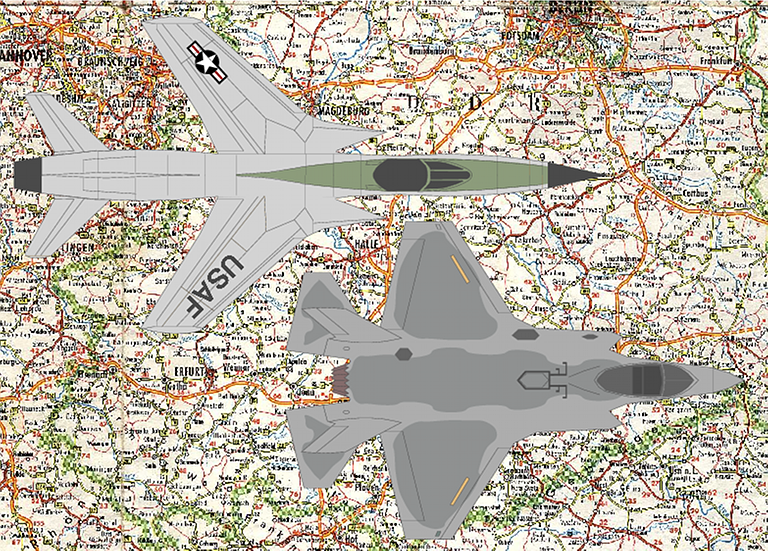 Designed around a non-existent Cold War era large scale battlefield air interdiction role, the F-35 Joint Strike Fighter is a Cold War anachronism without a mission. It is almost identical in size, weight and runway requirements to the Cold War era F-105D Thunderchief, also designed for much the same role. |
||||||||
| The Obama Administration’s stated intent to
“reform our defense budget so that we’re not paying for Cold War-era
weapons systems we don’t use” raises a good number of serious
questions. First and foremost is that of what constitutes a Cold War
era weapon system, and how one measures the use of such. The President’s statement has been interpreted by a number of observers as targeting the F-22 Raptor, but the Administration remains tight lipped on their future plans or lack thereof for the F-22 program. The two decades since the collapse of the Soviet Union and Warsaw Pact have seen profound geostrategic changes. These include the emergence of the “Arc” or “Belt of Instability” spanning Africa though Asia and into the South West Pacific. The Global War On Terror, sparked by the 9-11 attacks, has many of its deeper roots in the social and political meltdown across much of the developing world. These same two decades have seen the industrialization of Asia, and the rise of China, with a concurrent creeping arms race across Asia, which in numbers of advanced weapon systems procured, deployed and planned for, rivals the Warsaw Pact military spending surge of the 1980s, the surge which bankrupted the Soviets. Asia’s newfound wealth and mostly robust economies will see this arms race continue, albeit more slowly as the global economic downturn bites. These two major trends are paralleled by lesser trends, or processes. One of these is the increasing toxicity in the relationships between Russia and its Eastern European neighbours, all but one of whom have thrown their lot in with NATO. Another trend has been the unilateral disarmament of European NATO nations; most unwilling to maintain investments in modern military systems. Finally, there is the ongoing and festering problem of Iran, hostile to the West and its values, and clearly intending to capitalize on its energy wealth to become an influential and assertive regional power. Iran has been deeply implicated in problems observed in the Palestinian Territories, Lebanon, Iraq and Afghanistan. These geostrategic trends have arisen concurrently with a deep technological paradigm change across the former Soviet military industrial complex, now scattered across Russia and Russian aligned former Soviet republics. Having absorbed and integrated much of the high technology now available in the globalised technology market, Russian military products now match or outperform US and EU products in most areas, other than niche technologies like stealth and active array radars. Russia has found a lucrative and secure market niche in nations that are being embargoed by the West. What kind of military environment will the West, particularly the US, have to face over the coming decades? There is little doubt that the US will have to confront two fundamentally different types of warfighting “style” in the post 2010 era. The first will be the “Low Intensity” insurgency type of conflict encountered in Iraq and Afghanistan, and likely to be a feature of other failed nation states across the belt of instability. Such conflicts will be manpower intensive, demand a lot of Intelligence, Surveillance Reconnaissance capability, and impose often challenging logistical demands. The second type of conflict will be modern high technology “High Intensity” war, in which an opponent deploys the latest in Russian and Chinese built high technology weapons. Nations in such conflicts are likely to emulate modern US operational and tactical doctrine, or Russian and Chinese adaptations thereof. Contract Russian or Chinese military trained personnel will often fill gaps in indigenous skills sets at all levels. High intensity conflicts over the coming decades will mostly involve opponents armed with Russian and Chinese built weapons, covering the full spectrum of military capabilities. By far the best selling products supplied by Russia’s industry are what are termed “anti-access weapons”, built specifically to keep US and Coalition expeditionary forces out of a theatre of operations. In the naval domain, these weapons are primarily supersonic sea skimming anti-shipping missiles, delivered by quiet modern submarines, or high performance long range fighters like the Sukhoi designed Flanker series. The aim of these weapons is to inflict unsustainable losses on naval surface fleets and amphibious transports. In the domain of air power, the central pillar of US military strength in recent times, anti-access weapons include long range Flanker fighters, AWACS aircraft, aerial refuelling tankers, short range Surface to Air Missile systems designed to kill smart bombs, HARM anti-radar missiles, and cruise missiles in flight, and long range Surface to Air Missile systems, supported by powerful jammer resistant radars, intended to kill all but the stealthiest of US combat aircraft. An Integrated Air Defence System built up from such weapons will be impenetrable to all US aircraft other than the B-2A, the F-22A Raptor and the planned Next Generation Bomber (“2018 Bomber/QDR Bomber”). The strategic consequence of this is that prior to 2025, when the Next Generation Bomber is planned to be fully fielded, America’s ability to use air power in well defended areas will be determined almost wholly by the number of F-22s it builds and deploys. Standard techno-strategic analysis shows that around 700 F-22s are needed – and “strategic reality” has no respect for “political reality” in this equation. If one is to perform a “triage” on the current US fighter force structure, to determine which of the primary weapon systems currently in use or inherited from the Cold War are viable in the military environment of the coming two decades, some realities are unavoidable. The US Navy’s F/A-18A-D Hornets and F/A-18E/F Super Hornets are simply non viable in high intensity conflict and are only safely usable for low intensity conflict. The new EA-18G Growler cannot survive against the new Russian SA-21 missile system, and will be challenged by the SA-20 Gargoyle now being exported to Iran and China. Without new and highly stealthy combat aircraft such as proposed robotic UCAVs and the proposed navalised “F/A-22N Sea Raptor” the US Navy carrier fleet is unusable in high intensity conflicts. The Air Force fighter fleet faces similar challenges. The Cold War F-15C and F-15E fleets are not survivable against the latest Russian missile systems, and at best offer parity against the latest variants of the Flanker fighter. The F-16C, numerically most important in the US fighter fleet, is even less viable. The F-35 Joint Strike Fighter was intended by the Bush Administration Pentagon to be the new high technology fighter to replace most of the US Air Force, Navy and Marine Corps fleets. In performing triage on the force structure, the F-35 demands especially close scrutiny, since there will be enormous political pressure placed on the Obama Administration to keep this dysfunctional program alive. Notwithstanding the deluge of often attractive marketing material produced to promote the F-35 to US and foreign customers, this aircraft is an anachronism which was conceived around a number of ideas central to the Cold War era. The F-35 is a specialized ground attack fighter, designed for Cold War era missions, yet built using today’s technology base. The original rationale for the F-35 grew out of the experience of Desert Storm, in which Coalition F-16s, A-10s and F/A-18s pounded Saddam’s large tank armies in Kuwait and Southern Iraq, and out of a series of late Cold War studies on battlefield strike fighters to replace the A-10 and A-7, then intended to wipe out Soviet tank armies in the Fulda Gap. These were the fundamental influences that shaped the performance, size, payload and stealth specifications of the F-35 Joint Strike Fighter during the mid 1990s. For instance, a “wishlist” feature inherited from this period is the complex and technically risky Distributed Aperture System, intended to provide the pilot with spherical night vision coverage around the aircraft. The Navy and Marines, wanting a significant autonomous strike capability, sought sophisticated electro-optical targeting capability, and a high resolution imaging radar, adding weight, complexity and cost. As a result, the F-35 is an aircraft almost identical in size, weight and range/payload performance to the early 1960s F-105 Thunderchief, used extensively in the meat grinder bombing campaigns over North Vietnam. Much like the F-105, the F-35A CTOL variant demands long runways, lots of tanker support, and lots of protective fighter escorts to keep it alive, when confronted by opposing fighters and modern long range air defence missiles. While the F-35 was being developed, the world around it changed. The Cold War and Desert Storm style of conflict is likely never to be seen again – large tank armies of the Soviet variety lost their appeal after Coalition air forces annihilated Saddam’s forces in 1991. The style of mobile medium and short range battlefield Surface to Air Missile system that the F-35’s stealth was designed to defeat has also declined in popularity, as the tank armies these weapons were designed to protect withered away. High mobility long range Surface to Air Missile systems with much more powerful radars became the preferred product in this market. Ground forces adapted to overwhelming air power by shifting to concealment, dispersal, and away from the exposed massed land force formations of the Cold War era. The result is that strike aircraft may orbit for hours, waiting for targets to emerge so they can pounce on them and destroy them with precision weapons. This style of combat favours aircraft much larger than the F-35, that can carry much more fuel and greater weapon payload. So the F-35 has been bypassed by the evolution of air defence weapons, now much more potent than the Cold War era systems it was designed to defeat. Concurrently, its utility has declined, as the kind of battlefield targets it was built to hunt have become an increasingly less favoured force element. The latest generation of smart bombs, such as the JDAM and Small Diameter Bomb, already provide the precision strike capabilities planned for the JSF to US heavy bombers such as the B-52H, B-1B and B-2A, as well as the F-22A. The F-22A, in fact, carries the same internal payload of eight Small Diameter Bombs as intended for the F-35 yet, unlike the F-35, the Raptor can concurrently carry four Air-to-Air missiles, internally. The F-35 is, in basic force structure planning terms, simply redundant. There is nothing it can do which cannot be done better by the much more survivable and lethal F-22A Raptor in higher threat environments, or cheaper by any number of legacy aircraft in lower threat environments. From a force structure triage perspective, the F-35 falls into the same category as the US fleet of legacy fighters, including the F/A-18E/F Super Hornet. Unlike the legacy fighters, the F-35 is becoming about as expensive as an F-22A Raptor in quantity, but much less survivable and lethal than the F-22A. One US military strategist recently observed to this author that the “F-35 is not survivable enough for high intensity conflict, and too expensive and overbuilt for low intensity conflict”. As he put it: “what is more important to the strategic future of the United States – procuring many more vital F-22 Raptors, deploying stealthy UCAVs, replacing 1950s technology aerial refuelling tankers, and 1950s technology heavy bombers, OR sinking the very same funds into the F-35 Joint Strike Fighter for no strategic return on investment, with the very real risk that the F-35 will be later and more expensive than planned for?” The Joint Strike Fighter Program is demonstrably the best case study of everything that is not working properly in the US military procurement bureaucracy. Incoming “acquisition czar” Dr Ashton Carter might consider studying this program very carefully, as there is much to be learned from it which will be vital in preventing future catastrophes of this kind. These are the hard strategic and budgetary realities that America and its allies must now deal with. This coming year will demonstrate whether the Obama Administration’s efforts to restore integrity and intellectual rigour into the US military procurement machinery have been successful or not. If the F-35 Joint Strike Fighter, a redundant Cold War anachronism, survives this coming year, it will be clear that the reform process is not working. |
||||||||
| Air
Power Australia Website - http://www.ausairpower.net/ Air Power Australia Research and Analysis - http://www.ausairpower.net/research.html |
||||||||
 |
||||||||
| |
||||||||
|
|||||||||||||
|
|
|
|
|
|
|
|
|
|
|
|||
|
|
|
|
|
|
|
|
|
|
|
|||
| |
|
|
|||||||||||
| Artwork, graphic design, layout and text © 2004 - 2014 Carlo Kopp; Text © 2004 - 2014 Peter Goon; All rights reserved. Recommended browsers. Contact webmaster. Site navigation hints. Current hot topics. | |||||||||||||
|
Site Update
Status:
$Revision: 1.753 $
Site History: Notices
and
Updates / NLA Pandora Archive
|
|||||||||||||
|
|
Tweet | Follow @APA_Updates | |||||||||||
|
|
|||||||||||||
|
|
|||||||||||||






