|
||||||||||||||||||||||
 |
||||||||||||||||||||||
![F-22A Raptor, FB-22, F-22E, F-22N and Variants Index Page [Click for more ...]](APA/f-fb-22.png "F-22A Raptor, FB-22, F-22E, F-22N and Variants Index Page [Click for more ...]") |
 |
![People's Liberation Army Air Power Index Page [Click for more ...]](APA/pla-air-pwr.png "People's Liberation Army Air Power Index Page [Click for more ...]") |
 |
 |
 |
 |
 |
 |
![Military Ethics, Culture, Education and Training Index Page [Click for more ...]](APA/ethx-culture.png "Military Ethics, Culture, Education and Training Index Page [Click for more ...]") |
 |
||||||||||||
 |
![Russian / Soviet Weapon Systems Index Page [Click for more ...]](APA/rus-weps.png "Russian / Soviet Weapon Systems Index Page [Click for more ...]") |
 |
 |
 |

|
 |
 |
 |
 |
 |
||||||||||||
 |
 |
|||||||||||||||||||||
| Last Updated: Mon Jan 27 11:18:09 UTC 2014 | ||||||||||||||||||||||
|
||||||||||||||||||||||







|
Joint
Strike Fighter = Thunderchief II?
Back to the Future in
Battlefield
Interdiction |
Australian Aviation, November 2004 by Dr Carlo Kopp Text, Line Art © 2004, 2007 Carlo Kopp |
|
The new Joint Strike Fighter (JSF) program is often compared to the early nineteen sixties Tactical Fighter eXperimental (TFX/F-111) program, reflecting the multi-service structure of both programs. In concept and sizing, however, the JSF is very much closer to another early nineteen sixties tactical fighter, the Republic AP-63 series F-105 Thunderchief. The F-105 was the workhorse of the Vietnam air war, especially the 1964-1968 Rolling Thunder bombing campaign. Affectionately known as the Lead Sled, Super Hog, Ultra Hog, Iron Butterfly and famously Thud, the F-105A first flew in 1955, and was designed by Republic's legendary Alexander Kartvelli to be a highly survivable strike oriented tactical fighter, with a secondary air to air capability, primarily for self defence. The aircraft was to have significantly better combat radius than previous USAF jet fighters, and in line with the penetration paradigm of the day, very high speed. The resulting F-105 series was a fighter which is remarkably close to the current JSF in most important cardinal parameters. Both the F-105 and JSF are large single seat single engine
strike fighters, using the most powerful engine of the era (J75 vs
F135/F136), with empty weights in the 27,000 lb class, and wingspans
almost identical at 35 feet. Both carry internal weapon bays, and
multiple external hardpoints for drop tanks and weapons. Both were
intended to achieve combat radii in the 400 nautical mile class.
Neither have by the standards of their respective periods high
thrust/weight ratio or energy manoeuvre capability, favoured for air
superiority fighters and interceptors.  Both the F-105 and JSF were crafted around the dominant
penetration paradigm of their respective periods. The F-105 was built
to use speed to penetrate defences, and like the F-111 was designed to
penetrate and egress at very low altitudes, using terrain masking and
clutter to defeat opposing radar systems. The JSF is being built to
penetrate at medium to lower altitudes using X-band stealth to defeat
engagement radars and radar guided SAM seekers. While they differ in
the substance of their penetration technique, they share the common
feature of using the best technique of their respective eras. 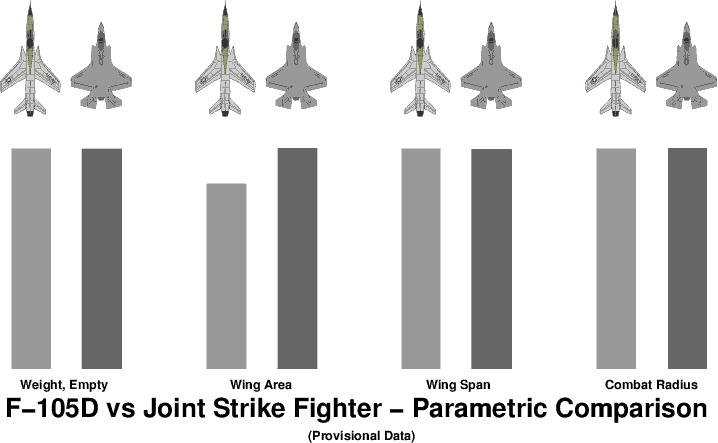 The avionics in both aircraft represent the latest technology of their respective periods. The F-105's ASG-19 Thunderstick I/II system was tightly integrated with the NASARR multimode radar, as is the JSF's ICP package and APG-81 radar. Both radars are designs biased toward air-ground modes, but with respectable air-intercept capabilities for their periods. The definitive F-105D, of which only 610 were built by 1964
due to higher than hoped for costs, could carry up to 2,500 lb in its
internal bomb bay, and external stores on two 3,000 lb inboard pylons,
two 3,000 lb outboard pylons and a 4,500 lb centreline pylon, for a
total of 12,000 lb. The JSF carries a 2,500 lb guided bomb in either
fuselage bay, up to 5,000 lb on a pair of inboard pylons, and 2,500 lb
on a pair of outboard main pylons, with a 1,000 lb centreline pylon.
The F-105D fleet was thrown into the meatgrinder of the NVA air defence system, then the most formidable in existence as the SovBloc pushed their latest SAMs, radars and MiG-21 Fishbeds into the theatre. Between 1965 and 1970 no less than 334 fell to enemy defences - 312 to SAM/AAA - not a bad figure in terms of sorties flown and the density of defences in theatre. Despite the bad press attached to the F-105, it was a rugged high performance aircraft capable of taking a lot of punishment. The typical configuration for strike sorties was a payload of 6 to 8 750 lb M117 dumb bombs (4,500 lb to 6,000 lb), with two external 450 USG tanks. For shorter ranging CAS/BAI tasks, up to 12 M117 or 9,000 lb were carried. These payloads are very similar to the nominal internal/external payloads of the JSF. Typical fuel for an F-105D using internal tanks, a bomb bay tank and two 450 USG tanks was 16,000 lb - very close to the internal fuel of a JSF. Early F-105 sorties were flown in a self escort configuration, armed with an internal 20 mm gun and an external AIM-9B missile, paired with an EWSP pod, on outboard pylons. The NVAF quickly learned that early engagement of the F-105 strike packages forced them to jettison bombs to achieve viable performance to defend themselves or evade attack, and very early the F-105s were supported by F-4C Phantom CAPs to keep the MiGs clear of the strike packages. A later tactic saw F-4C/D Phantoms interspersed with F-105s to effect defacto escort support. Most sources claim 22 F-105s lost to MiGs for 27.5 MiGs shot down by the F-105s, or an exchange rate of 1.25:1 in close air combat. The F-105 experience presents an interesting case study of self escorting strike fighter operations, and the utility of a strike optimised tactical fighter in air combat. Two factors make this experience important. The F-105D/F and MiG-21 Fishbed had defacto parity in radar/missile performance with the MiG doing better in turn/climb performance, and the extended duration of the campaign made for a large number of statistically valuable repeat engagements. This is especially relevant for the Australian DoD which intends to fly self escorted F/A-18As and later JSFs into a Sukhoi Su-30 rich regional environment. For the non-stealthy F/A-18A the reality is that an inbound Sukhoi will force an F/A-18A to jettison stores to achieve viable air combat performance to even survive the engagement - unlike an F-105D evading a MiG-21PF, the F/A-18 family does not have a speed/endurance advantage to play against the Sukhoi. For the JSF, which has roughly parity in radar performance against better Su-30 variants, and parity in energy performance against older Su-27SK configurations, it puts all of the survivability eggs into the stealth basket. There is another interesting parallel in the F-105/F-4 experience, which is that the F-4 had a significant advantage in radar/missile range and energy performance. This parallels the superior stealth, radar, missile kinematic and energy performance advantages held by the F-22A, intended to escort the JSF in US Air Force service. While the JSF and F-105 are separated by almost half a century in technology, they occupy almost identical niches in size and intended role optimisations. The F-105 was clearly an outstanding success in its primary role of strike/interdiction and close support, but was much less successful in air combat. The lesson in this for future JSF users is a simple one - the JSF is likely to be highly effective in its primary battlefield interdiction / close air support role but less likely to be successful in air combat, as its basic aerodynamic performance is close to parity with the most likely adversary types - advanced Su-30 variants. The decisive factor for the JSF in this game will be its limited stealth performance against the full spectrum of opposing radar systems, especially long range lower band surveillance radars used to guide Sukhoi intercepts. The Australian DoD's idea of using the reduced stealth export JSF as an F-22A substitute courageously defies historical experience in the use of strike optimised tactical fighters in air combat. It will inevitably attract criticism of the JSF's limited air combat performance rather than criticism of the intention to use the JSF outside of its design optimal roles. The JSF is no more an F-22A, than the F-105D was an F-4C. |
Sukhoi Flanker
Analysis [Click for
more ...]
S-300 SAM System Analysis [Click for more ...] F-22A Raptor Analysis [Click for more ...] |
|
References
|
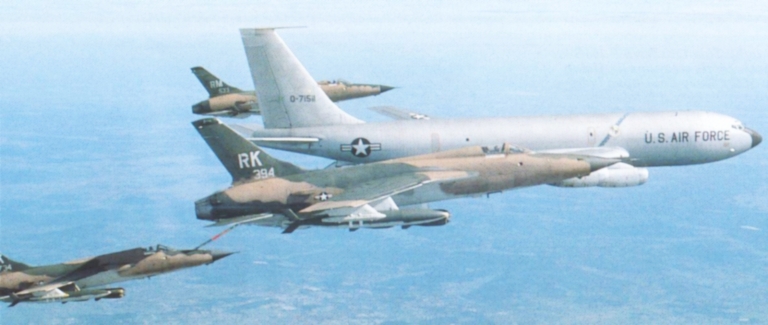
 The
JSF, like the Thud, will be heavily dependent on supporting tankers
to achieve tactical useful combat radii in the Pacrim regional
environment. This 354th TFS F-105D (above) is gassing up outbound in
1965 (US
Air Force).
  JSF Demonstrator hooking up with a KC-135E tanker (US Air Force). |
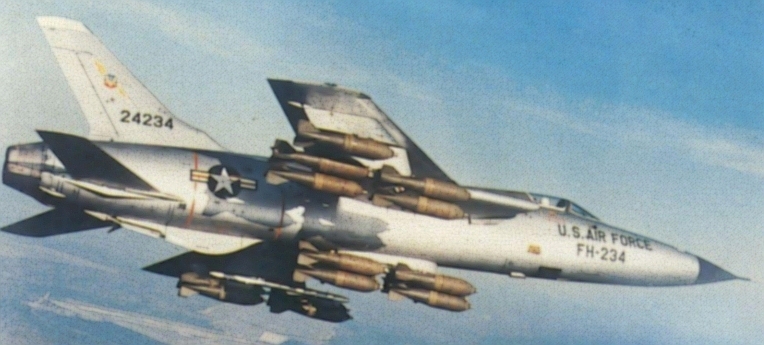 The
F-105
was optimised for battlefield strike and interdiction work,
like the JSF, and could carry internal and external stores like the
JSF. This Thud is flying a close air support profile with 12 750 lb
bombs (US Air Force).
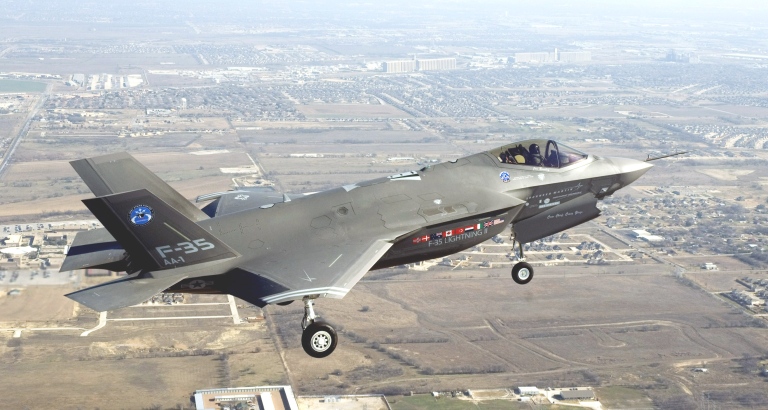
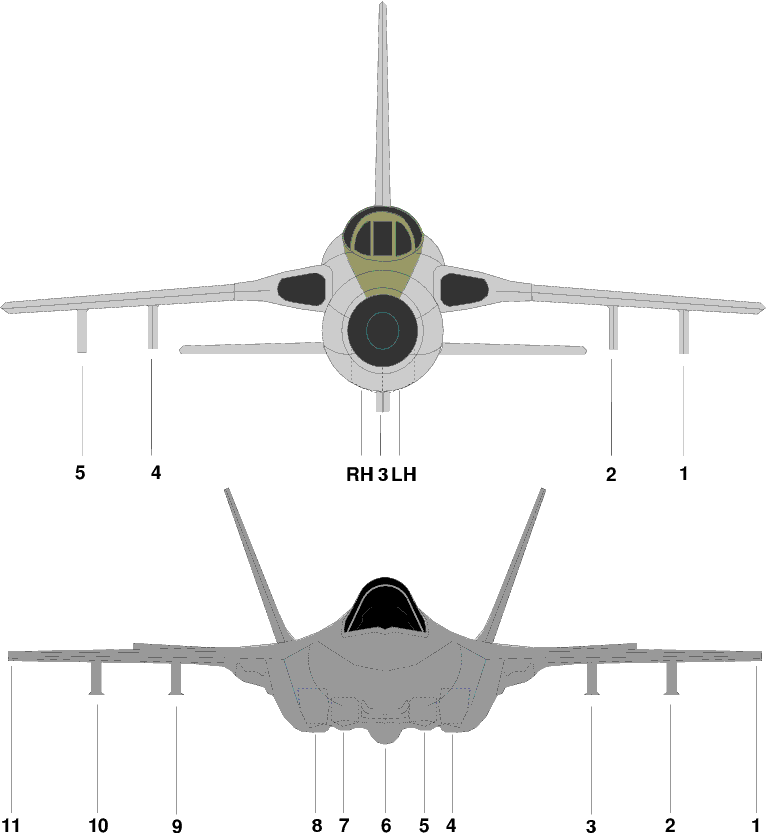
The differences in configuration between
the F-105 and F-35 are prominent and reflect very different
survivability CONOPS of designs which are 4-5 decades apart in basic
technology. The concept for both of these single seat single engine
bombers is however much the same (US Air Force).
 |
|
|
 While early F-105D sorties were flown without escorts, experience quickly showed that the self escort model was non-viable for a fighter without a significant advantage in radar/missile range and agility performance - Thuds usually exploited speed/endurance to evade MiG-21 interceptors rather than engage in close combat. MiGCAP support was soon provided by the F-4C/D, later also escorts were used. Depicted a 469th TFS F-105D in 1968 (US Air Force). 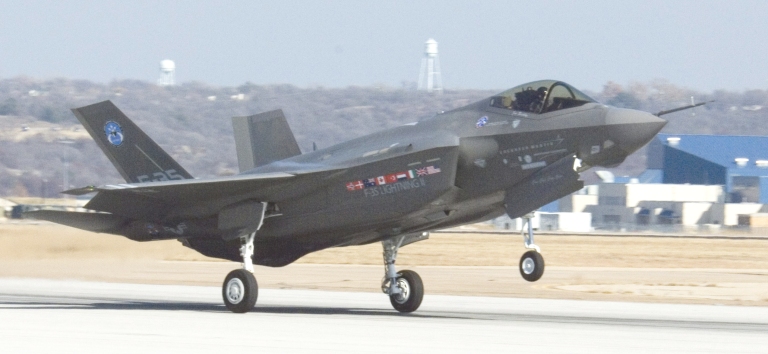 The formal naming of the F-35 saw it designated the 'Lightning II' which is curious insofar as the twin engine P-38 was developed primarily as a long range interceptor and escort, and by relative performance, and breadth of roles and application a much closer fit to the F-22 Raptor of today. The World War II US types which best fit the JSF in role were the P-39 and P-40 (US Air Force). 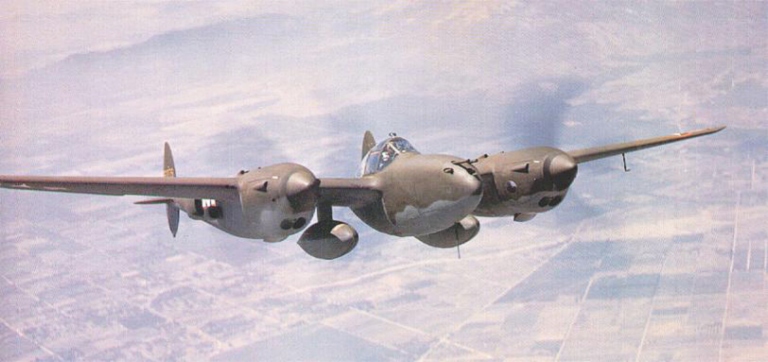 |
 The Joint Strike Fighter is the first US single seat single engine bomber designed since the 1960s LTV A-7A-D Corsair II, flown by the US Air Force and US Navy. The A-7 was however smaller and lighter than the JSF, unlike the F-105 series (US Air Force).  |
Imagery Sources: US Air Force, Author Line Artwork: © 2005, 2007 Carlo Kopp |


|
|||||||||||||
|
|
|
|
|
|
|
|
|
|
|
|||
|
|
|
|
|
|
|
|
|
|
|
|||
 |
|
|
|||||||||||
| Artwork, graphic design, layout and text © 2004 - 2014 Carlo Kopp; Text © 2004 - 2014 Peter Goon; All rights reserved. Recommended browsers. Contact webmaster. Site navigation hints. Current hot topics. | |||||||||||||
|
Site Update
Status:
$Revision: 1.753 $
Site History: Notices
and
Updates / NLA Pandora Archive
|
|||||||||||||
|
|
Tweet | Follow @APA_Updates | |||||||||||
|
|
|||||||||||||
|
|
|||||||||||||