|
||||||||||||||||||||||
 |
||||||||||||||||||||||
![F-22A Raptor, FB-22, F-22E, F-22N and Variants Index Page [Click for more ...]](APA/f-fb-22.png "F-22A Raptor, FB-22, F-22E, F-22N and Variants Index Page [Click for more ...]") |
 |
![People's Liberation Army Air Power Index Page [Click for more ...]](APA/pla-air-pwr.png "People's Liberation Army Air Power Index Page [Click for more ...]") |
 |
 |
 |
 |
 |
 |
![Military Ethics, Culture, Education and Training Index Page [Click for more ...]](APA/ethx-culture.png "Military Ethics, Culture, Education and Training Index Page [Click for more ...]") |
 |
||||||||||||
 |
![Russian / Soviet Weapon Systems Index Page [Click for more ...]](APA/rus-weps.png "Russian / Soviet Weapon Systems Index Page [Click for more ...]") |
 |
 |
 |

|
 |
 |
 |
 |
 |
||||||||||||
 |
 |
 |
||||||||||||||||||||
| Last Updated: Mon Jan 27 11:18:09 UTC 2014 | ||||||||||||||||||||||
|
||||||||||||||||||||||
|
||||||||||||||||||||||
|
||||||||||||||||||||||
|
|
|
|
|
|
|
|
|
|
|
||||||||||||
|
|
|
|
|
|
|
|
|
|
|
||||||||||||
| |
|
|
||||||||||||||||||||
| Last Updated: Mon Jan 27 11:18:09 UTC 2014 | ||||||||||||||||||||||
|
||||||||||||||||||||||
F-22 Termination: America’s Self-Induced Strategic Death Spiral |
||||||||
|
Air Power
Australia - Australia's Independent Defence Think Tank
|
||||||||
| Air Power Australia NOTAM 14th April, 2009 |
||||||||
|
||||||||
|
||||||||
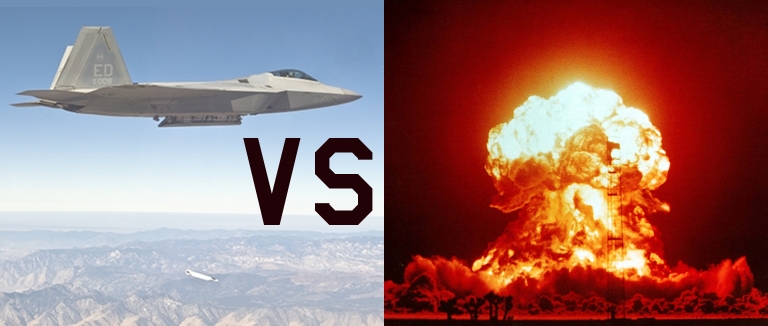 The F-22 is the only US fighter capable of defeating modern “anti-access” weapons. Without a sufficient number of F-22s a US President will be denied credible conventional weapons options in a nation state conflict (US DoD). |
||||||||
| When Defence
Secretary Robert Gates announced on
Monday last week his intended recommendation to Cabinet that the US
cease
further production of the F-22 Raptor fighter, it came as no surprise
to many
observers of the Pentagon bureaucracy. This recommendation is
unprecedented as
it amounts to a unilateral choice by the United States Office of the
Secretary
of Defense to opt out of the business of defending American forces,
allies and
interests against industrialised nation states. In an era of rising
industrialised regional powers across Asia, this choice amounts to a
self-induced strategic death spiral. The ground truth of current times is that “anti-access” technologies capable of denying access to all US combat aircraft other than the F-22A Raptor and B-2A Spirit have been the hottest selling items in the globalised arms market. These technologies include advanced digital technology fighter aircraft and long range Surface to Air Missiles (SAM), and a range of supporting systems such as radars, passive sensors, computer networks, data fusion systems, radar decoys, radar / communications / GPS jamming equipment and point defence weapons designed to shoot down US smart munitions in flight. Advanced Surface to Air Missiles are a particular concern since they are relatively cheap, often highly effective, and unchallenging in personnel training demands. Russia has exported large numbers of the S-300PMU / SA-10C, S-300PMU1 and PMU2 Favorit / SA-20, and is set to export the new S-400 Triumf / SA-21, which includes a 200 nautical mile range missile built to kill AWACS, JSTARS and jamming aircraft like the EA-6B Prowler and EA-18G Growler. These missile systems are often described as “Patriot class” and are similar to the US Patriot in basic design, but employ more refined radar designs, longer ranging missiles, and are much more mobile than the Patriot, making them vastly more difficult to kill compared to legacy Soviet era or Patriot SAM batteries. An opponent operating SA-10C/12/20/21/23 SAM systems can play the same “shoot and scoot” game even better than Saddam did with Scud launchers in 1991, or Serbia did with SA-6 SAM batteries in 1999, and evade US fighters most if not all of the time. Cold War era tactics of inundating enemy SAM batteries with HARM anti-radar missiles are effectively bankrupt. Not only are missile battery and search radars protected by smart decoys and other countermeasures, but they are also defended by advanced short range missiles and radar directed gun systems, the latter similar in concept to the US Navy Phalanx CIWS, designed to shoot down incoming US missiles or smart bombs. The Cold War era tactic of high power jamming against missile battery radars is also approaching bankruptcy, because the new generation of more powerful digital frequency hopping phased array radars are very difficult to jam, but also because SAM batteries are now equipped with missiles of sufficiently long range to kill a standoff jamming aircraft. The ALQ-99 Tactical Jamming System in both the US Navy Prowler and Growler lacks the power to permit jamming from outside the range of the newer SAMs, and both aircraft are too slow to outrun SAM shots. In the air, US forces will have to confront a new generation of high performance fighters, such as the fully digital supercruising Su-35-1/Su-35BM Flanker, and over the coming decade the stealthy PAK-FA. The only Western combat aircraft with the combination of performance and stealth sufficient to decisively defeat these new aircraft is the F-22A Raptor. While Russia remains the global leader in producing and exporting sophisticated “anti-access” weapons, China is now entering this market with a range of indigenous products, and derivatives of Russian products. This year China announced the export of the HQ-9/LD-2000, an improved Chinese derivative of the Russian S-300PMU/SA-10C SAM system, which includes the option of the FT-2000 passive anti-radar missile, designed to home on the radar emissions from an AWACS, JSTARS, U-2 or Global Hawk surveillance aircraft, or on emissions from jamming aircraft like the EA-6B Prowler and EA-18G Growler. To defeat US smart munitions in flight, the LD-2000 is on offer, a clone of the European Goalkeeper radar directed Gatling gun, carried on a high mobility truck. Other Chinese built anti-access products include Missile Approach Warning Systems for SAM batteries, and jammers, as well as a wide range of modern digital radars including low band designs with some counter-stealth capability, and phased arrays derived from the Russian S-300P series. The existence, performance and capabilities of these weapons are well documented in a plethora of unclassified Russian language and Chinese language literature, ranging from professional journals, academic journals, manufacturer’s literature and marketing documents, and also numerous public interviews and statements by the research scientists and engineers who developed these systems. Any nation which deploys a sufficient density of these modern high technology “anti-access” weapons will be able to put up a defensive umbrella which is impenetrable to legacy US combat aircraft like the F-15, F-16 and F/A-18 series. Moreover, these weapons can be used to effect an “ISR lockout”, driving US surveillance systems like the JSTARS, AWACS, Rivet Joint, U-2 and Global Hawk away and blinding US commanders in the field. Of no less concern is that the design specification for the F-35 Lightning II Joint Strike Fighter was written around the generation of potential threat radars, SAM systems and fighter aircraft which preceded the current generation of products now in the global market. The result is that the F-35’s stealth design, defensive systems and performance are completely inadequate to deal with modern “anti-access” systems. The F-35 would be shot down in combat almost as frequently as the legacy jets. The F-35’s poor aft hemisphere stealth and lack of supercruise capability make it highly vulnerable to long range SAM shots during escape manoeuvres and egress after weapons release. Whether the troubled F-35 meets its stated design specifications is now irrelevant, as that specification itself has been overtaken by opposing systems. The inadequacy of the F-35’s basic design specification against current threat systems continues to be ignored by senior US decision-makers despite the overwhelming volume of hard technical evidence proving this is so. One recently retired US Air Force strategist, upon receiving a technical briefing on the new generation of “anti-access” systems, observed that this painted a “scary picture”. It is a scary picture. Twenty years of clever scientific and operational thinking, motivated by profit rather than Soviet ideology, and access to sophisticated Western computer and software technology in a globalised market, has produced a deep generational change in Russian built weapons technology. The Chinese in turn have licensed or “acquired” this technology to build their own derivatives. The US has never confronted 1980s generation Soviet SAMs and radars in combat, nor has it ever confronted the 1980s generation Sukhoi Su-27 Flanker fighter. The derivatives of these weapons now in the market have two more decades of maturity and refinement in their designs, and digital weapon systems which are mostly of the same generation of technology seen in operational US weapons. The current generation of “anti-access” weapons are in techno-strategic terms a “check mate” play against US Cold War legacy weapons, and due to its poor design definition, also a “check mate” play against the F-35 Joint Strike Fighter. Where does this leave the United States in operational terms? The planned force of 187 F-22A Raptors is numerically insufficient to deliver the required number of sorties to effect an air campaign on the scale of Desert Storm, and would be challenged to cover the demands of a campaign on the scale of the bombing of Serbia in 1999. This can be easily proven by a simple throw weight calculation based on precision guided weapon capable fighters deployed in the 1991 and 1999 air campaigns. Between 500 and 700 F-22s are needed to preserve America’s historical advantage in air power. The notion that F-22s can quickly kill off opposing SAMs and carve corridors through an enemy’s SAM belts was predicated on the poor mobility of a preceding generation of SAM systems. This model is now also bankrupt. Linked by radio networks and using satellite navigation, modern high mobility SAM batteries and radars may take weeks to kill off in a sustained air campaign. Legacy fighters and the F-35 Joint Strike Fighter cannot be flown into such airspace, due to the very high risk of ambush SAM shots killing the aircraft. The result of having only 187 F-22s will be air campaigns limited in size and the rate at which critical targets can be attacked and reattacked, resulting in opportunities for opponents to play shell games with assets, evading attacks. If legacy aircraft or insufficiently stealthy F-35s are employed, combat losses are apt to mount quickly, and the few surviving aircrew become politically exploitable hostages for propaganda and political extortion purposes. Even at combat loss rates of only several percent, the “half life” of a fighter fleet would be measured in weeks even at modest sortie rates. Overuse of the small F-22 fleet will burn out airframe life much faster than planned for, seeing the fleet run out of life possibly in less than two decades, leaving the US without any credible tactical air capability. Where does this leave the United States in strategic terms? The inability to project power on an effective scale against even a regional nation state opponent in the class of Saddam’s former Iraq, equipped with modern “anti-access” weapons, without unsustainable losses in aircrew and aircraft, severely limits strategic options available to the United States. Confronted with a regional crisis in which force must be used to prevent a US ally or US forces on the ground from being overrun, a US President will be left with two wholly unacceptable choices. The first choice is to accept high losses in expensive to replace combat aircraft and even more expensive to replace aircrew, with the enormous political costs that entails with US voters and Congress, and the strategic, political and fiscal costs of replacement. The second choice is to threaten the use of, or to use, tactical nuclear weapons, which carries enormous costs politically, on the domestic and global stages, and which carries very real risks of escalation, especially if the opponent or its ally has a credible nuclear weapons capability. The political costs the US incurred by invading Iraq in 2003 would pale into insignificance if the US were to employ, unilaterally, tactical nuclear weapons to deal with a regional conflict. The cost of procuring a sufficient number of F-22 Raptors is trivial compared to the costs incurred by the alternatives. It is worth observing that one half of the current ‘on-record’ procurement budget for the F-35 would buy well in excess of 1,000 F-22A Raptors, making a complete mockery of any fiscal justifications for the F-35 over the F-22. This begs the question of why SecDef Gates opted to make his recommendation on F-22 Raptor termination. Basic strategic logic shows that this recommendation produces real and tangible strategic risks over the coming decade that the US will be unable to effectively intervene using conventional forces in regional conflicts involving nation state opponents, driving available military options into politically unacceptable choices such as tactical nuclear weapons. The recommendation is all the more remarkable given the President’s stated policy aims to “...preserve our unparalleled airpower capabilities to deter and defeat any conventional competitors, swiftly respond to crises across the globe, and support our ground forces”; and “America seeks a world with no nuclear weapons”. Unilaterally abandoning the capability to use conventional air power against industrialised nation states is simply not coherent with the stated philosophical and practical strategic aims of the Obama Administration. In the words of one senior US strategist, “the recommendation to terminate the F-22 is insane”. The unilateral grand strategic policy decision inherent in SecDef Gates’ F-22 recommendation is also not coherent with the thinking of key US allies in the West Pacific, such as Australia and Japan. Australia’s soon to be released White Paper, equivalent to a US QDR, is expected to strongly prioritise regional nation state conflicts over counter-insurgency campaigns. Japan’s 2007 Defence White Paper does much the same, also focussing on China’s enormous military growth, that being well detailed in the March OSD report to Congress on China’s military capabilities. As the Rumsfeld/Gates OSD actively discouraged both Japan and Australia from procuring the F-22, and marketed the F-35 instead, both nations are left to rely on the strategic deterrent effect of the US F-22 fleet, and its combat effect if hostilities were to break out. In grand strategy terms, SecDef Gates’ recommendation leaves both Japan and Australia “up the creek without a paddle” as a US fleet of only 187 F-22 aircraft is too small for viable deterrent or actual combat effect against China. The long term political impact is yet to be seen, but we should not be surprised if the Japanese start thinking seriously about developing and deploying nuclear armed ballistic missiles. Other Asian allies may change their alignment away from the US, throwing their lot in with China. The Gates recommendation will not be welcomed by Australia’s strategic analysts. The most likely explanation for SecDef Gates’ recommendation is bureaucratic advice based on a combination of very poor technical intelligence on new generation “anti-access weapons”; grossly optimistic assessments of the F-35’s procurement costs, survivability, capability, and Initial Operational Capability dates; and a complete absence of deeper strategic thought and operational analysis on the available force structure alternatives. There is ample evidence to argue that all three of these toxic ingredients are present in the current, largely Bush Administration staffed, senior Pentagon bureaucracy. It is known from numerous public statements that performance models for Russian and Chinese built weapons used in operational analysis are often ten or more years out of date, and the technical sophistication of these weapons has not been part of any recent Pentagon public statements or documents. There is also abundant public evidence of the F-35’s limited capabilities and performance being misrepresented inside and outside the Pentagon. Finally, the detailed force structure modelling required to validate force structure choices will likely not be performed until the Quadrennial Defence Review later this year, if at all given that robust analysis would not validate the current OSD strategic position. The weakness of the strategic argument supporting the OSD position is very clear. The idea of “complex hybrid warfare” is simply a renaming of the 1930s Nazi and Soviet practice of using insurgent proxies, which they often armed with state of the art light weapons, and employed to disrupt and destabilise nation state opponents in support of conventional military forces. The post Cold War growth in irregular forms of combat has been a reaction to the overwhelming effect of US conventional air power since the Cold War. Cripple that air power as the OSD intends to do, and opponents will return to the use of conventional forms of combat. A Sukhoi fighter-bomber armed with KAB-1500 satellite, laser or television guided thermobaric bombs can kill American troops far more effectively than any insurgent with a suicide vest could. The focus of the 2010 budget proposal, and repeated comments about “next-war-itis”, display a clear indifference to the strategic realities of Asia’s high technology arms race, which has produced many conventional military capabilities far more potent than those deployed by the Warsaw Pact during the 1980s. Gates is a highly experienced intelligence professional, with a doctorate in Russian/Soviet history, robust performance in a range of senior intelligence postings, and a well regarded track record in analytical intelligence. It is therefore surprising that he was prepared to make a decision on the basis of advice which is not only contestable, but has been contested, and repeatedly proven wrong in public. What is clear is that if the President and Congress agree to the Gates recommendation on F-22 termination, for the next two to three decades the US will be opting out of the business of deterrence and protecting American interests and allies against nation state threats, with all of the enormous strategic and political costs that introduces. |
||||||||
 |
||||||||
Related Reading: |
||||||||
| Air
Power Australia Website - http://www.ausairpower.net/ Air Power Australia Research and Analysis - http://www.ausairpower.net/research.html |
||||||||
 |
||||||||
| |
||||||||
|
|||||||||||||
|
|
|
|
|
|
|
|
|
|
|
|||
|
|
|
|
|
|
|
|
|
|
|
|||
| |
|
|
|||||||||||
| Artwork, graphic design, layout and text © 2004 - 2014 Carlo Kopp; Text © 2004 - 2014 Peter Goon; All rights reserved. Recommended browsers. Contact webmaster. Site navigation hints. Current hot topics. | |||||||||||||
|
Site Update
Status:
$Revision: 1.753 $
Site History: Notices
and
Updates / NLA Pandora Archive
|
|||||||||||||
|
|
Tweet | Follow @APA_Updates | |||||||||||
|
|
|||||||||||||
|
|
|||||||||||||






